
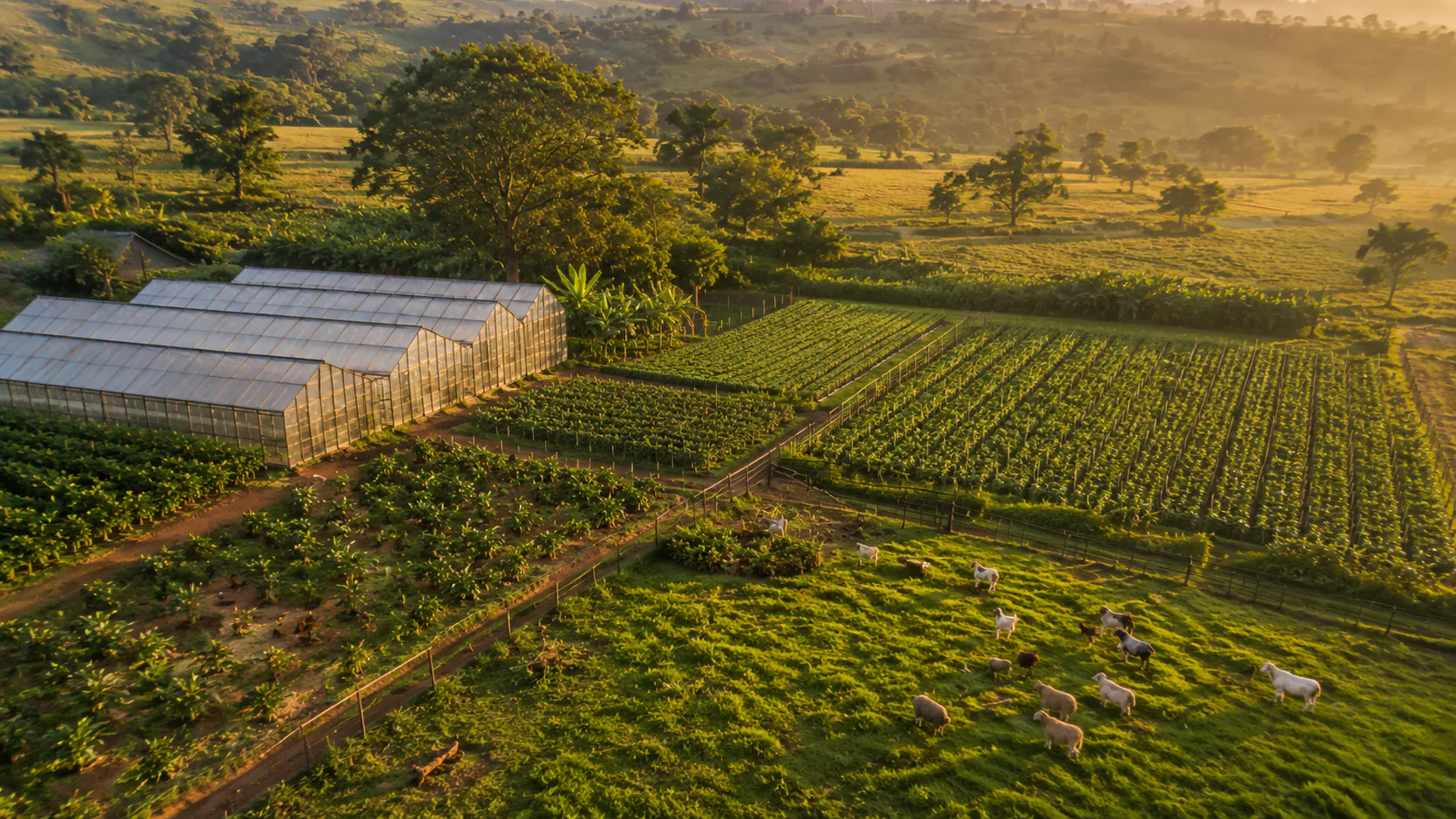
Falcon Foundation Ltd is a registered Ugandan agricultural company building practical, commercially responsible farming activities across protected horticulture, livestock and beekeeping.
Uganda does not lack agricultural ambition. What it lacks, more often, are farms that keep records, protect their soil and water, verify what they buy, and can explain to a buyer, a lender or an inspector exactly how a crop or an animal was produced. Falcon is building that kind of operation, and publishing the reasoning behind it.
What we do
Our current focus spans three connected areas.
Protected horticulture. Greenhouse production of large sweet bell peppers in yellow, red and green, and large Dutch-type greenhouse cucumbers. These are specification-driven products whose formal buyers commonly assess size, colour, firmness, shelf life and consistency alongside volume.
Livestock. Free-range local chickens and guinea fowl, local goats alongside Boer and Savannah hybrid genetics, and African sheep suited to local conditions. Our selection principle is adaptation first: animals that perform under Ugandan heat, parasite pressure and seasonal feed variability, with improved genetics introduced where the management can support them.
Beekeeping and Sidr trees. Colony management for honey and for the pollination bees return to the wider farm, together with cultivation of Sidr trees. Sidr honey production is a stated future objective, not a current product line.
Running through all three is an integrated approach to crops and livestock, supported by irrigation, soil improvement and phased farm development.
Why Uganda
Uganda's growing conditions are genuinely favourable and genuinely demanding, and both halves matter to anyone investing here.
Most of the country south of about latitude 3 degrees north has two rainy seasons, while the north has a single longer season. That gives much of Uganda two production windows a year where many countries have one. The difficulty is variability: season onset shifts from year to year, and dry spells can appear inside a rainy season (Mubiru et al., 2012).
This is why protected cultivation and irrigation sit at the centre of our horticulture, rather than being treated as refinements. A greenhouse and a reliable water source support more controlled planning in conditions that would otherwise be strongly influenced by weather. They can reduce specific risks. They do not remove them, and we do not present them as though they do.
How we work
Adaptation before performance figures. Genetics and technology are assessed against the conditions and management a farm can actually sustain, not against results produced somewhere else. Imported genetics and imported methods can be valuable. They are not automatically better, and the burden of proof sits with them.
Records before claims. Weak documentation limits a farm's ability to satisfy formal buyers, support a lender's assessment and learn from its own seasons. We treat records as infrastructure.
Specification before production. For fresh produce in particular, the buyer's requirement comes first and the growing plan is designed backwards from it. Growing first and looking for a market afterwards is the most common and most expensive mistake in Ugandan horticulture.
Evidence before assertion. Where we make a technical claim, we cite the source, and where Ugandan evidence does not exist we say so rather than borrowing someone else's.
Sustainability as an operating standard
Sustainability at Falcon is a set of constraints on how we work, not a statement of values.
Land and soil. Horticulture draws nutrients and structure down quickly. Manure return, organic matter management and testing before applying, rather than applying by habit, are the practical response. In Uganda's highland zones, erosion risk on slopes under heavy rainfall is a real constraint on how land can be used.
Water. Water is the binding constraint on almost every irrigation decision in Uganda. The first question is where dry-season water will come from, not which system to buy. We treat abstraction as something to be planned and, where required, authorised.
Animal welfare and biosecurity. These are the same discipline seen from two sides. Animals with shade, clean water, adequate space and predictable feed are both better treated and less likely to carry disease into a herd or flock.
Chemical discipline. Every spray decision carries a residue consequence, a worker safety consequence and a resistance consequence. Monitoring against thresholds is more defensible than spraying to a calendar.
Quality, records and traceability
Uganda's own export framework sets the standard here. The Ministry of Agriculture, Animal Industry and Fisheries requires a physical address and an approved producer traceability system before a company can be registered to export fruits and vegetables, with suspension and de-registration consequences for consignments that arrive without one (MAAIF).
Our records intent follows from that: what was planted or stocked and from which source, what was applied and when, what was harvested and to what grade, and where it went.
Supporting agricultural knowledge
We publish technical material through our Knowledge Hub because much of what reaches Ugandan farms is commercial guidance, while valuable work produced by Ugandan institutions often remains in journals and reports that are difficult for farmers to access and apply.
Our editorial position is straightforward: cite the source, state the date, and say plainly where the evidence comes from and where it runs out.
Who we work with
Farmers and farm managers, students and lecturers, extension professionals, Ugandan institutions, local entrepreneurs and foreign investors, and the buyers, suppliers and technical partners who need a counterpart that understands specification and verification.
We work with partners on the basis that claims should survive checking, and we expect to be held to the same standard we apply.
Current focus and future objectives
We state this distinction deliberately, and it should be read literally.
Current focus: greenhouse sweet bell peppers and Dutch-type cucumbers; free-range local chickens and guinea fowl; local goats and Boer and Savannah hybrids; African sheep suited to local conditions; beekeeping; Sidr tree cultivation; integrated crop and livestock systems; irrigation, soil improvement and farm development.
Stated future objective: Sidr honey production. Falcon does not currently offer Sidr honey for sale.
We do not claim certifications, production volumes, export contracts, facilities, technologies or commercial achievements beyond what we can evidence. Where this website discusses a capability we are building rather than one we hold, it says so.
Work with us
If you are a buyer defining a specification, a supplier who can meet one, an institution seeking a private-sector counterpart, or an investor assessing Ugandan agriculture seriously, we would rather begin with what you need verified than with what we would like to claim.
Make a business enquiry.