
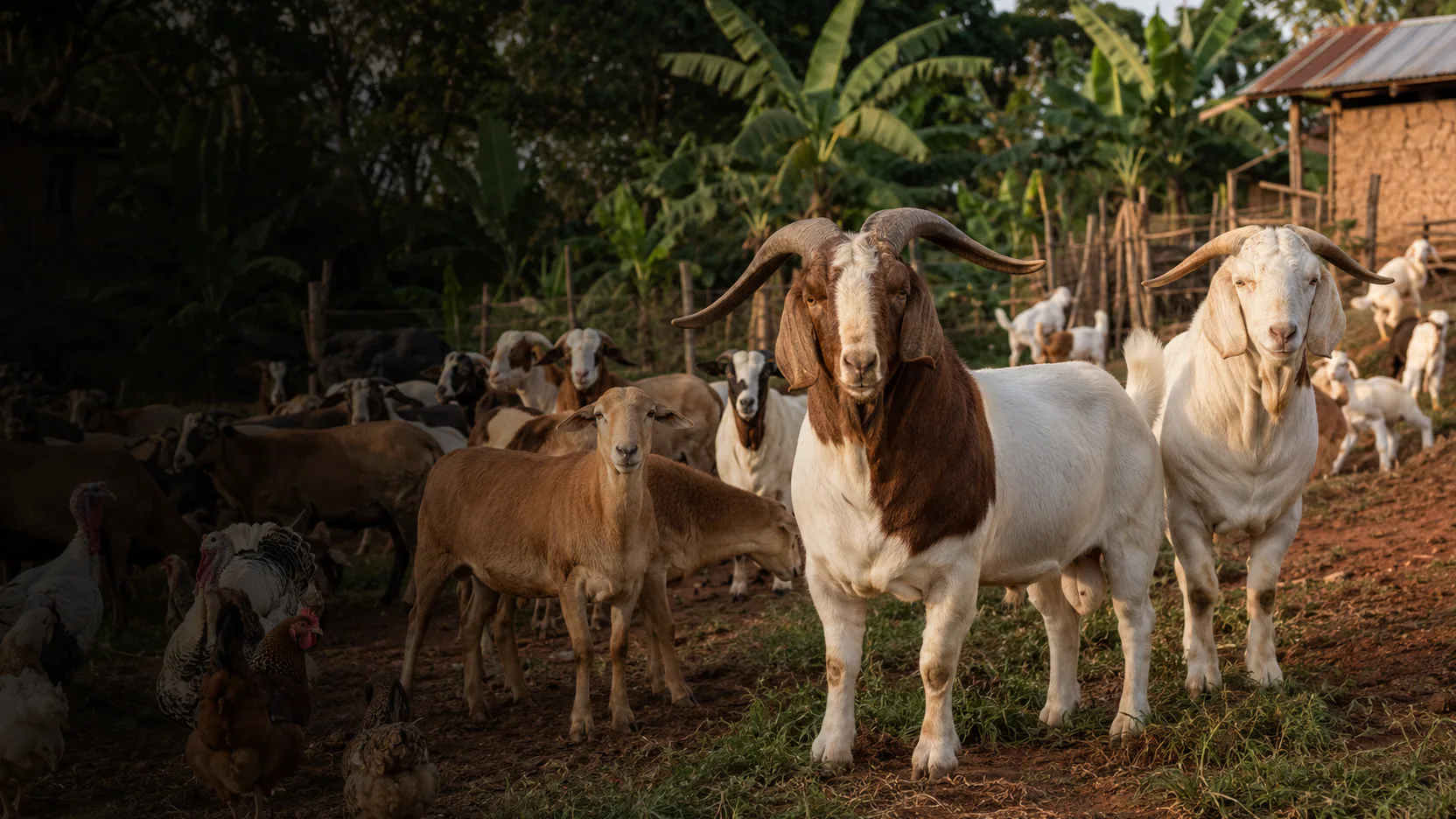
Falcon's livestock and beekeeping work rests on a commercial judgement: animals that cope with Ugandan heat, parasite pressure and seasonal feed variability cost less to keep and fail less often than animals selected on performance figures generated elsewhere.
That is not an argument against improved genetics. It is an argument for matching the animal to the management a farm can actually sustain, and for testing the result rather than assuming it.
What we keep
- Free-range local chickens and guinea fowl, managed as a mixed free-range flock
- Local goats alongside Boer and Savannah hybrid genetics
- African sheep suited to local conditions
- Honey bees, kept both for honey and for the pollination they return to the farm
Each has its own page. This one covers the standards that apply across all of them.
Adaptation as a commercial asset
Genome-wide research on Ugandan goat breeds found breed-specific genomic regions under selection in indigenous populations, associated with adaptation to the African tropical environment including thermotolerance and disease and parasite resistance (Onzima et al., 2018). Participatory work across three indigenous breed areas found Ugandan farmers ranking those adaptation traits alongside prolificacy and growth rate among their own breeding objectives (Onzima et al., 2018b).
Our position follows. Adapted foundation stock is worth protecting. Improved genetics can add real value where feeding and health management support them, and they are not automatically superior in every situation. The decision is site-specific, and it should be recorded and reviewed rather than assumed.
Housing and environment
Housing does three jobs: it protects animals from heat, it protects them from predators and theft, and it lets a stockperson observe and handle them.
Heat is the constraint most often underestimated, and it affects growth and feed efficiency before it becomes visible as distress. Shade, airflow and reliable water access are production inputs rather than comfort measures. Protection matters as much: research on indigenous chicken flocks in eastern Uganda found predators accounted for a substantial share of losses, which secure night housing addresses directly (Kugonza et al., 2008).
Feed and water planning
Feed availability is seasonal and animal condition follows it. The discipline is to plan for the dry months during the wet ones rather than react once condition has fallen: planned fodder rather than opportunistic grazing, conservation where material can be produced, and honest costing of purchased feed against the value of the animal being fed. Water is the input most often assumed and least often measured, and provision is not the same as adequacy.
Preventive health and biosecurity
Prevention is the more affordable strategy at smallholder and mid-scale, because treating an established outbreak is usually expensive and late.
The cross-species principles we apply: control what enters an animal area; quarantine new stock before mixing; separate species and age groups where disease risk differs; keep feed and water clean and off contaminated ground; dispose of dead animals promptly; and treat vehicles, footwear and shared equipment as disease routes.
We do not publish veterinary treatment protocols or dosing. Diagnosis and treatment belong with a qualified veterinary professional.
Welfare
We treat welfare and productivity as the same subject seen from two directions. An animal with shade, clean water, space, predictable feed, protection from predators and prompt attention to injury is both better treated and more productive. Welfare also constrains genetics: introducing animals that cannot cope with local heat, parasite pressure or feed variability is a welfare failure as well as a commercial one.
Records and traceability
Records turn a herd or flock into a managed enterprise. Without them, it becomes difficult to judge whether a change helped, demonstrate performance to a buyer or lender, or detect a slow decline before it becomes a larger loss.
The practical minimum is identification, parentage where breeding decisions are being made, births and deaths with a stated cause, health interventions with dates, condition scores at defined points, and sales with weight or count and destination.
Documented traceability is already a registration condition for horticultural export in Uganda (MAAIF), and operators planning to supply formal channels should expect comparable expectations to develop elsewhere.
Integration with our crop activities
We run livestock and crops as one system.
Nutrient cycling. Manure returns organic matter and nutrients to soil that horticulture depletes quickly, and reduces dependence on purchased fertiliser.
Pollination, with one deliberate exception. Bees kept for honey pollinate the wider farm. Our greenhouse cucumbers, however, are parthenocarpic and must be screened against pollinators, because fertilised fruit becomes seeded and misshapen. Apiary siting has to account for that.
Feed and risk. Crop residues and planned fodder reduce purchased feed costs through the dry season, and a farm with several unrelated enterprises is less exposed to a single disease event or market collapse than a farm with one.
Market planning
The same principle applies as on the crop side: establish the buyer and the specification before scaling production. Much Ugandan livestock trade is a live animal market with its own signals around weight, condition, age and seasonal timing, and those differ from carcass or processed product markets.
Genetics and the national framework
Uganda's National Animal Genetic Resources Centre and Data Bank, established under the Animal Breeding Act 2001, holds the national mandate for animal genetic improvement and operates the National Animal Genetic Data Bank and Central Livestock Registry (NAGRC&DB). Any breeding programme of scale should work with awareness of that framework.
Working with us
Investors should expect a livestock proposal to specify the dry-season feed plan, the disease risks and preventive programme, the housing standard, the records system and the market channel. A proposal missing any of those is not yet a proposal.
Suppliers should expect claims to be assessed against evidence and against performance in Ugandan conditions. Technical partners, including researchers and institutions, will find a counterpart that keeps records and publishes what it learns, including results it did not expect.
Explore the enterprises
- Free-Range Local Chicken - local birds and guinea fowl, night protection and the real limits of free-range systems
- Local and Hybrid Goats - indigenous Ugandan goats, Boer and Savannah genetics, and honest crossbreeding trade-offs
- African Sheep and Heat Adaptation - hair sheep, thermal thresholds and district variation
- Beekeeping, Sidr Trees and Premium Honey - apiary management, honey quality and our future Sidr honey objective
Talk to us about livestock
If you supply inputs, buy live animals or products, evaluate agricultural projects, or want a research or extension counterpart with records, we are open to a direct conversation.
Make a business enquiry.