
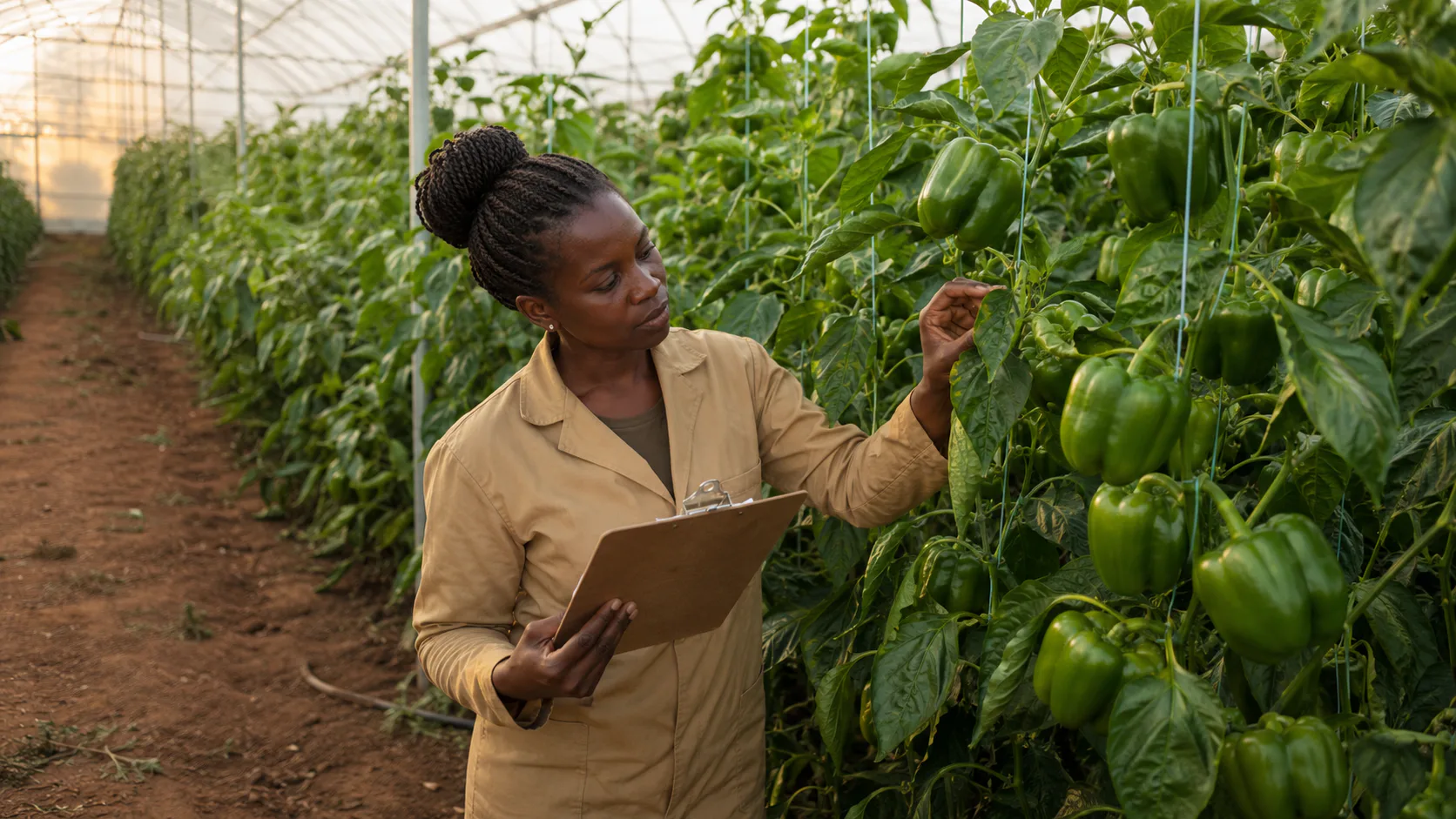
Green sweet pepper is a large blocky bell pepper, Capsicum annuum, harvested at full physiological size but before the fruit begins its colour transition. It is the colour bought on reliability: consistent size, firm walls, and delivery that arrives when it was promised.
Falcon grows large sweet bell peppers. We do not grow hot peppers.
Green is not an unripe chilli
Green fruit is sometimes assumed to be immature, or not yet hot. Neither idea is correct.
Bell peppers contain no capsaicinoids at any stage. Their synthesis requires a functional acyltransferase at the Pun1 locus, and sweet cultivars carry recessive alleles there that prevent the enzyme from being produced (Hernandez-Garcia and Zhang, PBGworks). Pungency is genetic, not a ripening phenomenon, and it is absent from this crop throughout.
Green harvest is a deliberate commercial stage rather than a shortfall. The fruit is fully grown, structurally complete and firm. What it has not done is convert its pigments.
The commercial character of green
All bell peppers start green and take on their final colour as they ripen, with cultivar determining what that colour will be (Government of Alberta, 2019). Harvesting green means taking fruit at the point where it has finished growing but before it commits the plant's resources to ripening.
Three consequences follow, and together they define this crop.
Shorter fruit occupancy. The plant carries each fruit for less time, freeing it to set the next.
Higher turnover. Picking cycles come round faster, which is what makes genuinely weekly supply possible.
Greater physical robustness. An unripened fruit has firmer walls and handles transport and repeated handling better than fully ripe fruit.
This is why green pepper suits volume buyers, foodservice, institutional catering and any channel where reliable weekly delivery matters more than colour.
Cultivar choice for a green programme
Cultivar identity still has to be verified, because it determines fruit shape, wall thickness, lobe count and how quickly fruit will break colour if a picking round slips.
Confirm the cultivar name and stated mature colour, and check the lot number and packing date against supplier documentation. For a green programme, prioritise consistent blocky shape, good wall thickness and a slower tendency to colour break, and avoid the fast-colouring yellow and orange types, which break colour sooner than red ones (McAvoy, Coolong and Torrance, 2024).
Growing for repeated set
The central agronomic skill here is sustaining successive sets rather than maximising one.
Because fruit is removed earlier, the plant is released sooner to set again, and a well-run green crop settles into a rhythm. Allowing fruit to hang past the green stage breaks that rhythm, because the plant continues investing in fruit it has already finished growing and the next set is suppressed.
Fruit and flower abortion follows low light, temperature extremes at flowering, low humidity, and the plant being unable to support the load it has set (Government of Alberta, 2019). On a continuity programme, a heat event is not only a loss of that week's set; it creates a gap in supply weeks later, which is precisely the failure a weekly buyer notices.
Canopy management is aimed at fruit protection and at supporting a high repeated set rather than at colour uniformity. Excessive shade is less penalising here than on a coloured crop, since pale or bicolour development is not a defect on fruit sold green.
The environmental conditions governing fruit set apply to any bell pepper crop and are covered on our Greenhouse Farming page.
The harvest window
The green window is defined at both ends and is narrower than it looks.
The fruit must have reached full size with firm, thick walls. It must not yet have begun colour break. Picking too early costs size, weight and wall thickness. Picking too late produces breakers, which fail a green specification and simultaneously suppress the next set.
A breaker is fruit showing premature colour development at the green harvest stage, and the management response is simply to harvest on schedule (McAvoy, Coolong and Torrance, 2024). Breakers are the direct penalty for letting a picking round slip.
Fruit is cut cleanly through the peduncle rather than pulled, which protects both fruit and plant. Regular picking rounds at a fixed interval, rather than picking when fruit looks ready, are what hold a green programme together.
Defects that matter when fruit is sold by count
Shape defects carry more commercial weight here than on coloured crops, because green pepper is frequently sold by count rather than by weight.
Pancaking follows poor pollination under temperature extremes and is resisted better by elongated blocky cultivars than short blocky ones. Tapered fruit is a genetic trait linked to three-lobed rather than four-lobed fruit. Crowding produces indentations where fruit grows against stems or other fruit, and is reduced by larger plants with longer internodes and less dense trellising (McAvoy, Coolong and Torrance, 2024).
Blossom-end rot is a localised calcium deficiency in young expanding fruit, driven by calcium delivery rather than soil calcium level. Uniform moisture, restrained nitrogen and healthy roots are the controls (Hochmuth and Hochmuth, 2025). Because green fruit is picked earlier, affected fruit is discarded earlier, which at least limits the wasted input.
Chemical timing on a short cycle
For a programme run on short, repeated picking rounds, the pre-harvest interval is the binding constraint on chemical use. There is less time between application and harvest than on a long-carried coloured crop, so product selection has to be made with the interval in mind before the spray is chosen.
Ugandan survey work in the central region found several thrips species present on pepper, with infestation peaking at flowering (Ssemwogerere et al., 2013). Monitoring practice is covered on our Greenhouse Farming page.
Durability and buyer expectations
The accepted quality indices for bell pepper are uniform shape, size and colour typical of the variety, firmness, and freedom from defects such as cracks, decay and sunburn (UC Davis Postharvest Center). For green fruit, depth and evenness of green, absence of colour break, and wall thickness carry particular weight.
Green fruit's practical advantage is robustness rather than a different storage regime. Firmer walls tolerate handling, stacking and transport better than fully ripe fruit, which is a real commercial asset in Ugandan distribution conditions. It is not a reason to neglect prompt field heat removal. Cold chain requirements are the same as for other bell peppers and are covered on our Red Sweet Pepper page.
Expect specification to cover uniform deep green colour with no colour break, size class, firmness and wall thickness, blocky shape and lobe consistency, freedom from cracking, sunburn and thrips scarring, stem condition and clean cut, count or weight per carton, and delivery reliability. Volume buyers frequently treat consistency of weekly supply as a contract condition rather than a preference.
Risks
The characteristic risks of a green programme are scheduling risks. A missed picking round converts saleable fruit into breakers. A heat event suppresses a set and creates a supply gap weeks later. A single planting rather than a staggered one produces a peak and then nothing. Short pre-harvest intervals constrain chemical options. And because green pepper often competes on volume, price pressure is a permanent feature of the channel.
Our approach
We run green sweet bell pepper as a continuity crop. The emphasis is on staggered planting so that supply is a schedule rather than an event, fixed picking rounds so that fruit does not slip past the green window, plant load management so successive sets are sustained, and product selection that respects pre-harvest intervals.
We do not publish yield, price or income figures we cannot evidence, and we do not guarantee uninterrupted supply irrespective of season.
Discuss green pepper supply
If you buy green bell pepper on a weekly or contracted basis, the conversation worth having is about volume, frequency, specification and what happens in a difficult month.
Make a business enquiry.