
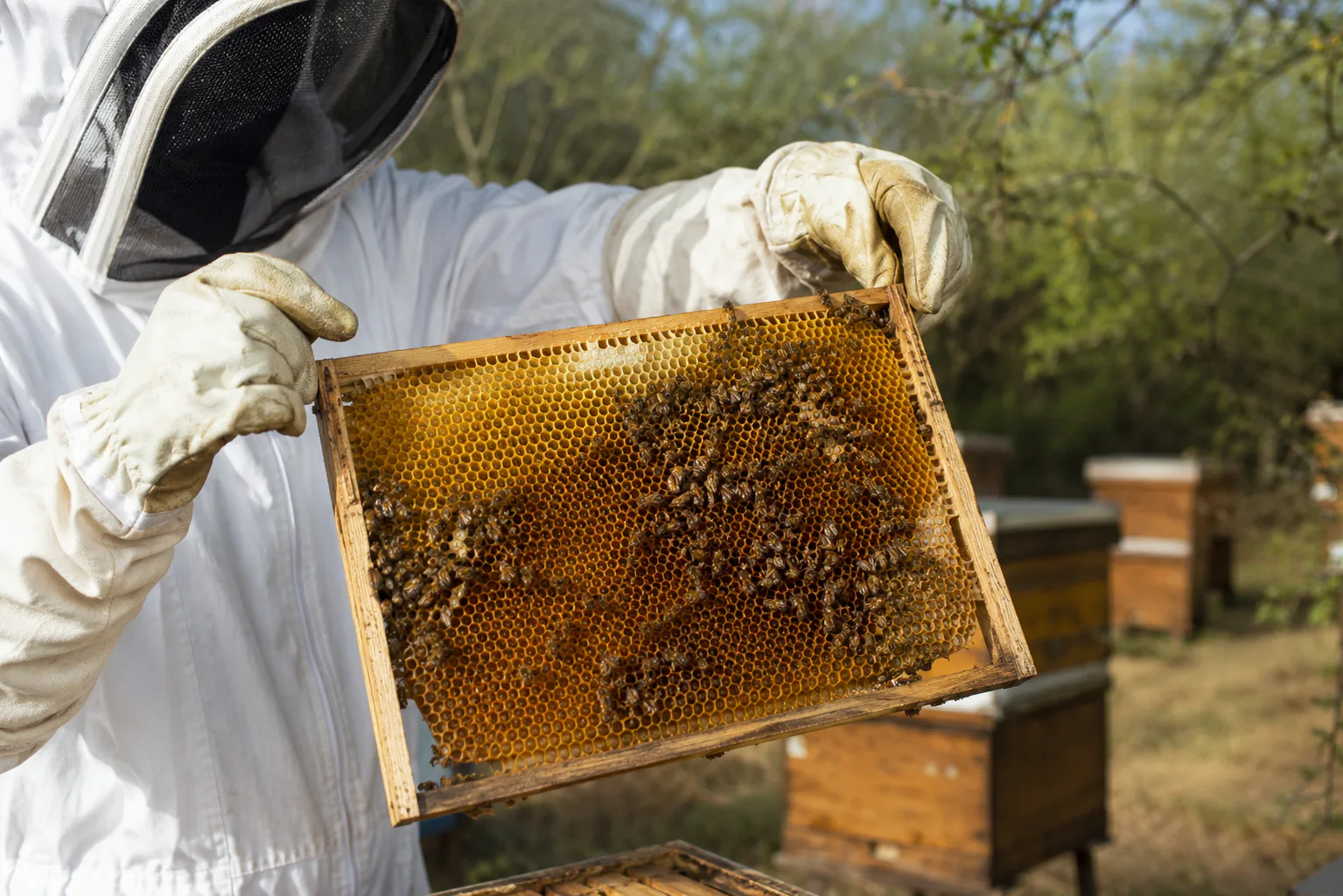
Falcon keeps bees for two returns: honey, and the pollination colonies deliver to the wider farm, which is often the larger benefit on a mixed holding.
We also cultivate Sidr trees. Sidr honey production is a stated future objective. It is not a current product line, and we do not offer Sidr honey for sale.
Beekeeping in Uganda
Uganda has a very large beekeeping base and a persistent quality problem, and both shape any serious entry into the sector.
A 2023 review describes a sector dominated by traditional log hives, with transitional top-bar hives producing considerably more per hive and modern types showing low adoption because of cost. The main constraints identified are agrochemical exposure, colony absconding, climate variability, pests including varroa mites, wax moths and hive beetles, brood diseases, and limited technical skills. Ugandan bee products trade largely in informal regional markets with less demanding requirements than European buyers apply (Ogweng et al., 2023).
The honest summary: abundant bees and beekeepers, and little honey meeting a formal quality specification.
Bees and the wider farm
A colony is an input to the crop enterprise as well as a producer in its own right, and introduced pollinators have been reported to improve flower set in greenhouse sweet pepper (Government of Alberta, 2019).
One exception runs the other way. Our greenhouse cucumbers are parthenocarpic and set seedless fruit without fertilisation; if bees reach those flowers the fruit becomes seeded and fails specification. Apiary siting has to account for cucumber houses being screened against pollinators.
Siting, colony health, water and forage
Uganda published a national code of practice for apiary management and bee-product handling in 2006, and we reviewed that edition for this page. It covers siting, including accessibility for bees and beekeeper, avoidance of waterlogged and densely forested ground, a minimum separation from public places, and adequate nectar and pollen flora, shade, water, air circulation and shelter from wind. It also sets a regular inspection rhythm covering colony strength, brood, queen performance, disease indicators and honey maturity (UNBS, US 641:2006).
The current status of that code has not been confirmed for this page. Anyone relying on it commercially should confirm the latest applicable edition directly with the Uganda National Bureau of Standards.
Beyond the code, responsible management means strong colonies, minimal disturbance, and treating absconding as a management signal. Because agrochemical exposure is one of the sector's identified constraints (Ogweng et al., 2023), spray timing and apiary placement are the same decision on a mixed farm.
Colonies need water continuously, particularly in hot weather, and providing it at the apiary is simpler than managing where bees find it otherwise. Forage is seasonal, and a colony's capacity is set by what is flowering within range, so it is planned in advance or not at all.
Harvest hygiene and moisture control
This is where Ugandan honey most often fails, and the evidence is specific.
A study of locally processed Ugandan honey found moisture across sampled brands ranging from roughly 22 to 31 percent, with every sample above the 20 percent threshold, and gross contamination in open-market samples but not branded ones. The authors concluded that enforcement of quality standards across production, processing and marketing would be needed for Ugandan honey to attract a premium (Amulen et al., 2012).
Moisture is the central issue: honey above roughly 20 percent moisture risks fermentation, which ends both shelf life and any premium positioning.
The controls are straightforward and most sit in the 2006 code: harvest only sealed or capped combs, the most effective moisture control available because capping shows the bees have already reduced moisture themselves; keep smoke minimal; strain through clean, appropriately fine mesh; store airtight under conditions that prevent moisture being absorbed or lost; and avoid high-temperature processing, which degrades enzymes. The code also sets personnel hygiene requirements stricter than much current Ugandan practice (UNBS, US 641:2006).
Traceability
Origin claims carry commercial value in honey, which is why they are so often unreliable. Our intent is that honey should be traceable to apiary, hive group and harvest date, with the forage available in that period recorded. That record is what allows a floral origin claim to be defended rather than asserted, and it is the foundation of any future claim about Sidr-derived honey.
The Sidr tree
Ziziphus spina-christi, family Rhamnaceae, is known in Arabic as sidr and in English as Christ's thorn. It is a tough shrub or tree: drought hardy and heat resistant though frost tender, tolerant of extended dry seasons, and associated with watercourse edges where groundwater is available. Documented uses beyond honey forage include livestock forage, edible fruit, termite-resistant timber, charcoal, windbreaks and living fencing (World Agroforestry).
The sidr, or lote tree, also holds a place in Islamic tradition. It is referenced in the Qur'an in Surah An-Najm, where the Prophet's vision is described as taking place at the Lote Tree of the utmost boundary, the Sidrat al-Muntaha (Qur'an 53:14-16), and it carries long-standing cultural associations across the arid regions where it grows. We present this respectfully and factually, make no religious claim on behalf of any product, and do not use religious significance as a marketing device.
Sidr leaves have documented traditional uses, recorded here as cultural and historical information. We make no medical, therapeutic or health claim about Sidr leaves, Sidr honey or any other product. Traditional use is not evidence of efficacy, and nothing here is health advice.
Sidr in Uganda: a stated limitation
The World Agroforestry species profile lists the documented native range of Ziziphus spina-christi across a number of African and Asian countries. Uganda is not among them (World Agroforestry).
That matters. The species is native to drier environments than most of Uganda, and its documented ecological preferences do not describe Uganda's wetter zones. Establishment is plausible, particularly in drier districts, but it is not established fact, and we did not identify Ugandan performance data for this page.
Sidr cultivation here therefore requires local validation: trial planting across sites, honest recording of survival, growth and flowering, and willingness to publish results that do not support the expectation. Nobody should plant a Sidr block in Uganda on the strength of its reputation elsewhere.
Premium honey and its risks
Sidr honey occupies a genuine premium position in international markets. A characterisation study covering origins across the Middle East, North Africa and Asia notes it is regarded as the most valuable honey in Saudi Arabia, and that limited availability and high price mean it is often adulterated (Hegazi et al., 2022).
Two observations follow. Baseline quality comes before floral positioning: moisture levels in that international characterisation sit well below those measured in locally processed Ugandan honey, and a premium floral claim is worth nothing on honey failing a basic moisture specification (Hegazi et al., 2022; Amulen et al., 2012). And no characterised Sidr honey in that study came from Uganda, so there is no Ugandan reference profile.
Adulteration is endemic in this segment, so a genuine producer competes against counterfeit product and carries the cost of proving authenticity. Floral origin is established through pollen analysis and physicochemical profiling, not by appearance or proximity to trees.
Our future objective, stated precisely
Falcon Foundation Ltd cultivates Sidr trees and intends, in future, to produce Sidr honey. This is an objective, not a current activity. We do not currently sell Sidr honey.
Reaching it depends on conditions not yet met: Sidr trees established and validated under Ugandan conditions and flowering across enough area to provide meaningful forage; colonies sited to work that forage; harvest and processing meeting moisture and hygiene requirements; and analytical verification of what the resulting honey is. We will not describe a honey as Sidr honey on the basis of proximity to Sidr trees.
A future line supplying Sidr seedlings is also under consideration. That too is a plan, not a current offering. We do not sell Sidr seedlings, quote prices or availability, or take orders. Any future supply would depend on the local validation above justifying a recommendation of the species to other Ugandan growers.
Talk to us about beekeeping
If you buy honey to specification, supply hives, equipment or processing capacity, work in apiculture research or extension, or want to follow our Sidr validation work, we are open to a direct conversation.
Make a business enquiry.