
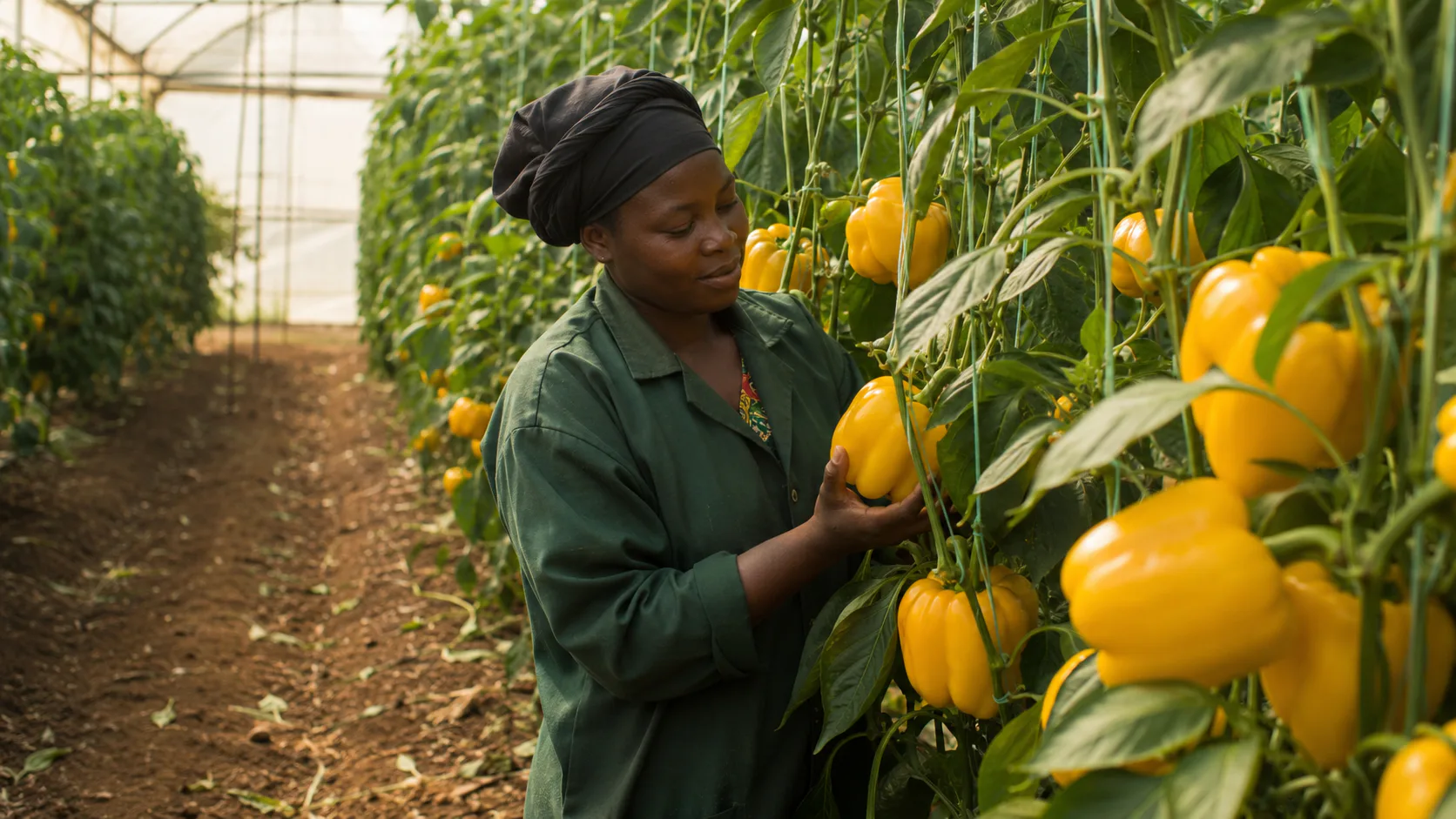
Yellow sweet pepper is a large blocky bell pepper, Capsicum annuum, carried on the plant until it reaches full yellow colour. It is bought on appearance, and appearance is the hardest attribute to hold consistently across a greenhouse.
Falcon grows large sweet bell peppers. We do not grow hot peppers of any kind.
Sweet is not a matter of degree
Buyers occasionally assume sweet peppers are mild chillies. They are not, and the difference is genetic rather than a question of intensity.
Heat in Capsicum comes from capsaicinoids, whose synthesis depends on a functional acyltransferase encoded at the Pun1 locus. Sweet bell cultivars carry recessive alleles there, so the enzyme is not produced and capsaicinoids are not synthesised (Hernandez-Garcia and Zhang, PBGworks).
A sweet pepper cannot become hot through stress, heat or delayed harvest. There is no continuum between a bell pepper and a chilli.
Why yellow is a distinct product
Every bell pepper starts green, and final colour is determined by cultivar as the fruit ripens on the plant (Government of Alberta, 2019). Yellow fruit is not green fruit left alone. It comes from a cultivar bred to finish yellow, and it must stay on the plant through the entire colour transition.
Three consequences follow. The fruit occupies the plant longer. It is exposed to greenhouse conditions longer. And its value depends on the evenness of a colour that is still forming while it hangs there.
Growing several colours in one house is discouraged unless they are physically separated, because cultural requirements differ between cultivars (Government of Alberta, 2019).
Getting the cultivar right
Because colour is cultivar-determined, buying the wrong seed produces the wrong product, and the error is invisible until harvest.
Verification means confirming the cultivar name and its stated mature colour, checking the lot number and packing date against supplier documentation, and confirming seed age. Selection should also weigh disease resistance, fruit shape and canopy characteristics rather than colour alone.
Growing for even colour
Canopy management is the decisive skill on a yellow crop, and it is a colour decision as much as a light decision.
Too open a canopy exposes fruit to direct sun, producing sunburn where tissue is damaged or suntan where it is discoloured without damage. Too dense a canopy produces pale or bicolour fruit, because some fruit never receives enough light to colour evenly (McAvoy, Coolong and Torrance, 2024). The target is a canopy that shades fruit without shading it out, achieved through canopy development, staking and stringing against lodging, and cultivar choice.
The environmental conditions that govern fruit set apply here as they do to any bell pepper crop, and they are covered on our Greenhouse Farming page. What is specific to yellow is that a fruit carried through a full colour transition accumulates more exposure to whatever the environment does wrong.
Blemishes that decide the grade
On a yellow surface, cosmetic defects are far more visible than on green fruit, and several are governed by conditions rather than by chance.
Cracking and russetting follow sustained high humidity, and surface cracking and corking are also driven by day and night temperature swings and by water standing on fruit shoulders (Government of Alberta, 2019; McAvoy, Coolong and Torrance, 2024).
Silvering, or epidermal separation, occurs when rapid expansion under hot wet conditions forms an air layer in the outer skin. Management options are limited and it is associated with particular genetic backgrounds (McAvoy, Coolong and Torrance, 2024).
Blossom-end rot is a localised calcium deficiency in young expanding fruit, driven by calcium delivery through the transpiration stream rather than by soil calcium level. Uniform moisture, restrained nitrogen and healthy roots are the controls, and foliar calcium sprays rarely correct it (McAvoy, Coolong and Torrance, 2024).
Shape defects including pancaking, tapered fruit and crowding are driven by pollination conditions, lobe number genetics and fruit growing against stems or each other, and are addressed mainly through cultivar selection and spacing.
Thrips and cosmetic damage
Thrips matter disproportionately on a premium visual crop, because the damage is cosmetic as well as physiological. Scarring removes fruit from a premium grade regardless of internal quality.
Ugandan survey work in the central region found several thrips species present on pepper, with infestation reaching its peak at flowering (Ssemwogerere et al., 2013). Monitoring practice for protected crops is covered on our Greenhouse Farming page.
The harvest decision
This is the judgement that defines the crop.
Published guidance harvests bell pepper at 85 to 90 percent colour, cut cleanly through the peduncle (Government of Alberta, 2019). That figure comes from Canadian greenhouse practice and is a reference point rather than a rule for a Ugandan site, but the principle behind it holds anywhere: colour continues to develop after cutting, while firmness only declines.
Harvesting well below that threshold produces a fruit that is neither a proper green pepper nor a proper yellow one. Faster-maturing yellow and orange cultivars break colour sooner than red types (McAvoy, Coolong and Torrance, 2024), which narrows the window further. The window between insufficient colour and over-mature softening is real, and it is managed by picking to a schedule rather than by picking when convenient.
Grading and buyer expectations
The accepted quality indices for bell pepper are uniform shape, size and colour typical of the variety, firmness, and freedom from defects such as cracks, decay and sunburn (UC Davis Postharvest Center).
Buyers grade coloured pepper by fruit diameter into size classes. Class boundaries vary between markets and buyers, and should be confirmed against the specific buyer's specification rather than assumed from any published system.
Expect a yellow pepper specification to cover colour evenness and depth, size class, blocky shape with consistent lobe count, firmness, freedom from sunburn, cracking, silvering and thrips scarring, stem presence and cut quality, and count or weight per carton.
Handling and cold chain requirements are the same as for other bell peppers and are covered on our Red Sweet Pepper page.
Risks
Longer time on the plant means greater accumulated exposure to heat events, humidity spikes and pest pressure, and a higher sunk cost for every fruit lost. Cosmetic defects that a processing buyer might tolerate remove fruit from a premium visual grade entirely. Colour uniformity across a whole house is the hardest attribute to hold.
Our approach
We treat yellow sweet bell pepper as a distinct product with its own harvest discipline rather than as a by-product of a general pepper crop. The emphasis is on canopy management for even colour, monitoring against thresholds rather than routine spraying, and picking to colour rather than to convenience.
We do not publish yield or income figures we cannot evidence, and we do not promise a grade outturn.
Discuss yellow pepper supply
If you buy coloured bell pepper to a written specification, or supply seed, structures or inputs able to support one, we would rather begin with your specification than with a product description.
Make a business enquiry.