
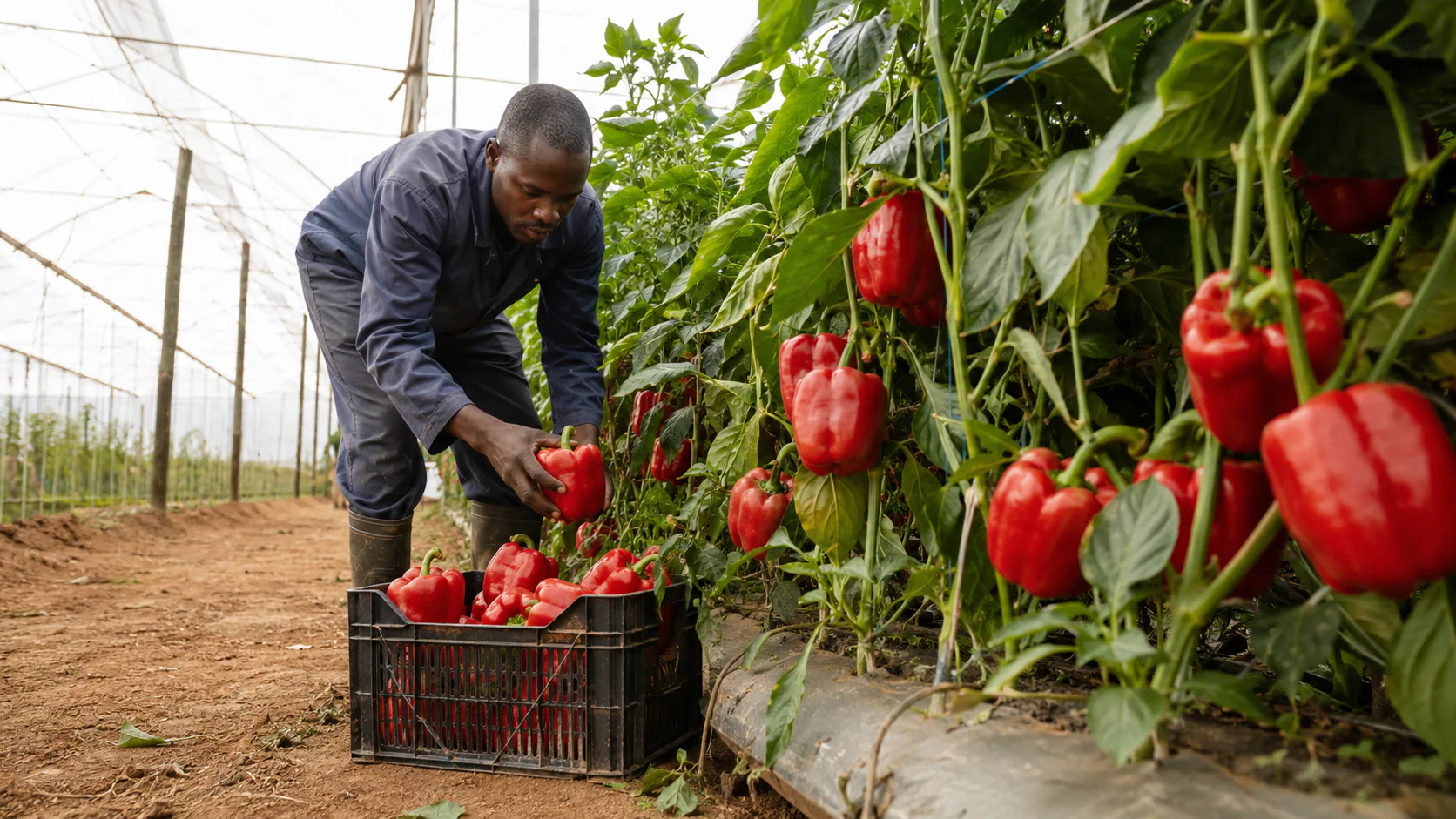
Red sweet pepper is a large blocky bell pepper, Capsicum annuum, carried on the plant until it reaches full red colour. It is the ripest form in which a bell pepper is normally sold, and it is the colour where handling decides whether the crop reaches the buyer in the condition it left the farm.
Falcon grows large sweet bell peppers only. No hot pepper types are grown.
Why a red bell pepper is not a mild chilli
The word red causes confusion, because most culinary hot peppers are also red. The two are unrelated.
Heat in Capsicum comes from capsaicinoids, produced through a pathway requiring a functional acyltransferase at the Pun1 locus. Sweet bell cultivars carry recessive alleles there and produce no capsaicinoids at all (Hernandez-Garcia and Zhang, PBGworks). Redness comes from carotenoid pigment accumulating during ripening. Pigment and pungency are separate systems controlled by different genes, and a red bell pepper is sweet by construction.
The economics of carrying fruit to red
Every bell pepper begins green and takes on its final colour as it ripens, with cultivar determining that colour (Government of Alberta, 2019). Red is generally the slowest transition, since faster-maturing yellow and orange types break colour sooner (McAvoy, Coolong and Torrance, 2024).
That slowness defines the commercial character of the crop. Fruit carried to red occupies the plant longest, suppresses the setting of subsequent fruit for longest, and carries the largest accumulated input cost per fruit. It also arrives at the buyer with the highest expectations attached. A red pepper that fails on firmness or shelf life has wasted considerably more of a season than a green one.
Because cultivars differ in their cultural requirements, growing more than one colour in a single house is discouraged unless the crops are physically separated (Government of Alberta, 2019). For a red crop that separation also protects the harvest schedule, which runs on a different rhythm from a green one.
Cultivar choice for a long carry
Mature colour is fixed when seed is bought, so verification is a commercial control rather than a formality: confirm the cultivar name and stated mature colour, and check the lot number and packing date against supplier documentation.
For a red programme, cultivar choice should also weigh how well fruit holds firmness through an extended ripening period, and lobe consistency, since shape defects have longer to develop.
Managing a long ripening period
The environmental conditions governing fruit set apply to any bell pepper crop and are covered on our Greenhouse Farming page. What is specific to red is duration.
Canopy protection has to be sustained. A fruit hanging through a long ripening window needs consistent shading across many hot days, not adequate shading on average. Sunburn damages tissue and admits secondary pathogens, while suntan discolours without destroying tissue. Both are managed through canopy development, staking and stringing against lodging, and cultivar choice favouring larger canopies (McAvoy, Coolong and Torrance, 2024).
Plant load matters more than on a green crop. Fruit held for a long ripening period is a sustained sink, and a plant carrying too many will abort its next set rather than ripen everything it holds.
More day and night cycles mean more opportunities for surface defects. Cracking and corking are driven by temperature fluctuation and by water standing on fruit shoulders, and sustained high humidity is associated with cracking and russetting (McAvoy, Coolong and Torrance, 2024; Government of Alberta, 2019).
Disorders that matter most on red fruit
Blossom-end rot originates as a localised calcium deficiency in rapidly expanding young fruit, driven by calcium delivery rather than by soil calcium supply. Calcium moves in the transpiration stream and preferentially reaches leaves rather than waxy-skinned fruit, and the earliest crown fruit are most at risk. Prevention is uniform moisture, restrained nitrogen, low soluble salts and healthy roots. Foliar calcium is not an effective correction (Hochmuth and Hochmuth, 2025).
The timing is unforgiving on this crop: the disorder is set early in fruit development, but the loss is only realised weeks later when a fully ripened fruit is discarded.
Stip presents as small discoloured spots, is thought to relate to calcium but is often of unknown cause, and is managed mainly through variety selection. Blue nose or purpling is anthocyanin expression under temperature stress and is genetically controlled; on fruit heading toward red it can produce a muddy transitional appearance that buyers reject, and varieties lacking anthocyanin expression are available (McAvoy, Coolong and Torrance, 2024).
Harvest timing
Published guidance harvests bell pepper at 85 to 90 percent colour rather than at full colour, cut cleanly through the peduncle (Government of Alberta, 2019). That figure comes from Canadian greenhouse practice and is a reference point requiring calibration to the site and cultivar, but the reasoning behind it applies generally.
Colour continues to develop after cutting. Firmness only declines. Waiting on the plant for the last portion of colour costs firmness and shelf life without adding market value, and extends the period during which the fruit can still be lost to a defect.
Post-harvest: the decisive stage
This is where a red crop is most often lost after it has already succeeded in the greenhouse.
Published postharvest guidance for bell pepper gives optimum storage at 7.5 degrees Celsius with relative humidity above 95 percent, storage life falling sharply at lower temperatures, and chilling injury developing below about 5 degrees. Chilling injury presents as pitting, decay, discolouration of the seed cavity and softening without water loss. Respiration rises steeply with temperature, and bell peppers respond very little to ethylene (UC Davis Postharvest Center).
These are United States reference figures and should be treated as indicative of the crop's behaviour rather than as settings for a particular Ugandan cold room, which will need its own calibration.
Two practical points follow. Chilling injury is a trap because it does not appear in the cold store; it appears after the fruit reaches ambient temperature, often after delivery, and is then attributed to the grower. And because respiration accelerates with temperature, every hour of field heat retained after harvest consumes shelf life.
The workable Ugandan sequence is to harvest in the cooler part of the day, remove field heat promptly, hold at a moderate chill rather than as cold as the equipment allows, keep humidity high to limit shrivel, and avoid breaks in the chain rather than chasing a lower set point. Colder is not better with this crop.
Buyer expectations
Expect specification to cover colour uniformity and depth, size class, firmness at delivery, wall thickness where the buyer is a processor or foodservice operator, freedom from chilling injury symptoms, sunburn, cracking and stip, stem condition, and count or weight per carton. Buyers holding stock for more than a few days will usually want to discuss handling and temperature history.
Buyers grade coloured pepper by fruit diameter into size classes, and class boundaries vary between markets. Confirm them against the buyer's own specification.
Risks
The dominant risk is accumulated exposure: longer plant occupancy means more heat events, more humidity spikes, more pest cycles and a higher cost for every fruit lost. Lost firmness is generally not restored through later handling. Cold-chain error can also damage a compliant crop after it leaves the farm, with symptoms sometimes appearing too late for corrective action.
Our approach
We treat red sweet bell pepper as a crop where post-harvest decisions carry as much weight as agronomic ones. The emphasis is on picking to schedule at colour rather than holding for maximum colour, removing field heat promptly, and holding at the correct temperature rather than the lowest available.
We do not publish yield, price or income figures we cannot evidence, and we do not guarantee a grade outturn.
Discuss red pepper supply
If you buy coloured bell pepper and hold stock, the useful conversation starts with your handling chain and acceptance criteria rather than with a product description.
Make a business enquiry.