
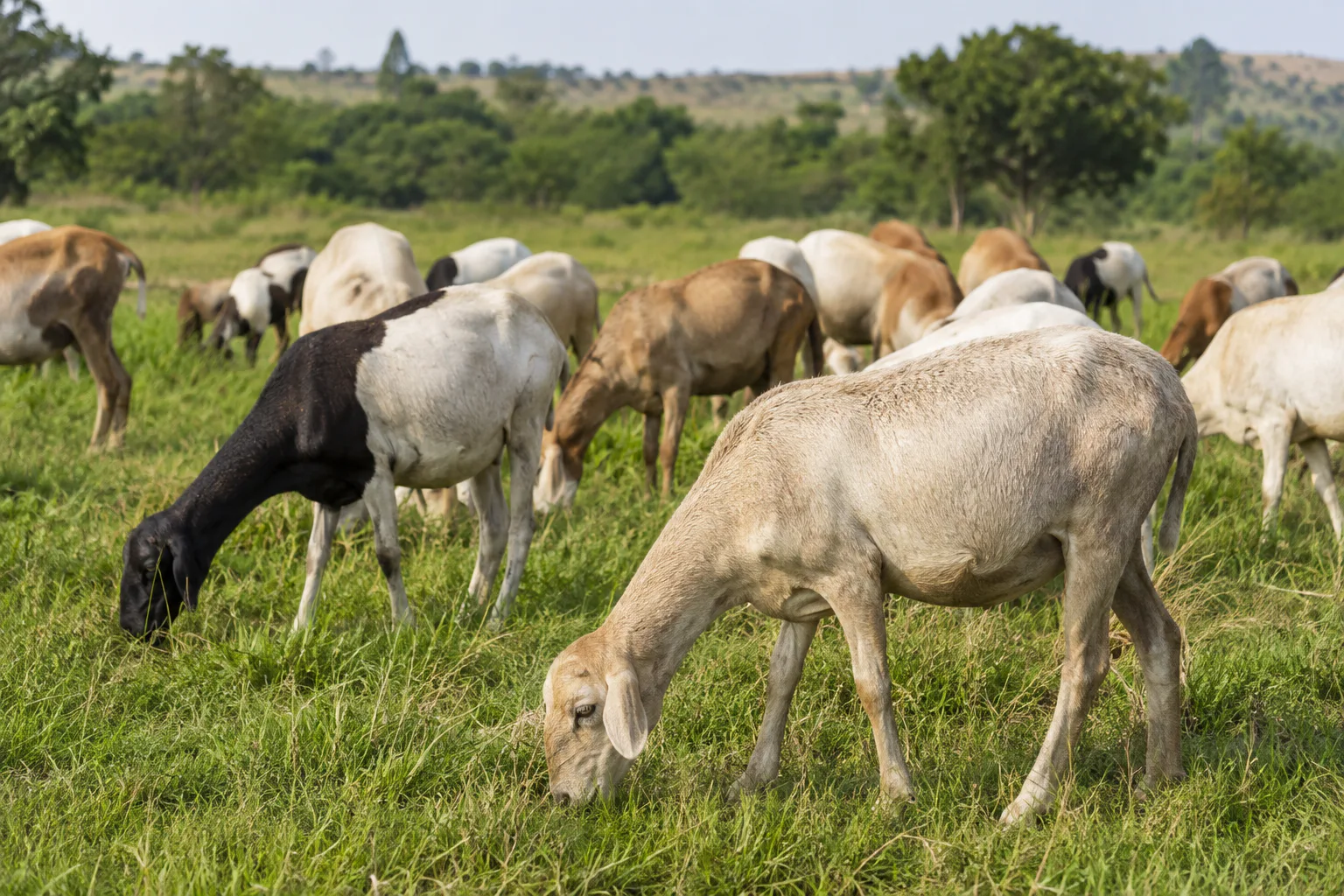
The sheep that suit Uganda are hair sheep, for physiological rather than aesthetic reasons. Heat management is the central production question in this climate, and coat type largely determines how well an animal handles it.
Falcon keeps African sheep suited to local conditions.
Sheep in Uganda
FAO's survey of small ruminant genetic resources in tropical Africa records two sheep types in Uganda. The Red Maasai, associated primarily with communities in Kenya and Tanzania, is also found in the drier parts of Uganda and especially in Karamoja. The East African Blackheaded sheep is documented in southern Uganda, particularly around Mbarara. Both are small-framed animals, generally hornless, adapted to semi-arid and sub-humid zones under agro-pastoral management (FAO, Animal Production and Health Paper 88).
Their distribution reflects the country's conditions. Most of Uganda south of about latitude 3 degrees north has two rainy seasons while the north has one (Mubiru et al., 2012). A flock in a drier northern district faces a single long season, higher heat and lower rainfall, with water and dry-season feed as its main constraints. A flock in the wetter south faces two seasons and higher parasite pressure. The same feeding calendar and parasite strategy will not serve both.
Why hair sheep
Published review evidence sets out the mechanism. Sheep dissipate heat mainly through respiration, with sweating contributing a much smaller share. Hair sheep tolerate heat better than wool breeds because shorter hair permits airflow, sweat gland density and skin surface area are greater, the skin is thinner, and heat shock protein responses are activated. Wool retains heat effectively, an advantage in a cold climate and a serious impairment in a hot one. The same review places the hair sheep comfort zone at roughly 12 to 27 degrees Celsius with an upper limit generally taken around 30 degrees (Pérez et al., 2020).
A limitation applies to those figures. The review draws largely on research conducted outside East Africa. The physiology transfers well; the specific thresholds were generated under other management systems and are indicative reference points rather than Ugandan operating targets.
What heat stress costs
Heat stress is a measurable production loss rather than a comfort issue. Heat-stressed animals show increased respiratory rate and rectal temperature alongside reduced feed intake and rising water consumption, and the review cites work reporting substantial reductions in growth rate and feed efficiency. Reproduction responds differently: oestrus and ovulation are reported as largely unaffected while corpus luteum function declines, with birth weights stable but prolificacy potentially reduced during hot months (Pérez et al., 2020).
The practical reading is that heat management is primarily a growth and feed efficiency intervention. The losses are continuous rather than dramatic, which is why they are often noticed only when performance is compared across seasons.
Breed and genetic selection
Selection for Ugandan conditions should start from the adapted population rather than from an imported performance figure.
The traits that matter are coat type; body size appropriate to available feed rather than the largest available; parasite resilience, the dominant health economic factor in a wet climate; ability to hold condition through a dry season without exceptional feeding; sound feet on wet ground; and ewes that raise lambs to weaning reliably.
Two cautions apply to breed comparison. Figures generated for improved breeds under temperate conditions, controlled feeding and routine veterinary support say little about performance on a Ugandan farm, and any comparison has to be made under the management the farm can sustain. And wool breeds are not a realistic candidate here, whatever their figures elsewhere.
Housing and shade
Sheep housing in Uganda addresses heat, wet and predation.
Shade is the primary heat intervention and the cheapest. Natural tree shade works and moves with the sun. Constructed shade needs to be high enough to allow air movement beneath it, since a low roof traps heat rather than relieving it.
Airflow matters as much as shade, because respiration is the dominant cooling route. A structure with solid walls on all sides defeats the purpose.
Dry standing and lying areas are essential in a wet climate. Sheep tolerate heat far better than persistent damp, and wet ground underfoot drives both foot problems and parasite exposure.
Night enclosure addresses predation and theft, and allows individual observation.
Feed and water
Sheep are grazers rather than browsers, which makes pasture management the central feed question and distinguishes their planning from that of other small ruminants.
The dry season is the constraint. Condition lost then is expensive to restore and appears later in conception rates and lamb survival, so planning means conserving or planting fodder during the wet season rather than purchasing feed during the dry one.
Water requirements rise under heat, since consumption increases as feed intake falls (Pérez et al., 2020). Clean water, continuously available and sited in shade where possible, is a heat management measure as well as a nutritional one.
Parasites and health
Internal parasites are the dominant health and economic constraint in Uganda's wetter zones, and the pressure reflects moisture, stocking density and grazing management rather than chance.
The management levers are grazing management to keep young stock off the most contaminated ground, dry lying areas, stocking density appropriate to the pasture, quarantine of incoming animals, and treatment based on evidence of burden rather than a fixed calendar.
That last point is the most often ignored. Routine calendar dosing selects for anthelmintic resistance in the parasite population, and resistance is effectively irreversible on a farm scale. Adapted animals carrying some natural resilience reduce dependence on chemical control, which is a commercial argument as much as a biological one.
We do not publish anthelmintic products, doses or treatment protocols. Diagnosis, product selection and dosing are matters for a qualified veterinary professional.
Routine observation
Two routine checks catch most problems while they are still cheap to address.
Foot inspection matters in a wet climate, because persistent damp underfoot leads to lameness, and a lame sheep stops grazing, loses condition and becomes a secondary problem. Regular inspection, trimming where required, dry standing and prompt isolation of affected animals are the response.
Body condition scoring is the single most useful routine measurement on a sheep enterprise. Scored by hand at mating, mid-pregnancy, lambing and weaning, it detects a decline weeks before it is visible across the flock and makes feeding decisions evidence-based rather than reactive. It costs nothing but the time to handle the animals.
Reproduction and records
Because early pregnancy appears more heat-sensitive than mating itself, manage heat exposure and nutrition through early pregnancy rather than concentrating on the mating period alone, and time mating so lambing and early lactation fall where feed availability is best.
Controlled mating rather than continuous ram access makes lambing predictable and breeding records meaningful. Lamb survival is where the margin sits, and the controllable factors are ewe condition at lambing, a clean dry lambing area, prompt colostrum, and protection of young lambs from damp and predation.
Worth recording: individual identification; sire and dam where breeding decisions are made; lambing date and litter size; lamb survival to weaning; body condition scores at defined points; health interventions with dates; and sales. Condition score history is the record that most improves decisions, because it converts an impression into a series that can be compared across years.
Market relevance
Sheep in Uganda are sold predominantly as live animals, with weight, condition, age and timing determining value. Matching finishing to periods of higher demand captures more value than producing a heavier animal at the wrong time.
We do not publish prices, weights or income figures we cannot evidence.
Our approach
We keep African sheep suited to local conditions and manage them on the basis that adaptation is the asset. The emphasis is on shade and airflow as production inputs rather than welfare extras, dry lying areas, grazing management and evidence-based rather than calendar parasite control, body condition scoring as routine, controlled mating timed to feed availability, and records that make seasonal comparison possible.
We do not claim that any imported sheep genetics outperform Uganda's adapted types, and we do not publish flock size or output figures we cannot evidence.
Enquire about sheep
If you buy live sheep, supply feed, fencing or housing materials, or work in extension or research on small ruminants in Uganda, we are open to a direct conversation.
Make a business enquiry.