
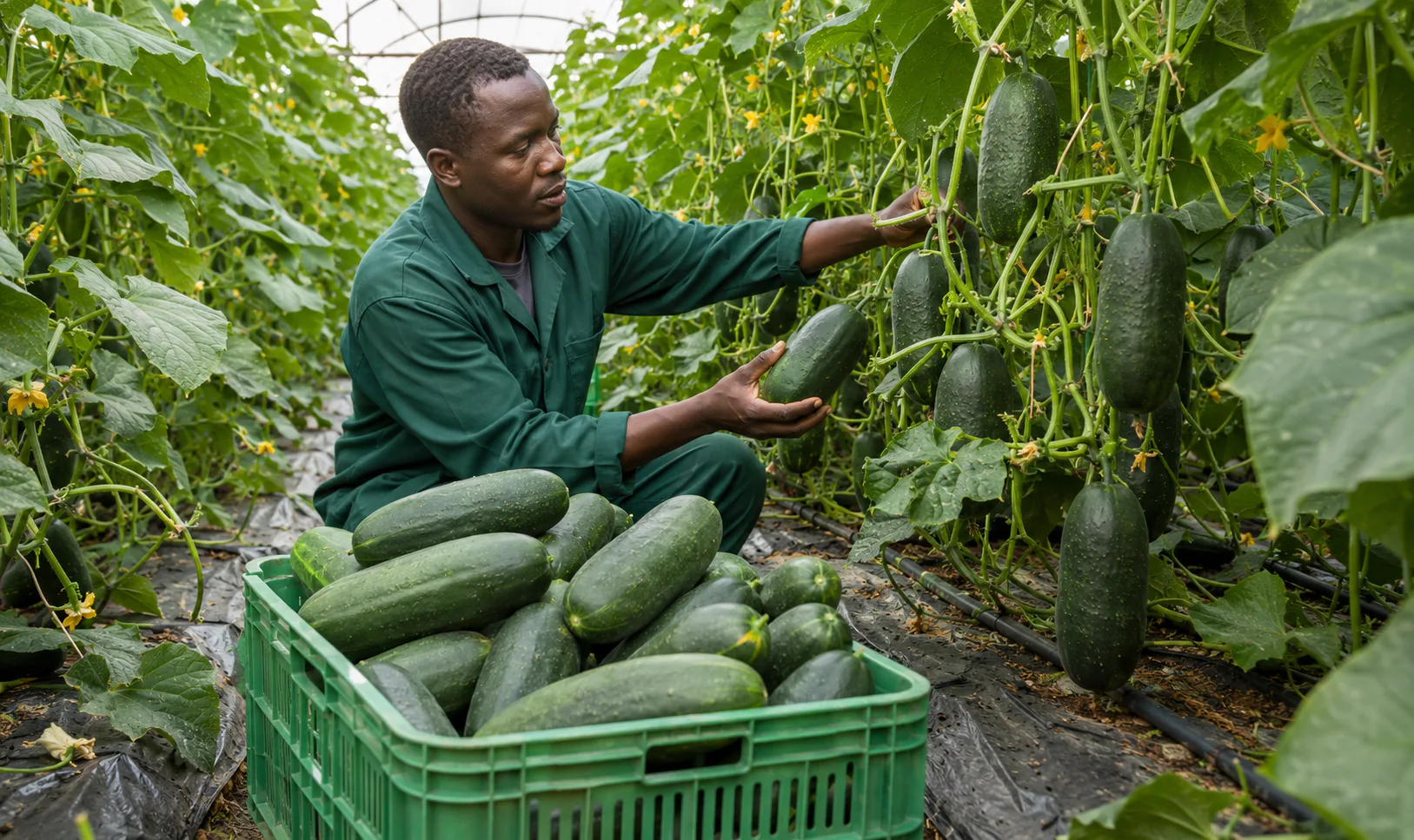
The large Dutch-type greenhouse cucumber, also called the long English cucumber, is a long, smooth, thin-skinned, dark green fruit sold individually wrapped. Published guidance places the type at roughly 12 to 14 inches in length and 300 to 400 grams (Blanchard, Pickens and Wells, 2022).
It is a different product from the short pickling cucumber, and the two are not interchangeable in any market. Pickling types are small, thick-skinned and grown for processing. The Dutch type is a fresh salad cucumber sold whole and judged on length, straightness, uniform diameter, colour and the absence of seeds or bitterness.
Falcon grows the large Dutch type.
Why it is a protected crop
This cucumber is grown under protection wherever it is grown commercially, for structural reasons rather than preference.
The fruit is thin-skinned and blemishes easily, so it needs shelter from rain, wind and abrasion. The plant is a fast, heavy-yielding vine requiring vertical support and continuous training. And commercial varieties are parthenocarpic, setting fruit without fertilisation to produce seedless fruit (Blanchard, Pickens and Wells, 2022), a characteristic that only holds if pollinating insects are excluded.
Cucumber also prefers warmer conditions than pepper, with productivity falling at both temperature extremes and disease pressure rising once humidity moves above its preferred range (Blanchard, Pickens and Wells, 2022). Under a poorly ventilated structure in equatorial conditions the upper limit is reached easily, which makes ventilation design the first specification decision rather than a later refinement.
Pollination: the point most often misunderstood
For most crops, pollination is something a grower wants. For this one, it is something a grower excludes.
If bees reach the flowers and fertilisation occurs, the fruit develops seeds, swells unevenly and becomes club-shaped or bulbous at the blossom end, failing specification on both shape and seed content.
The implication is direct: insect screening on vents and doors is a product quality control as much as a pest control. Where a farm also keeps bees, apiary siting has to account for cucumber houses being screened against pollinators rather than open to them.
Variety verification
Two parthenocarpic types dominate protected production: English or Dutch types, and Beit Alpha types. Both set fruit without pollination, but they are different products, and Beit Alpha fruit are considerably shorter and lighter and packed by the tray rather than individually wrapped (Blanchard, Pickens and Wells, 2022).
Because the two look similar as seed and are often sold through the same channels, verification matters. Confirm the variety name, its stated fruit type and length, and that it is parthenocarpic as described, and check the lot number and packing date against supplier documentation. Buying an open-pollinated field type by mistake may produce short, seeded or tapered fruit that fails a buyer's Dutch-cucumber specification.
Training, canopy and plant management
Training is the daily labour of this crop and the decision that most affects yield.
Two systems predominate. In the vertical cordon, each plant is grown as a single leader. In the V-cordon, plants are set in a double row and trained on alternating strings to form a V. Pruning then divides between the modified umbrella system, which clips the growing point at the trellis wire and drapes two leaders downward, and the alternative of leaving the growing point intact and looping the vine over the wire. Published research has reported yield gains for the intact growing point method across a range of studies (Blanchard, Pickens and Wells, 2022). Those results come from trials outside Uganda and indicate a direction worth testing rather than a guaranteed outcome here.
In both systems, fruit is not allowed to form on the lower section of the main stem, since early low fruit stunts the plant before it has built the frame that will carry the crop.
Canopy work is continuous: leaves removed progressively from the base, fruit thinned where too many have set, and the vine clipped and guided weekly. Density has to match available light, since excessive density reduces yield. Neglect for a week produces a tangled canopy that cannot be corrected without losing crop.
Water, nutrition and root zone
Cucumber is fertigated, with nutrition raised progressively as the plant moves from establishment through flowering into continuous harvest, and electrical conductivity and pH held within defined bands (Blanchard, Pickens and Wells, 2022). Those published values are specific to the substrate, water quality and climate they were developed for, and need to be set locally rather than transferred.
Two Ugandan points matter more than any imported figure. The daily water volume this crop requires has to be available in the dry season, from a source established before the structure is built. And water quality determines whether the emitters stay open, since sediment or high mineral content in surface and shallow well water is the commonest cause of drip failure.
Fruit quality and shape
Buyers judge this fruit on uniform shape, firmness and dark green colour, together with size, freedom from defects and decay, and absence of yellowing (UC Davis Postharvest Center).
Shape defects have identifiable causes. Bulbous or seeded fruit indicates unwanted pollination. Tapered or curved fruit follows uneven water supply, temperature stress or fruit growing against an obstruction. Fruit abortion and malformed fruit occur when the plant is carrying too many fruit at once (Blanchard, Pickens and Wells, 2022), which is why thinning is part of routine canopy work rather than an occasional correction.
Harvest rhythm
This is the operational discipline that separates a working cucumber house from a struggling one.
Growers harvest several times a week, in practice daily, to hold fruit within specification (Blanchard, Pickens and Wells, 2022). The window in which a cucumber is the right size is short. Fruit left an extra two days is oversized, coarser and outside specification, and draws resources from the fruit behind it.
Handling and storage
Cucumber handling differs from pepper handling in two ways that matter commercially.
Chilling injury begins at a higher temperature. Published guidance gives optimum storage in the region of 10 to 12.5 degrees Celsius at high relative humidity, with storage life generally under two weeks, and chilling injury developing below about 10 degrees after only a short period, showing as water-soaked areas, pitting and accelerated decay (UC Davis Postharvest Center). A cold room operating at a lower pepper-storage setting may therefore damage cucumbers.
Ethylene is a serious risk. Cucumber is highly sensitive to ethylene, and low concentrations cause accelerated yellowing and decay (UC Davis Postharvest Center). In practice this means cucumbers should not be stored or transported alongside ripening fruit such as bananas, mangoes or tomatoes. This is one of the most common and least recognised causes of quality loss in mixed produce handling.
Respiration is high, so field heat removal is urgent. Dutch-type fruit is individually wrapped in film, and the wrap is functional rather than decorative: it limits water loss from a thin-skinned fruit with a high surface area, which is what preserves firmness and gloss through distribution.
Buyer expectations
Expect a specification covering length and weight range, straightness, uniform diameter, deep dark green colour with no yellowing, firmness, absence of seeds and bulbous blossom ends, skin free of abrasion, individual wrapping, and count per case. Buyers holding stock frequently specify delivery temperature and freedom from ethylene exposure in transit.
Common production failures
Ventilation undersized at design stage, so the house overheats through the middle of the day. Humidity above the crop's preferred range, followed by mildew. Screening incomplete, so pollinators enter and fruit becomes seeded. Harvest rounds spaced too widely, producing oversized fruit and suppressed set. Fruit load left unthinned. Emitters blocked by unfiltered water. And cold storage set for the wrong crop, producing chilling injury that appears only after delivery.
Our approach
We grow the large Dutch-type greenhouse cucumber as a specification product for buyers requiring consistent size, straightness and colour. The emphasis is on the disciplines this crop rewards: adequate ventilation, humidity held in range, complete screening to protect parthenocarpic fruit quality, daily harvest rounds, and a handling chain that respects both the temperature floor and the crop's ethylene sensitivity.
We do not publish yield, price or income figures we cannot evidence.
Discuss cucumber supply
If you buy long cucumber to a written specification, or supply seed, structures, screening or irrigation capable of meeting one, we would rather begin with the specification and the handling chain than with a product description.
Make a business enquiry.