
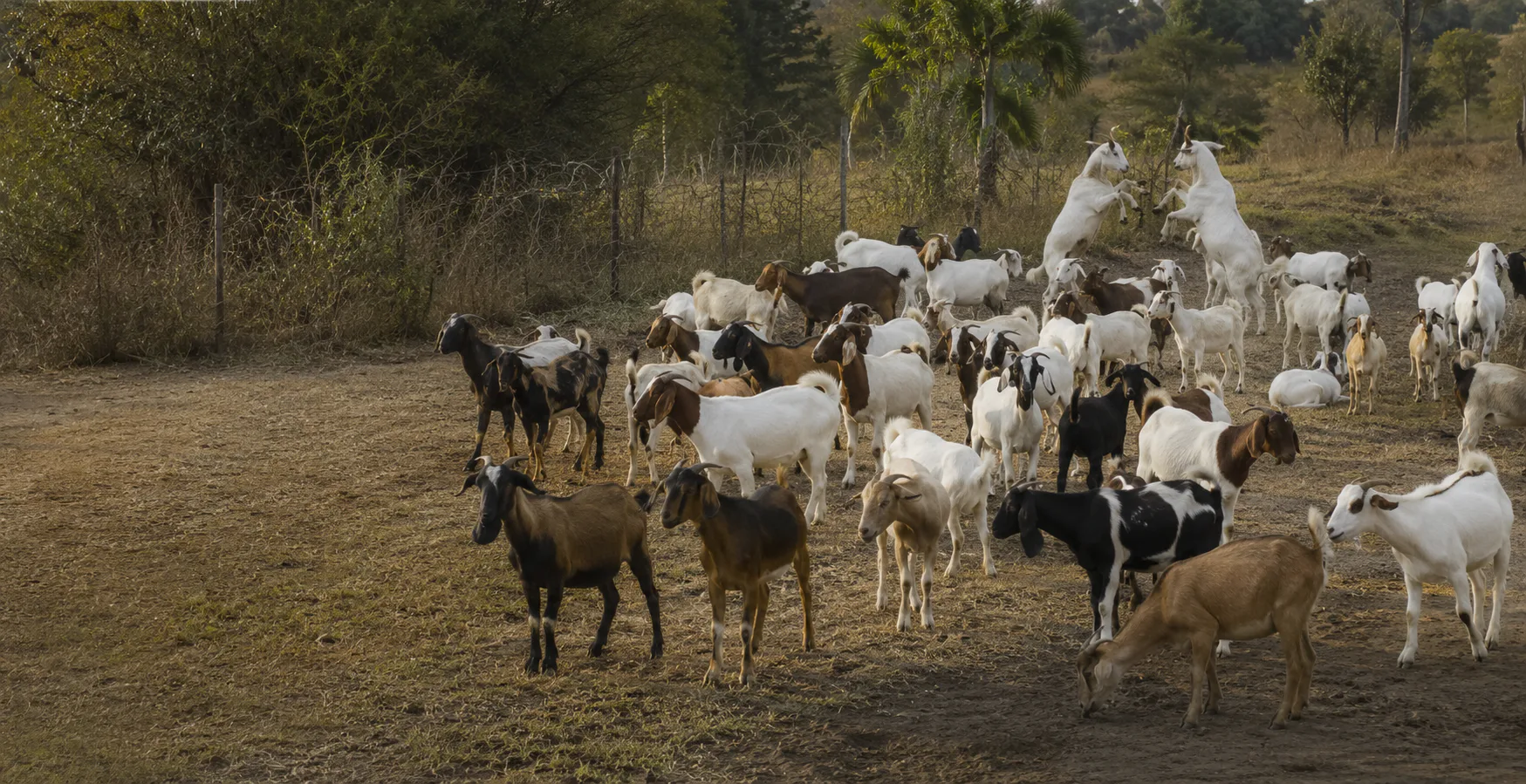
Goats are among the most widely kept and most commercially liquid livestock in Uganda. Participatory research across three indigenous breed areas found the sale of live animals was the primary reason farmers kept goats (Onzima et al., 2018b). A goat is a store of value that converts quickly, a genuine commercial function.
Falcon keeps local goats alongside Boer and Savannah hybrid genetics. This page covers goats only; sheep are on our African Sheep and Heat Adaptation page.
Uganda's indigenous goats
Uganda holds more genetic diversity in goats than is generally recognised. Genome-wide work identified five distinct indigenous breeds, Karamojong, Kigezi, Mubende, Small East African and Sebei, across the country's agro-ecological zones. The same study found breed-specific genomic regions under selection in those populations, associated with thermotolerance, disease and parasite resistance and the capacity to subsist on marginal fodder and water, alongside broad genetic variation with little sign of recent inbreeding (Onzima et al., 2018). That is the raw material a selection programme needs.
Boer and Savannah genetics
Boer is the improved meat-type genetics most commonly introduced into East African goat populations, and was the comparator in the Ugandan genomic work above.
We also work with Savannah genetics. A limitation should be stated: we did not identify a peer-reviewed Ugandan study evaluating Savannah crosses under Ugandan conditions. The evidence below relates to Boer and indicates a general pattern rather than a finding about Savannah crosses.
What crossbreeding delivers, and where it stops
This is the section most goat content avoids, and it is the most commercially important part of the page.
The best available regional evidence comes from an on-station study in Ethiopia comparing purebred Boer, F1 Boer crosses with Central Highland goats, F2 crosses and backcrosses (Mustefa et al., 2019).
The results run in both directions. Purebred Boer performed best in early life, with higher birth and weaning weights than the F1 crosses. After weaning that advantage disappeared, and the authors found no significant post-weaning gain difference among the genotypes.
Their conclusions matter more than any single figure. They described overall growth as irregular and below expectation, attributed it to sub-optimal adaptability to the study area, cautioned that higher crosses may perform poorly compared with local breeds because of adaptation problems, and recommended within-breed selection rather than continued crossbreeding.
Two caveats attach. The study was Ethiopian rather than Ugandan, and East African conditions are broadly comparable but not identical. And it ran under semi-intensive management with confined housing, daily concentrate feeding and veterinary oversight, which the authors noted may not represent typical farmer operations. That is the practical point: the exotic advantage that did appear, appeared under a level of feeding and attention most farms do not provide.
Making the crossbreeding decision
Our position: no hybrid automatically outperforms a local goat, and no local goat is automatically the right choice either. Performance is conditional on management, and the management required rises with exotic blood level. Questions worth answering first:
Can the farm feed and manage to the standard the genetics require, in the dry season as well as the wet? If not, the animals will underperform and their welfare will suffer, and reduced parasite resistance is a cost paid when veterinary support is least accessible.
Is there evidence for this specific cross under conditions like these? If not, the introduction is an experiment and should be run and recorded as one, at a scale the farm can afford to lose.
What is the target? Growth rate, mature size, conformation and market weight are different objectives, and a cross that improves one may not improve another.
What is being given up? Ugandan farmers rank disease resistance, heat tolerance and survival among their own breeding objectives (Onzima et al., 2018b), and those traits are the easiest to dilute.
Breeding records
A crossbreeding programme without records is not a programme; it is an accumulation of animals of unknown composition.
The practical minimum: individual identification of breeding animals; sire and dam of every kid; birth date and type; weaning weight; blood level carried forward each generation; health interventions; and the reason for every culling or sale decision.
The blood-level record is often neglected and is what makes the programme legible. Without it, a farm may be unable to establish the genetic composition of its herd after several years or interpret performance data confidently.
Uganda's National Animal Genetic Resources Centre and Data Bank, established under the Animal Breeding Act 2001, holds the national mandate for animal genetic improvement (NAGRC&DB). Any breeding programme of scale should be aware of that framework.
Housing
Goats tolerate heat far better than damp. A raised, slatted floor that lets droppings and urine fall through keeps bedding dry and reduces both hoof problems and internal parasite exposure, which is the most valuable housing feature in a wet climate. Ventilation without draughts matters particularly for kids, since ammonia accumulation causes respiratory disease directly.
Separation capacity is what allows a farm to manage rather than merely keep goats: space to isolate a sick animal, quarantine new stock, hold does close to kidding, and separate breeding males so mating is a decision rather than an accident.
Feeding and water
Goats are browsers rather than grazers and perform best where woody and broad-leaved material is available alongside grass. That suits a mixed farm, where hedgerows, fodder trees and crop residues become feed rather than waste.
The binding constraint is the dry season. Condition lost then is expensive to restore and shows up in conception rates and kid survival months later, so dry-season feed has to be planned during the wet season. Clean, continuously available water is directly linked to feed intake and to milk supply in lactating does. Feed planning is covered in the Falcon Knowledge Hub.
Health and biosecurity
Goat health in Uganda is dominated by internal parasites, and this is where the adaptation argument becomes financial. Diluting the parasite resistance carried by indigenous stock (Onzima et al., 2018) tends to increase anthelmintic dependence, and dependence drives resistance in the parasite population, which is a compounding cost.
The preventive disciplines we apply: quarantine new stock before mixing; keep housing dry and floors raised; avoid grazing young stock on the most contaminated ground; observe animals individually; and treat on evidence of burden rather than on a fixed calendar.
We do not publish anthelmintic products, doses or treatment protocols. Diagnosis, product choice and dosing are matters for a qualified veterinary professional.
Reproduction and kid survival
Kid survival decides the margin. The controllable factors are doe condition at mating and kidding, a clean dry kidding environment, prompt colostrum, protection from damp and cold in the first days, and separation of very young kids where disease pressure is high. Controlled mating, rather than letting males run with the herd continuously, makes kidding predictable and the breeding record meaningful.
Selection, culling and market
Selection is how a herd improves, and disciplined removal of persistently unsuitable breeding animals is an important part of it. Keeping every animal regardless of health, adaptation or reproductive performance weakens the selection programme.
Practical criteria: does that raise kids to weaning reliably rather than does that produce the most kids; animals holding condition through the dry season without exceptional feeding; sound feet and udders; temperament that permits handling. Selecting within an adapted population is a legitimate improvement strategy in its own right, and it is what the Ethiopian authors recommended in preference to continued crossbreeding (Mustefa et al., 2019).
The Ugandan goat market is predominantly a live animal market with its own signals: weight, condition, conformation, age and seasonal timing. Market weight and timing are production targets rather than outcomes. We do not publish prices, weights or income figures we cannot evidence.
Our approach
We keep local goats alongside Boer and Savannah hybrid genetics and treat the combination as something to be evaluated rather than assumed: adapted foundation stock, records that make blood level and outcomes legible, improved genetics introduced deliberately and in stages, management matched to what those genetics require, and continuous selection within the herd rather than reliance on introduction alone.
We do not claim that our hybrids outperform local goats, and we do not publish performance figures we cannot evidence.
Enquire about goats
If you buy breeding or slaughter stock, supply feed or housing, or work in research or extension on small ruminant genetics, we are open to an evidence-based conversation.
Make a business enquiry.