
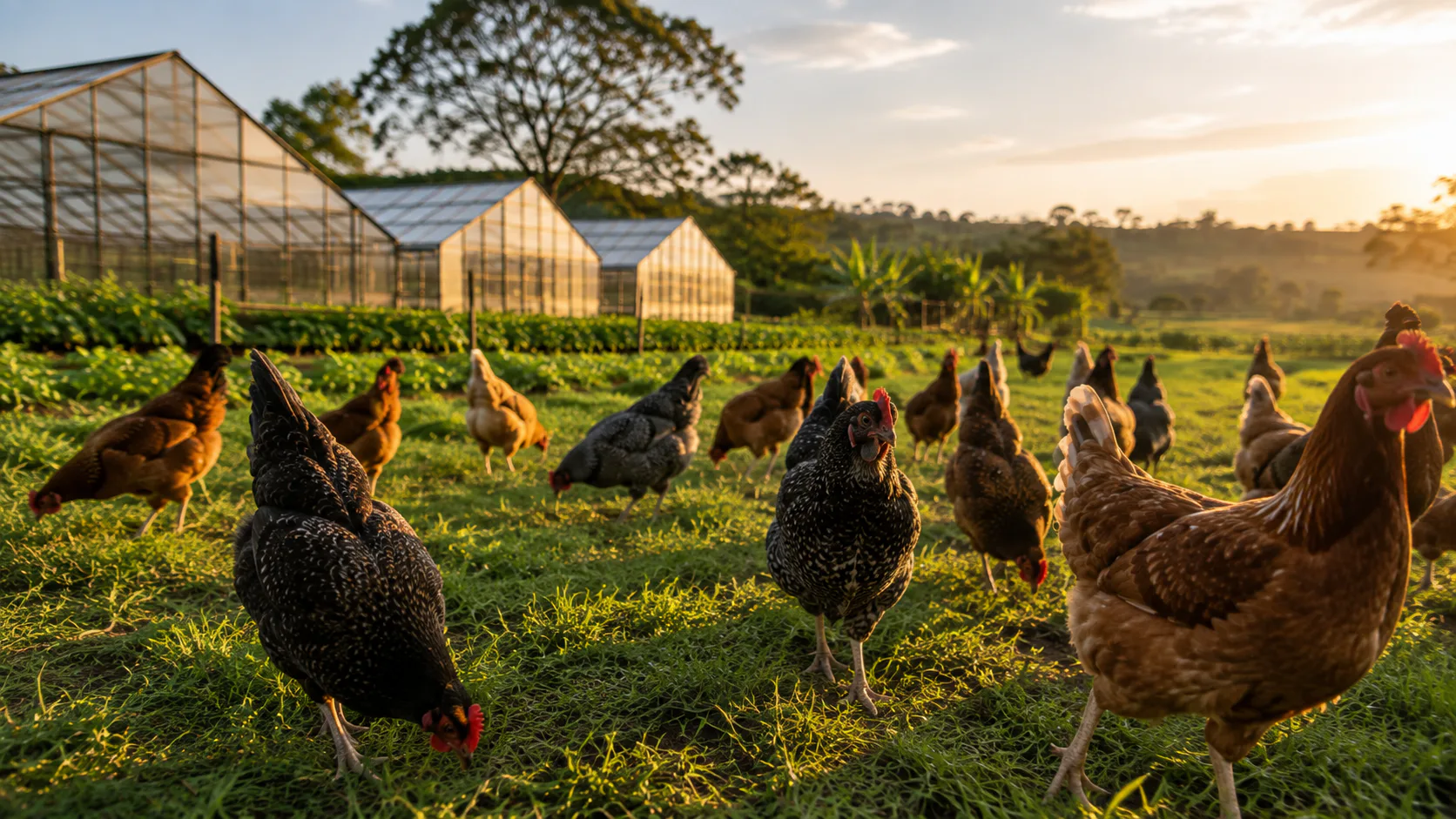
The Ugandan local chicken is a hardy, slow-growing, dual-purpose bird kept across the country under scavenging and semi-managed conditions. It converts household and farm by-products into meat and eggs on inputs a commercial hybrid could not survive on, and it holds a distinct position in Ugandan markets, where local birds and their eggs attract different buyers and different prices from commercial broiler and layer product.
Falcon keeps free-range local chickens and guinea fowl as part of an integrated farm.
What free-range actually means
Free-range is a management system, not an absence of management, and that distinction is where most losses originate.
Research on indigenous chicken flocks in eastern Uganda described the baseline system clearly. Most households provided a complete night enclosure, most provided water, and roughly half relied on scavenging alone while the rest supplemented seasonally with cereal grains during harvest periods. The study projected annual production in the region of 40 eggs per hen under that management (Kugonza et al., 2008).
Those are findings from one study in one region, not a national average. They establish the shape of the system rather than a benchmark: modest output, seasonal supplementation and heavy dependence on housing.
Anyone presenting free-range local poultry as a high-output enterprise without changing the management is either mistaken or selling something.
Housing and night protection
Night housing is the highest-return intervention in this system, and the reason is loss rather than comfort. The same eastern Uganda research attributed a substantial share of flock losses to predators (Kugonza et al., 2008), and a secure structure addresses that directly.
A functional night structure needs to be genuinely closable against predators including birds of prey, snakes and small mammals; dry and draught-free without being sealed; ventilated enough to prevent ammonia and moisture accumulation; easy to clean; and fitted with perches and accessible nest boxes where hens are laying. It also has to be somewhere a person can enter and observe the birds, because a house that cannot be inspected will not be. Theft is a real risk alongside predation, and the same structure, siting and routine address both.
Feed and supplementation
Scavenging alone does not meet the requirements of a laying hen or a growing bird, and what is available varies sharply by season. The eastern Uganda data showed supplementation concentrated at harvest, when grain is plentiful, rather than in the lean months when birds need it most (Kugonza et al., 2008).
The discipline is to supplement counter-seasonally, prioritising laying hens and growing birds, and to consider what the scavenged diet is short of rather than simply adding grain. Cereal grains supply energy; the common shortfalls are protein, calcium for shell formation and specific minerals, and adding maize to a diet already short of protein does not correct it.
Water is the input most often assumed and least often measured. Containers that run dry in afternoon heat, or that become fouled, are a production constraint and a disease route at the same time. Clean, shaded, continuously available water in containers that can be cleaned is the standard.
Health monitoring
Newcastle disease is the dominant health reality of Ugandan village poultry and should be the first thing any keeper plans for. In the eastern Uganda study, chick mortality was widespread across the surveyed farms and Newcastle disease was implicated in the majority of it, with disease accounting for most losses overall and mortality peaking in the dry season (Kugonza et al., 2008).
Two things follow. A free-range flock is not a disease-free flock, and material suggesting otherwise is wrong. And because Newcastle can move through a flock faster than any treatment response, prevention through vaccination and biosecurity is the strategy that works at this scale.
We do not publish vaccination schedules, product names or dosing. Vaccination planning, cold chain and administration are matters for qualified animal health workers and veterinary professionals, and campaign timing at community level is often more effective than individual household vaccination.
Day to day, a keeper observes: appetite, alertness, droppings, breathing, and any sudden change in laying. Sudden deaths in a previously healthy flock warrant immediate professional advice.
Biosecurity in a free-range system
Free-range and biosecurity are in genuine tension, and pretending otherwise is unhelpful. Birds that range cannot be isolated from wild birds, neighbouring flocks or contaminated ground.
What remains achievable: quarantine new birds before mixing; avoid returning birds from a market without separation; keep feed and water clean and off contaminated ground; clean the night house regularly; dispose of dead birds promptly; restrict casual visitor access; and treat footwear, containers and crates as disease routes. Separating species and age groups at night reduces cross-transmission.
Guinea fowl in a mixed flock
We keep guinea fowl alongside local chickens. They behave differently and should not be managed as though they were chickens.
A limitation has to be stated here. The most detailed production data available comes from a baseline study across 20 districts in northern Ghana rather than from Uganda, and West African production conditions differ from Ugandan ones. It indicates the character of the system rather than serving as a Ugandan benchmark.
That study found adult guinea fowl mortality low, while keet mortality was a problem for most respondents and reached very high levels in one region, with the majority of disease occurring in the first six weeks of life. Local hens were the predominant means of incubating guinea fowl eggs, and more eggs were laid in the rainy season than the dry (Avornyo et al., 2016).
The practical reading is that guinea fowl are hardy as adults and fragile as keets. The management effort belongs at the brooding stage, in warmth, dryness and protection, and adult birds thereafter demand relatively little. Their alertness and noise also make them useful sentinels within a mixed flock, though that is an observed behaviour rather than a substitute for secure housing.
Market considerations
Local chicken meat and eggs occupy a distinct market position from commercial broiler and layer product, with different buyers, price behaviour and quality expectations. Eggs from a scavenging flock vary in size and shell quality, which affects presentation and grading.
The commercial constraint is continuity. At the output levels indicated by baseline research, supplying a buyer weekly requires a substantially larger flock than most households keep, improved management, or both. Size the flock against the commitment rather than the other way round.
We do not publish prices, volumes or income figures we cannot evidence.
Manure, farm role and records
Poultry manure is a concentrated nutrient source and one of the direct links between our livestock and crop activities. Collected from the night house, composted and applied deliberately, it returns nutrients and organic matter to soils that horticulture depletes. Ranging birds also consume insects and weed seeds, which is a genuine contribution to farm ecology rather than a pest management programme.
Worth recording: flock count by class, eggs collected, birds sold or consumed, deaths with an observed cause, disease events with dates, and supplementary feed given and when. Without those, a keeper cannot tell whether this season was better than the last.
The honest limits
Output per bird is modest without changed management. Disease losses are heavy and concentrated in chicks. Predation is significant where night housing is inadequate. Production is seasonal, so supply is uneven. Individual birds are hard to monitor when ranging. Biosecurity is structurally limited by the system itself. And free-range does not mean low effort: the effort moves to housing, protection, water and observation rather than to feeding a confined flock.
Free-range local poultry is a sound enterprise on its own terms. It is not a shortcut, and not automatically healthier than a well-run confined system.
Our approach
We keep free-range local chickens and guinea fowl within an integrated farm rather than as a standalone commercial poultry operation. The emphasis is on secure night housing, counter-seasonal supplementation, clean water, prevention rather than treatment, chick and keet survival as the point where effort pays, and manure returned to crop production.
We do not present free-range production as disease-free or effortless, and we do not publish output or income figures we cannot evidence.
Enquire about local poultry
If you buy local chickens or eggs, supply feed or housing materials, or work in extension or research on village poultry, we are open to a direct conversation.
Make a business enquiry.