
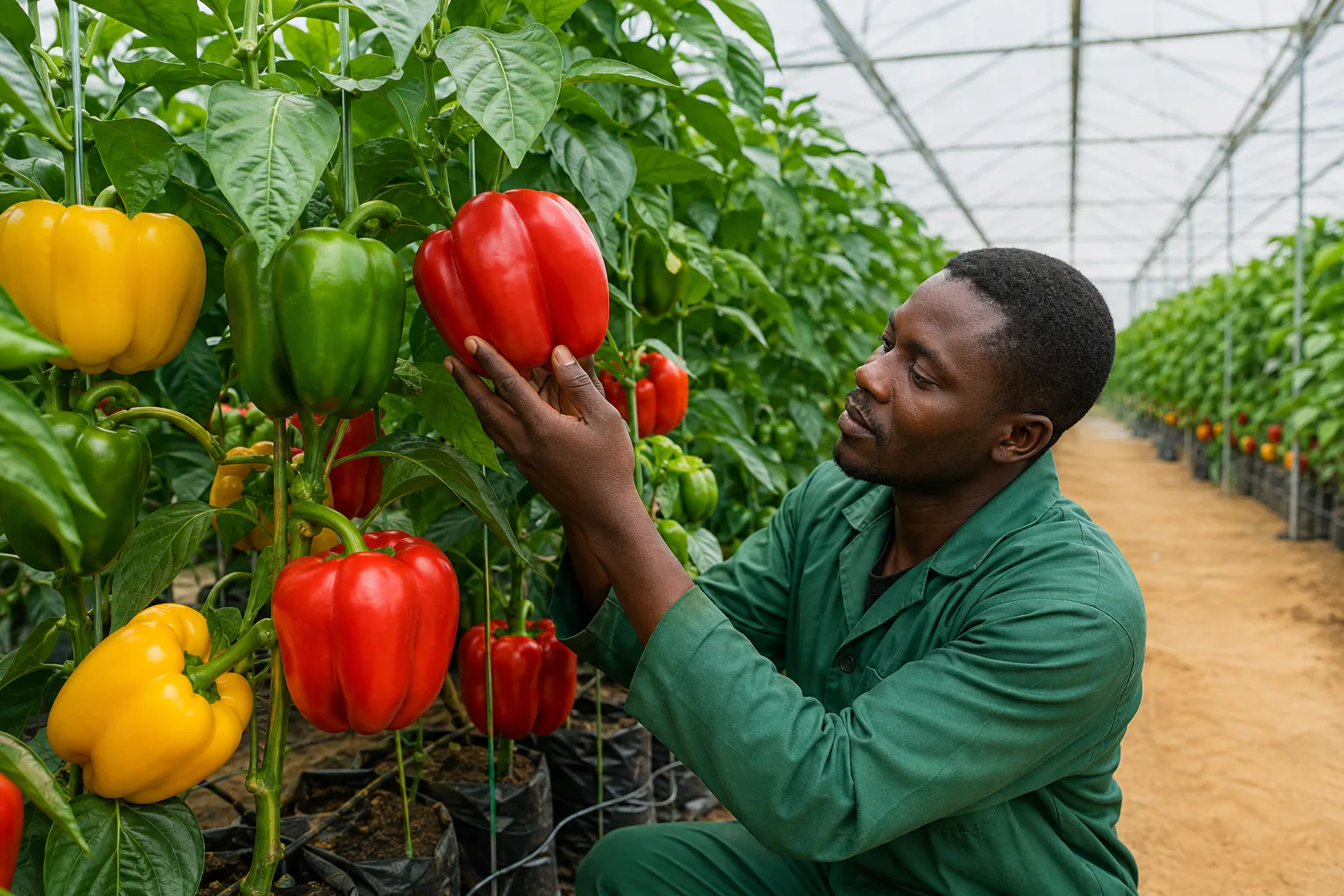
A greenhouse is a risk management decision before it is a production decision. It buys control over the conditions that make open-field horticulture unpredictable, at a cost that has to be earned back through consistency of supply and quality.
Falcon's protected cultivation focus is on two crop groups: large sweet bell peppers in yellow, red and green, and large Dutch-type greenhouse cucumbers. Both are specification-driven products, which means quality is measurable rather than negotiable.
Why protected cultivation matters in Uganda
Uganda's rainfall is favourable in total and unreliable in timing. Most of the country south of about latitude 3 degrees north has two rainy seasons and the north has one, but season onset shifts from year to year and dry spells can occur within a rainy season (Mubiru et al., 2012).
For a staple crop, an interrupted season is a yield problem. For fresh produce sold on specification it is a reliability problem, and reliability is what a buyer pays for. Protected cultivation narrows that uncertainty without removing it.
What a greenhouse can and cannot address
Being clear about this is the difference between an investment and a disappointment.
It can help with rain damage to fruit, soil-borne disease pressure where production moves to a controlled growing medium, the timing of supply, exclusion of some pests through screening, and consistency of fruit quality.
It does not solve heat. In an equatorial climate a poorly ventilated structure runs hotter than the field outside it, and heat is a primary constraint on fruit set in sweet pepper. Nor does it remove pest pressure, since an enclosed humid environment favours whitefly, thrips and spider mite once they establish, or the need for a market, working capital and daily skilled attention.
A greenhouse also concentrates consequences. Problems a field would absorb over a season can develop in a protected crop within days.
Environmental control
Temperature and humidity matter most, and they interact.
Published guidance for greenhouse sweet pepper indicates that fruit set declines above about 27 degrees Celsius, and that low temperatures during flowering impair flower development and produce malformed fruit (Government of Alberta, 2019). Cucumber prefers warmer conditions than pepper, with productivity falling away at both temperature extremes (Blanchard, Pickens and Wells, 2022). High relative humidity is associated with fruit cracking and russetting in pepper, and cucumber carries materially higher disease pressure once humidity rises above its preferred range.
These figures come from Canadian and United States protected cropping. They indicate the direction and rough magnitude of the effect rather than serving as operating targets, and require calibration to the Ugandan site, structure, cultivar, growing medium and season.
The practical conclusion is that ventilation capacity, orientation and screening specification should be settled before a structure is priced, because they are difficult and expensive to retrofit.
Water, root zone and irrigation
Irrigation under protection is a daily quantitative decision, with two prerequisites that are frequently skipped.
The water source comes first. A dry-season source has to be established before the structure, and the volume has to be available in the months when it is hardest to find.
Water quality decides whether the system keeps working. Sediment and dissolved minerals block emitters, and drip failure is a common reason a system stops performing within its first year. Filtration specified against the actual source is the control.
Protected production usually moves the crop off native soil into a defined medium such as perlite or pine bark (Blanchard, Pickens and Wells, 2022). The trade-off is honest: a controlled medium removes soil-borne disease and allows precision, and in exchange it removes the buffering soil provides. Consistency matters more than any single setting, because uneven moisture is the mechanism behind the most damaging fruit disorders in both crop groups.
Monitoring and pest prevention
Monitoring is the cheapest input in a greenhouse and the most often skipped. Yellow sticky cards capture whitefly, aphids and leafminers, blue cards catch thrips, cards sit just above the canopy including near vents and doors, and spider mites are found only by inspecting leaf undersides (Hale and Cloyd, 2018). Published action thresholds from North American protected cropping are a starting framework, not calibrated for Ugandan conditions, and should be adjusted against a site's own records (Rettke, 2022).
Prevention is structural before it is chemical: screening, clean transplants, hygiene between cycles, and humidity control.
Uganda-specific evidence exists for thrips, which affect both crop groups. A survey across central Uganda found several thrips species on pepper, with infestation peaking at flowering, and recorded that populations fell as spray frequency increased (Ssemwogerere et al., 2013). That finding deserves care rather than adoption: frequency reduces populations in the short term while accelerating resistance and residue risk over a season. Monitoring against thresholds, rotation of modes of action and exclusion are the more defensible response.
Quality and market expectations
Quality in fresh produce is defined by the buyer. For bell pepper the accepted indices are uniform shape, size and colour typical of the variety, firmness, and freedom from defects such as cracks, decay and sunburn. For cucumber they are uniform shape, firmness, dark green colour and absence of yellowing (UC Davis Postharvest Center).
Most serious defects are management outcomes rather than misfortune. Blossom-end rot is a localised calcium problem driven by water relations rather than soil calcium supply, sunscald follows inadequate canopy, and cracking follows temperature swings and water standing on fruit (Hochmuth and Hochmuth, 2025; McAvoy, Coolong and Torrance, 2024).
The commercial sequence that fails is to build the structure, grow the crop, then look for a buyer. Establish who buys, at what grade, in what volume and on what terms, work backwards to the planting schedule, and commit to the structure last.
For formal or export markets, Uganda's requirements are explicit. MAAIF's Department of Crop Inspection and Certification requires registration, a physical address and an approved producer traceability system, with consequences for non-compliant consignments. Traceability is a condition of entry rather than an aspiration.
Risks worth naming
Wind damage and polythene degradation under equatorial ultraviolet. Consumable replacement, since cladding and drip lines are operating costs rather than capital. Power and water reliability. Skills, since protected cropping needs daily competent observation and this is the constraint most often underestimated. Market concentration and rejection on specification. And a long establishment period before first revenue.
Falcon's approach
We work in phases: structure and ventilation specification, then water source and quality, then growing medium and irrigation control, then monitoring discipline, then market commitment, and expansion only after those hold. We do not present protected cultivation as a guaranteed route to income, and we do not publish yield or profit figures we cannot evidence.
Explore the crops
- Yellow Sweet Pepper - colour development and premium visual specification
- Red Sweet Pepper - ripening, firmness and post-harvest timing
- Green Sweet Pepper - mature-green judgement and continuity of supply
- Greenhouse Cucumber - large Dutch-type production and harvest rhythm
Talk to us about protected cultivation
If you are a buyer specifying fresh produce, a supplier of structures or irrigation, or an investor assessing a protected cropping proposal in Uganda, we are open to a technical conversation.
Discuss a requirement.