
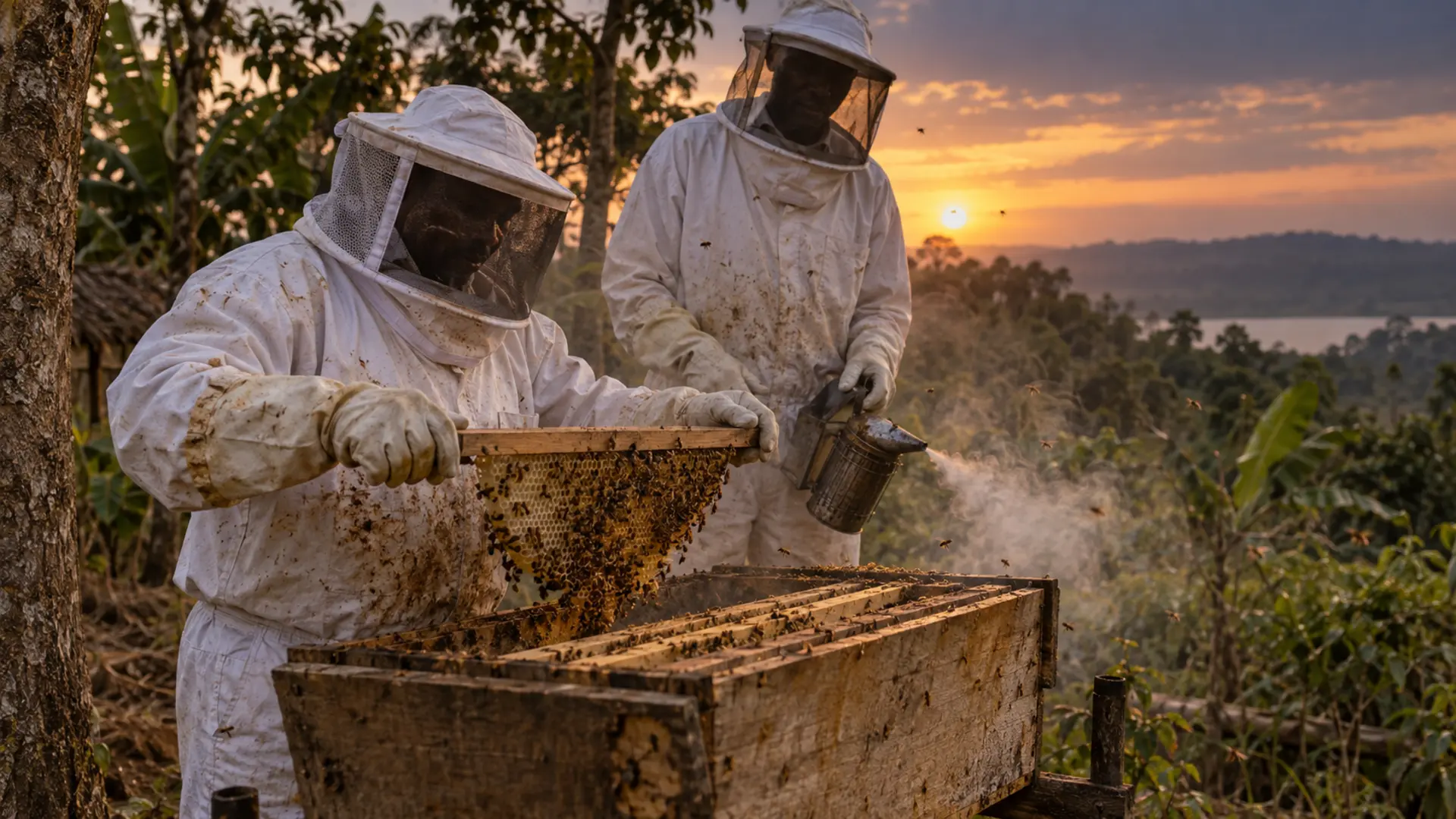
You read that you should inspect every seven to ten days. You watch a video of somebody in a light veil, no gloves, opening a hive at eleven in the morning and lifting frames while bees walk calmly over their bare hands.
You try it. Within thirty seconds you are being hit repeatedly, you are walking fast towards the house, and the bees are still with you at the treeline. Two weeks later the colony has gone.
Neither of those outcomes means you did beekeeping wrong. It means you followed instructions written for a different animal.
What this guide helps you decide
By the end you should understand what the research actually measured about African honey bee defensive behaviour and why temperate inspection advice does not transfer; know when to open a hive, how often, and how to use smoke; know what an inspection is actually for and what to record; and know precisely when to stop, how to withdraw, and who else on your land is at risk.
It does not cover hive type, siting, pests and predators, harvesting or queen rearing.
The short answer
Open hives less often than temperate advice says, at low flight activity, in full protective clothing, with a working smoker, and get out again quickly.
Inspect with a purpose, not out of curiosity. Every opening costs you something, and in African bees what it can cost you is the colony.
And before you open anything, know where the children are, where the workers are, and where any tethered animal is standing.
What the research actually measured
The claim that African bees are more defensive is not folklore. It has been measured, and the figures are worth having because they explain the practical rules.
How fast they respond. A study comparing African-derived and European honey bees found that 81 per cent of the first bees to sting in a standardised test were African, in the first ten seconds, and that African bees stung 8.2 times faster than European bees.
Ten seconds. That is the window between disturbing a colony and being stung, and it is why there is no such thing as a quick look inside.
How many, and for how long. A study of feral hybrid colonies with African ancestry in southern California recorded sting rates ranging from about 6 stings per minute at their least defensive to about 66 stings per minute at their most defensive across the season, against about 27 per minute at peak defensiveness in managed European colonies in the same study. The same work found guarding behaviour persisting longer in African-derived families, at around 4.3 to 5.1 days against 2.5 to 3.5 days in European families.
Why. A study of alarm pheromone production found that African bees produce larger quantities of several alarm compounds than European bees, and that there were significant positive correlations between alarm pheromone levels and defensive behaviour, especially numbers of stings. When one bee stings, it marks you, and more bees come.
That single mechanism explains a great deal. FAO’s African beekeeping guidance puts it plainly: the first bee sting attracts others to strike.
Pursuit. The same comparative study found that observers who retreated five metres were disproportionately followed by African bees. Walking away is not automatically the end of it.
One important qualifier. The California study found that the amount of African ancestry was not a significant predictor of nest defensiveness. So this is not a simple more-African-genes-means-more-dangerous rule. Individual colonies vary, and yours may be calm. Plan for the defensive case anyway.
Why the temperate advice fails, point by point
Inspection frequency. Temperate guidance inspects often, because in a European colony the cost of disturbance is low. In Uganda the cost is high, and Ugandan research says so directly.
A study of Ugandan beekeeping households records that 57 per cent of beekeepers rarely inspected their colonies, and states that frequent inspection of honeybees, for example every two weeks, is discouraged because of the bees’ high absconding rate if repeatedly disturbed. A separate Ugandan study in Bushenyi district notes that daily inspection, done by almost a quarter of all respondents, is not recommended as it may cause stress to the bees.
And here is a real tension the reader should know about. Uganda’s own code of practice for apiary management states that hives shall be inspected at regular intervals at least once a week and at least three times a month. That is the national standard’s floor. Ugandan field research says that even fortnightly inspection is too much.
We are not going to resolve that quietly by picking one. The standard sets a minimum for a commercial quality-assurance framework. The field evidence describes what disturbance costs in absconding. Our reading is that the number of openings matters less than what each opening is for: a purposeful inspection at a sensible interval, done quickly and well, is a different thing from repeatedly lifting the lid to see how they are getting on.
Time of day. Temperate videos are filmed in the middle of a warm day, when the foragers are out and the colony is at its emptiest. Ugandan practice runs the other way. Ugandan research records that hives are generally inspected at dusk due to the bees’ defensive behaviour.
The African field studies show why the picture is not simple. A study of African honey bees in Cameroon found that colonies did not defend their hives around midday and at night, with the defensive perimeter greatest during morning and evening periods, and 67 per cent of defensive flights occurring by day against 33 per cent at night. A study in Ghana found two daily peaks of defensiveness during the honey flow season, one early in the morning and the other late in the evening, reducing to a single morning peak in the rainy season, and recorded that the bees stung about four times more frequently during honey flow than during the rainy season. Its author recommends that handling take place during periods of low flight activity.
Those two studies do not fully agree, and they were done on colonies in different countries. What they agree on is the principle: work when flight activity is low, and expect defensiveness to change with the season as well as with the hour. Ugandan practitioners have settled on dusk. Follow local practice, not a video.
Temperament expectation. Do not expect a calm colony. Expect a colony that will respond fast if you give it a reason, and be pleasantly surprised when it does not.
The season matters. Four times more stinging during honey flow than in the rains, in the Ghana study. The same colony is not the same proposition in different months.
Smoke: what it does and how to use it
The mechanism, verified. Research on smoke and alarm pheromone perception found that smoke interferes with olfaction generally rather than specifically with honey bee alarm pheromones, by reducing peripheral sensitivity in the antennae, and that responsiveness gradually returned to that of controls within 10 to 20 minutes.
Two things follow. Smoke buys you a window, not a state. And that window is roughly ten to twenty minutes, which is a useful way to think about how long an inspection should last.
How much. Uganda’s code of practice states that a minimum amount of smoke shall be puffed into the hive, and records that three short successive puffs of smoke followed by a one minute interval of waiting has been used by some farmers with successful results.
FAO’s African beekeeping guidance describes a fuller approach: puff some smoke gently around the hive, then puff continuously through the main entrance for at least three minutes, then wait about one or two minutes for the bees to rush in and gorge themselves.
The waiting is the part people skip. Smoke and then immediately open, and you have annoyed the colony without gaining anything.
Fuel. Uganda’s national beekeeping training and extension manual lists semi-dry grass, wood shavings, coffee husks, maize cobs, bean husks, millet husks, dry cactus and dry pawpaw stem.
What you want is cool white smoke, plenty of it, and a smoker that will not go out. A smoker that dies halfway through an inspection is not an inconvenience. It is the reason you stop and close up.
Safety
This section matters more than the rest of the article and it is written to be read before anything else.
Protective clothing
Uganda’s code of practice requires that all personnel including management and visitors wear protective clothing before entering the production areas. The national training manual specifies a bee suit, bee gloves and gumboots alongside a hive tool set.
With bees that sting 8.2 times faster and in greater numbers, and where one sting chemically recruits others, the light-veil-and-bare-hands approach in temperate content is not a style choice you can copy. Full suit, veil fully closed, gloves, boots, and trousers tucked in. Check the suit for holes before you put it on.
Do not crush bees
Uganda’s code of practice gives this its own instruction: avoid crushing the bees as this triggers the release of pheromones which provokes other bees into aggressive action including attack and stinging action.
Slow movements. Lift bars vertically. Do not scrape, bang or drop anything.
When to stop
Stop the inspection and close up when:
- The number of bees flying at you rises sharply
- Bees begin striking the veil repeatedly rather than landing on it
- Bees follow you when you step back
- A colony that was quiet becomes loud
- Your smoker goes out
- Any part of your protective clothing opens
- Anyone without protective clothing comes near
Closing up quickly and coming back another day costs you nothing. There is no inspection finding worth being stung a hundred times for.
How to withdraw
An honest note on sourcing. We could not find an authoritative African beekeeping or medical source setting out a formal withdrawal protocol, and we searched for one specifically. What follows is practical judgement, offered as such, from the mechanisms the research does establish.
Close the hive. Move away steadily rather than sprinting, because sudden movement attracts attention. Get away from the apiary, and keep going further than feels necessary, because the comparative research found that observers who retreated five metres were still followed. Get into a building or a vehicle if one is close. Do not swat, because crushing a bee releases the alarm pheromone that recruits more. Do not go back for equipment.
Who else is at risk
This is the part that gets least attention and deserves most.
Neighbours and passers-by. Uganda’s apiary code sets a minimum distance from public places for a reason, and it is covered in the siting guide. A defensive event does not stop at your boundary.
Children. Uganda’s responsible business guidance for the honey sector is explicit that climbing to check, install or remove hives placed in trees should be undertaken by experienced beekeepers and not by children. The broader point is simpler: children should not be near an apiary during an inspection, and they should know not to go near it at any time.
Workers without protective clothing. Anyone on the farm during an inspection needs to know it is happening and stay away. Somebody weeding downwind of an apiary is at risk from a decision they did not make.
Tethered and penned livestock. This deserves naming on its own, because an animal on a rope cannot leave. A goat tethered near an apiary, a calf in a pen, cattle in a crush, are all in the path of a defensive event with no ability to move away.
We searched for documented Ugandan or African incident literature on this and found none. That absence is not reassurance. It is a gap in the literature. The practical instruction stands on its own logic: before you open a hive, know where every tethered or confined animal on the farm is, and move any that are within reach of the apiary.
Medical
Three different things can happen after stings, and they are not the same.
A local reaction. Pain, redness, swelling at the site. Normal, self-limiting, unpleasant.
An allergic reaction. Peer-reviewed clinical literature records that severe complications have been reported in adults with fewer than 30 stings, even as few as one sting, particularly in sensitised individuals. A single sting can cause anaphylaxis in someone who is sensitised, and they may not know they are until it happens.
The warning signs to act on, from an authoritative medical reference, include hives and itching, constriction of the airways with a swollen tongue or throat, wheezing and trouble breathing, a weak and rapid pulse, low blood pressure, nausea, vomiting or diarrhoea, and dizziness or fainting. Symptoms usually occur within minutes of exposure.
A systemic toxic reaction from many stings. The same clinical literature indicates that a non-allergic person weighing 60 to 70 kilogrammes could theoretically face a 50 per cent risk of fatality from 1,000 to 1,500 stings, while fatalities have been reported with as few as 200 to 500 stings.
What to do. Get medical help immediately for any breathing difficulty, swelling of the face, mouth or throat, dizziness, collapse, or a large number of stings. This guide gives no treatment and names no medication. Tell whoever treats the person how many stings and how long ago.
Know before you start where the nearest health facility is and how you would get someone there.
Working African Honey Bees: Inspection, Temperament and Why Most Online Advice Does Not Apply
Safety panel showing the stop-and-withdraw decision, who is at risk around the apiary, and the medical warning signs that need emergency help
What an inspection is actually for
FAO’s African beekeeping guidance frames it directly: the only means the beekeeper has of knowing for sure whether everything is going smoothly is to open the hives and inspect each comb.
So inspection has a purpose, and the purpose is what makes an opening worth its cost. What you are checking:
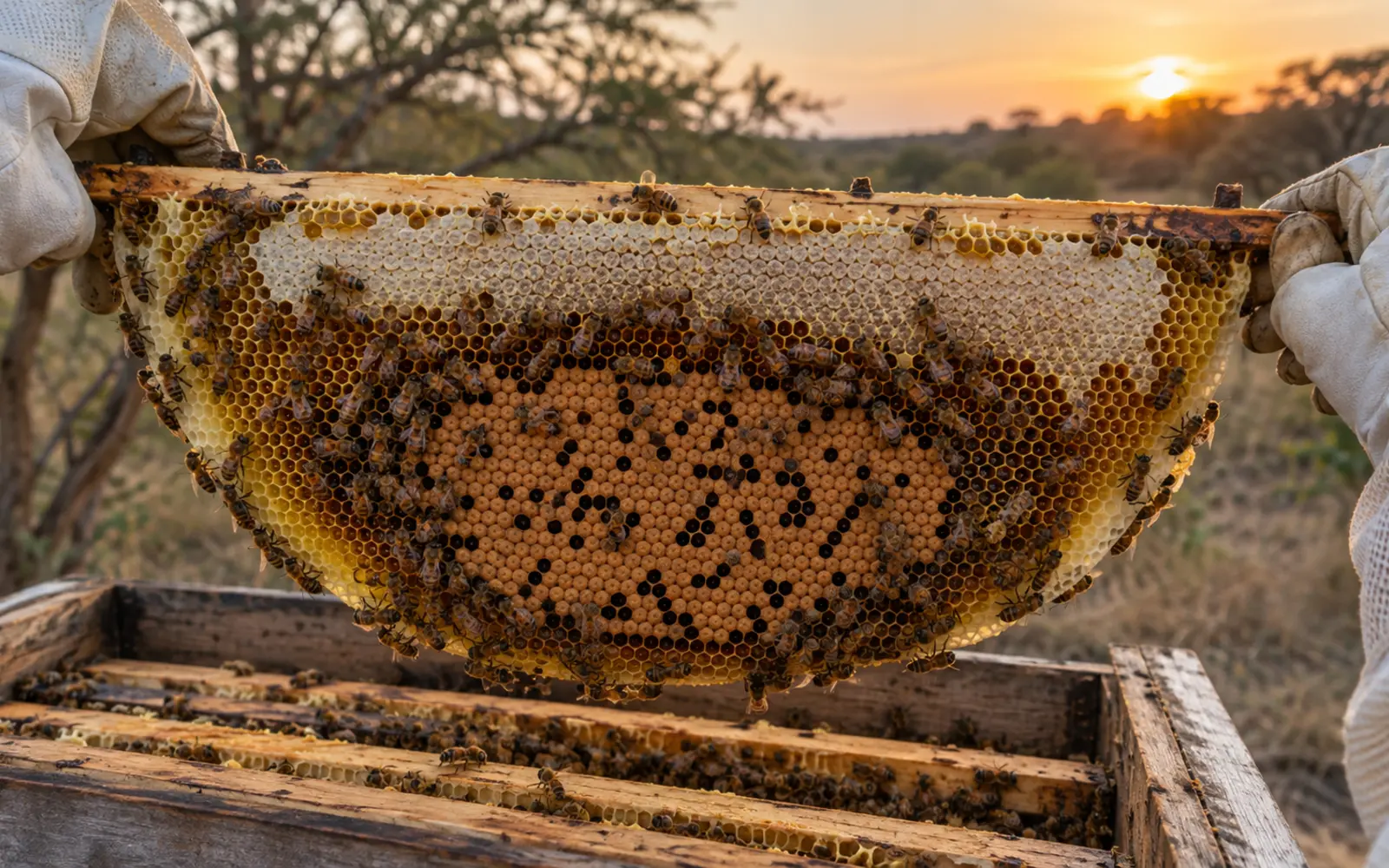
- Brood. Is there sealed brood, and does it sit in a solid pattern rather than scattered?
- Eggs or very young larvae. Evidence that a queen is laying, without having to find her.
- Stores. Honey and pollen, and whether they are increasing or falling.
- Comb condition and attachment. Particularly in top bar and log hives, where comb is attached to the bar rather than held in a frame and can break under its own weight if mishandled.
- Space. Whether the colony has room, which bears on swarming.
- Anything unusual. Pests, damage, an odd smell, dead bees at the entrance.
A limitation worth stating. We could not find an itemised inspection checklist written specifically for top bar and log hives, which are what most Ugandan beekeepers actually use. The list above adapts general guidance to those hive types, and the comb-attachment point in particular is ours rather than a quoted instruction.
Record it. Date, time, colony, what you saw, what you will do. Six lines in a notebook. Without it you cannot tell whether a colony is building or declining, and you will open hives to find out things a record would have told you.
Working African Honey Bees: Inspection, Temperament and Why Most Online Advice Does Not Apply
Inspection routine and record card showing the approach sequence, what to check on each comb, and what to write down
Absconding and swarming, which are not the same thing
Getting this distinction right changes what you do about it.
Swarming is reproduction. The colony divides and part of it leaves with a queen. Research on the seasonal cycles of African honey bees found swarming occurring in October and November, following two to three months of intense brood production. It follows abundance.
Absconding and migration are departure. The whole colony leaves. Research in Botswana following African honey bee colonies found that those that migrated had increasing population sizes, high brood production with low brood mortality, relatively large food stores and expanding foraging distances, while non-absconding colonies showed decreased brood production, higher brood mortality and reduced food stores. Migration occurred from November to May during reduced and variable floral resources. Of four colonies tracked over one migration season, two absconded. That study tested seven weather parameters and found weather showed no clear association.
So a colony can leave because conditions are deteriorating around it, even while the colony itself is strong. It is not a failure. It is a tropical strategy, and it is why African beekeeping is not European beekeeping with hotter weather.
What Ugandan work adds. A Ugandan field trial notes that African bees have a natural tendency to abandon their hives completely, with absconding rates reaching 50 per cent in some regions. It also shows management matters: managed apiaries reached 83.4 per cent colonisation against 47 per cent unmanaged at twelve months, with 73.7 per cent of colonies in managed apiaries rated strong against only 6.1 per cent unmanaged.
A review of Ugandan beekeeping lists the local absconding drivers as inadequate forage, deforestation, pests and disease, predators, leaking hives and human disturbance. Four of those six are things you control.
One thing we could not find. We searched for peer-reviewed or Ugandan work describing the visible signs a colony is preparing to abscond, as opposed to the underlying conditions that drive it, and found none. Folklore exists. We are not passing it on as fact.
Why this matters for whether anyone keeps bees at all
Two Ugandan studies make the same point from different directions, and it is the reason this article exists.
A study across three Ugandan agro-ecological zones found that among 130 non-beekeeping households, fear of defensive honey bees was cited by 59 per cent as a reason for not taking up beekeeping. A study in Bushenyi district recorded phobia of bee stings cited by 90 and 82 per cent of beekeepers in two areas and 80 and 66 per cent of non-beekeepers.
Fear is the largest single barrier to Ugandan beekeeping. The answer to it is not bravado and it is not pretending the bees are gentle. It is a proper suit, a working smoker, the right time of day, a purpose for opening, and a clear rule about when to stop.
Cost categories
No prices. Budget across:
- A full bee suit with an intact veil, per person who will work the hives, replaced when it holes
- Gloves and gumboots
- A smoker, and spare bellows leather
- A hive tool
- Fuel for the smoker, which can be gathered
- A record book
- A torch, if you work at dusk
- The time cost of inspecting properly, which is longer than inspecting badly
- First aid provision and a plan for getting someone to a health facility
Common mistakes
Inspecting on a temperate schedule. Ugandan research describes fortnightly inspection as discouraged because of absconding.
Opening in the middle of a hot day because that is what the video showed. Ugandan practice is dusk.
Working without gloves to look competent. With bees that sting 8.2 times faster and recruit chemically, this is not a skill display.
Smoking and opening immediately. The waiting interval is the part that works.
Letting the smoker go out and carrying on. That is a stop signal, not an inconvenience.
Crushing bees. Named in Uganda’s own code of practice as directly provoking attack.
Swatting during a defensive event. Crushing a bee releases the pheromone that brings more.
Running. Move away steadily and further than feels necessary.
Opening a hive without knowing where the children and the tethered animals are.
Opening out of curiosity. Every opening has a cost. Have a reason.
Warning signs and escalation points
At the hive:
- A colony markedly louder or more defensive than its neighbours in the same apiary
- Bees flying at you before you have opened anything
- A sudden change in temperament from one visit to the next
Around the apiary:
- Any sting incident involving a person outside your household, which is a matter to report to your local authority as well as to fix
- Any stinging incident involving a tethered or confined animal
- Neighbours reporting bees at their homestead
Medically, seek help immediately for any breathing difficulty, facial or throat swelling, dizziness, collapse or a large number of stings.
If a colony has become consistently dangerous and cannot be worked safely, that is a conversation with an experienced local beekeeper or your district production office, not a problem to keep trying to manage alone.
Where this works, and where it does not
It works for a beekeeper with proper protective clothing, a working smoker, and an apiary sited where an inspection does not endanger anyone else.
It works less well in three situations. Where protective clothing is not available or is holed, the honest answer is not to open hives at all until it is, because the sting rates in the research are not survivable in ordinary clothes. Where the apiary is close to a footpath, a school or a neighbour’s compound, the siting is the problem and no inspection technique fixes it, which is the subject of the siting guide. And where somebody in the household has had a serious reaction to a sting, the risk calculation is different and worth discussing with a health worker before continuing.
Evidence limits. The defensive behaviour figures come from studies in California, Mexico, Cameroon and Ghana on African and Africanized bees, not from Uganda. The two time-of-day studies partly disagree with each other. Uganda’s national standard and Ugandan field research disagree on inspection frequency. We could not source a formal withdrawal protocol, any incident literature on tethered livestock, or any account of the visible signs preceding absconding. Where we have filled those gaps with practical judgement, we have said so in the text.
A low-risk first step
Do not open a hive. Sit and watch one, from a safe distance, at three different times of day.
Watch the entrance at first light, at midday and at dusk. Count roughly how many bees are coming and going. Note whether any bee comes at you where you are sitting.
Do that for a week and you will learn, for your own colonies at your own site, when they are busiest, when they are quietest, and how they respond to a person nearby. That is the information the videos cannot give you, it costs you nothing, and it is what decides when you should be opening hives.
While you are doing it, check your suit for holes and get the smoker working properly.
What to do next
- Check your protective clothing for holes and repair or replace it before the next inspection.
- Practise lighting the smoker until you can get cool white smoke that lasts thirty minutes without attention.
- Watch the hive entrances at three times of day for a week and pick your working window from what you see.
- Decide what each inspection is for before you go out, and write it down.
- Rule up a six-line record card and use it every time.
- Walk the apiary surroundings and identify where children play, where workers pass, and where animals are tethered.
- Move any tethered animal well clear before you open a hive.
- Find out where the nearest health facility is and how you would get someone there quickly.
Related reading: siting an apiary and getting your first colonies - scheduled in this programme covers where the hives go and the distances required, choosing a hive system - scheduled in this programme covers the equipment, and hive pests and predators - scheduled in this programme and harvesting honey - scheduled in this programme cover what comes after. The published guide to whole-farm biosecurity covers the wider holding.
About the author
This guide was researched and written by the Falcon Foundation Ltd Editorial Team. Falcon Foundation Ltd is a privately owned Ugandan agricultural company producing greenhouse crops, livestock and honey. Our Knowledge Hub is written for Ugandan farmers making practical decisions with incomplete information. Every behavioural claim here is drawn from primary research on African or Africanized bees rather than from general beekeeping material, we give no medical treatment, and where we have supplied practical judgement in place of a source we have said so.
