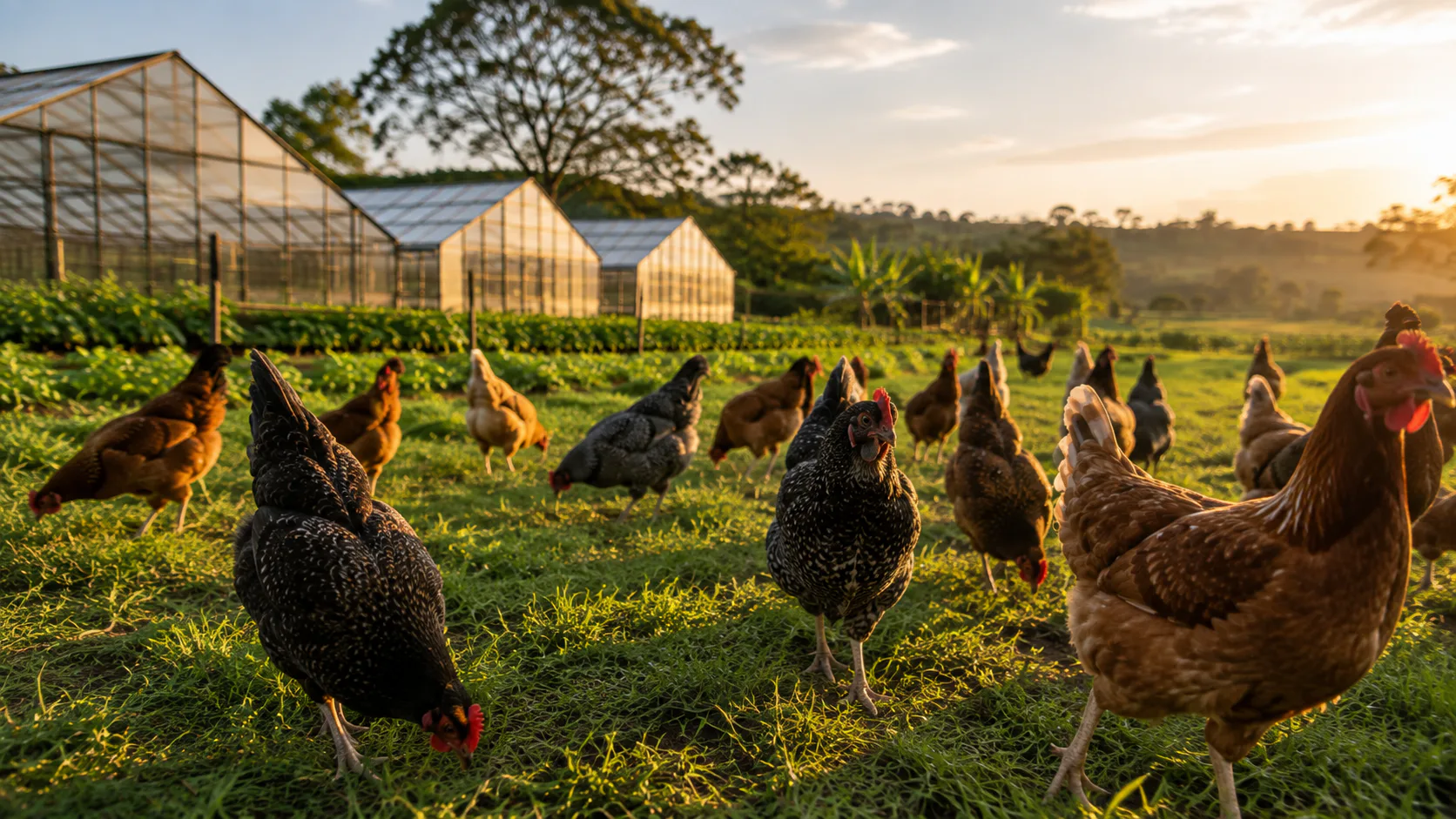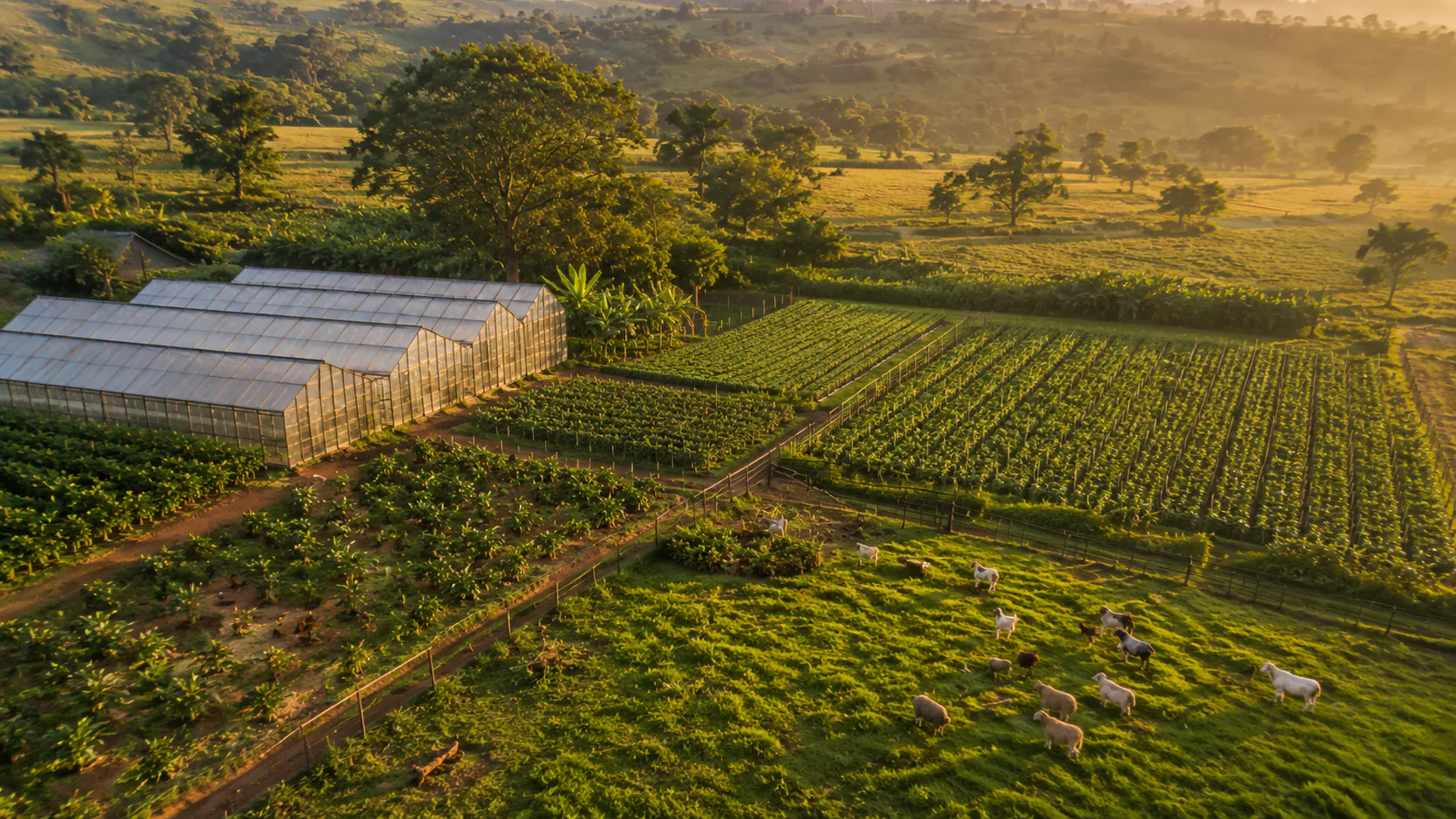
Connecting crops and livestock on the same farm - using manure to build soil fertility, using crop residues as feed or bedding, sharing labour and water infrastructure - can reduce reliance on external inputs, but only if the connection is deliberately designed. Without zoning, manure-maturity discipline, and basic records, the same connections that create benefit can also create contamination pathways, animal-health risks, and hidden operational costs. This guide sets out a whole-farm framework for planning, running, and evaluating integration.
Direct answer
Crops and livestock can be connected safely by treating the farm as a system of zones and flows rather than a collection of separate enterprises: separate clean zones (where food crops are handled and stored) from dirty zones (where livestock, manure, and waste are managed), route manure through a defined maturation process before it reaches food crops, plan crop residue and forage flows deliberately rather than allowing informal grazing wherever convenient, and keep basic records that let you evaluate whether the integration is actually delivering a benefit. The Food and Agriculture Organization's framework for integrated crop-livestock systems identifies the core rationale as closed nutrient and energy flows between crops and livestock, which can reduce dependence on external inputs, but the same FAO framework is explicit that this equilibrium is not automatic and requires deliberate management as farm intensity and demand increase.[1] This guide does not reproduce the detailed poultry biosecurity system (see Article 9) or the specific functional role of free-ranging chickens (see Article 2); it addresses the whole-farm design question that sits above both.
Who this guide is for
This is written for Ugandan farm managers and investors designing or evaluating a mixed crop-and-livestock enterprise, and for agricultural professionals advising on whole-farm system design.
The problem this guide solves
Mixed farming is frequently presented as inherently sustainable because nutrients "cycle" between crops and livestock. This framing skips the operational discipline that makes cycling safe and effective: manure applied before it has matured can carry pathogens onto food crops; livestock moved without a zoning plan can damage crops or contaminate produce; and labour or water shared informally between livestock and crop enterprises without planning can create bottlenecks that reduce, rather than improve, overall farm efficiency. This guide addresses that operational layer directly.
Step 1: Map your farm into zones
Before connecting crops and livestock operationally, map the farm into functional zones: a livestock zone (housing, holding, and ranging areas), a manure/composting zone (physically separated from food-crop and water-source areas), clean crop-production zones, and any shared-infrastructure areas (water points, equipment storage, pathways). Define which zones are "clean" (intended to stay free of direct livestock and raw-manure contact) and which are "dirty" (where livestock and raw manure are expected), and plan movement routes - for people, equipment, and animals - that do not require crossing from a dirty zone directly into a clean zone without an intervening control point.
Step 2: Plan the manure pathway deliberately
Raw manure carries a genuine contamination risk to food crops and should not be applied, or allowed to reach, food-crop areas without first passing through an adequate maturation or composting process. A widely used reference standard, developed for organic-certification composting in the United States, specifies that compost intended to reduce pathogen risk should reach and maintain a temperature of approximately 55-77°C (131-170°F) for at least 15 days, with the pile turned a minimum of five times during that period, followed by a longer curing period before the compost is considered mature.[2] This is a US organic-certification reference standard, not a Ugandan requirement, and is cited here to illustrate the general principle - that manure needs sustained heat over time, with turning, to reduce pathogen risk - rather than as a mandatory Ugandan specification; farms should adapt the underlying principle (sustained heat, turning, adequate duration, and a curing period) to locally practical composting methods and confirm any food-safety-relevant interval with a qualified adviser where produce will be sold. A simple field indicator that active composting has finished is the pile returning to near ambient temperature, though this indicates the end of active heating, not necessarily full maturity - a longer curing period is still needed afterward.[2]
Step 3: Plan crop residue and forage flows
Crop residues (maize stover, bean haulm, and similar) can be a valuable livestock feed or bedding resource, but informal, unplanned grazing of residues across the whole farm removes organic matter that might otherwise be returned to the soil and can create the same zone-crossing contamination risk described above if livestock then move from a harvested-residue area into a growing food-crop area without any control point. Decide deliberately, field by field and season by season, which residues will be grazed, which will be retained or incorporated for soil organic matter, and which will be collected for controlled use as feed or bedding elsewhere.
Step 4: Coordinate livestock movement with cropping calendar
Livestock movement (rotational grazing, controlled ranging, or residue grazing) should be planned against the farm's cropping calendar so that animals are not present on a plot during a period that conflicts with planting, an active food crop, or the pre-harvest interval needed after any manure deposit (see Step 2). This coordination is a planning exercise, not a one-time decision - it needs to be revisited each season as crop and livestock plans change.
Step 5: Plan water and labour sharing without creating bottlenecks
Shared water infrastructure between livestock and crop irrigation should be designed so that livestock access points do not contaminate water intended for irrigation or food-crop use, and so that livestock water demand does not create unplanned competition with irrigation timing (see Small-Scale Irrigation Planning in Uganda for irrigation-specific design). Shared labour between livestock and crop tasks should be planned against both calendars - a labour plan that assumes staff can always be reallocated instantly between livestock care and crop work during peak-demand periods in both is a common source of operational strain that only becomes visible once the system is running.
Step 6: Consider bees and other pollinators deliberately
Where bees or other managed pollinators are part of the farm system, their placement should account for pesticide use timing and location on nearby crops, and for livestock movement patterns that might disturb hives. This is a planning consideration specific to farms that include apiculture as part of their integration, and should be discussed with a beekeeping specialist where relevant, since pesticide-pollinator interactions are technical and situation-specific.
Step 7: Maintain biosecurity discipline across the whole system
Whatever livestock species are integrated, the zoning and movement-control principles in this guide should operate alongside, not instead of, species-specific biosecurity practice (see Poultry Biosecurity for Ugandan Farms for the poultry-specific barrier system). Integration increases the number of contact points between different parts of the farm, which is precisely why zoning discipline matters more, not less, on an integrated farm than on a single-enterprise operation.
Records to evaluate integration
- Manure sources, composting start/end dates, and turning records, with any temperature checks performed.
- Crop residue allocation by field and season (grazed, retained, or collected).
- Livestock movement/rotation schedule relative to the cropping calendar.
- Any observed contamination incidents, crop damage from livestock, or animal-health issues linked to a specific zone or practice.
- Input cost changes attributable to integration (for example, reduced purchased fertiliser or feed), tracked over multiple seasons rather than assumed from a single season's results.
Hidden costs of integration
Integration is not free of cost even when it reduces some external input purchases. Labour required for zoning discipline, manure turning and monitoring, and coordinated planning between crop and livestock calendars is a real cost that should be accounted for, not assumed to be absorbed automatically by existing staff. Infrastructure for zoning (fencing, dedicated composting areas, controlled water points) requires capital that should be planned rather than retrofitted after problems occur. Where these costs are not accounted for, integration can create more operational complexity than benefit, particularly at smaller scale where labour is already constrained.
A peer-reviewed survey of 40 smallholder farms using cattle manure in Wakiso and Kampala districts gives a Uganda-specific picture of exactly these hidden costs.[3] Every surveyed farmer applied cattle manure, but only 5% supplemented it with inorganic fertiliser, and the manure's own nutrient content was found to be low (0.42-0.56% total nitrogen), which the study attributed to poor livestock diet and inadequate manure storage - a direct illustration of why the maturation and handling discipline in Step 2 matters for nutrient value, not just pathogen safety.[3] On the constraint side, farmers cited the manure's weight and bulkiness (75% of respondents), lack of labour (67.5%), insufficient quantities available (55%), and high transport and application costs, particularly in the rainy season (37.5%), alongside limited storage infrastructure.[3] On the benefit side, farmers reported increased yields (52.5%), lower cost relative to inorganic fertiliser (37.5%), and reduced disease incidence (30%).[3] These figures are specific to the surveyed districts and should not be assumed to apply uniformly across Uganda, but they confirm that the "hidden costs" described in this section are not a theoretical caution - Ugandan farmers using manure integration report exactly these constraints in practice.
When to stop or scale back an integration
Integration that is not working shows recognisable signs: repeated contamination incidents or crop damage traced to livestock movement, manure management consistently falling behind (raw or under-matured manure being used out of time pressure), labour strain during peak periods in both calendars, or a multi-season review showing no measurable input-cost or yield benefit relative to the added labour and infrastructure cost. Any of these is a reasonable basis to scale back the specific connection causing the problem - for example, separating a previously shared water point, or reducing the scope of residue grazing - rather than treating integration as an all-or-nothing commitment.
Local Ugandan considerations
Farm size significantly affects how much genuine zoning separation is achievable - a small farm may have limited physical space to fully separate clean and dirty zones, requiring more reliance on movement-control discipline (routes, timing, control points) rather than physical distance alone. Water reliability and access vary by district and affect how feasible shared-but-controlled water infrastructure is. Labour availability, particularly during peak agricultural seasons, affects how realistic coordinated crop-livestock calendars are without additional hired labour. Larger commercial operations are more likely to have the capital for dedicated zoning infrastructure than smallholder or emerging-commercial farms, which may need to rely more on procedural controls (timing, routes, records) than physical separation.
Common mistakes
- Treating "mixed farming" as automatically sustainable without operational zoning.
- Applying manure to food-crop areas before it has adequately matured.
- Allowing informal, unplanned livestock movement across the whole farm rather than planned rotation.
- Sharing water points between livestock and irrigation without contamination controls.
- Assuming labour can be freely reallocated between livestock and crop tasks during peak-demand periods in both.
- Continuing an integration practice for multiple seasons without reviewing whether it is actually delivering a net benefit.
When professional support is required
- An agronomist should help design residue-allocation and rotation plans that balance soil organic matter retention against feed value.
- A veterinarian should be consulted on livestock health considerations specific to your integration plan, particularly where multiple species or contact points are involved.
- A food-safety professional should be consulted where produce grown on an integrated farm will be sold, to confirm appropriate manure-to-harvest intervals for your specific situation.
- An irrigation engineer (see Small-Scale Irrigation Planning in Uganda) should be involved where water infrastructure is shared between livestock and crop irrigation.
- A beekeeping specialist should be consulted where apiculture is part of the integration plan.
Limitations of this guide
This guide provides a whole-farm operational framework; it does not provide species-specific livestock health guidance, crop-specific agronomic detail, or a Uganda-specific compost-maturity standard, since none was located during this research pass - the composting reference cited is a US organic-certification standard presented to illustrate a general principle requiring local adaptation. FAO's integration framework is strategic and international; it establishes the rationale for integration but does not itself provide farm-level operational specifications, which this guide has developed as an editorial framework informed by that rationale together with general food-safety and composting evidence.
What to do next
- Draw a simple map of your farm identifying clean zones, dirty zones, and the movement routes between them.
- Review your current manure-handling process against the maturation principle in Step 2 and identify any gaps.
- Plan your next season's crop residue allocation deliberately (grazed, retained, or collected) rather than defaulting to unplanned grazing.
- Set up the basic records listed above if you do not already keep them, so you can evaluate integration after a full season or year rather than by impression alone.
- If you already see signs of a problem (contamination incidents, manure backlog, labour strain), identify and scale back the specific connection causing it rather than abandoning the whole approach.