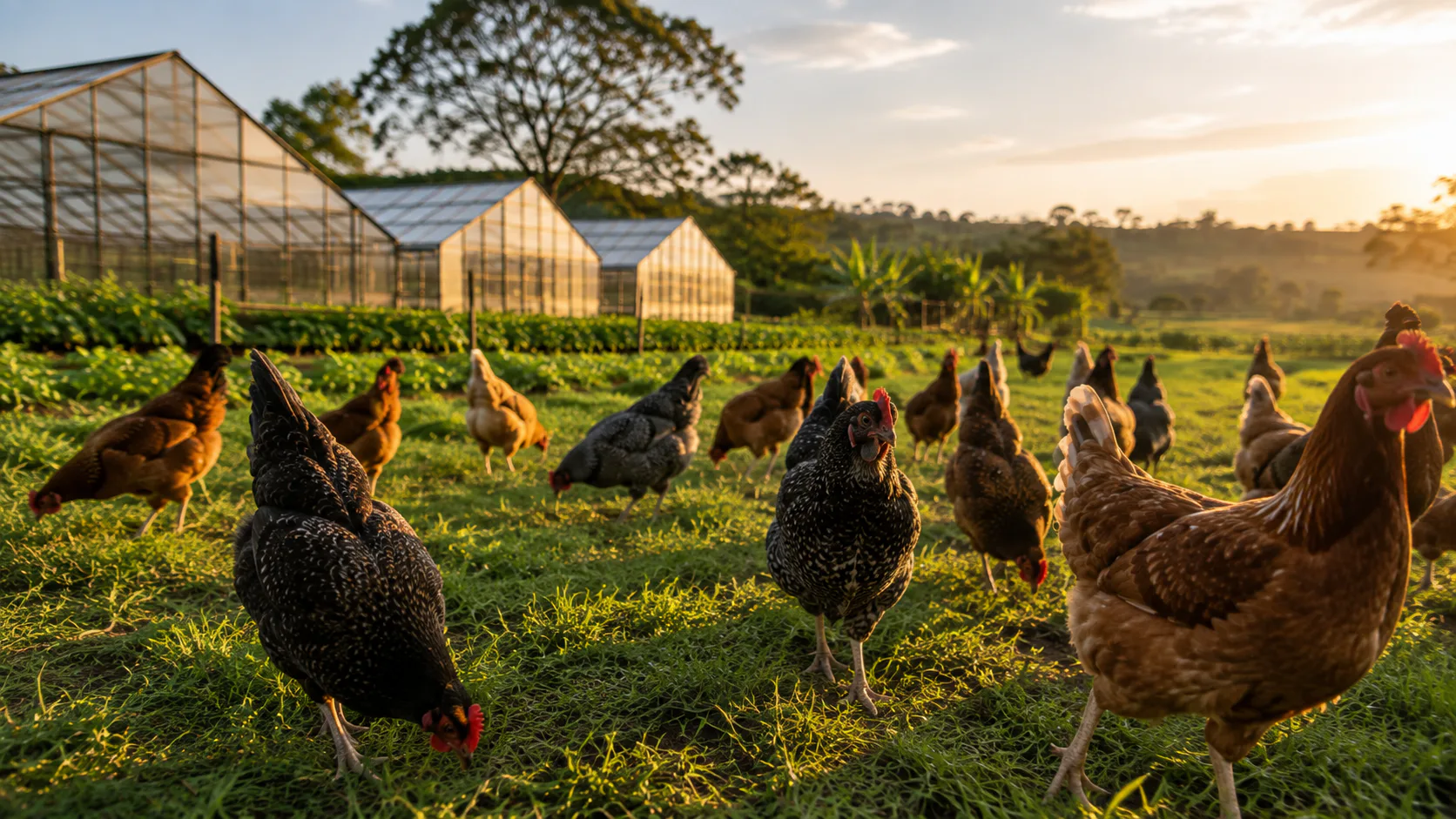
Chickens allowed to range in a controlled way - moved deliberately between paddocks or crop areas rather than left unrestricted across the whole farm - can contribute more to a mixed farm than eggs and meat: they redistribute nutrients, consume some insects and weed seeds, and disturb soil and crop residue in ways that can support the next planting cycle. None of this makes them a complete pest-control or fertility solution, and the same behaviours that provide benefits also create risks - to soil, to crops, and to food safety - if ranging is not managed deliberately. This guide explains the mechanisms, the evidence behind them, and where controlled ranging does not work well.
Direct answer
Controlled free-ranging chickens can contribute to a mixed farm through several documented mechanisms: distributing manure nutrients across a rotated area rather than concentrating them in one place, consuming some insect larvae and other pests they encounter while foraging, consuming some weed seeds, and disturbing soil and crop residue through scratching. Research on pastured poultry, mostly conducted outside Uganda, documents these benefits alongside real limitations - chickens cannot digest plant cellulose efficiently like ruminants, prolonged concentration in one area damages soil and vegetation, and manure on or near produce carries a food-safety risk that requires a waiting interval before harvest.[1][3] A peer-reviewed study of indigenous chicken flocks in Eastern Uganda confirms that scavenging is already the dominant management system in that context - just over half of surveyed households relied entirely on scavenging for feed - and documents the productivity constraints and disease risk that come with it.[4] This guide does not claim chickens function as a guaranteed or complete pest-control or fertility method, and it does not duplicate the disease-prevention barrier system covered in the poultry biosecurity guide - the focus here is what controlled ranging contributes functionally to a wider farm system, and what it does not.
Who this guide is for
This is written for Ugandan mixed-farm owners and managers considering, or currently practising, controlled free-ranging of chickens as part of a wider crop-and-livestock system, and for those evaluating whether the practice fits their specific farm.
The problem this guide solves
Chickens are frequently described in general farming advice as beneficial for "natural pest control" and "free fertiliser" without explaining the actual mechanisms, their limits, or the conditions under which the practice causes more harm than good. This leaves farmers unable to judge whether controlled ranging is likely to help their specific situation, or to manage it in a way that captures the benefit while avoiding the risks.
Natural chicken behaviour and why it matters
Chickens forage by scratching at soil and litter and pecking at what they find - insects, seeds, and plant material. This behaviour is the mechanical basis for most of the functional benefits attributed to free-ranging: scratching mixes surface organic matter and manure into the topsoil, and foraging brings chickens into contact with insects and larvae they will eat opportunistically. Chickens are not, however, able to efficiently digest plant cellulose the way ruminant livestock can, which limits their role in vegetation management to what they can peck and scratch rather than sustained grazing of tough forage.[1]
What scavenging looks like on Ugandan mixed farms
A peer-reviewed study of indigenous chicken flocks in Eastern Uganda gives a direct, Uganda-specific picture of how free-ranging already works in practice on smallholder farms.[4] Just over half of surveyed households (52%) relied entirely on scavenging for feed, with a further 49% combining scavenging with occasional grain supplementation; 73% of households scattered feed directly on the ground rather than using containers, and 87.5% provided drinking water.[4] The study found that scavengeable feed resources alone were nutritionally inadequate for optimum growth and egg production, which is consistent with this guide's framing of ranging as a contributing input rather than a complete feeding strategy.[4] The same study found Newcastle disease responsible for around 70% of chick mortality, concentrated predominantly in the dry season - a finding that reinforces why the disease-prevention barrier system in Poultry Biosecurity for Ugandan Farms should be treated as inseparable from any ranging system, not an optional add-on.[4] The study also documented the multipurpose role chickens play in these households beyond meat and eggs: as a source of income, as gifts, and as a form of traditional capital exchanged for larger livestock such as goats and, eventually, cattle.[4]
Nutrient cycling and manure distribution
One documented benefit of moving poultry across a farm, rather than confining them permanently in one place, is more even distribution of manure nutrients. Research summarised by the Sustainable Agriculture Research and Education (SARE) program describes pastured poultry acting, in effect, as mobile manure distributors, with scratching behaviour helping to mix manure and organic matter into the soil and contributing to increased soil organic matter and fertility over time; calcium-rich manure from laying hens has also been noted to gradually influence soil pH.[1] This evidence comes primarily from US pastured-poultry systems and has not been independently verified under Ugandan soil and climate conditions in this research pass; the underlying mechanism (nutrient redistribution through controlled movement) is a reasonable basis for local testing, not a guaranteed outcome.
Insects, larvae, and pest interaction
Chickens will opportunistically consume insects, larvae, and other invertebrates they encounter while foraging. Documented examples include hens picking through cattle manure to consume fly larvae, which both reduces some fly breeding material and helps break down and distribute the manure.[1] This is a genuine mechanism, but it is not equivalent to a guaranteed or comprehensive pest-control programme: chickens consume what they happen to encounter while foraging, not a targeted or complete removal of a specific pest population, and reliance on chickens alone for pest management is not supported by the evidence located for this article.
Weed seeds and crop residue
Foraging chickens will consume some weed seeds and disturb crop residue and stubble as they scratch, which can contribute to residue breakdown and reduce weed seed carryover on a plot between crop cycles. As with insect consumption, this is an opportunistic contribution rather than a targeted or complete weed-management method, and should be evaluated alongside, not instead of, other weed-management practices relevant to your cropping system.
Soil disturbance, rotation, and the overgrazing risk
Soil disturbance from scratching can be beneficial in moderation - mixing organic matter, aerating surface soil - but the same behaviour becomes damaging if chickens are concentrated in one area for too long or at too high a density. Pastured-poultry research is explicit on this point: birds left too long in one place, particularly on wet ground, kill vegetation and compact soil, and rotation with adequate rest periods between uses of the same plot is necessary to avoid this outcome.[1] This means the benefit of controlled ranging depends specifically on the word "controlled" - rotation planning, stocking density, and rest periods are not optional extras but the mechanism by which the practice avoids becoming counterproductive.
Produce contamination risk
Poultry manure, like other raw animal manure, can carry foodborne pathogens such as E. coli and Salmonella, which can transfer to fresh produce grown on or near soil where birds have ranged.[3] US Food and Drug Administration guidance under the Food Safety Modernization Act's Produce Safety Rule recommends, while research continues, following intervals adapted from the US National Organic Program standard: approximately 120 days between raw manure application (or, by extension, animal presence depositing manure) and harvest for crops that contact the soil, and approximately 90 days for crops that do not contact the soil.[3] These specific intervals were developed for US regulatory purposes and have not been established as Ugandan standards; they are cited here to illustrate that a meaningful waiting period between chicken ranging on a plot and harvesting a food crop from that plot is a recognised food-safety practice, not to assert that these exact day-counts are the correct or required interval in Uganda. Where produce will be sold, especially into any market with food-safety requirements, this should be discussed with a food-safety professional or the relevant Ugandan authority rather than assumed from a foreign figure.
Predator risk and wild-bird contact
Ranging chickens are exposed to predation risk that fully confined birds are not, and pastured-poultry research notes weather exposure and predation as recognised limitations of ranging systems.[1] Ranging also increases the opportunity for contact with wild birds, which is relevant to disease risk (see Poultry Biosecurity for Ugandan Farms for the full barrier-system treatment of this issue) - this article does not repeat that content but notes that controlled ranging changes, rather than removes, the biosecurity considerations a farm must manage.
When controlled ranging is unsuitable
Controlled ranging is not a good fit for every situation. It is generally less suitable when: the farm cannot provide adequate rotation area to avoid prolonged concentration on one plot; predator pressure is high and cannot be adequately managed; the farm grows produce for sale into markets with food-safety requirements and cannot manage or verify an adequate interval between ranging and harvest; or disease risk in the surrounding area (proximity to live bird markets, wild bird habitat, or other poultry operations) is high enough that the exposure from ranging outweighs the functional benefit. In these situations, more confined or semi-confined systems may better balance function against risk - this is a farm-specific judgement, not a rule that applies uniformly.
How this fits into a wider farm system
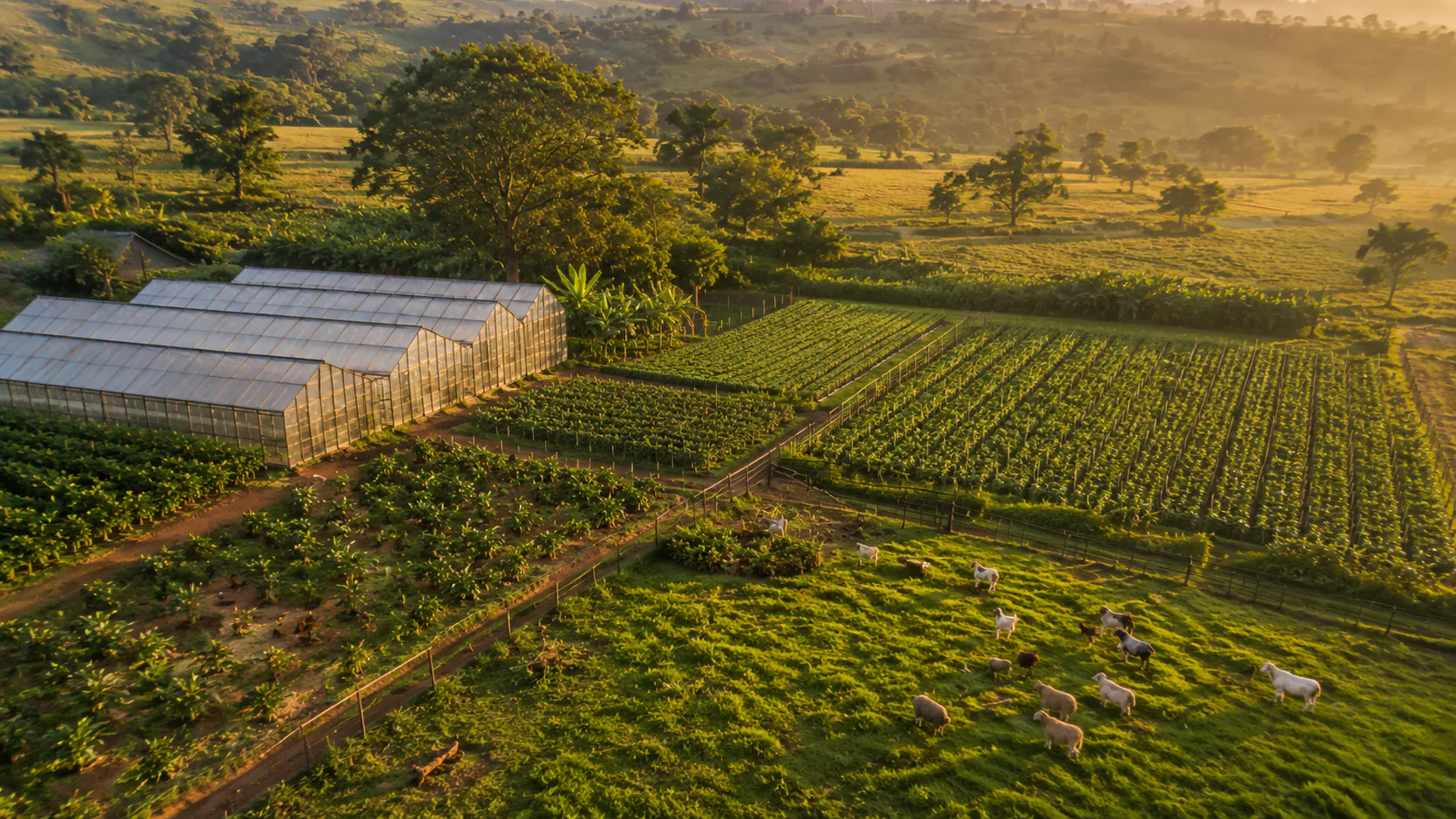
Free-ranging chickens are one component of an integrated crop-and-livestock system, not a standalone practice. Rotation planning should align with the farm's overall crop rotation and residue-management plan (see Integrated Crop and Livestock Farming for the whole-farm zoning and material-flow view), and disease-prevention measures should follow the barrier system set out in Poultry Biosecurity for Ugandan Farms regardless of whether birds are ranged or confined.
Records to keep
- Rotation schedule: which plot chickens ranged on, dates, and duration.
- Stocking density used per rotation area.
- Rest period observed before the next use of a given plot.
- Interval observed between chicken presence and harvest of any food crop from that plot.
- Any observed soil or vegetation damage, and predator incidents.
Local Ugandan considerations
Farm size and layout affect how much genuine rotation area is available - a very small plot may not allow the rest periods needed to avoid overgrazing damage, in which case a more confined system may be more appropriate. Predator pressure, wild-bird contact (including proximity to wetlands), and local disease prevalence vary by district and should inform how much ranging area and what level of supervision is practical. Labour availability affects how consistently rotation can be managed, since the benefit of controlled ranging depends on active management rather than simply releasing birds to range unsupervised.
Common mistakes
- Treating unrestricted, unmanaged ranging as equivalent to "controlled" ranging.
- Relying on chickens as a sole pest-control or fertility method rather than one contributing input.
- Leaving birds on the same plot too long, causing soil compaction and vegetation loss.
- Harvesting food crops from a recently ranged plot without any waiting interval.
- Ignoring predator risk when planning ranging areas.
- Treating ranging as separate from, rather than integrated with, the farm's biosecurity practice.
When professional support is required
- An agronomist can help design a rotation plan that aligns chicken ranging with your crop rotation and residue-management plan.
- A food-safety professional or the relevant Ugandan food-safety authority should be consulted on an appropriate interval between chicken ranging and harvest for produce intended for sale, particularly into regulated markets.
- A veterinarian should be consulted on disease-risk management specific to ranging systems (see also Poultry Biosecurity for Ugandan Farms).
Limitations of this guide
The evidence cited in this article comes primarily from research and extension material developed outside Uganda, mainly in the United States; no Uganda-specific research on the functional role of free-ranging chickens in mixed farms was located during this research pass. The mechanisms described (nutrient distribution, pest and weed seed consumption, soil disturbance) are documented in that international literature but have not been independently confirmed under Ugandan soil, climate, and farm-system conditions. Specific figures such as the FDA's manure-to-harvest interval are cited to illustrate a food-safety principle, not as a Ugandan standard, and should not be treated as regulatory guidance for Uganda.
What to do next
- If you are already free-ranging chickens without a rotation plan, define rotation areas and rest periods before continuing, to avoid soil and vegetation damage.
- If you grow produce for sale on or near ranging areas, establish and record a waiting interval before harvest, and confirm appropriate practice with a food-safety professional.
- Align your ranging rotation with your overall crop rotation plan (see Integrated Crop and Livestock Farming).
- Apply the disease-prevention barrier system in Poultry Biosecurity for Ugandan Farms regardless of your ranging system.
- Keep basic rotation and interval records so you can evaluate whether the practice is delivering the expected benefit on your specific farm.