Poultry disease outbreaks usually enter a farm through one of a small number of predictable routes - newly acquired birds, contaminated equipment or vehicles, people, wild birds, rodents, or contaminated feed and water - and once inside, spread through many of the same routes between birds and houses. A biosecurity system is a set of barriers placed at each of these routes. This guide sets out a practical barrier system scaled for small and medium Ugandan poultry farms, and is explicit about what biosecurity can and cannot achieve.
Direct answer
A practical poultry biosecurity system for a small or medium Ugandan farm combines controlled bird sourcing and isolation of new arrivals, a defined clean/dirty zone separation at the farm entrance, controls on worker and visitor movement and clothing, cleaning and disinfection of equipment and vehicles before they enter production areas, protection of feed and water from wild birds and rodents, prompt and safe removal of dead birds, and awareness of the reporting obligation for suspected notifiable disease. These measures follow the general structure of the World Organisation for Animal Health's international biosecurity standard for poultry production, adapted here to smaller-farm scale.[1] Biosecurity reduces the probability of disease entry and spread; it does not eliminate the risk, since some pathogens persist in the environment for extended periods and some transmission routes (airborne spread, wild bird movement) are difficult to fully control even with strict measures in place.[2] This guide does not replace veterinary diagnosis or current MAAIF disease-reporting guidance, both of which should be sought directly when disease is suspected.
Who this guide is for
This is written for small and medium Ugandan poultry farm owners and managers seeking a practical, implementable biosecurity system, and for agricultural professionals advising them.
The problem this guide solves
Generic biosecurity advice ("keep your farm clean," "wash your hands") does not give a farmer a structured way to identify which specific routes disease can use to enter or spread on their farm, or which control measure addresses which route. Large-commercial-operation biosecurity checklists, meanwhile, often assume infrastructure (dedicated shower facilities, multiple isolated houses, full-time biosecurity staff) that is not realistic for a small or medium farm. This guide organises the same underlying principles into a barrier system that can be implemented at smaller scale, and is honest that the goal is risk reduction, not elimination.
The barrier system
1. Control bird sourcing. New stock should come from sources with good health status, ideally breeder flocks and hatcheries free from known vertically transmitted infections; day-old birds should arrive in new or properly disinfected containers.[1] MAAIF's own poultry training material for extension workers similarly instructs farmers to obtain chicks from reliable, disease-monitored sources and to run an "all-in, all-out" system where a house is filled and emptied as a single batch rather than continuously mixing ages.[3] MAAIF's infection-prevention guidelines add that parent flocks should be health-checked before purchase and that day-old chicks should already be vaccinated against Marek's disease, Newcastle disease, and infectious bronchitis before they arrive on the farm.[4] Buying birds from open markets or mixed sources carries higher risk than buying from a known, health-monitored supplier, because market birds may have had contact with birds from many different farms.
2. Isolate new arrivals. Birds newly brought onto the farm - whether purchased stock, birds returning from a market or show, or birds from an uncertain source - should be kept physically separate from the existing flock before mixing, to reduce the chance that an incubating infection spreads to the rest of the flock before symptoms appear. MAAIF's infection-prevention guidelines specify that new birds should be quarantined separately for one month and should be fed and attended to last during this observation period, after the existing healthy flock.[4] This one-month figure is a specific, sourced Ugandan reference point rather than a general estimate, though the appropriate period for a specific disease concern should still be confirmed with a veterinarian.
3. Establish clean and dirty zones. Define a boundary separating a "clean" zone (where birds are kept) from a "dirty" zone (outside, where vehicles, visitors, and unscreened equipment first arrive). MAAIF's infection-prevention guidelines recommend a single, controlled entry point to the farm with a visitor log, footbaths containing disinfectant at all house entrances, and screening to exclude wild and domestic animals from production areas.[4] MAAIF's extension manual adds that farms should install disinfection barriers at gate and house entrances and provide shower or changing facilities where feasible.[3] Workers and visitors should ideally change into clean clothing and footwear provided at the farm, or at minimum avoid entering production areas in clothing or footwear used elsewhere, particularly if they have had recent contact with other poultry or poultry waste.[1]
4. Control worker and visitor movement. Limit visitors to those with a genuine need to be on the farm, and ask about recent contact with other poultry operations before allowing entry to production areas. MAAIF's infection-prevention guidelines call for hand and foot washing with soap before entry, farm-specific clothing and footwear that does not leave the site, and footbaths at the boundary between different compartments of the farm, not only at the outer perimeter.[4] Where multiple poultry sites or compartments are managed by the same workers, establish a sensible order of movement (youngest/healthiest stock visited first, any sick or newly arrived birds visited last) to avoid carrying contamination from a higher-risk group to a lower-risk one.
5. Clean and disinfect equipment and vehicles. Equipment, crates, and vehicles entering production areas should be cleaned and disinfected before entry; cleaning (removal of organic material) should happen before disinfection, since organic matter can shield pathogens from disinfectant chemicals and reduce their effectiveness.[4] Containers used to transport birds should be cleaned and disinfected between uses.[1] MAAIF's guidelines further specify that vehicles should be cleaned and disinfected and parked at least 30 metres from poultry houses, and that equipment should never be shared between farms.[4]
6. Protect feed and water. Store feed in a way that prevents access by wild birds and rodents, and clean up spilled feed promptly, since spilled feed attracts pests that can carry disease. Water systems and drinkers should be cleaned and disinfected regularly; MAAIF's extension manual specifically recommends daily sanitisation of drinkers and, where eggs are handled, treatment with hydrogen peroxide, quaternary ammonium compounds, or chlorine-based disinfectants.[3]
7. Control rodents, wild birds, and insects. Implement measures to prevent wild birds and other domestic animals from entering poultry housing, and control rodents and insects, both of which can act as disease vectors; MAAIF's extension manual specifically recommends acaricide and insecticide spraying as part of routine biosecurity.[3] Some pathogens have been documented to survive for extended periods in dust, manure, or on surfaces, and insects and rodents can carry contamination between houses or between flocks even after a house has been emptied and appears clean.[2] MAAIF's infection-prevention guidelines also recommend that farms be sited at least 3 kilometres apart from other poultry operations where possible, reducing the baseline risk of airborne or vector-carried spread between neighbouring farms.[4]
8. Handle mortality promptly and safely. Remove dead birds from housing as quickly as possible, at minimum daily, and dispose of carcasses safely - leaving dead birds in place increases exposure risk to the rest of the flock and to workers.[1] MAAIF's guidance specifies that dead birds should be incinerated, deeply buried, or composted, and should never be abandoned in the open or in waterways.[3][4] Unusual or sudden mortality, especially affecting multiple birds over a short period, should prompt immediate veterinary consultation rather than being treated as routine.
9. Manage manure and litter. Manure and used litter can harbour pathogens and should be managed and stored away from production housing and water sources; if manure is used elsewhere on an integrated farm (see Integrated Crop and Livestock Farming), it should go through an appropriate composting or treatment process before use near food crops or livestock feed.
10. Keep vaccination and health records. Maintain records of vaccination dates and products used, mortality (including unexplained deaths), and any veterinary visits or treatments. These records support disease investigation if a problem occurs and demonstrate due diligence in disease-prevention practice.
11. Know your reporting obligation. Uganda's Animal Diseases Act (Cap 38) creates a direct legal duty: any person who possesses, or is in charge of, an animal that is diseased or suspected of being diseased must notify the nearest administrative officer, veterinary officer, or inspecting officer "as soon as possible."[5] Breach of this duty falls under the Act's general penalty provision, which allows for imprisonment of up to twelve months, a fine, or both.[5] The Act does not specify an exact hour-based reporting window or name a single reporting hotline, and no other primary Ugandan document reviewed for this guide - including MAAIF's own poultry manuals and Uganda's disease-surveillance guidelines - supplied one either. Sudden or unusual mortality, or symptoms consistent with a notifiable disease such as Newcastle disease or avian influenza, should therefore be reported promptly to a veterinarian or the nearest administrative or veterinary officer, and the current specific reporting channel for your district should be confirmed directly with MAAIF or your local veterinary officer.
Records to keep
- Source and date of arrival for all new birds, with isolation start/end dates.
- Vaccination dates and products.
- Daily or regular mortality counts, with notes on any unusual pattern.
- Visitor log (name, date, purpose, and any recent poultry contact disclosed).
- Cleaning and disinfection dates for housing, equipment, and vehicles.
- Any veterinary consultations, diagnoses, or treatments.
Local Ugandan considerations
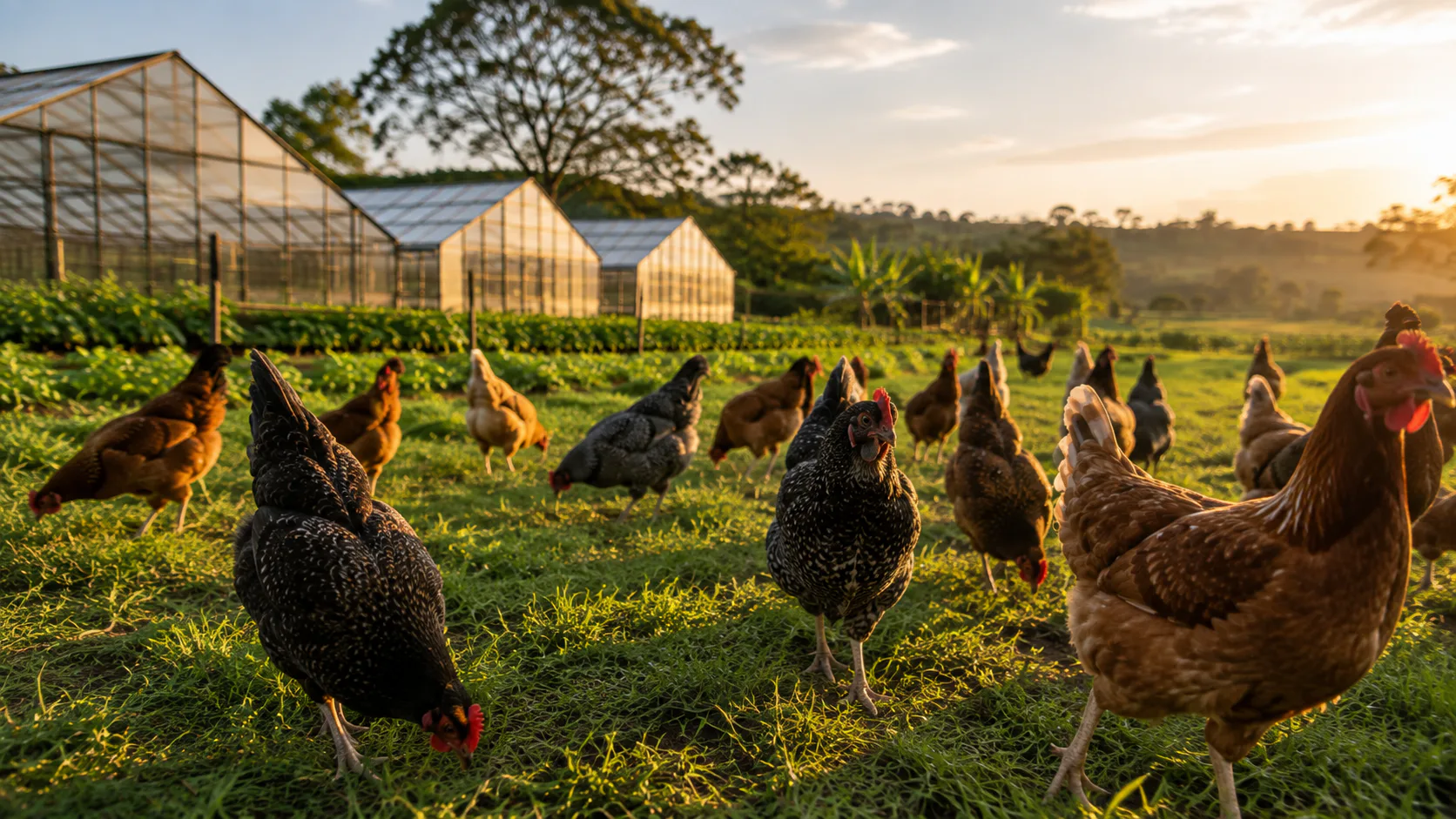
Farm scale and system (confined commercial housing versus semi-intensive or free-range systems common on many Ugandan smallholdings) affect which biosecurity measures are practical and how much control is achievable - a fully confined commercial house allows tighter control over wild bird and rodent access than an open free-range system, which instead requires different risk-management priorities around ranging area, predator and wild-bird contact points, and water sources (see Why Free-Range Chickens Matter in an Integrated Farm for the functional trade-offs of controlled ranging). Veterinary service availability varies by district, affecting how quickly professional support can be reached when disease is suspected. Farms near live bird markets, major poultry-trading routes, or wild bird habitats (including wetlands) may carry different baseline risk levels than more isolated farms, and should weigh isolation and visitor-control measures accordingly.
Common mistakes
- Buying replacement or additional stock from mixed-source markets without any isolation period.
- Allowing visitors or workers to move directly from another poultry site into production housing without any barrier.
- Disinfecting equipment without cleaning organic material off first, reducing disinfectant effectiveness.
- Leaving dead birds in housing rather than removing them promptly.
- Treating biosecurity as a one-time setup rather than an ongoing daily practice.
- Assuming biosecurity measures guarantee disease-free status and delaying veterinary consultation when unusual mortality occurs.
When professional support is required
- A veterinarian should be consulted for any unusual or sudden mortality, suspected notifiable disease, vaccination programme design, or isolation-period guidance specific to the diseases relevant in your area.
- MAAIF or the local veterinary/animal health authority should be contacted to confirm current disease-reporting procedures and to report any suspected notifiable disease.
- An agricultural/veterinary extension officer can help adapt this barrier system to your specific farm layout and production system.
Limitations of this guide
This guide combines the international (WOAH) biosecurity structure with specific measures published by MAAIF for Ugandan poultry farms and the general legal reporting duty set out in Uganda's Animal Diseases Act; it does not replace a site-specific biosecurity plan developed with a veterinarian. It does not establish a specific current reporting hotline or an exact hour-based reporting timeframe for suspected notifiable disease, because no primary Ugandan document reviewed - including MAAIF's own manuals and Uganda's disease-surveillance guidelines - specifies one; readers are directed to confirm the current administrative channel with MAAIF rather than being given an invented figure. Biosecurity measures described here reduce disease risk; they do not guarantee disease-free status, and this guide should not be read as implying otherwise.
What to do next
- Map your farm's clean/dirty zone boundary and install a footbath or disinfection point at the entrance if one does not already exist.
- Establish an isolation area and protocol for newly acquired birds before they join the main flock.
- Confirm your current disease-reporting obligation and contact channel with MAAIF or a local veterinary officer.
- Set up basic records (visitor log, mortality log, vaccination log) if you do not already keep them.
- Identify a veterinarian you can reach quickly if unusual mortality or disease symptoms occur, before you need one urgently.