
Somebody at a farmer meeting says urea makes maize stover into good feed. The next week a bag of fertiliser urea is emptied over a heap of dry stover in a yard, water is thrown on it, and it is fed out the following morning.
Two things can happen. Usually nothing happens, because without sealing there is no ammoniation and the stover is exactly as poor as it was. Occasionally something much worse happens, because urea that has not been converted is still urea, and a ruminant that eats a lot of it can be dead within two hours.
This is a technique that works. It is also the one procedure in the whole feed cluster where getting the detail wrong kills animals. Read the whole thing before you start.
The rule that has no exceptions
Urea-treated residue is for adult ruminants only. Cattle, goats and sheep with a working rumen.
Never poultry. Never any animal without a functioning rumen. Never very young calves.
The reason is physiological rather than a matter of caution. The rumen converts urea to ammonia, which rumen microbes then use to build protein. Veterinary reference material states that rumen urease is normally present after the animal is fifty days old. An animal without that conversion capacity does not get the benefit, and the material is not a feed for it.
Nothing later in this article softens that rule.
What this guide helps you decide
By the end you should be able to decide whether the technique is worth doing on your farm at all; carry out the mixing, sealing and curing correctly with figures you can check against the source; recognise urea poisoning early; and know exactly when to stop and call a veterinarian.
It does not cover urea molasses block manufacture, general residue handling without treatment, or how much treated material to include in a ration. That last exclusion is deliberate and explained below.
The short answer
Weigh your dry residue. For every 100 kilogrammes of dry residue, dissolve 5 kilogrammes of urea completely in 40 to 60 kilogrammes of water. Spread the residue in layers, wet each layer evenly, compact it, and seal it under polythene so it is airtight.
Leave it sealed. In Ugandan lowland conditions, where ambient temperature usually sits in the 15 to 30 degree band, FAO’s guidance is one to four weeks. Above 30 degrees, less than a week.
Then open it and air it before any animal eats it. Feed only to adult ruminants, and introduce it gradually.
What the treatment actually achieves
The ammonia released from the urea does two things: it adds nitrogen the microbes can use, and it partly breaks the bonds in the cell wall that make straw so indigestible.
FAO’s technical paper on ammoniation of crop residues, drawing on Chinese experience, gives measured changes:
- Wheat straw: crude protein up 5.44 per cent, digestibility up 10.3 per cent
- Rice straw: crude protein up 3.98 per cent, digestibility up 24.0 per cent
- Maize stover: crude protein up 5.02 per cent, digestibility up 20.0 per cent
A separate review of ammoniation for dry-season ruminant feeding reports crude protein typically increasing from around 5 to 6 per cent to 9 to 12 per cent. A Nigerian review reports untreated straw at 3.8 per cent crude protein rising to 6.8 per cent with 6 per cent urea.
Those are real improvements on a material that was close to worthless. They are also improvements to a poor feed, not the creation of a good one. Treated stover is still bulk. It is not a concentrate.
The mixing ratio, and why the sources disagree about water
Here is the honest position. The urea figure is settled across the literature. The water figure is not, and no article should pretend otherwise.
Urea. Sources cluster tightly at 4 to 5 kilogrammes per 100 kilogrammes of dry residue:
- FAO’s Chinese-experience paper: 5 kilogrammes urea per 100 kilogrammes of dried straw, described as 4 to 5 per cent on a dry matter basis
- FAO’s roughage utilisation paper for warm climates: 5 kilogrammes per 100 kilogrammes, with an acceptable range of 4 to 6
- FAO’s practical manual: 4 to 5 per cent urea
- A Nigerian review: optimum rates between 4 and 6 kilogrammes per 100 kilogrammes
Water. This is where the spread is genuine and large:
- FAO’s Chinese-experience paper: 40 to 60 kilogrammes per 100 kilogrammes of straw
- FAO’s warm-climates paper: 50 litres per 100 kilogrammes, acceptable range 40 to 80, targeting a moisture content of 30 to 50 per cent
- FAO’s practical manual: an equal weight of water, meaning roughly 100 kilogrammes
- FAO’s earlier state-of-knowledge paper, describing Indian subcontinent practice: a 4 per cent solution at one litre per kilogramme, which is 100 litres per 100 kilogrammes
- A published Syrian study: a 10 per cent solution at 400 litres per 100 kilogrammes, far above everything else
We are not going to average these. What they have in common is the target, which FAO’s warm-climates paper states directly: a moisture content of 30 to 50 per cent in the finished material.
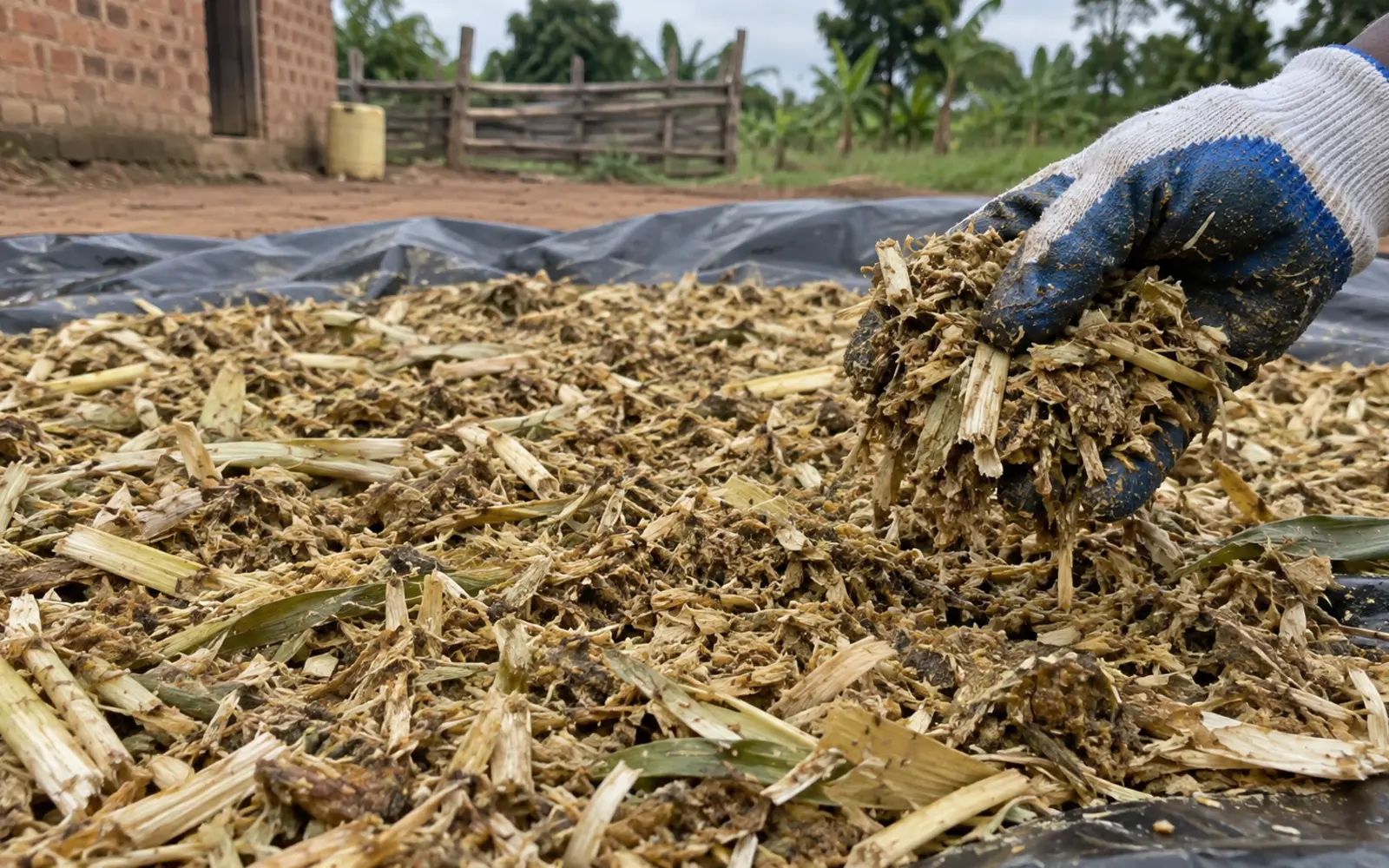
The practical rule we recommend. Use the FAO Chinese-experience figures, because they are the most explicit and sit in the middle of the range: 5 kilogrammes of urea and 40 to 60 kilogrammes of water per 100 kilogrammes of dry residue. Then check the result by hand. Squeeze a handful. It should feel evenly damp all through, hold together when squeezed, and release no free water. If water runs out, you have used too much. If the middle of the handful is dry, you have used too little.
Weigh the residue. Do not estimate a heap. This is the step people skip, and it is the step that makes every other figure meaningless.
The procedure
Step one: chop. Not strictly required, but chopped material packs down better, seals better and is treated more evenly.
Step two: weigh the residue. A spring balance and a sack. Work in 100 kilogramme units so the arithmetic stays simple.
Step three: dissolve the urea completely. In the measured water, in a drum, stirred until no granules remain. Undissolved urea is the hazard. A granule that never dissolved is a granule that never converted, and it is still urea when the animal eats it.
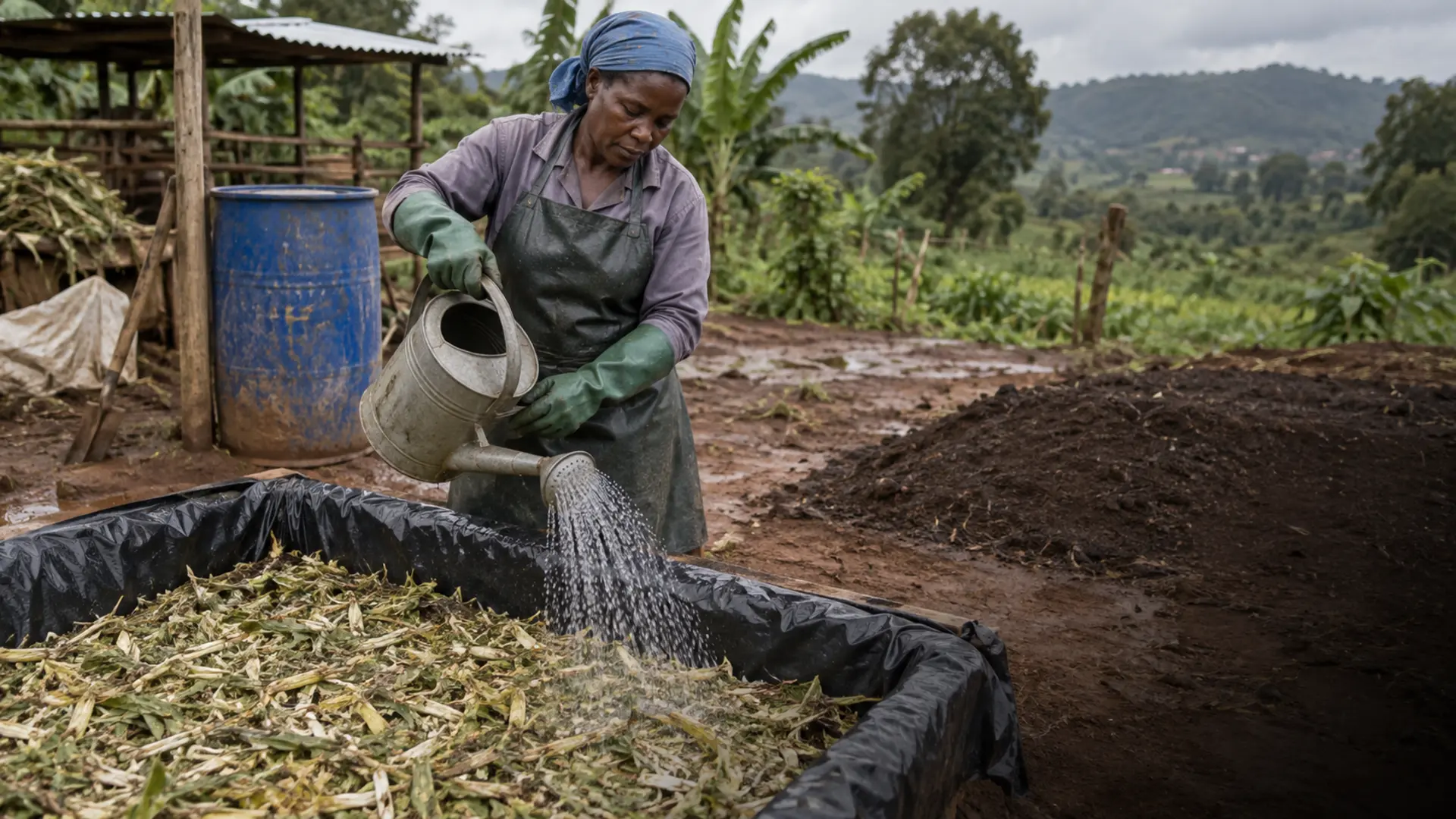
Step four: build in layers. Spread perhaps 15 to 20 centimetres of residue, wet it evenly with a watering can with a rose fitting, tread it down, then add the next layer. Repeat. Even wetting matters more than speed.
Step five: seal. The whole point of the technique is holding the ammonia in. A pit lined with polythene, a stack fully wrapped, or a heavy plastic bag or drum. Published practice describes concrete or earthen pits lined with plastic, and one field report from Niger describes sealing with braided grass and no plastic at all.
Sources differ in emphasis here too. FAO’s state-of-knowledge paper says an airtight cover is preferable to prevent loss of gaseous ammonia but is not essential. FAO’s warm-climates paper says hermetic sealing matters less for urea than for anhydrous ammonia treatment. Other published guidance is firmer, describing a plastic-lined pit as invariably producing a good result. Our reading of the difference: a poor seal does not create a hazard, it wastes the ammonia and gives you a weaker result. Seal it properly anyway.
Step six: mark the date. Write it on a card and tie it to a stake. You will not remember.
Curing: how long, and why temperature decides it
The urea has to be converted by enzymes to ammonia, and that conversion is temperature-driven. FAO’s warm-climates paper states the underlying rule plainly: the rate of urea breakdown doubles for a temperature rise of ten degrees Celsius.
FAO’s Chinese-experience paper gives the clearest table:
| Ambient temperature | Treatment duration |
|---|---|
| Below 5 degrees Celsius | More than 8 weeks |
| 5 to 15 degrees Celsius | 4 to 8 weeks |
| 15 to 30 degrees Celsius | 1 to 4 weeks |
| Above 30 degrees Celsius | Less than 1 week |
Most of Uganda sits in the 15 to 30 degree band most of the year, which puts you in the one to four week row. Highland sites in the cooler months sit lower and need longer.
Other sources give different framings for the same thing. FAO’s practical manual says 10 to 30 days, hotter meaning shorter. Published work reports 14 to 28 days depending on ambient temperature, roughly 14 days in a tropical environment and up to 42 in cooler regions, and notes that around 70 per cent of the urea was decomposed after two days with all of it gone after twenty at room temperature. Work in Bangladesh and Sri Lanka found seven to ten days sufficient with no additional benefit from longer treatment.
The honest summary: at Ugandan lowland temperatures, two to four weeks is comfortably inside every published recommendation, and longer does no harm except that FAO’s practical manual warns against leaving treatment periods so long that mould develops. If in doubt, err longer rather than shorter, and inspect before feeding.
Urea Treatment of Crop Residues: A Real Improvement With a Real Danger
Six-step urea treatment procedure showing weighing, dissolving, layering, sealing, curing by temperature band, and airing before feeding
The airing step
This is the step that gets skipped and the step that matters most for the animal accepting the feed.
FAO’s Chinese-experience paper is direct: after opening a stack of ammonia-treated straw, it should be aerated for a time before feeding. FAO’s practical manual is emphatic about how not to do it, stating the material must not be sun-dried because this loses gaseous ammonia, and describing pumping air through the straw to drive the ammonia into a water trap for recycling. A 2026 review notes that poorly aerated material retains strong ammonia odours which can temporarily depress intake if not adequately ventilated before feeding.
Now the honest gap. Not one of the sources we opened states how long to air it. Every one of them says to do it and none of them says for how long. We are not going to invent twenty-four hours or any other number to fill that hole.
What we can give you is a judgement you can make yourself. Open the stack, fork the material out into a loose spread heap in the open, stand upwind, and leave it until the sharp ammonia smell has gone from the material when you put your face near a handful. If it still stings your eyes and nose, it is not ready. That is a sensory test, not a sourced protocol, and we label it as such.
Two practical points while you do this. Open the stack in the open air, not inside a store or a shed, because concentrated ammonia coming off an opened stack is unpleasant and, in a closed space, genuinely harmful. And keep your face out of the opening while you break the seal.
Urea poisoning: the signs, and what to do
Read this section before you make your first batch, not after.
How fast. Veterinary reference material gives the period from urea ingestion to onset of signs in cattle as generally 20 to 60 minutes. Death typically occurs within two hours of ingestion in cattle and four hours in sheep. One published veterinary case series recorded first signs 10 to 15 minutes after an animal started eating a toxic amount.
The signs, in the order they appear. Early signs include muscle tremors, especially of the face and ears, abdominal pain, frothy salivation, frequent urination and teeth grinding. The tremors progress to incoordination and weakness, followed by fluid on the lungs causing marked salivation and respiratory distress. A published veterinary case series describes the same progression as: refusing feed, head shaking, intermittent belching, kicking at the flank, uneasiness and frequent urination, then impaired vision and knuckling at the rear fetlocks, then convulsions and bloat, then collapse. Government extension guidance in Australia lists twitching of ears and facial muscles, teeth grinding, frothy salivation, bloat, abdominal pain, frequent urination, rapid and laboured breathing, weakness, staggering, violent struggling and bellowing, and terminal spasms.
Dose. Veterinary reference material states that for ruminants, dosages of 0.3 to 0.5 grammes of urea per kilogramme of body weight can cause adverse effects, and 1 to 1.5 grammes per kilogramme are usually lethal. One published veterinary case report records a fatal outcome in a steer at 0.21 grammes per kilogramme, below the commonly quoted toxic threshold. Treat those figures as a general range with real individual variation, not as a safe margin to work to.
What to do. Call a qualified veterinarian immediately. This article gives no treatment and names no medicine. Move other animals away from the feed. Keep the affected animal quiet and do not force it to move. Take a sample of what it was eating so the veterinarian can see it.
Introducing it gradually is not optional. FAO’s guidance on non-protein nitrogen in ruminant nutrition states that animals not previously fed urea, and especially underfed animals receiving only poor quality hay or pasture, may be unusually sensitive to urea toxicity and must gradually be adapted. It also states that animals should never be permitted access to urea not mixed with other feeds. Both of those describe exactly the situation on a Ugandan smallholding at the end of a dry season.
Urea Treatment of Crop Residues: A Real Improvement With a Real Danger
Safety panel listing urea poisoning signs in order of appearance with the time to onset, beside the species and age rule and the veterinary escalation instruction
Why we give no inclusion rate
You will find inclusion percentages elsewhere. We are not giving one, for a reason.
An inclusion rate is only safe if the treatment was done correctly, the curing was complete, the material was aired, the animal is an adapted adult ruminant, and the rest of the ration is known. Change any one of those and the number is wrong. A percentage printed in an article cannot check any of them.
What we will say: introduce it gradually over a week or more, feed it alongside other feeds and never alone, make sure water is always available, and if you want a specific inclusion level for your animals and your ration, that is a conversation with your veterinarian or district production officer, not a number from a webpage.
Handling safety for you
FAO’s own guidance on this family of techniques lists poisoning of animals with urea among the accidents that may occur. We found no source giving specific guidance on urea solution contact with skin and eyes, or on doing this work near a dwelling, which is a real gap in the literature.
The precautions below are ordinary chemical handling practice rather than sourced findings, and we give them because the hazard is obvious:
- Wear gloves and long sleeves when mixing and applying the solution
- Keep the solution away from your eyes, and have clean water to hand
- Mix and build in the open air
- Open a cured stack in the open air, never inside a store or shed
- Keep the urea bag locked away from children and away from all livestock
- Never leave loose urea where an animal can reach it
That last point is worth its own line. Almost every documented case of urea poisoning involves an animal getting at concentrated urea, not treated feed.
Cost categories
No prices. Urea is widely sold in Uganda as a fertiliser, which is exactly what makes this technique accessible and the misuse risk high. We could not verify a current Ugandan urea price from an institutional source and will not quote one.
Budget across:
- Urea, priced per bag locally, and the arithmetic of how many 100 kilogramme batches a bag treats
- Polythene sheeting, which can be reused several times if handled carefully
- Water, and the labour of carrying it
- Labour for chopping, layering, wetting and sealing, which is the largest input
- A spring balance, once
- Storage space that stays sealed for weeks
- Gloves
Then set that against what the material was worth untreated, which for most cereal straw is close to nothing.
Common mistakes
Not sealing. No seal, no ammoniation. You have made wet stover and wasted a bag of urea.
Not dissolving the urea fully. Undissolved granules are the direct poisoning route.
Estimating the residue weight. Every ratio in this article assumes you weighed it.
Feeding straight from the opened stack. The airing step exists.
Feeding it to the wrong animals. Poultry and any animal without a working rumen. This is the error with the worst consequence.
Feeding it to a hungry animal that has never had it. Adaptation is a documented requirement, and a hungry unadapted animal eats fast.
Leaving the urea bag accessible. More animals are poisoned by loose fertiliser than by treated feed.
Treating for too long in warm conditions. FAO warns about mould developing where treatment periods run too long.
Warning signs and escalation points
Do not feed, and investigate, if any of these appear when you open the stack:
- Visible mould, or a musty smell distinct from the ammonia smell
- Material that is soaking wet with free water in the bottom of the pit
- Dry patches that clearly never got wet
- Any sign that animals or children have reached the stack while it was sealed
Call a qualified veterinarian immediately if any animal that has eaten treated material shows facial or ear tremors, frothy salivation, bloating, staggering, laboured breathing or teeth grinding. Do not wait to see whether it passes. In cattle the window between first signs and death can be under two hours.
Where this works, and where it does not
It works where you have a substantial quantity of poor cereal residue, adult ruminants, a place you can seal for several weeks, and someone who will follow the procedure exactly rather than approximately.
It does not work in three situations. On a farm with only young stock or with poultry sharing the feed area, the species risk is too concentrated and the technique is not worth running. Where the residue is already reasonable quality, the gain is small and the risk is not. And where nobody can be relied on to weigh, seal, wait and air, the honest answer is that untreated residue fed well beats treated residue fed carelessly.
An evidence note. We found no MAAIF, NARO or Ugandan technical guideline on sealed urea treatment of residues. The Ugandan work we could open concerns urea molasses supplementation, which is a different practice. Every procedural figure in this article therefore comes from FAO technical papers and international peer-reviewed work, and is attributed as such in the text.
A low-risk first step
Do one 100 kilogramme batch. Not a season’s worth.
One hundred kilogrammes of chopped stover, 5 kilogrammes of urea, 40 to 60 kilogrammes of water, sealed in a lined pit or a heavy bag, dated, left for three weeks.
Then open it, air it, and look at it. Does it smell of ammonia rather than of mould? Is it evenly damp all through, and darker than it went in? Do the animals eat it once it has aired?
One batch tells you whether you can do the procedure. It also limits what a mistake costs. Nobody should scale this up before they have done it once and seen the result.
What to do next
- Read the poisoning section again and make sure everyone who feeds animals on the farm knows the signs.
- Move the urea bag somewhere locked, away from animals and children, today.
- Weigh out one 100 kilogramme batch of chopped residue.
- Dissolve 5 kilogrammes of urea completely in 40 to 60 kilogrammes of water, and check the squeeze test as you wet the layers.
- Seal it, date it, and leave it three weeks.
- Open it in the open air, spread it to air, and do the smell check before any animal sees it.
- Introduce it to adult ruminants gradually over a week, alongside other feeds, with water always available.
- Talk to your veterinarian or district production officer about how much to feed for your animals and your ration.
Related reading: handling crop residues without treatment covers the fodder planning this fits into. Within the programme, see getting real value from stover, straw and haulms - scheduled in this programme for the untreated handling that comes first, anti-nutritional factors in alternative feeds - scheduled in this programme for the wider safety picture, and taking a local feed resource inventory - scheduled in this programme for deciding whether you have enough residue to be worth treating.
About the author
This guide was researched and written by the Falcon Foundation Ltd Editorial Team. Falcon Foundation Ltd is a privately owned Ugandan agricultural company producing greenhouse crops, livestock and honey. Our Knowledge Hub is written for Ugandan farmers making practical decisions with incomplete information. Every figure in this article is attributed to the document it came from, we name no medicines and give no treatment, and where the sources disagree or fall silent we say so rather than supplying a number of our own.
