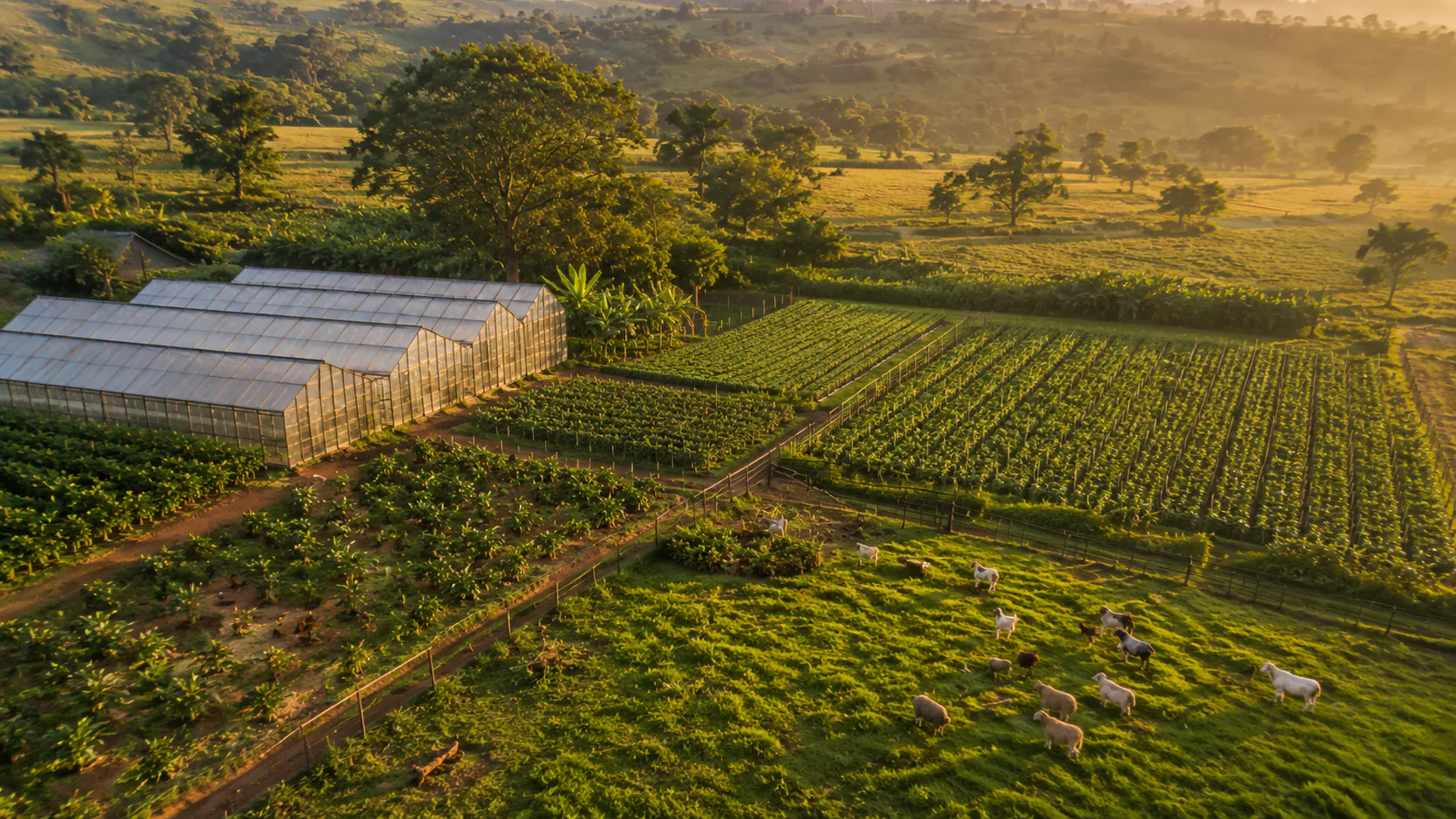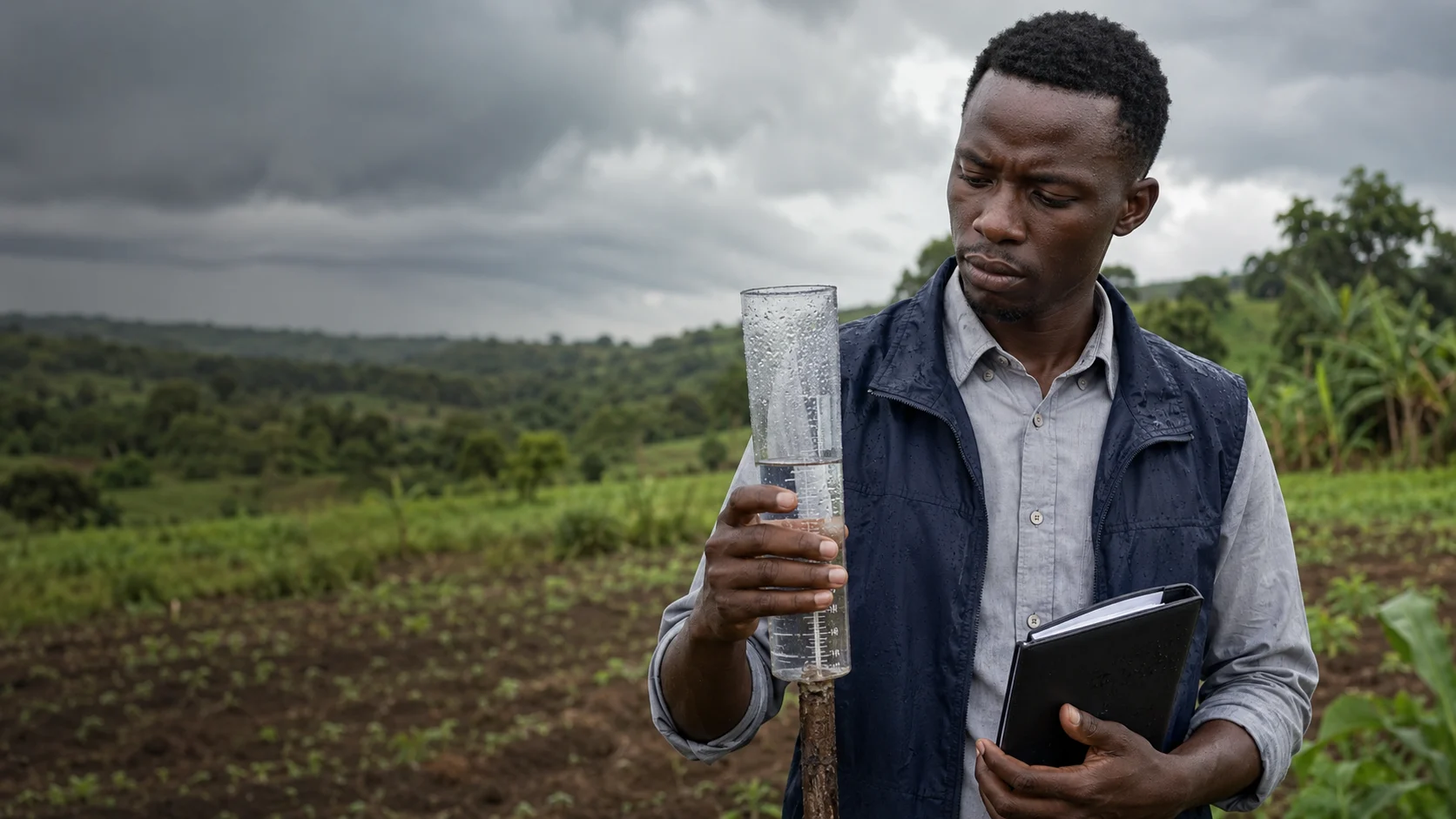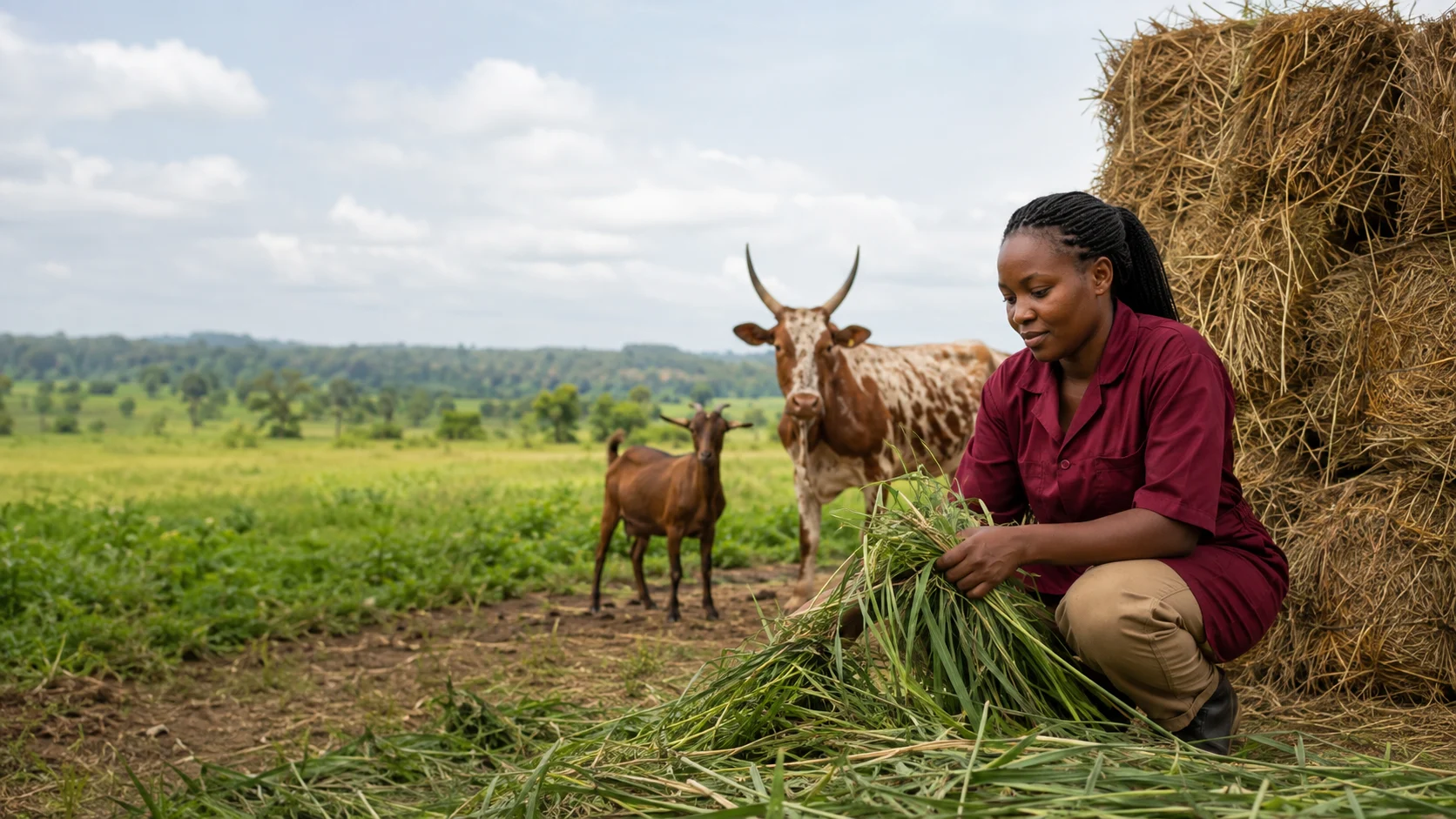
A herd does not stop eating because the rains have stopped. In most of Uganda, pasture growth and crop residues follow the wet and dry pattern of the year, but an animal's need for feed stays close to constant, and rises in late pregnancy or lactation. The gap between a fairly steady demand and a seasonal, sometimes unreliable, supply is the problem this guide addresses: how to plan so that no single feed source, whether open grazing, one fodder crop, or a hope that the rains arrive on time, is the only thing standing between the herd and a shortfall.
Direct Answer
Year-round fodder planning for goats and cattle in Uganda means estimating roughly how much dry matter the herd needs each day, mapping when pasture and crop residues are naturally abundant or scarce across the wet and dry periods of the local agro-ecological zone, and deliberately building supply for the lean months through a combination of fodder crops, conserved hay or silage, and, where useful, purchased supplementary feed, rather than relying on standing pasture alone. It also means checking pasture and forage condition regularly, testing conserved feed where possible, keeping simple records, and having a drought contingency plan before a bad season arrives rather than after. None of this replaces a site-specific ration from a qualified animal nutritionist; it gives the planning steps and questions that make that professional input more useful when it is sought.
Who this guide is for: Goat and cattle keepers of any scale in Uganda, mixed-farm managers combining crops and livestock, extension workers, and animal-science students who need a working method for forage planning rather than a single feeding recipe.
The problem it solves: Many herds are fed well in the wet season and poorly in the dry season because forage supply was never planned ahead, conservation was attempted too late or with the wrong method for the situation, or losses in storage quietly erased much of what was conserved.
What the reader will decide or do: After reading, a farmer or advisor should be able to roughly estimate herd forage demand, sketch a seasonal forage calendar for their zone, judge pasture condition, choose sensibly between fodder crops, hay and silage, reduce storage losses, know when and where to seek feed testing, keep a basic field log, and build a simple drought contingency plan.
Estimating Herd Forage Demand
Ration formulation is a specialist task and this guide does not attempt to replace it. What it can offer is the general principle behind estimating roughly how much forage a herd needs, so a keeper can judge whether their planned supply is in the right order of magnitude before seeking professional ration advice.
United States government livestock nutrition guidance (USDA NRCS) approximates standard forage demand for a beef animal at around 2.6 percent of body weight in dry matter per day, rising to around 3 percent for a lactating dairy cow, with observed intake ranging roughly 1.5 to 3.5 percent depending on forage quality, age, breed and physiological stage. University extension guidance on sheep and goats (a recognised US small-ruminant specialist) gives a comparable maintenance guideline of around 1.5 to 2 percent, rising substantially in late gestation and early lactation, and states that adjustments should be made for size, body condition, environment and forage quality, with forage testing and formal nutrient tables used for precise rationing rather than a general percentage alone.
These figures are not Ugandan and are not a ration; they show only the general shape of the calculation, that dry matter demand is a proportion of body weight, higher for lactating and growing animals than for those at maintenance. A practical starting estimate is to multiply an animal's approximate live weight by a proportion in this general range appropriate to its production stage, multiply by the number of animals in that group, and treat the result as a rough planning figure to be checked with an extension officer or nutritionist using local breed and condition data, not as a final ration. Breed, body condition, local forage quality and management will change the real figure for any specific herd.
Building a Seasonal Forage Calendar for Your Zone
Uganda's rainfall is not uniform. Much of the south and centre experiences a bimodal pattern with two wet seasons and two shorter dry spells, while the "cattle corridor" running through central, southern and north-eastern districts is drier overall, with a single more pronounced dry season and rainfall described in the peer-reviewed literature as low, unreliable and associated with prolonged drought risk. A Frontiers in Veterinary Science study of livestock movement in the cattle corridor found that January to March is when pasture and water shortages are most acute there, prompting farmers to sell or move animals. A calendar built for a bimodal southern district will not match the dry-corridor pattern, so the calendar described here is a concept to be filled in locally, not a fixed national schedule.
Building one involves four steps: mark the typical start and end of each wet and dry period for the specific district or sub-county, using local knowledge, extension records, and, where available, the seasonal rainfall information covered in Falcon's companion article on rainfall records and forecasts; mark when pasture and crop residues are naturally most abundant (during and shortly after wet periods) and scarcest (later in each dry period); mark the windows for planting fodder crops so they mature before the next dry period, and for cutting surplus wet-season growth for hay or silage while still of reasonable quality; and mark the drawdown period when conserved feed is expected to be fed out, checking whether the quantity conserved realistically covers it. Because rainfall onset varies year to year, treat this calendar as a planning guide to revisit each season, not a fixed timetable.
Assessing Pasture Condition
Before deciding how much to conserve, it helps to judge what the pasture itself is currently offering and how it is holding up under grazing. Signs that pasture is under strain include ground increasingly bare between plants, a shift toward less palatable or weedy species as preferred grasses are grazed out before they can recover, visibly shorter regrowth between grazing rounds, and soil showing compaction or erosion on paths and around water points. None of these signs alone proves overgrazing, since they can also reflect drought stress independent of stocking, but a pattern of several together, especially persisting after rain, is a signal to reduce grazing pressure, rotate animals to rest the area, or bring in supplementary feed. Regular observation walks noting condition at the same points over time are more useful than a one-off assessment, because the trend matters more than a single day's reading.
Fodder-Crop Options and Selection Criteria
Deliberately growing forage, rather than relying only on natural pasture, gives a keeper more control over the timing and quality of supply. Selection should weigh several criteria rather than assuming one species suits every farm: how well the crop tolerates the specific rainfall and soil conditions of the site, whether it can be established from available planting material locally, how it fits with existing cropping plans and land availability (an area covered in more depth in Falcon's integrated crop-and-livestock content), the labour required to plant, manage and harvest it, and whether it is intended for direct grazing, cut-and-carry feeding, or conservation, since not every fodder crop suits all three uses equally well. Uganda's national livestock research institute (NaLIRRI, under NARO) has worked on improving legume forages such as lablab for livestock nutrition, reflecting a wider regional principle that combining a grass or cereal-type forage with a legume can improve overall forage protein content, though the right combination depends on local conditions. Any specific crop recommendation should be verified with a local agricultural officer or NARO/NaLIRRI extension contact, since suitability varies by district, soil and altitude.
Hay-Making: Decision Criteria and Procedure
Hay-making suits a period of reliably dry, sunny weather long enough to cure the cut forage, since it depends on drying rather than fermentation and does not work well if cut material is repeatedly rained on before it is dry. FAO's smallholder hay-making guidance sets out the core decision point and procedure.
When to cut. Forage should be cut early in the flowering stage, when it offers close to its maximum nutrient content; cutting too early leaves too little bulk and too much moisture, while cutting too late reduces quality as leaves become more brittle and protein content falls.
The procedure. The FAO guide summarises the sequence as cut, dry, rake, collect, bale and store, done manually or mechanically. The cut material needs roughly two to three days of good, dry weather to cure, helped by sunshine, wind and low humidity; raking helps it dry evenly. Hay is ready to bale once it reaches roughly 15 to 20 percent moisture content.
Storage. Cured hay should be stored in a sheltered place, off the ground where possible, away from direct sunlight and rain. Insufficiently dried hay can heat up in storage, which degrades its quality and creates a fire risk; hay that feels stuck together in clumps, or shows mould, indicates it was baled too wet and should be checked before feeding.
Silage-Making: Decision Criteria and Procedure
Silage relies on fermentation under airtight, low-oxygen conditions rather than drying, making it more workable than hay in cloudy, humid or unpredictable weather, provided sealing equipment and materials are available. FAO's smallholder silage guidance sets out the following.
When to ensile. Forage is typically harvested at the point where dry matter content reaches around 30 to 35 percent (for maize, roughly three to four weeks after the first dark layer appears at the base of the grain). A simple field check, the "grab test," involves squeezing a handful of chopped forage into a ball for 20 to 30 seconds; a ball that holds its shape with only a little free juice indicates suitable moisture for ensiling.
Chopping and packing. Recommended chop length varies with growth stage, roughly 3 to 5 centimetres at the milk stage down to under 1 centimetre at the wax stage, with shorter chopping packing more densely. Material should be packed as densely as possible to exclude air, since trapped air prevents proper anaerobic fermentation, and packed within a day of harvest.
Sealing. The container, pit, bag or heap must be sealed tightly enough to exclude air for the whole fermentation period; the FAO guide describes practical smallholder methods such as twisting and tying plastic bag necks or weighting down sheeting with boards.
Fermentation and quality checks. Adequate fermentation typically takes around three weeks. Good silage has a mild, pleasantly sour smell similar to yoghurt and a light green to green-brown colour; a rancid or putrid smell, visible mould, or a very dark colour with a sour smell indicate poor fermentation or weather damage and such material should be treated with caution rather than assumed safe to feed.
Storage Losses and How to Reduce Them
Both hay and silage lose quality and quantity in storage if conditions are wrong. A review of forage conservation across sub-Saharan Africa led by ILRI found that smallholder-conserved forage often suffers from lower-quality source material and inadequate storage techniques, and specifically noted that smallholder farmers rarely make silage despite repeated recommendations, suggesting real practical barriers beyond simple awareness. For hay, the main loss pathways are baling before the material is dry enough (leading to heating, mould and nutrient loss) and storing in the open, exposed to rain or sun. For silage, FAO guidance identifies seepage when dry matter is too low, bird or rodent damage letting air in, inadequate compaction trapping oxygen, and poor or delayed sealing as the main causes of loss; a firm, well-drained storage surface, regular seal checks, and non-chemical rodent control are practical mitigations. In both cases, periodic physical inspection of stored feed, rather than assuming it is fine once put away, is the simplest loss-reduction step available.
Feed Testing: What It Verifies and Where to Seek It
Feed testing (forage or feed analysis) checks the actual nutrient content and quality of a specific batch of pasture, hay, silage or purchased feed, commonly covering dry matter, crude protein, digestibility or energy value, and sometimes contamination indicators. It matters because forage that looks adequate can vary widely in real nutritional value depending on species, growth stage at cutting, and how well it was conserved, and a ration cannot be reliably balanced without knowing what the feed actually contains. Uganda's National Animal Feeds Policy identifies feed analysis and quality monitoring as a national research and regulatory function, and calls for encouraging private feed-analysis laboratories alongside strengthening public referral laboratories, indicating that feed testing is recognised as a service still being built out rather than something universally available already. In practice, a keeper seeking feed testing should ask local extension officers, NARO/NaLIRRI, a nearby agricultural university or veterinary faculty, or the Dairy Development Authority which laboratories currently offer forage analysis in their area, since availability and turnaround time vary by region and can change; this article does not name a specific laboratory as guaranteed available.
Records and Field-Log Table
A simple, consistently kept log turns forage planning from guesswork into a system that improves over time. The table below is a starting template; columns can be adjusted to the farm's situation.
| Date | Herd group and count | Approx. total live weight | Feed source in use | Estimated quantity offered | Pasture/forage condition note | Conserved feed remaining (hay/silage) | Action taken or needed |
|---|---|---|---|---|---|---|---|
Recording even a few of these fields weekly, alongside notes on rainfall and any visible body-condition changes in the herd, gives an early warning of a developing shortfall and a record to discuss with extension staff or a nutritionist.
Warning Signs of Feed Shortfall
Signs that forage supply may be falling short include visibly declining body condition across several animals rather than one, reduced milk yield in lactating animals beyond what is expected for the stage of lactation, animals grazing further from water or searching longer for forage than usual, increased competition at feeding or watering points, and, in a district-wide dry spell, similar reports from neighbouring farms. None of these signs alone proves feed shortage, since disease can produce similar signs, but a cluster appearing together, especially during a known lean period, is a signal to check stored feed, review the herd-demand estimate, and seek animal-health and nutrition advice promptly.
Common Mistakes
Common planning mistakes include starting conservation only once the dry season has already begun rather than during the wet-season surplus; conserving forage without checking curing or fermentation was done correctly, so quality is lower than assumed when most needed; relying on a single feed source with no fallback if it fails; skipping pasture condition monitoring until visible overgrazing has set in; and treating a herd-demand estimate as fixed rather than revisiting it as herd size or production stage changes through the year.
When Each Method Works, and When It Does Not
Hay-making works best where a reliable multi-day dry spell is available at the right point in the forage's growth stage and sheltered, dry storage exists; it is less reliable in humid or unpredictable weather, since rain on partially cured hay can ruin the batch. Silage-making can work in wetter or less predictable weather since it does not depend on sun-drying, but it requires careful attention to chop length, packing density and sealing, and the ILRI-led review's finding that smallholder silage adoption remains low despite repeated recommendations suggests it demands more consistent technique and, often, more labour or equipment than hay. Fodder crops extend and diversify supply but take land, establishment time and often reliable rainfall or irrigation to succeed, so they work best as one part of a wider plan rather than a sole solution. The right method, or combination, depends on local rainfall pattern, labour, equipment, storage and herd size, which is why this guide gives decision criteria rather than a single recommended method.
Cost Categories to Plan For
Without inventing specific prices, which vary by district, season and market conditions, a realistic fodder plan should budget across several cost categories: land preparation and planting material for fodder crops; labour for cutting, curing or ensiling and feeding out (the Uganda case study referenced below found labour made up the majority of both hay and silage production costs on the farms it studied); consumables such as plastic sheeting, twine or preservatives; storage infrastructure such as a covered store or a firm base for silage bags or pits; and, where used, feed testing and professional nutrition advice fees. Costing these against the household's own labour availability and cash flow, rather than a single price assumption, gives a more realistic picture of what a plan will require.
Questions to Ask Extension, Nutritionists and Feed-Testing Labs
Before committing to a plan, it is worth asking a local extension officer or NARO/NaLIRRI contact which fodder crops and conservation approaches are currently recommended for the specific district and soil type; asking a qualified animal nutritionist to review a site-specific ration once herd composition, body condition and available feed types are known; and asking any feed-testing laboratory what parameters they test, what sample preparation they require, and their current turnaround time and fee, since these details change and should be confirmed directly.
A Low-Risk Pilot Approach Before Scaling Up
Rather than committing all available forage, labour and cash to hay- or silage-making in the first season, it is lower-risk to trial a small batch first, for example one silage bag or a limited number of hay bales, and check its quality (using the smell, colour and texture indicators above, or formal feed testing where accessible) before scaling up to cover a larger share of dry-season needs. A trial batch also builds practical skill in cutting timing, moisture judgement, packing and sealing before those skills are relied on for a season's main feed reserve.
Drought Contingency Planning
Because rainfall in parts of Uganda, particularly the cattle corridor, is described in the peer-reviewed literature as low, unreliable and associated with prolonged drought risk, a fodder plan benefits from an explicit contingency layer beyond the normal seasonal calendar. This can include identifying in advance where supplementary feed could realistically be purchased if home-conserved stock runs low, and roughly what that would cost against household cash flow; deciding which animals would be prioritised for available feed, sold, or moved if a shortfall became severe, echoing the destocking and movement responses documented in Ugandan cattle-corridor research; keeping a buffer of conserved feed rather than planning to use the last of it before the next expected rains, since onset can be later than expected; and maintaining contact with local extension or veterinary services so early warning of a developing drought reaches the farm in time to act.
Next Actions
A practical next step is to draft a rough seasonal forage calendar for the specific farm location; estimate current herd forage demand using the general dry-matter-intake principle above as a starting point, then have it checked by a local extension officer or nutritionist; assess current pasture condition; decide, using the decision criteria above, whether hay, silage, a fodder crop, or a combination best fits the farm's weather, labour and storage situation; trial a small conserved batch before scaling up; set up a simple field log; and sketch a basic drought contingency plan before the next dry period begins.
Limitations, Risks and When to Seek Professional Support
This article is a planning framework and evidence-based introduction to forage estimation, seasonal calendars, conservation methods and record-keeping. It is not a substitute for professional animal-nutrition advice, and it deliberately does not provide a universal ration, a fixed daily feed quantity for any specific animal, or a single forage species recommendation intended to apply to every Ugandan farm. Actual dry-matter and nutrient requirements depend on the individual animal's breed, body weight, age, production stage, body condition, health status and the measured quality of the specific feed available, all of which can only be combined into an accurate ration by a qualified animal nutritionist or experienced veterinary/extension professional working with site-specific information, ideally supported by feed testing. Because rainfall, soil, forage availability and market access vary significantly across Uganda's agro-ecological zones, and because conservation techniques carry real risks (spoiled hay or silage can be unpalatable or, in some cases, unsafe to feed), readers should treat the calendar concept, selection criteria and procedures here as a starting framework to verify and adapt with local extension services, NARO/NaLIRRI, a veterinary or nutrition professional, and, where relevant, the Dairy Development Authority, rather than a finished plan. Where a herd shows signs of a genuine feed shortfall or declining condition, prompt professional consultation is advised rather than continued reliance on general guidance.