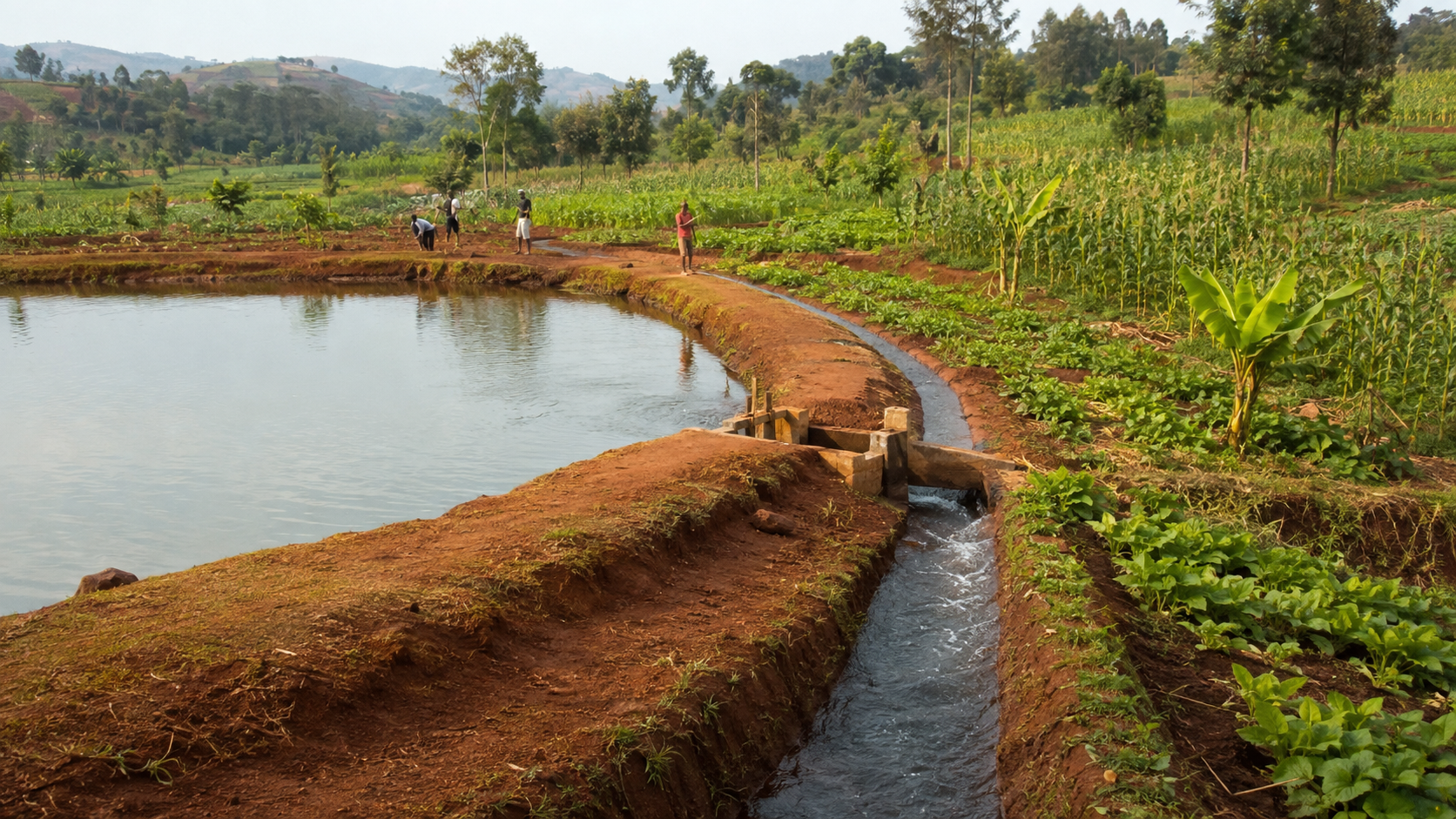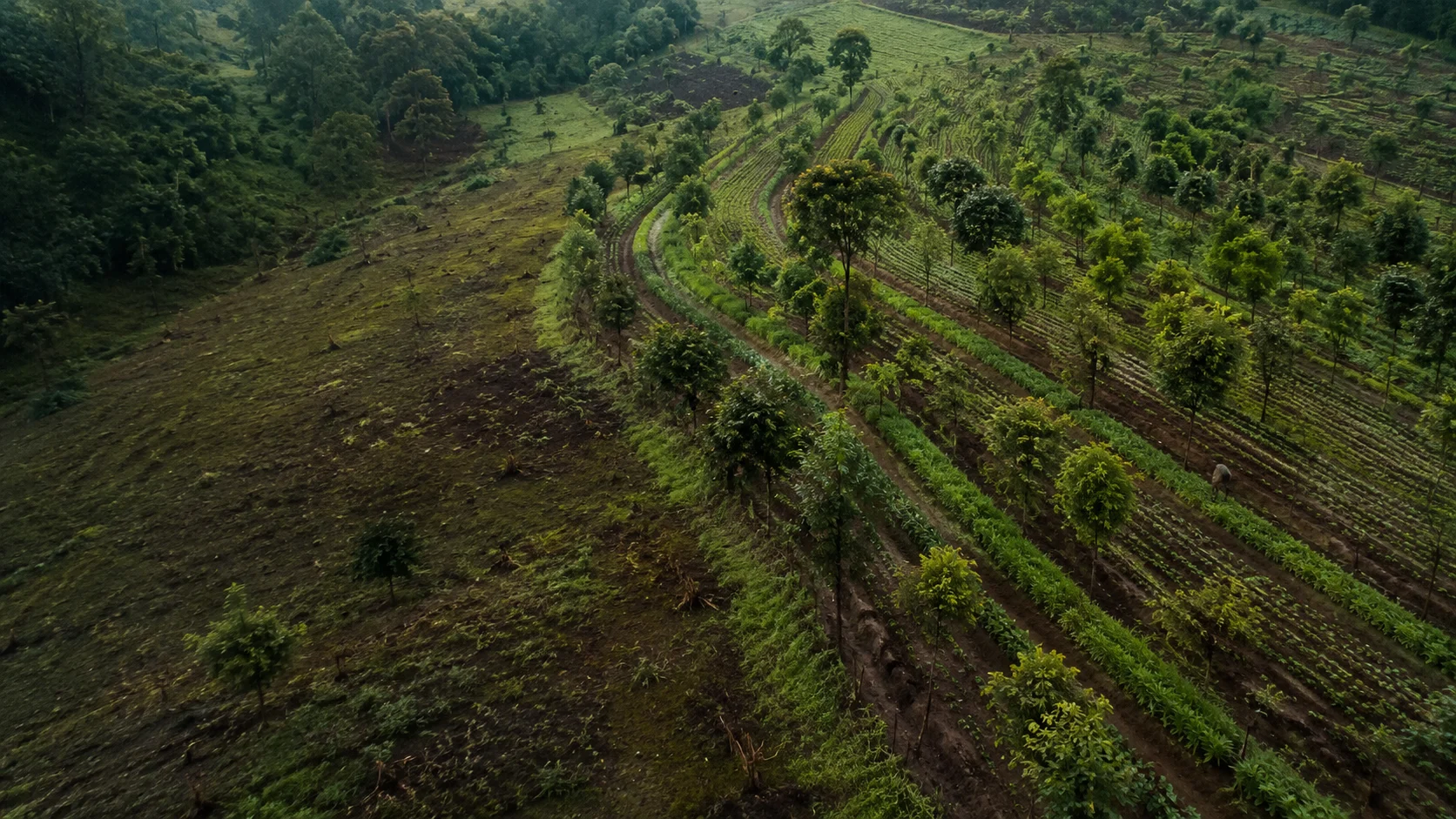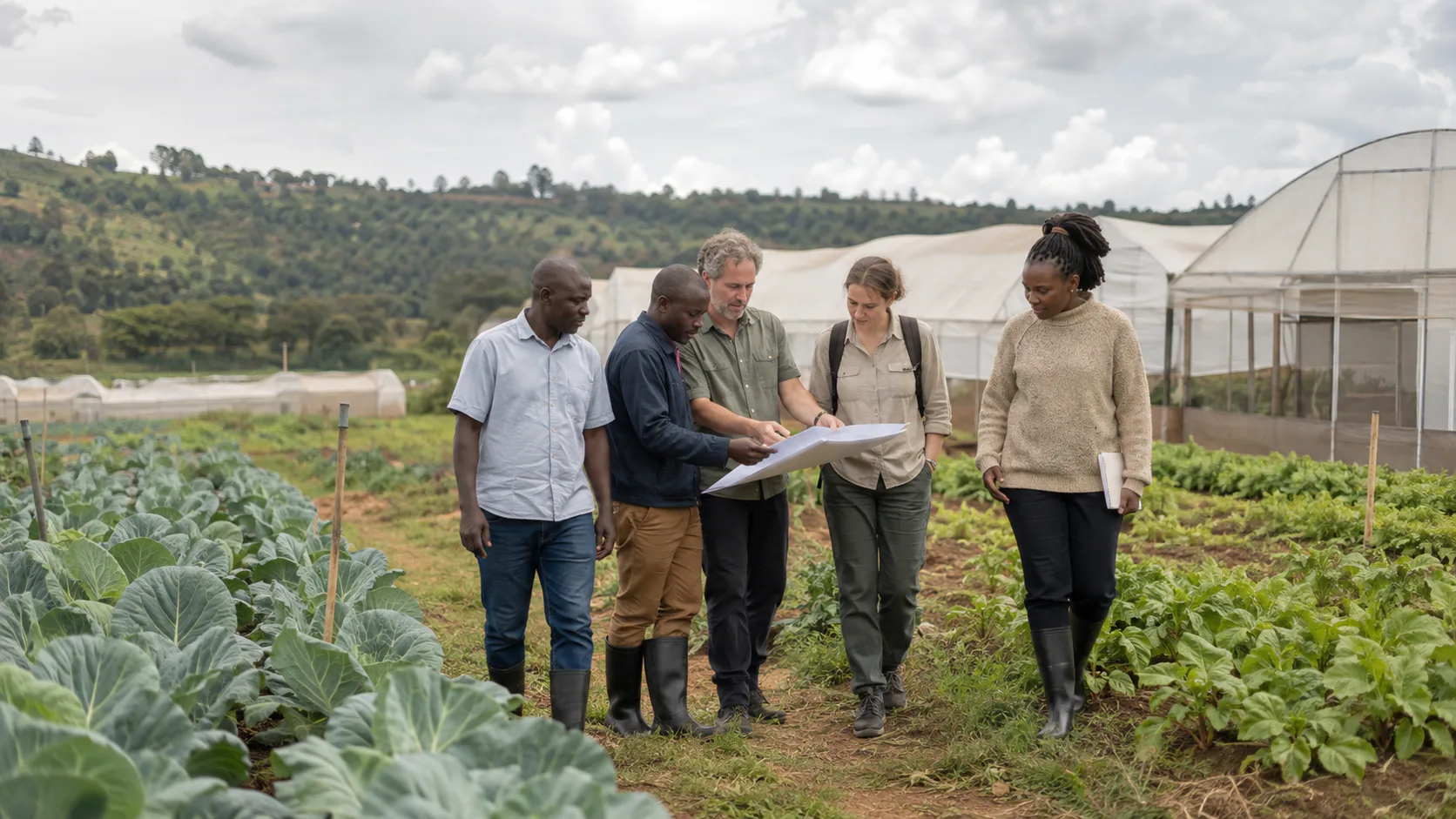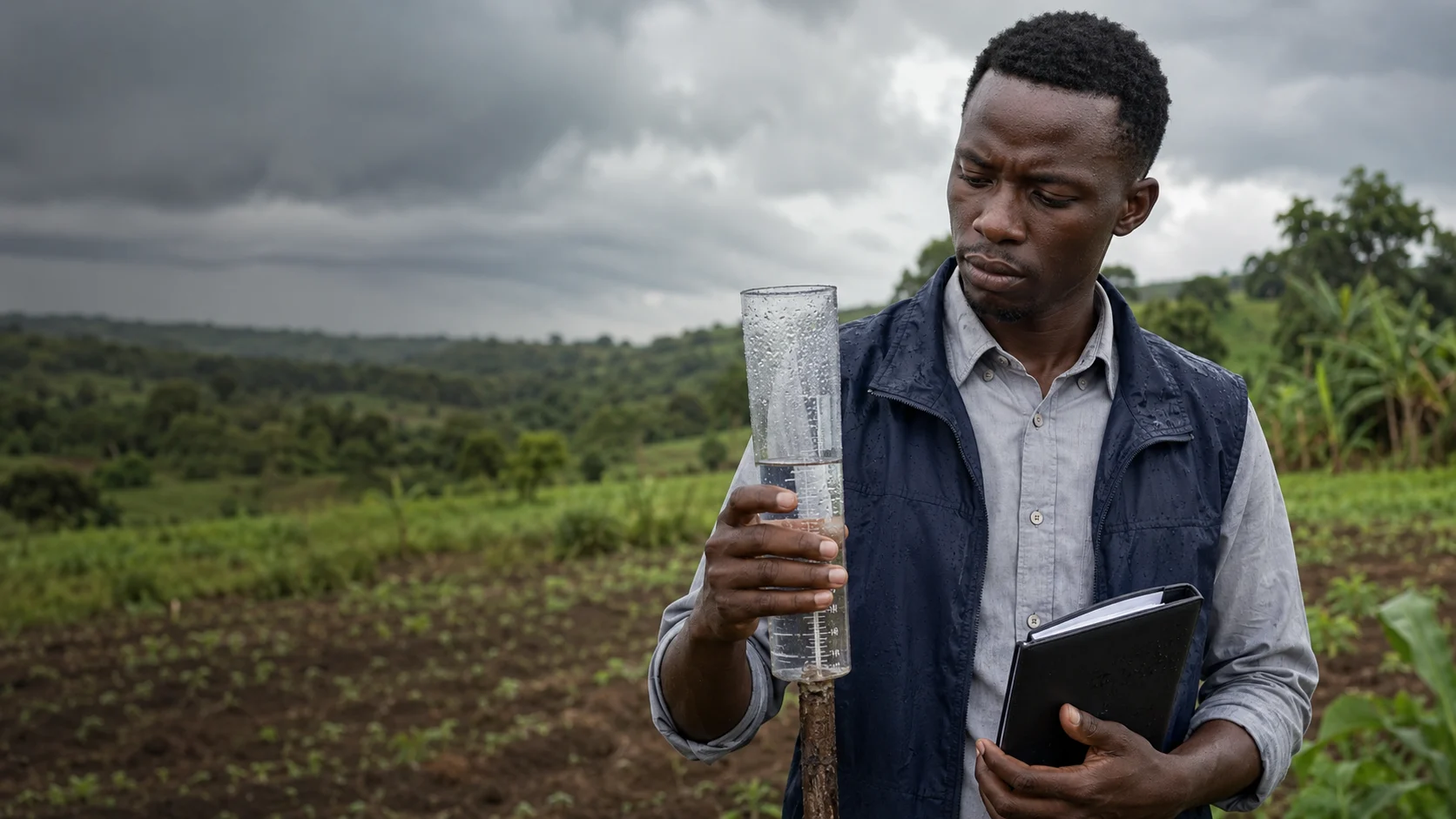
A seasonal forecast from Uganda's meteorological authority is a statement of probability across a wide area, built from imperfect models of a genuinely uncertain system. A rain gauge sitting in a farmer's own field for three seasons is a small but concrete record of what actually happened on that specific piece of land. Neither on its own is enough to plan a season around. Used together, and used cautiously, they can help a Ugandan farm narrow its planting window, choose sensible contingencies, and avoid some of the more costly guesses that come from planting purely by habit or purely by hope. This article sets out how to build that combined approach without overstating what either source can promise.
Direct Answer
Ugandan farms can improve planting decisions by keeping a simple local rainfall and field-condition record over several seasons, reading the Uganda National Meteorological Authority's (UNMA) seasonal climate outlooks and dekadal updates for the probability categories they actually state (such as near-normal, above-normal or below-normal rainfall, usually expressed as a percentage chance rather than a certainty), and then using both together to set a cautious planting window, often staggered rather than a single fixed date, alongside a contingency plan for a below-normal or delayed season. A seasonal forecast indicates a likely tendency over a season and a wide area; it does not guarantee rainfall on a specific field on a specific date. Farms that treat forecasts this way, cross-check them against their own records for at least one full season before relying on them more heavily, and keep a written post-season review, are better placed to reduce (not eliminate) planting-related risk than farms that plant purely on habit or that treat a single forecast headline as certain.
Who this guide is for: Farmers and farm managers who currently plant by fixed calendar dates or by watching neighbours, extension officers who need a clear way to explain forecast uncertainty to farmer groups, students studying agricultural risk management, and investors who need to understand how rainfall risk is actually assessed and managed on the ground before relying on yield projections.
The problem it solves: It replaces two common failure modes - ignoring official forecasts entirely, and treating a single forecast statement as a guarantee - with a documented, repeatable method for weighing local evidence and forecast information together.
What the reader will decide or do: By the end of this guide, a reader should be able to set up a basic rainfall and field log, read a UNMA or ICPAC seasonal bulletin and correctly state what it does and does not claim, decide on a cautious (often staggered) planting window for the coming season, prepare at least one contingency response for a below-normal season, and run a short post-season review that feeds into the following season's decisions.
Uganda's Rainfall Pattern and Why Records Matter
Most of Uganda has a bimodal rainfall pattern, with two rainy seasons a year in the majority of districts (broadly March-May and September-November), though the far north of the country tends towards a single, longer wet season. Even within this general pattern, onset dates, cessation dates and the distribution of rain within a season vary substantially from year to year and from district to district. A peer-reviewed study of agrometeorological risk in Ugandan crop production found that while the end of the March-May rains has stayed relatively stable, the onset date varies considerably from year to year, and that dry spells of three to four weeks can occur within a nominally wet season - a pattern that can shorten the effective growing season even when the season as a whole is not classified as below-normal. A separate peer-reviewed study of climate variability and agricultural productivity in Uganda found that the effects of rainfall variability differ by crop (beans and bananas showed greater sensitivity than maize and cassava in that study) and by region, with eastern Uganda identified as particularly vulnerable.
The practical implication is that a farm cannot rely on either a fixed historical planting date or a single seasonal forecast headline alone. A local rainfall record, built up over several seasons on the actual farm in question, is the only source of information that reflects that specific field's history rather than a district or national average. It is also the baseline a farm needs in order to judge, honestly, how well a forecast has matched its own conditions in the past - which is the basis of the low-risk pilot approach described later in this article.
Building a Local Rainfall and Field-Log Record
Manual rain gauge basics
A local rainfall record does not require expensive equipment. A simple manual rain gauge (a graduated collection cylinder from an agricultural supplier, or an improvised straight-sided container calibrated against a ruler), placed in an open area away from trees, buildings and overhangs and read at the same time each day, is sufficient. What matters more than the equipment is consistency: reading daily, recording zero-rainfall days as zero rather than leaving them blank, and keeping the gauge in the same location so records stay comparable across seasons.
What else to log
Rainfall depth alone is not the whole picture. A useful farm record also tracks planting and emergence dates, any dry spells and their approximate length, unusual events (hailstorms, prolonged waterlogging, unseasonal dry periods), and the crop's response (delayed germination, wilting, lodging). Recording all of this in one place, even briefly, turns a rainfall log into a field-condition record that is far more useful for planning than rainfall figures on their own.
Uganda's Current Seasonal Forecast Authority and Products
Uganda's national meteorological body is the Uganda National Meteorological Authority (UNMA). UNMA was established as a semi-autonomous government authority by an Act of Parliament in 2012 and operates under the Ministry of Water and Environment; it is the successor to the former Department of Meteorology, which previously carried out this function as a government department rather than a semi-autonomous authority. UNMA's stated mandate covers weather and climate services, analysis of scientific research findings, and guidance on climate change, and it represents Uganda in its coordination with the World Meteorological Organization (WMO). This identity and history were independently checked for this article rather than assumed, given that meteorological institutions in the region have changed names and legal status over time; readers relying on this article after its review date should still confirm UNMA's current name and status directly, since institutional arrangements can change again.
UNMA issues seasonal climate outlooks ahead of each rainy season, plus more frequent dekadal (ten-day) updates during the season itself. Its outlooks are produced with reference to, and broadly consistent with, the regional forecasts issued by the IGAD Climate Prediction and Applications Centre (ICPAC), the specialised regional climate centre for the Greater Horn of Africa. ICPAC describes its methodology as having moved from a subjective, consensus-based approach to an objective, data-driven method (a transition it dates to around 2019), communicating outlooks using tercile probability maps - the probability that rainfall in a given area falls into the below-normal, near-normal or above-normal category for that season - together with onset likelihood and a verification of the previous season's performance.
As reported in Ugandan press coverage of UNMA's March-May 2026 seasonal outlook, UNMA defined "near-normal" rainfall for that outlook as falling between 75 percent and 125 percent of the long-term average for the area and period concerned, and forecast near-normal to above-normal rainfall for most of the country for that season, while explicitly noting that even areas expected to receive above-normal rainfall could experience uneven distribution within the season. A UNMA official was reported as recommending timely planning to mitigate risks and to take advantage of favourable conditions, and referring to advisories being developed jointly with other ministries on the implications of the forecast. This is a useful, concrete illustration of how UNMA actually communicates a seasonal outlook: as a probability-based, area-wide tendency with explicit acknowledgement of possible unevenness, not as a locked prediction for any specific farm.
Reading a Seasonal Forecast Bulletin Honestly
Probability categories, not certainties
When a bulletin states a probability of above-normal, near-normal or below-normal rainfall for a season, it is describing a tendency across a defined area and time window, generally with a stated probability rather than a guarantee. A forecast that favours near-normal or above-normal rainfall for a season does not mean every location within the forecast area, or every ten-day period within the season, will receive normal or above-normal rain; it means that outcome is judged more likely than the alternatives across the area as a whole.
Dekadal updates
Because a seasonal outlook is issued before the season starts, it necessarily carries more uncertainty than a shorter-range forecast. UNMA's ten-day (dekadal) updates during the season itself are intended to narrow that uncertainty as the season progresses and should be checked periodically rather than relying solely on the pre-season outlook once the season is underway.
What a bulletin does not tell you
A seasonal outlook does not tell a farm the exact date rain will start on its field, the exact volume it will receive, or whether a dry spell will fall during a sensitive crop stage, and it does not remove the need for judgement about soil type, slope, crop choice and input timing. Treating a bulletin as the single input to a planting decision is the most common misuse of this information.
From Forecast to Cautious Planting-Window Decision
A cautious approach uses the seasonal outlook to set a plausible window, not a single fixed date, and then narrows that window using local rainfall observations and dekadal updates as the season approaches and begins.
Staggered planting
Rather than planting an entire field on one date chosen from a forecast, many farms reduce risk by staggering planting across several dates within the plausible window, particularly where labour and seed allow it. This spreads exposure to a poorly timed dry spell across the crop rather than concentrating it in a single planting cohort.
Short-cycle varieties as a hedge
Where a forecast indicates a less favourable or later-than-usual onset, choosing a shorter-cycle variety, where agronomically suitable for the crop and market, can reduce the window of exposure to late-season dry spells, since the crop reaches maturity sooner. This is a general risk-reduction principle; the suitability of any specific variety for a specific farm depends on local agronomic and market conditions and should be checked with local extension services or, for seed-specific questions, appropriate agronomic guidance rather than assumed from this article.
Do not plant purely on the forecast alone
Even a favourable seasonal outlook should be checked against local, on-the-ground signs (soil moisture, recent rainfall in the immediate area, dekadal updates) before committing to planting. A forecast that favoured near-normal or above-normal rainfall at the seasonal level can still coincide with a poor start in a specific location.
A Decision Framework: Information, Not Guarantee
A simple way to keep this distinction clear in practice is to separate every planting-related decision into three columns: what the forecast says (the stated probability category and any explicit caveats in the bulletin); what the farm's own recent record shows (rainfall received so far this season, compared with the same point in previous seasons); and what the farm will actually do, stated as an action with a built-in contingency rather than a single commitment. For example: the forecast may indicate a favourable probability of near-normal rainfall; the farm's own record may show rain has started later than the three-season average; the resulting decision might be to begin staggered planting on drought-tolerant plots first, holding remaining land for a second planting date pending further local rainfall or the next dekadal update. This framework keeps the forecast in its proper place as one input that informs, rather than replaces, judgement grounded in the farm's own evidence.
Contingency Planning for Below-Normal and Above-Normal Seasons
For a below-normal forecast, or where local records diverge from a favourable one, options include delaying planting on part of the land pending further rainfall, switching some planned area to shorter-cycle or drought-tolerant crops where agronomically and commercially suitable, and, where irrigation infrastructure already exists, using stored or diverted water to supplement rainfall during establishment (engineering detail for that option belongs to the separate Falcon irrigation planning guide, not here). Soil and water conservation measures that improve moisture retention, including agroforestry approaches covered in the Falcon agroforestry guide, are worth planning ahead of a season rather than after a dry spell has caused damage.
For an above-normal forecast, contingencies include planning drainage on waterlogging-prone plots, adjusting planting density or timing to reduce disease pressure from prolonged wet conditions, and holding back a portion of inputs that would otherwise be wasted on a flooded planting.
In both cases, the point of contingency planning is to decide, calmly and in advance, what the farm will do if the season does not match the forecast - because seasonal forecasts carry meaningful uncertainty and a mismatch between forecast and outcome is a normal, expected possibility, not a rare failure of the system.
Records and Field-Log Table
| Field / plot | Season | Planting date(s) | Rainfall to date (mm, farm gauge) | Forecast category (UNMA) at season start | Dekadal update notes | Dry spell observed (Y/N, duration) | Crop response observed | Decision taken | Outcome / notes for next season |
|---|---|---|---|---|---|---|---|---|---|
This table is intended to be copied into a farm diary or spreadsheet and completed through the season, then used directly as the input to the post-season review described below.
Warning Signs of Over-Reliance on Forecasts
A farm may be over-relying on forecasts if: the entire farm is planted from a single seasonal headline without checking local rainfall as the season begins; contingency plans do not exist because "the forecast was good"; dekadal updates go unchecked once planting has started; probability language ("near-normal", "above-normal") is treated internally as a certainty; or a poor outcome in a forecast-favourable season is written off as bad luck rather than logged and reviewed for what it reveals about the gap between area-wide forecasts and the farm's own conditions.
Common Mistakes
Common mistakes include: planting the entire farm on a single date chosen from the outlook alone; discarding forecasts entirely after one inaccurate season instead of continuing to cross-check them; keeping no local rainfall record, which removes the only farm-specific evidence available; confusing a seasonal outlook (issued before the season, covering weeks to months) with a short-range weather forecast (covering days); and relying only on the pre-season outlook once the season is underway, without checking dekadal updates.
When Forecasts Are Useful, and When They Are Not
Seasonal forecasts are most useful for setting a plausible planting window, deciding whether to prepare drought or drainage contingencies in advance, and informing conversations with extension officers about crop and variety choice. They are least useful, and should not be relied on, for predicting the exact date rain will start on a specific field, guaranteeing a specific planting date will succeed, replacing a farm's own records, or justifying a decision to skip contingency planning. A forecast that "may help" reduce risk alongside local records and cautious planning is a materially different claim from one that "will ensure" a good season; this article deliberately uses the former framing throughout.
Cost Categories to Plan For
Without stating specific prices, which vary by supplier, region and season, a farm adopting this approach should budget across these categories: a basic rain gauge or equivalent recording equipment; labour time for daily reading and record-keeping; short-cycle or drought-tolerant seed held in reserve; drainage works prepared in advance for an above-normal contingency; and, where irrigation is chosen as a contingency, the separate cost categories covered in the Falcon irrigation planning guide. None of these costs can be responsibly stated as fixed figures in a general guide, since they depend on current local supplier pricing, farm scale and existing infrastructure.
Questions to Ask UNMA and Extension Officers
Useful questions for UNMA's public information channels, its published bulletins, or local MAAIF extension officers include: what is the current outlook's stated probability for my specific district, rather than the national headline; how did the previous season's outlook compare with what was actually received, where a seasonal performance review is published; what dekadal updates are available during the season and how can I access them; and what crop or variety guidance, if any, is being issued jointly by UNMA and MAAIF. MAAIF's extension services, delivered through its Directorate of Agricultural Extension Services and local extension workers, are a relevant channel for translating a forecast into locally specific advice; a peer-reviewed study on climate variability and productivity in Uganda found that extension access helped offset the negative effects of rainfall variability on farming household productivity, supporting the use of extension officers alongside a bulletin, not instead of one.
A Low-Risk Pilot: Cross-Checking a Season Before Trusting a Forecast
A cautious way to begin using seasonal forecasts more heavily in farm decisions is to run at least one full season, and ideally two or three, as a validation exercise before letting the forecast materially change planting scale or investment. During this pilot period: keep the local rainfall and field-log record described above in full; note the UNMA seasonal outlook's stated category for the area at the start of the season; continue making planting decisions primarily on established local practice and local records, while separately noting what a forecast-led decision would have been; and, after the season, compare the two. This approach lets a farm build direct, farm-specific evidence of how well UNMA's and ICPAC's seasonal outlooks have matched its own conditions before shifting greater weight onto forecast-led decisions, rather than adopting forecast-led planting on faith in the first season.
Post-Season Review Method
At the end of each season, complete the field-log table above in full, then answer, in writing, four questions: did the season's actual rainfall pattern (recorded locally) fall within, above or below the range the seasonal outlook indicated; where the outlook and the local record diverged, what would the farm do differently if a similar divergence occurred again; did any contingency plan get used, and did it work as intended; and what, specifically, will change in next season's planting window, variety choice or contingency plan as a result. Keeping this review in the same document as the field log turns each season into evidence for the next, which is the core discipline this article is asking farms to adopt.
Next Actions
- Obtain and install a basic rain gauge, or set up a consistent daily reading routine with an improvised gauge, before the next season begins.
- Set up the field-log table above, on paper or in a spreadsheet, and begin recording immediately, even mid-season.
- Locate and bookmark UNMA's current seasonal outlook and dekadal update channels, and note the access date each time a bulletin is checked.
- Before the next planting window, apply the three-column decision framework (forecast says / local record shows / farm will do) rather than deciding from the forecast headline alone.
- Prepare at least one written contingency plan for a below-normal season and one for an above-normal season before planting starts.
- At season end, complete the post-season review and carry its conclusions into the following season's planning.
Limitations, Risks and When to Seek Professional Support
This article provides a general method for using rainfall records and seasonal forecasts in farm planning; it is not a substitute for a current UNMA bulletin, a site-specific agronomic assessment, or professional advice from a qualified agronomist, extension officer or engineer. Seasonal forecasts, including those issued by UNMA and ICPAC, carry inherent uncertainty, are issued at a district or regional scale rather than a field-specific scale, and can and do diverge from what any individual farm actually experiences; this article does not, and should not be read to, claim that any forecast guarantees a specific rainfall amount, planting outcome or yield. Where a planting or investment decision involves significant financial exposure, particularly for commercial-scale or investor-backed operations, readers should seek a current, site-specific assessment from a qualified agronomist or agricultural risk adviser rather than relying on this article or on a seasonal forecast alone. Where a contingency plan involves irrigation infrastructure, engineering design should be sourced from the dedicated Falcon irrigation planning guide and a qualified irrigation professional, not derived from this article. Institutional names, mandates and bulletin formats referenced here (UNMA, ICPAC, MAAIF) were current as of the research dates stated in Section E and should be reverified by the reader for any use after this article's review date, since government agency names, structures and online bulletin locations in Uganda have changed before and may change again.