Trees on a farm are not automatically an improvement. Planted with a clear objective, the right species for the site, and sensible spacing from crops, they can help reduce soil erosion, moderate water loss and add organic matter and fodder to a farm system. Planted without a plan, the same trees can shade out a maize crop, pull water and nutrients away from adjacent rows, or create a boundary dispute with a neighbour years after planting, when the trees are too large to move. This article sets out a structured way for a Ugandan farmer, farm manager or extension worker to decide whether, where and how to introduce trees for soil and water conservation, and how to catch problems early rather than after they have become established.
Direct Answer
Agroforestry can help control soil erosion, moderate water loss from bare soil, and add fertility, fodder or fuelwood to a Ugandan farm, but only when the objective, species, placement and maintenance are matched to the specific site. Species suited to one agro-ecological zone or soil type in Uganda may not suit another, so species choice needs local validation from a district forestry officer, NaFORRI, or the World Agroforestry (ICRAF) species-selection tool rather than a generic list. Trees should generally be kept back from crop rows by a distance related to their expected mature canopy and rooting spread, planted along contour lines on sloping land rather than up-and-down the slope, and managed through routine pruning to limit shade and root competition rather than left unmanaged. A small trial block, planted and monitored for at least one full season before wider planting, is a lower-risk way to test how a chosen species behaves on a particular farm than planting the whole farm at once. Carbon-market payments are sometimes mentioned alongside agroforestry; these are not a guaranteed source of income, involve verification and market-access requirements that vary by scheme, and should be treated as uncertain until confirmed with a specialist, not assumed as part of a planting decision.
Who this guide is for: Crop farmers and mixed-farm managers considering planting trees for the first time or expanding an existing scattered-tree system, extension workers advising farmer groups on soil and water conservation options, agriculture and forestry students, and investors who need to understand agroforestry as a land-management practice rather than a guaranteed financial return.
The problem it solves: It replaces vague general advice to "plant trees for the soil" with a decision framework covering objectives, species-selection criteria, placement and spacing, erosion-control layout, and ongoing management, so that a reader can plan a system suited to their own site rather than copy a scheme designed for a different location.
What the reader will decide or do: By the end of this guide, a reader should be able to state a clear objective for introducing trees, apply a set of species-selection criteria appropriate to their agro-ecological zone, decide on a placement and spacing approach that limits shade and water competition, lay out a contour-based erosion-control planting on sloping land, plan a maintenance and monitoring routine, and run a small pilot block before committing the whole farm.
Why Farmers Consider Agroforestry: Objectives
Agroforestry is not a single practice but a family of practices that combine trees or shrubs with crops, livestock, or both, on the same piece of land. The FAO's Sustainable Forest Management Toolbox describes the purpose of such systems in terms of increasing farm production or income, diversifying production such as food, fibre, fodder, fruit, construction materials, medicine, honey, dyes, resins and gums, and providing environmental services. On a Ugandan farm, the objectives most relevant to soil and water conservation typically fall into a small number of categories, and it is worth naming the objective clearly before choosing species, because the objective drives the placement and management decisions that follow.
Erosion control is usually the objective on sloping land, where tree and shrub roots help bind soil and above-ground vegetation slows runoff. Water conservation is a related but distinct objective: trees and associated vegetation can reduce the proportion of rainfall lost directly to evaporation from bare soil, though the effect depends heavily on species and management, as discussed below. Soil fertility improvement is a common objective where nitrogen-fixing or fast-decomposing-litter species are used to add organic matter or nitrogen to cropland over time; this objective works alongside, not instead of, direct soil testing, which is covered in Falcon's separate soil testing and fertility management guidance. Shade and windbreak provision protects sensitive crops, livestock or buildings from wind or excess sun, but is also the objective most likely to create competition problems if not carefully placed, discussed later in this article. Fodder and fuelwood production is an objective in its own right on many Ugandan mixed farms, where trees and shrubs supply livestock feed or household energy needs alongside their conservation function.
A single planting can serve more than one objective, but naming the primary objective first makes it far easier to choose appropriate species and to judge, later, whether the system is actually working.
Species-Selection Criteria for Ugandan Conditions
There is no single list of "good agroforestry trees for Uganda" that applies uniformly across the country. Uganda spans several agro-ecological zones with different rainfall, altitude, and soil conditions, from the montane areas of the south-west and Mount Elgon to the drier cattle corridor and the lakeshore and lowland zones, and a species that performs well in one zone may be poorly suited, or even invasive, in another. The World Agroforestry (ICRAF) interactive Suitable Tree Species Selection and Management Tool for Uganda addresses this directly, offering an online database of tree and shrub species that can be filtered by origin (native or exotic), products (fruit, firewood, charcoal, timber, medicine, fodder and others), ecological services (erosion control, soil fertility improvement, shade, windbreak, riverbank stabilisation) and planting niche (cropland boundary, homestead, woodlot, conservation structure), alongside growth-rate category, management needs and leaf phenology for each species. This kind of filtered, location-aware tool is a more reliable starting point than a fixed species list, because it lets a farmer or extension officer match species to the actual site rather than to a generic national recommendation.
Agro-ecological zone variation
Because suitability varies by zone, altitude, rainfall pattern and soil type, any species shortlist produced from a general tool or handbook should be checked against local conditions before planting, ideally with input from a district forestry officer, a NaFORRI researcher, or an established local nursery that already grows the species successfully in the area. A species that thrives in the wetter, higher-altitude montane zone may struggle or grow very differently in a drier lowland zone, and vice versa.
Native versus exotic species
Both native and exotic (introduced) species appear in Ugandan agroforestry systems, each with trade-offs. Native species are often, though not always, better adapted to local pests, diseases and soil conditions and pose a lower risk of becoming invasive, while some exotic species have been selected and promoted specifically for fast growth, nitrogen fixation, or fodder value. Species-selection tools that flag invasiveness risk, such as the ICRAF Uganda tool referenced above, are useful precisely because an unmanaged fast-growing exotic species can become a maintenance burden or a spreading problem on a farm rather than a benefit.
Multi-purpose versus single-purpose trees
Multi-purpose species that combine two or more benefits, such as a nitrogen-fixing species that also supplies fodder, or a fruit tree that also offers some shade, can make efficient use of limited planting space on a smallholding. However, a multi-purpose species is not automatically the right choice for every situation: a farmer whose primary objective is strict erosion control on a steep slope may still be better served by a species selected specifically for root-binding and dense ground cover than by a multi-purpose species that happens to have a wider canopy and greater shade or competition risk near crops.
In every case, species selection should also weigh the tree's likely mature size and rooting habit against the placement and spacing plan described next, since a species chosen without regard to eventual crown spread and root spread is a common source of later shade and competition problems.
Placement and Spacing: A Decision Framework
Where a tree is planted, and how far it sits from crop rows, existing structures and boundaries, matters as much as which species is chosen. The FAO's agroforestry guidance frames this as a design problem: the aim of an agroforestry layout is to minimise competition for land, sunlight, water and nutrients among system components while maximising their complementarity, and spatial arrangement (the distance between trees, and the configuration of tree plots relative to crop plots) is the primary tool for achieving that balance.
A practical placement decision framework for a Ugandan farm should work through, in order: first, the primary objective for the planting (erosion control on a slope, a boundary or windbreak line, a woodlot, or scattered on-farm trees for fodder or shade); second, the chosen species' expected mature canopy width and rooting habit, sourced from a species-selection tool or local extension advice rather than assumed; third, the sensitivity of the neighbouring crop to shade and root competition, since shade-tolerant crops and shallow-rooted, less water-sensitive crops can generally be planted closer to trees than sun-loving, deep-rooted or drought-sensitive crops; and fourth, any legal or customary boundary-distance requirement relevant to the specific location, which should be confirmed locally rather than assumed, since land-boundary and neighbour-relations norms can vary and a mature tree's canopy or roots extending onto a neighbour's land is a genuine and avoidable source of dispute.
Because exact spacing distances depend on the specific species, site, slope and crop combination, this article deliberately does not state a fixed spacing figure that would apply across Uganda; a spacing decision should be confirmed against the chosen species' documented mature size (using a tool such as the ICRAF Uganda species database) and, ideally, verified against a local example of the same species already established nearby, before planting at scale.
Erosion Control Layout Principles on Sloping Land
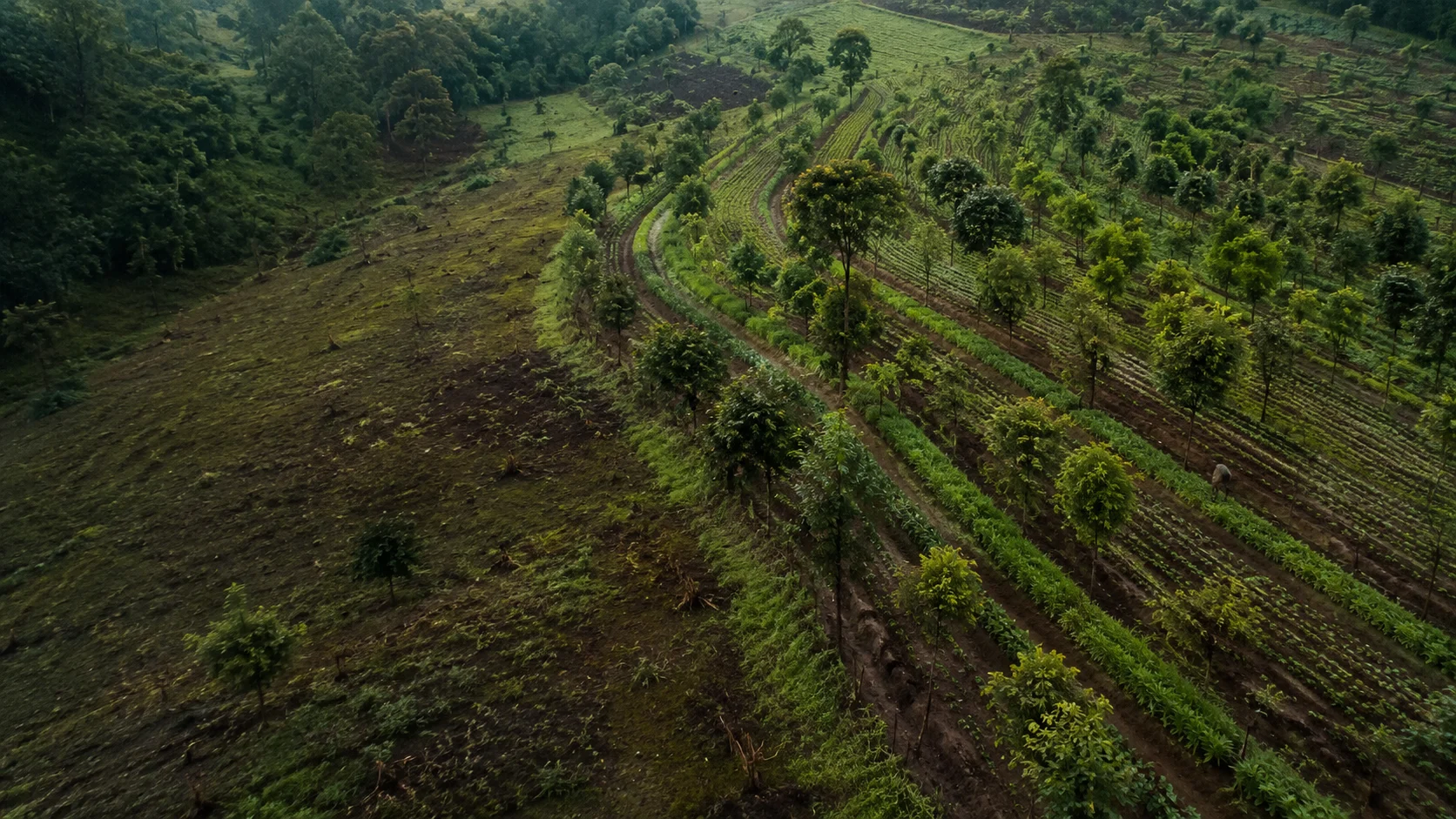
On sloping farmland, the layout of trees and associated vegetation, not just the species chosen, determines how effective an agroforestry planting is at reducing erosion. FAO erosion-control guidance is explicit that cropping and planting patterns should follow contour lines - that is, lines of constant elevation running across a slope - rather than running up and down the slope, because rows or barriers aligned with the contour slow and spread surface runoff, while rows running down-slope can channel water and accelerate erosion. The same guidance notes that the effectiveness of contour-based measures decreases as slope steepens, meaning that gentle slopes benefit more from contour planting alone, while steeper slopes need contour planting combined with additional structures or denser vegetative cover to achieve a similar level of protection.
Vegetative buffer strips - bands of grass, shrubs or trees planted along the contour - are a widely documented erosion-control measure, and FAO guidance notes that buffer strip-cropping can be particularly effective on gentler slopes, with ground-creeping and densely tillering grasses generally more effective at slowing runoff than sparse, tufted grasses. Trees are commonly planted along the edge of such contour strips, both to reinforce the barrier with root structure over time and to give the strip a productive function, such as fruit, fuelwood or construction material, which in turn gives farmers a practical incentive to maintain the strip rather than clear it. On very degraded or low-biomass slopes, a mixed planting of leafy ground cover, shrubby legumes and trees spaced along the contour can provide both erosion control and a source of mulch material, though the specific spacing and species mix should again be confirmed locally rather than copied from a different agro-ecological context.
A contour-based layout is not a one-off installation. Contour lines should be marked out carefully (using a simple levelling tool such as an A-frame or line level, in consultation with an extension officer where available) before planting, since a poorly marked contour undermines the erosion-control benefit the layout is intended to provide.
Managing Shade and Water Competition with Crops
Shade and root competition are the two mechanisms most likely to turn a well-intentioned tree planting into a source of reduced crop yield, and both can be actively managed rather than simply accepted as an inevitable cost of having trees on the farm.
A peer-reviewed field study on bench terraces in south-western Uganda, published in the journal Agroforestry Systems, measured soil water content and evaporation under different tree species and pruning regimes alongside crops. It found that the effect of trees on soil water available to crops was not uniform across species: two nitrogen-fixing species (sesbania and alnus) were associated with increased soil water content of roughly 9 to 18 percent in the adjacent cropping area, while a third species (calliandra) was associated with reduced soil water content of roughly 3 to 15 percent, despite also reducing evaporation. The same study found that evaporation as a proportion of rainfall was consistently lower under tree-based treatments than under sole-cropped plots, particularly after heavy rainfall, and that root and shoot pruning of some species (alnus and a tree mixture, in this study) increased soil water available to adjacent crops, while pruning showed no significant effect for other species tested. This is Uganda-specific, peer-reviewed evidence, but it comes from one site over one study period with a limited set of species and pruning regimes; it demonstrates that tree-crop water interactions depend heavily on species and management, not that any particular species will behave the same way on a different farm, soil type or agro-ecological zone.
Pruning and pollarding
The CIFOR-ICRAF Agroforestry Primer describes pruning as the agroforester's main tool for managing competition between trees and crops, and between trees themselves, by removing branches to reduce shading of neighbouring plants. It also notes that pruning is an important tool for controlling root competition, because reducing a tree's photosynthetic (leaf) capacity through pruning tends to cause some corresponding root dieback, reducing below-ground competition for water and nutrients as well as above-ground shading. Pollarding, a heavier form of repeated pruning back to a stable framework, is described as a shade-management technique used in some agroforestry systems, historically also used in situations where livestock would otherwise graze regrowth from a normal coppice.
Root management
Because pruning affects roots as well as canopy, root management and canopy management should be considered together rather than treated as separate problems; a heavily pruned canopy with an untouched root system may still compete strongly for water and nutrients below ground, which is part of why the south-western Uganda study above tested root and shoot pruning both separately and in combination.
Timing and light
The same primer cautions that pruning should be done in moderation: as a general rule, no more than about one-third of a tree's live crown should be removed in any single year, to avoid excessive stress on the tree, and pruning of timber and young fruit trees is generally best carried out towards the end of the dry season, when the risk of fungal infection through fresh cuts is lower. Pruning also affects the microclimate around crops, including temperature and air circulation, which the same source notes can in turn affect pest and disease pressure, a further reason to treat pruning as an active, planned part of system management rather than an occasional afterthought.
Taken together, this means shade and competition are not simply a fixed cost of having trees on a farm; they are a management variable that responds to species choice, placement, and a genuine, ongoing pruning routine, but only where that routine is actually carried out.
Maintenance Requirements
Trees planted on a farm require ongoing management, not a one-off planting effort. The CIFOR-ICRAF Agroforestry Primer states plainly that trees planted on farms require management under any system, that this management can be time-consuming, and that a workable agroforestry system needs a long-term commitment, sufficient resources and sound knowledge, not just an initial planting exercise. Practical maintenance tasks that follow directly from the guidance above include routine pruning on a schedule appropriate to the species and season (respecting the one-third live-crown guideline), weeding and mulching around young trees while they establish, monitoring for pest or disease pressure that may change as the tree canopy alters the surrounding microclimate, replacing failed seedlings promptly rather than leaving gaps in an erosion-control line, and periodically checking that contour lines and buffer strips have not been damaged by livestock, water flow or encroaching cultivation.
Maintenance needs also change as a system matures: a newly planted contour strip needs frequent attention to establish successfully, while a mature system needs less frequent but still regular pruning and monitoring to keep shade and competition within acceptable limits.
Monitoring Approach and Field-Log Table
A simple, consistent monitoring routine makes it possible to catch shade, competition or erosion problems while they are still easy to correct, rather than only noticing them once a crop yield has already declined for a season or more. A practical monitoring approach checks, at a fixed interval (for example, at the start and end of each cropping season), tree survival and health, visible canopy spread relative to the nearest crop row, any visible sign of crop stress specifically on the side nearest the trees (compared with the same crop further away), the condition of contour lines and buffer strips after the rains, and whether planned pruning was actually carried out.
Recording these observations in a simple field log, rather than relying on memory, allows a farmer or extension officer to compare seasons and to distinguish a genuine, worsening competition problem from normal seasonal variation. A basic field-log table might include the following columns:
| Date | Planting block / row | Species | Observation (survival, canopy spread, crop stress, erosion, pest/disease) | Pruning or management action taken | Follow-up needed |
|---|---|---|---|---|---|
Warning Signs of a Poorly Planned System
Several observable signs suggest that an agroforestry planting needs review or corrective management before problems become established. These include: visibly stunted, pale or wilting crops specifically in a band close to trees, compared with the same crop further away, which can indicate shade or root competition; tree canopies that have grown to meet or overlap above a crop row that was intended to remain in sun; exposed or bare soil and visible rilling (small channels cut by running water) between contour lines after rainfall, suggesting the erosion-control layout is not functioning as intended; tree roots visible at the soil surface within the cropped area, which can indicate the tree's root system has spread further than the placement plan allowed for; and a pattern of skipped pruning or maintenance over more than one season, since the maintenance requirements described above are cumulative and a system that falls behind on management tends to develop shade and competition problems more quickly than one kept on schedule.
Common Mistakes
Common mistakes seen in poorly planned agroforestry systems include: choosing a species from a generic list without checking its suitability for the specific agro-ecological zone or soil type; planting rows of trees running up and down a slope rather than along the contour, which can worsen rather than reduce erosion; planting trees too close to a crop row for the species' eventual mature size, without a plan to manage this through pruning; treating agroforestry as a one-off planting exercise rather than budgeting time and labour for ongoing maintenance; planting an entire farm to a single new species at once, rather than trialling it first; and assuming that any mention of carbon credits or "climate finance" attached to a tree-planting scheme represents a guaranteed or fixed income, rather than treating it as a separate, uncertain arrangement that needs independent verification.
When Agroforestry Works, and When It May Not
Agroforestry is more likely to deliver on its intended soil and water conservation objectives when the species is genuinely suited to the local agro-ecological zone and soil, the layout follows contour lines on sloping land, spacing and pruning are planned with the neighbouring crop's shade and water needs in mind, and the farm has the labour and time available to carry out ongoing maintenance rather than only the initial planting. It is less likely to work well, and more likely to create the shade, competition or land-use problems this article aims to help readers avoid, where species are chosen without local validation, where trees are planted without a maintenance plan, where a farm's labour is already fully committed elsewhere, or where the objective for planting was never clearly defined in the first place. Agroforestry is also not a substitute for addressing an underlying soil fertility problem identified through proper soil testing, which is covered in Falcon's separate soil testing and fertility management guidance; a nitrogen-fixing tree species may contribute to fertility over time, but it does not replace the diagnostic value of a soil test.
Cost Categories to Plan For
Introducing agroforestry involves several categories of cost that a farmer should plan for, without this article stating specific prices, since costs vary by region, species, seedling source and scale. These categories typically include: seedling or planting-material costs, which vary depending on whether seedlings are raised on-farm, obtained from a district nursery or forestry programme, or purchased; establishment labour for planting, staking and initial watering or mulching; ongoing labour for weeding, pruning and monitoring, which recurs every season rather than being a one-off cost; any structural inputs for erosion-control layout, such as materials for marking contours or reinforcing buffer strips; and the opportunity cost of land taken out of full crop production where trees occupy space that would otherwise be cropped, which should be weighed against the erosion-control, water-conservation or fertility benefit expected from the planting. Readers assessing agroforestry as part of a wider farm investment decision should also see Falcon's separate guidance on agricultural investment due diligence for a fuller financial appraisal framework.
Questions to Ask Forestry and Extension Officers
Before planting at scale, a farmer or farm manager should be able to get clear answers, from a district forestry officer, a NaFORRI contact, or another qualified local source, to questions including: which tree species are documented as suitable for this specific agro-ecological zone and soil type; what is this species' expected mature canopy spread and rooting habit; is this species associated with any invasiveness risk locally; what spacing from existing crops and from farm boundaries is recommended for this species and this slope; what pruning schedule and technique is recommended, and at what time of year; are there any local or district requirements relating to tree planting near boundaries, roads or protected areas that should be checked with the National Forestry Authority or the National Environment Management Authority; and, where a scheme mentions carbon payments or other external finance, who is verifying the scheme, what obligations does it place on the farmer, and what happens if the promised payment does not materialise.
A Low-Risk Pilot: Trial Block Before Farm-Wide Planting
Rather than planting a chosen species across an entire farm or an entire contour line in one season, a lower-risk approach is to establish a small trial block first, ideally representative of the range of conditions (slope, soil, distance from water) found across the wider planting area, and to monitor it for at least one full cropping season, and ideally through both rainy seasons where the farm experiences a bimodal pattern, before committing to wider planting. During the trial, the farmer should apply the same monitoring approach and field log described above, paying particular attention to survival rate, growth relative to what the species-selection source described, and any visible sign of shade or competition affecting the nearest crop row. If the trial block performs as expected, wider planting can proceed with reasonable confidence that the species and layout suit the specific site; if it does not, the farmer has avoided the larger cost, in labour, land and time, of discovering the same problem at full scale.
Next Actions
A reader ready to act on this guide should, in order: confirm the primary objective for introducing trees (erosion control, water conservation, fertility, shade or windbreak, fodder or fuelwood, or a combination); use a species-selection tool such as the ICRAF Uganda database, together with local extension or NaFORRI advice, to shortlist species suited to the specific agro-ecological zone and soil; where fertility is part of the objective, arrange soil testing separately, following Falcon's soil testing and fertility management guidance, rather than assuming a nitrogen-fixing species alone will resolve a fertility problem; mark out contour lines on any sloping land intended for planting, ideally with extension support; establish a small trial block and set up the field-log monitoring routine described above; and only proceed to wider planting once the trial block has been monitored through at least one full season and any necessary adjustments to species, spacing or management have been identified.
Limitations, Risks and When to Seek Professional Support
This article provides a general decision framework and does not replace a site visit by a qualified forestry, agroforestry or agricultural extension officer, who can assess the specific slope, soil, existing land use and neighbouring boundaries of an individual farm. Species suitability, appropriate spacing and pruning schedules vary by agro-ecological zone, soil type, rainfall pattern and the specific crop being grown alongside the trees; the general principles set out here should be confirmed locally before planting at scale, and the low-risk pilot approach above is intended to support that local confirmation rather than replace it. Where a planting is intended primarily for erosion control on steep or unstable slopes, or where there is any doubt about slope stability, drainage or flood risk, professional advice from a qualified engineer or the National Environment Management Authority, in addition to forestry advice, should be sought before planting, since vegetative measures alone may not be sufficient on very steep or unstable terrain. Any scheme involving carbon credits, carbon payments or other external climate finance linked to tree planting should be treated as uncertain and independently verified before it is relied upon as part of a farm's income plan; this article does not promise, and readers should not assume, any specific level or certainty of carbon-related income. Where a proposed tree species, layout or scheme raises a legal question, such as boundary distance, protected-area proximity, or wetland or riverbank restrictions, readers should consult the National Forestry Authority, the National Environment Management Authority, or a qualified local legal adviser, rather than relying on general guidance of this kind.