Buying an irrigation pump because it matches your acreage, or because a supplier recommended it, skips the questions that actually determine whether the system will work: how reliable is your water source in the dry season, do you have the legal right to abstract from it, how much lift and friction will the pump actually have to overcome, and who will fix the system when a part fails. This guide sets out the verification sequence to work through before money changes hands.
Direct answer
Before purchasing small-scale irrigation equipment in Uganda, verify seven things in order: the water source and its dry-season reliability; whether you need a water permit and from which authority; your crop water demand and irrigated area; the total dynamic head the pump must overcome; pipe sizing and pressure requirements; filtration needs for your water source and emitter type; and your energy source and realistic maintenance and spare-parts access. Skipping any one of these is a common reason small-scale systems under-perform or fail within a season. A Ugandan Ministry of Water and Environment permit is legally required for most motorised abstraction above defined thresholds, and the Ministry of Agriculture, Animal Industry and Fisheries runs a cost-sharing programme for micro-scale irrigation equipment that smallholders should check eligibility for before buying at full price. This guide does not replace a site visit from a qualified irrigation engineer or hydrogeologist, both of whom you will likely need at some stage of implementation.
Who this guide is for
This is written for Ugandan smallholder and emerging-commercial farmers planning a first or expanded irrigation system on up to a few hectares, farm managers evaluating irrigation as part of a wider farm plan, and agricultural investors assessing water infrastructure as one part of due diligence. It assumes no prior engineering background but expects the reader to be prepared to commission a professional assessment before construction.
The problem this guide solves
Irrigation equipment marketing tends to size systems by horsepower or by land area alone ("a 2-acre plot needs a 2HP pump"). That shortcut ignores the two variables that actually determine whether a pump will deliver enough water at the field: the vertical lift and friction losses the pump must overcome (total dynamic head), and the actual flow rate available from the source during the driest part of the irrigation season - not the flow rate in the wettest month. A system that performs well on paper using land area alone can fail to deliver adequate pressure at the far end of a field, or can be undersized as soon as the source drops in the dry season.
Step 1: Assess the water source
Before considering any equipment, establish:
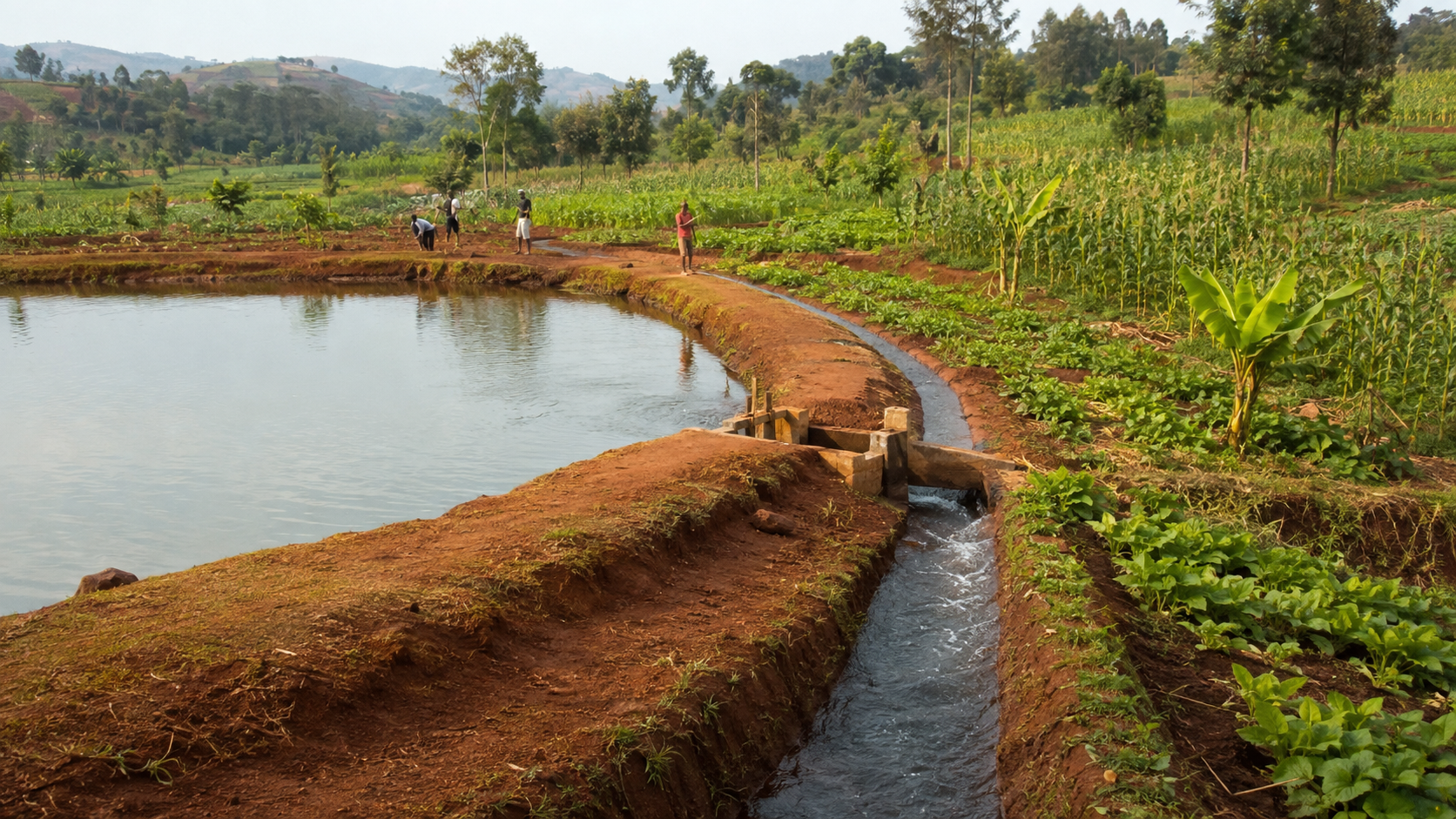
- Source type - perennial river or stream, seasonal stream, lake, wetland-fed channel, borehole, shallow well, or constructed storage (pond or tank). Each has a different reliability profile and a different permitting pathway.
- Dry-season reliability - what does the source look like in the driest months, not the wettest? A source assessment done only in the rainy season will overstate what is actually available for irrigation later in the year. Where historical flow or water-level records are not available, this generally requires direct observation across at least one dry season, or professional hydrogeological assessment for groundwater sources.
- Competing users - other farmers, domestic water users, livestock, and downstream ecological needs (wetlands, rivers) that share the same source. Uganda's water permitting framework exists partly to manage exactly this kind of competition.
- Water quality - sediment load, salinity, and any contamination risk, which affects both crop suitability and filtration requirements for drip systems in particular.
Step 2: Confirm permitting requirements
Uganda regulates water abstraction under the Water Act, administered through the Ministry of Water and Environment's water resource planning and regulation function. According to the Ministry's published guidance, all major water users - whether abstracting water or discharging wastewater - are required to apply for a permit.[1] Specific thresholds and figures published by the Ministry include:
- A surface water abstraction permit is required for motorised pumping, or for diverting or impounding more than 400 cubic metres of water per day from a river, stream, or lake.[1]
- A groundwater abstraction permit is required for motorised extraction from boreholes, wells, or springs.[1]
- Published processing fees are 450,000 Ugandan shillings for each of the surface water and groundwater abstraction permit categories, with a 50,000 shilling renewal fee, and annual charges that scale with abstraction volume (as low as 200,000 shillings per year for 1-400 cubic metres per day, rising for higher volumes).[1]
- Applications are processed within 90 days of the Ministry receiving a complete application.[1]
These figures and thresholds should be reconfirmed directly with the Ministry of Water and Environment before budgeting, since fee schedules and procedures can change and this guide cannot substitute for a current official confirmation. Separately, some irrigation projects - particularly larger schemes, or those involving dams, wetland conversion, or river diversion - may trigger environmental assessment requirements administered by the National Environment Management Authority (NEMA) under the National Environment Act's project schedules, which classify projects as requiring mandatory assessment, possibly requiring assessment, or exempted.[2] Whether a specific small-scale project falls into one of these categories is not something this guide can determine in the abstract - it depends on project scale, location (including proximity to a wetland or protected area), and current schedule classifications, and should be confirmed with NEMA or a registered environmental practitioner before construction begins, especially for any project involving a dam, wetland, or riverbank works.
Step 3: Check whether you qualify for government cost-sharing
The Ministry of Agriculture, Animal Industry and Fisheries operates a Micro Scale Irrigation Program aligned with Uganda's National Irrigation Policy target of expanding irrigated area.[3] According to the Ministry's published programme description:
- The programme targets smallholder farmers transitioning from subsistence to commercial production, with support capped at 2.5 acres (about 1 hectare) per farmer.[3]
- Government funding covers between 25% and 75% of equipment costs depending on farmer and farm characteristics, with a stated maximum government contribution of 7.2 million Ugandan shillings per acre - meaning farmers contribute the remainder, cited as roughly 2-8 million shillings per acre depending on equipment and site factors.[3]
- Applications are submitted as an expression of interest through the farmer's Local Government, which then procures the equipment on the farmer's behalf following a successful application.[3]
This programme, its cost-sharing ratios, and its contact channel should be reconfirmed directly with MAAIF or the relevant Local Government office before assuming eligibility, since programme terms, funding availability, and application windows change over time and are not guaranteed to remain as described in the source cited here.
Step 4: Estimate crop water demand and irrigated area
Crop water requirement depends on the specific crop, its growth stage, local evapotranspiration (driven by temperature, humidity, wind, and sunshine hours), and soil water-holding capacity. There is no single figure that applies to "vegetables" or "maize" across Uganda's varied agro-ecological zones. Rather than adopting a generic figure, this step should be treated as a calculation to be done with an irrigation engineer or agronomist using local climate data and the specific crop and area in question. What you can determine yourself in advance is the maximum area you intend to irrigate and the crops you intend to grow in each season, since both directly scale the demand calculation.
Step 5: Calculate total dynamic head
Total dynamic head (TDH) is the total resistance a pump must overcome to deliver water at the required pressure at the field - not simply the vertical distance from source to field. According to university extension engineering guidance on irrigation water pumps, TDH is the sum of four components:[5]
- Static head - the vertical distance from the water source to the highest point of delivery (the elevation the pump must lift the water).
- Pressure head - the pressure required at the delivery point, converted to an equivalent height of water (roughly 2.31 feet of head per 1 psi of required pressure).[5]
- Friction head - resistance inside pipes, fittings, filters, and valves, which increases with pipe length and flow rate and decreases with larger pipe diameter.[5]
- Velocity head - the energy needed to keep water moving at the design flow rate; this component is usually small relative to the other three but is included in a complete calculation.[5]
Undersizing a pump relative to actual TDH is one of the most common reasons a system delivers far less water than expected, particularly at the far end of a field or at the top of sloped land. Pump type should also be matched to the source and site: centrifugal pumps suit sources with a shallow lift and a steady supply, while submersible pumps suit boreholes and deep wells.[5] This is a calculation worth doing on paper with an engineer before ordering equipment, not one to leave to a supplier's default recommendation based on plot size alone.
Step 6: Plan pipe sizing, pressure zones, and filtration
- Pipe diameter should be selected to keep friction losses within an acceptable range at your design flow rate - undersized pipe increases friction loss and reduces pressure at the far end of the system.
- Irrigation zones (dividing a large field into sections irrigated in sequence rather than all at once) may be necessary where the water source or pump cannot supply the full field simultaneously at adequate pressure.
- Filtration matters most for drip irrigation, where small emitter openings clog easily with sediment, algae, or organic matter; the filtration requirement depends on water source and quality, and should be confirmed with the equipment supplier or an irrigation engineer based on your specific water source rather than assumed from a generic product listing.
- Flushing - the ability to periodically flush sediment from mainlines and driplines - should be designed into the system rather than added afterward.
Step 7: Decide on energy source
Small-scale pumps in Uganda are commonly powered by grid electricity (where available and reliable), diesel or petrol generators, or solar photovoltaic systems. Each has different cost categories (capital cost, fuel or electricity cost, maintenance cost) and different reliability characteristics - solar depends on sunlight availability and battery or direct-drive configuration, fuel-powered systems depend on consistent fuel access and generator maintenance, and grid power depends on local supply reliability, which varies significantly across Uganda's districts. This guide does not recommend one energy source as universally best; the right choice depends on your site's grid access, budget structure, and tolerance for maintenance complexity.
Step 8: Plan for maintenance and spare parts
Before purchase, ask the supplier directly:
- What is the expected service life of the pump and filtration components under continuous irrigation use?
- Where are spare parts stocked, and what is the typical lead time to obtain them in your district?
- Is local technical support available, or does a technician need to travel from another region?
- What is the warranty period and what does it cover?
- Are consumable parts (filters, seals, drip lines) available locally, or do they need to be imported?
A system that cannot be serviced locally within a reasonable time frame carries a higher risk of extended downtime during the growing season than one with slightly lower rated efficiency but strong local support.
A staged approach: pilot before you scale
Rather than installing a full-field system in one step, consider piloting on a smaller area first - enough to validate that the water source performs as expected through a dry season, that the pump delivers adequate pressure across the intended distance, and that the maintenance plan works in practice - before committing capital to expand the system to the full planned area.
Local Ugandan considerations
Uganda's agro-ecological and infrastructure conditions vary significantly by location. Grid electricity reliability, water table depth, dry-season length, and access to irrigation technicians differ between, for example, the Lake Victoria basin, the semi-arid cattle corridor, and highland districts such as Kabale. Wetland-adjacent sites carry additional environmental sensitivity and are more likely to require NEMA engagement.[2] Farm size also matters: a subsistence farmer irrigating under half an acre has different equipment, financing, and permitting needs than a commercial operator irrigating several hectares for export-oriented horticulture. This guide provides the verification framework; the specific answers depend on your location and scale.
Common mistakes
- Sizing a pump by land area or horsepower alone, without calculating total dynamic head.
- Assessing the water source only in the wet season, then discovering it is inadequate in the dry season.
- Installing a drip system without adequate filtration for the water source, leading to repeated emitter clogging.
- Proceeding with abstraction without confirming permit requirements, risking legal and operational problems later.
- Assuming a government subsidy programme's terms without confirming current eligibility and funding availability.
- Choosing equipment based on the lowest capital cost without checking local spare-parts and service availability.
When professional support is required
- An irrigation engineer should calculate total dynamic head, pipe sizing, and pressure zones, and validate pump selection against your specific site and crop plan.
- A hydrogeologist should assess groundwater sources (boreholes, wells) for yield and sustainability before a borehole-fed system is finalised.
- The Ministry of Water and Environment (or its relevant regional office) should confirm current permit requirements, fees, and processing timelines for your specific abstraction source and volume.
- NEMA or a registered environmental practitioner should be consulted where a project involves a dam, wetland, or riverbank works, or where project scale may trigger environmental assessment requirements.
- MAAIF or your Local Government agricultural office should confirm current Micro Scale Irrigation Program eligibility and application procedure.
- An agronomist should help translate crop water requirement calculations into an irrigation schedule for your specific crops and growth stages.
Limitations of this guide
This article provides a verification framework, not a substitute for site-specific engineering design, hydrogeological assessment, or legal confirmation of permit requirements. It cannot establish the actual yield, flow rate, or water quality of your specific source - those require direct measurement or professional assessment. Government programme terms, fee schedules, and regulatory procedures referenced here were accurate as sourced at the time of writing but are subject to change; always confirm current requirements directly with the relevant authority before committing funds. This guide does not constitute engineering, environmental, or legal advice.
What to do next
- Observe or commission an assessment of your water source through at least one dry season before finalising equipment plans.
- Contact the Ministry of Water and Environment (or its regional office) to confirm whether your intended abstraction requires a permit, and what the current fees and timelines are.
- Contact MAAIF or your Local Government agricultural office to check current Micro Scale Irrigation Program eligibility.
- Engage an irrigation engineer to calculate total dynamic head and confirm pump and pipe sizing for your specific site.
- Pilot the system on a smaller area before scaling to your full planned irrigated area.