Most greenhouse temperature and humidity advice available online was written for Mediterranean, European, or North American climates, where the underlying problem is usually keeping heat in, not getting rid of excess heat and moisture. Uganda's near-equatorial, generally warm and humid conditions present a different challenge, and importing a foreign threshold without checking it against your own structure can lead to wrong decisions about ventilation, shading, and irrigation timing. This guide sets out how to measure your greenhouse climate and respond to it, rather than starting from a single imported number.
Direct answer
Diagnosing greenhouse heat and humidity problems starts with measurement, not assumption: record temperature and relative humidity at canopy height, at multiple points in the greenhouse, at morning, midday, evening and night, and compare these against outside conditions at the same times. Excess heat is usually addressed first through ventilation (roof and side vents sized and positioned correctly) and shading, not fans alone. Excess humidity and condensation are usually addressed through a combination of ventilation, irrigation timing (watering early enough that foliage dries before evening), plant spacing for airflow, and drainage. Published temperature and humidity thresholds vary significantly between sources because they were developed for different climates and crops - a Mediterranean source may recommend different ranges than a tropical one - so this guide explains where each figure comes from and why local verification against your own crop and structure is necessary before treating any number as a fixed rule. This guide does not replace direct monitoring of your own greenhouse or agronomic advice specific to your crop and location.
Who this guide is for
This is written for Ugandan greenhouse and shade-net operators growing any protected crop who are experiencing signs of heat stress, excess humidity, condensation, or humidity-related disease pressure, and for those designing a new structure who want to understand climate management before construction.
The problem this guide solves
Two things commonly go wrong. First, growers apply a single temperature or humidity "rule" found online without checking whether it came from a climate resembling Uganda's - a Mediterranean greenhouse paper's humidity target, for instance, was developed for a drier, more seasonal climate than most of Uganda experiences.[1] Second, growers treat heat and humidity as one problem to be solved with one action (usually "add fans"), when in practice they are related but separate variables that need separate diagnosis: a greenhouse can be well-ventilated and cool but still humid enough to promote disease if irrigation timing and airflow at canopy level are wrong.
Step 1: Measure before you act
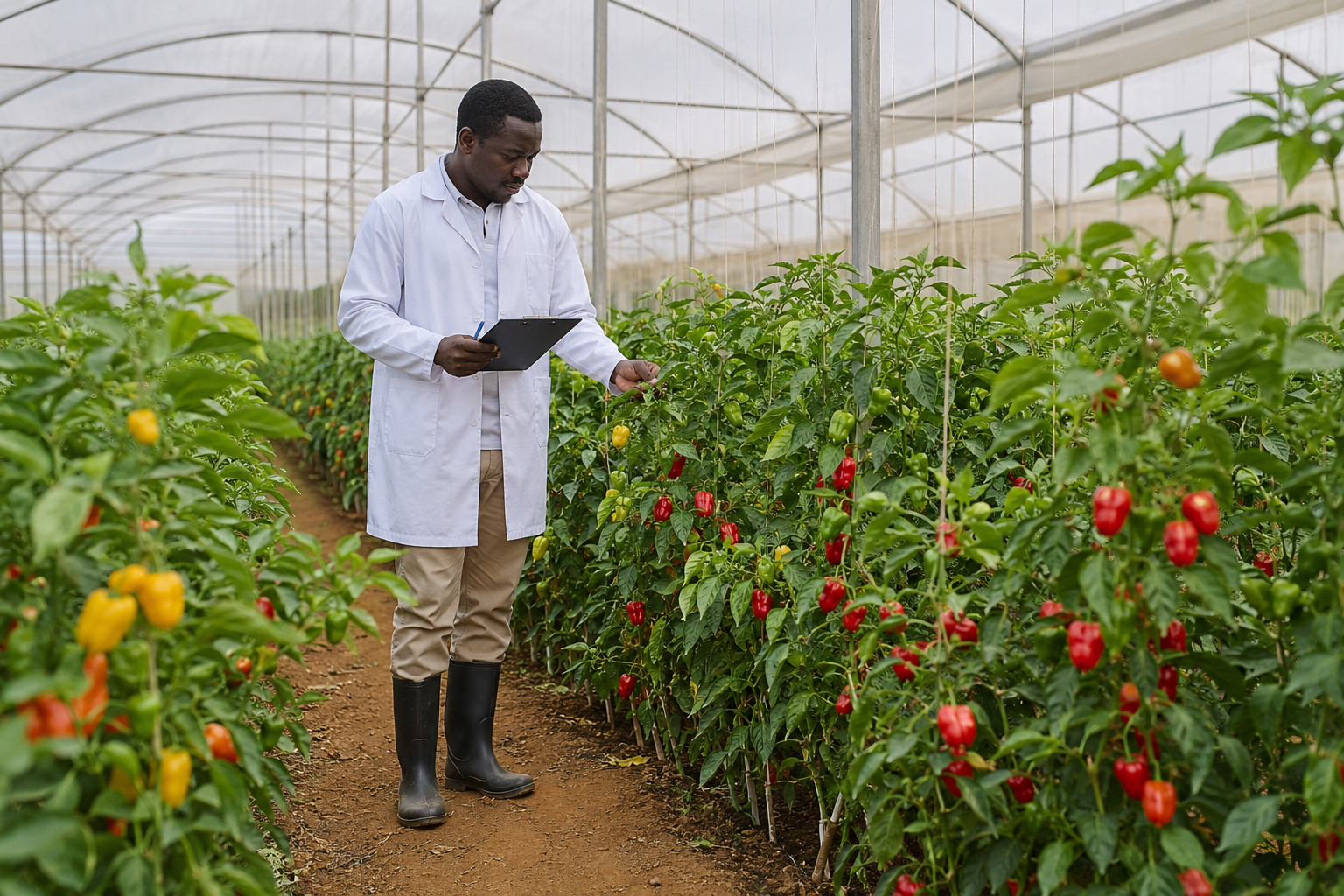
Place a thermometer and hygrometer (combined sensors are widely available and inexpensive) at canopy height - not at head height or near the greenhouse peak, where readings can differ substantially from what the crop actually experiences. Take readings at:
- Early morning (before sunrise or shortly after), when radiative cooling overnight often produces the highest relative humidity and greatest condensation risk.
- Midday, when solar heating is at its peak and temperature stress is most likely.
- Late afternoon/evening, as the structure cools and humidity typically rises again.
- Overnight, if condensation or disease problems are occurring, since prolonged surface moisture on leaves overnight is a widely recognised contributor to fungal disease risk.
Take multiple readings across the greenhouse (near vents, in the centre, near the ground and near the canopy) since temperature and humidity are rarely uniform throughout a structure. Compare every inside reading against an outside reading taken at the same time - this tells you how much the structure itself is adding to heat or humidity, which is the variable you can actually control.
Step 2: Understand what drives excess heat, and what to do about it
Natural ventilation - air moving through roof and side vents driven by temperature differences and wind - is generally the most economical way to manage excess greenhouse temperature, according to FAO's Mediterranean greenhouse guidance, though that guidance also notes that some target temperature differentials are difficult to achieve without mechanical ventilation under high solar load.[1] A tropical greenhouse manual developed for Caribbean conditions recommends roof vent area equal to roughly 20% of floor area, positioned on the leeward side, with side walls in excess of 3 metres to allow adequate air volume and stack-effect ventilation.[3] These figures come from a genuinely tropical context and are a reasonable starting reference, but they were developed for Caribbean structures and crops, not Ugandan ones, and should be checked against your own structure's performance rather than treated as an exact specification.
Insect screening reduces pest entry but also restricts airflow - one tropical greenhouse source notes that fine mesh suitable for whitefly exclusion can reduce ventilation by around 30%, which means mesh selection is a trade-off between pest control and cooling capacity, not a free addition.[3] External shading (shade cloth outside the greenhouse covering) is generally more effective at reducing heat load than internal shading, because it blocks solar radiation before it enters the structure, though canopy density and crop-specific light requirements also affect the right shading level for a given crop and growth stage.
Step 3: Understand what drives excess humidity and condensation, and what to do about it
Condensation forms when warm, moist air inside the greenhouse contacts a cooler surface - commonly the roof covering overnight as the structure radiates heat outward faster than the air cools. FAO's Mediterranean guidance notes that condensation droplets on greenhouse covers can reduce light transmission by as much as 20%, in addition to promoting fungal disease when droplets fall onto foliage.[1] Practical responses documented in temperate-climate greenhouse guidance - while not Uganda-specific - illustrate widely applicable mechanisms:
- Irrigate early in the day so that leaf and soil surfaces have time to dry before evening, reducing the moisture load that accumulates overnight.[4]
- Maintain adequate plant spacing and prune dense canopy to improve airflow at the crop level, since the zone immediately around and within the canopy is typically the most humid part of the greenhouse.[4]
- Keep air moving continuously, even gently, since still air allows moisture to settle and condense on leaf surfaces, while moving air reduces the duration of leaf wetness that fungal pathogens depend on.[4]
- Ensure drainage in the root zone and greenhouse floor, since standing water and waterlogged growing media add to the ambient moisture load and can independently cause root-zone oxygen problems unrelated to air humidity.
Step 4: Treat published thresholds as reference points, not universal rules
Published temperature and humidity targets vary meaningfully by source, which is itself informative. FAO's Mediterranean greenhouse guidance describes an optimal ambient temperature range of roughly 17-28°C with absolute limits around 12°C and 32°C, and a desirable relative humidity range of 70-90%.[1] A tropical greenhouse manual developed for Caribbean conditions instead describes an optimal relative humidity target closer to 50-70%, with stress appearing below 30% and growth inhibition above roughly 30-35°C.[3] These figures disagree because they come from different climates, different crop mixes, and different growing objectives - neither should be treated as the correct number for a Ugandan greenhouse without checking it against your own crop's known requirements and your own structure's actual performance. Where crop-specific literature (for example, sweet pepper production guidance) gives a narrower range for a particular crop and growth stage, that crop-specific figure should generally take precedence over a general greenhouse-climate figure, and should still be checked against local monitoring.
Disease-risk thresholds are also stage- and pathogen-specific: temperate-climate research cited by university extension sources describes fungal-disease-relevant humidity thresholds that rise with temperature (for example, thresholds around 83% relative humidity at 10°C rising to around 95% at 30°C in one commonly cited temperate framework), reflecting that the relationship between humidity and disease risk is not a single fixed percentage but depends on temperature and the specific pathogen.[4] How long free moisture remains on the leaf surface (leaf wetness duration) is also relevant to fungal infection risk independent of the ambient relative humidity reading, which is one reason relative humidity alone is an imperfect proxy for disease risk - though the growing practices already listed above (irrigation timing, spacing, and continuous air movement) address this mechanism regardless of whether it is tracked as a separate measurement.
Records to keep
- Daily or twice-daily temperature and relative humidity readings at canopy height, inside and outside, with time of day noted.
- Ventilation actions taken (vents opened/closed, shading applied/removed) and the time of each action.
- Irrigation timing and duration.
- Disease or pest observations, with date, location in the greenhouse, and crop growth stage.
Keeping these records over a full season allows you to correlate specific climate conditions with disease outbreaks or crop stress on your own site - which is more reliable for your specific structure and crop than any imported threshold on its own.
Local Ugandan considerations
Uganda's altitude, rainfall pattern, and proximity to the equator mean conditions differ meaningfully by location: highland districts such as Kabale experience cooler, sometimes drier air than the Lake Victoria basin, while lowland and lake-adjacent areas tend toward higher ambient humidity year-round. A greenhouse in a naturally humid, low-altitude location will need a stronger ventilation and drainage strategy than one in a cooler, drier highland site, even using an identical structure design. Seasonal rainfall variability also affects ambient humidity and the practicality of external shading and drainage. Farm scale matters too: a small hobby or trial greenhouse has more flexibility to adjust ventilation manually than a larger commercial structure, which may need engineered ventilation calculations from the outset.
Common mistakes
- Applying a single imported temperature or humidity threshold without checking its climate origin or your own readings.
- Measuring temperature and humidity only at one point (often near the door) rather than at canopy height across the structure.
- Treating heat and humidity as the same problem requiring the same fix.
- Irrigating late in the day, leaving foliage wet overnight.
- Choosing insect mesh density without accounting for its ventilation trade-off.
- Ignoring root-zone drainage as a humidity contributor.
When professional support is required
- An agronomist should confirm crop-specific and growth-stage-specific temperature and humidity targets for your particular crop, rather than relying on general greenhouse-climate figures.
- A greenhouse structural engineer or designer should be consulted when planning vent sizing, orientation, and mechanical ventilation for a new or expanding commercial structure.
- A plant pathologist or extension officer should be consulted for diagnosis when disease symptoms appear, since humidity is one of several contributing factors and visual diagnosis alone can be unreliable.
- An irrigation specialist should be consulted where irrigation timing and greenhouse humidity need to be jointly optimised (see also Small-Scale Irrigation Planning in Uganda).
Limitations of this guide
This article explains mechanisms and gives reference figures with their source context; it cannot tell you the correct temperature or humidity target for your specific crop, growth stage, and structure without local measurement. No Uganda-specific peer-reviewed research on tropical greenhouse microclimate management was located during this research pass - the tropical reference cited here was developed for Caribbean conditions, and the other cited sources are Mediterranean or temperate. All numeric thresholds in this article should be treated as reference points requiring verification against your own monitoring data and, where available, crop-specific agronomic guidance, not as guaranteed correct values for Uganda.
What to do next
- Install a thermometer/hygrometer at canopy height and begin twice-daily readings, inside and outside, for at least two to four weeks.
- Compare your readings against the reference ranges in this article, noting that they come from Mediterranean and Caribbean sources respectively, not Uganda.
- Adjust one variable at a time (ventilation, shading, irrigation timing) and record the effect before making further changes.
- Consult an agronomist for crop-specific thresholds relevant to what you are growing.
- If disease symptoms appear, keep dated records and involve a plant pathologist or extension officer rather than relying on humidity data alone to diagnose the cause.