Greenhouse sweet pepper is often promoted in Uganda as a high-value crop without much explanation of what "sweet pepper" actually means botanically, what buyers specifically require, or how to test the concept on a small scale before committing significant capital to a structure. This guide works through the planning decisions in order: what the crop actually is, how to establish and manage it, what determines marketable versus total yield, and what a pilot should look like before scaling.
Direct answer
Sweet pepper (bell pepper, Capsicum annuum) is a distinct crop identity from hot/chilli peppers - the distinction is based on capsaicin content, not just size or colour, and buyers, seed suppliers, and market standards treat them as separate products.[1] A commercially credible greenhouse sweet pepper project in Uganda requires confirming market demand and buyer specifications before construction, establishing healthy transplants, managing plant support and canopy density through the crop cycle, maintaining consistent irrigation and calcium availability to avoid blossom-end rot, and harvesting at the colour and firmness stage the buyer requires - since total fruit produced and marketable fruit accepted by a buyer are not the same number. This guide does not provide yield or profit estimates, because no verifiable Uganda-specific figures were found during research; any such figures should be requested directly from an agronomist or extension officer familiar with local conditions, and treated cautiously even then. A pilot planting on a small area, run through at least one full crop cycle, is a reasonable way to test these variables before scaling.
Who this guide is for
This is written for Ugandan farmers, farm managers, and investors evaluating a new or expanding greenhouse sweet pepper enterprise, and for agricultural professionals advising on such a project. It assumes the reader has not yet finalised buyer arrangements or committed to greenhouse construction.
The problem this guide solves
Two confusions recur in Ugandan greenhouse-farming discussion. First, "pepper" is used loosely to cover both sweet (bell) pepper and hot/chilli pepper, which are grown, marketed, and priced differently - a project plan based on hot pepper economics or agronomy will not transfer directly to sweet pepper. Second, promotional content typically skips from "plant it" to "profit," omitting the buyer-specification and quality-grading step that actually determines what portion of a harvest is sellable at a given price, versus rejected, downgraded, or sold into a lower-value channel.
Step 1: Confirm crop identity and market before building anything
Sweet peppers (bell peppers) belong to the species Capsicum annuum and are classified as "sweet" because they contain no measurable capsaicin (0 Scoville Heat Units), distinguishing them from hot peppers, which range from mild to extremely hot depending on species and variety (for example, Capsicum chinense habaneros or Capsicum frutescens tabasco-type peppers rank far higher on the Scoville scale).[1] This matters for planning because seed selection, spacing systems, buyer relationships, and price points differ between the two crop types - a plan should specify which crop is intended from the outset rather than treating "pepper" as one undifferentiated product.
Before committing to construction, identify who will buy the crop and under what specification. Fresh sweet peppers sold into graded commercial or export channels are commonly classified against a formal quality-grading framework. The United States Department of Agriculture's Agricultural Marketing Service, for example, publishes a sweet pepper grading standard with three classes - U.S. Fancy, U.S. No. 1, and U.S. No. 2 - distinguished by shape, firmness, minimum size (U.S. Fancy requires a minimum diameter of about 3 inches and length of about 3.5 inches; U.S. No. 1 requires a minimum diameter and length of about 2.5 inches), colour development (at least 90 percent of the specified colour where a colour designation is claimed), and defect tolerance (U.S. Fancy excludes sunscald, freezing injury, decay, scars, and hail damage; U.S. No. 1 tolerates minor such damage; U.S. No. 2 tolerates more significant damage while still requiring firmness and excluding major decay).[2] This is a United States standard, not a Ugandan or Uganda-facing export requirement, and is cited here to illustrate the kind of formal grading criteria - shape, firmness, size, colour percentage, and named defect categories - that a buyer specification is likely to reference in some form; the specific criteria a Ugandan grower must meet depend entirely on the actual buyer and market, and should be obtained directly from that buyer rather than assumed from any single country's published standard. Related guidance for the broader fresh chilli/capsicum category, published by the Centre for the Promotion of Imports from developing countries (CBI, part of the Netherlands Ministry of Foreign Affairs), describes typical European buyer requirements including consistent size grading, minimal skin defects, firmness, phytosanitary certification, and compliance with maximum pesticide residue levels.[3]
On EU import controls specifically: the current EU Commission Implementing Regulation on temporary increased official controls on certain imported food (Regulation (EU) 2026/194, in force as of January 2026) lists Uganda in its control annex for "peppers of the genus Capsicum (other than sweet)" - that is, hot/chilli peppers, not sweet/bell peppers - at a 50 percent physical/identity check rate for pesticide residues.[4] This article verified this directly against the current regulation text rather than a secondary summary. On the evidence reviewed, sweet (bell) peppers specifically are not listed in this particular control category for Uganda as of the version of the regulation checked; this status can change with each periodic update to the regulation, so any grower or exporter planning EU sales should independently reconfirm the current control status and the current CN product code classification directly against the latest EU regulation, or with a customs/trade adviser, before relying on this distinction.
For sweet pepper sold into domestic Ugandan retail or wholesale markets rather than export, buyer specifications will differ and should be confirmed directly with the intended buyer (supermarket chain, wholesaler, hotel/restaurant supplier) rather than assumed from export standards.
Step 2: Establish healthy transplants
Sweet pepper is typically raised as transplants in a nursery before being moved into the production greenhouse, rather than direct-seeded. University extension guidance on pepper transplant production notes that growers can either raise their own transplants or purchase certified, disease-free seedlings, and that transplanting can be done by hand or with mechanical setters at larger scale.[5] Whichever method is used, transplants should be free of visible disease and pest symptoms, appropriately hardened off before moving into the greenhouse environment, and planted into a growing medium or soil that has been assessed for fertility and drainage - see the existing Soil Testing and Fertility Management in Uganda guide for sampling and interpretation procedure.
Step 3: Plan plant support and canopy management
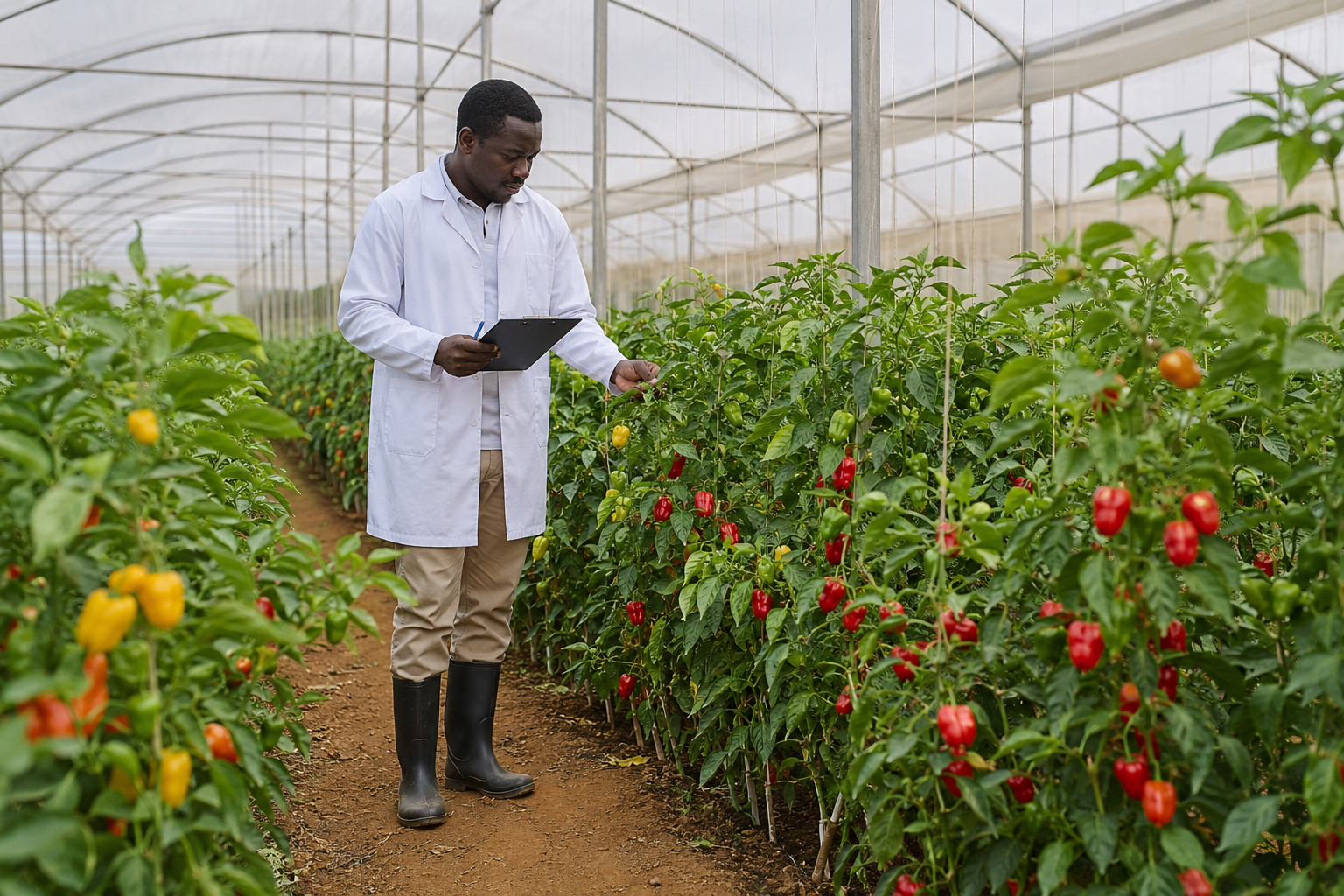
Sweet pepper cultivars grown under greenhouse conditions, particularly indeterminate types, generally require ongoing pruning and training to balance vegetative growth against fruit production; unmanaged canopy growth can result in excessive leaf density, reduced light penetration, and higher humidity within the canopy, which in turn raises disease risk (see Managing Greenhouse Heat and Humidity in Uganda for the climate-management side of this).[6] Plant support systems - stakes, strings, or trellis netting - should be installed early in the crop cycle, since retrofitting support to an already-sprawling plant is more difficult and can damage the crop.
Step 4: Manage flowering, fruit set, and fruit load
Fruit set in sweet pepper is influenced by temperature, humidity, and plant vigour; excessive vegetative growth at the expense of flowering, or conversely excessive fruit load relative to the plant's capacity, can both reduce marketable yield. Growers commonly manage fruit load through selective pruning and, in some systems, targeted removal of excess flowers or small fruit early in the cycle to concentrate the plant's resources on a manageable number of fruit - the appropriate fruit load depends on cultivar, plant spacing, and growing conditions, and is a decision best made with input from an experienced greenhouse agronomist rather than applied as a fixed rule.
Step 5: Manage root zone, irrigation consistency, and calcium availability
Consistent irrigation matters for sweet pepper not only for general plant health but specifically because calcium uptake and distribution within the plant depend on active transpiration; university extension guidance on greenhouse vegetable fertiliser management explains that calcium moves into fruit tissue via the plant's transpiration stream, and that irregular water availability, or conditions that suppress transpiration (such as prolonged high humidity), can starve fruit tissue of calcium even when soil or substrate calcium levels are adequate - a leading cause of blossom-end rot, a common and yield-limiting fruit disorder in peppers.[7] Healthy, actively growing root systems are also important for calcium uptake specifically, since most calcium absorption occurs just behind the root tip; root disease or root-zone waterlogging can therefore contribute to blossom-end rot independently of irrigation scheduling.[7] This reinforces the importance of coordinating irrigation planning (Article 7) and greenhouse climate management (Article 8) with root-zone and fertility planning (existing Article 5) rather than treating them as unrelated decisions.
Step 6: Harvest at the correct maturity and handle post-harvest carefully
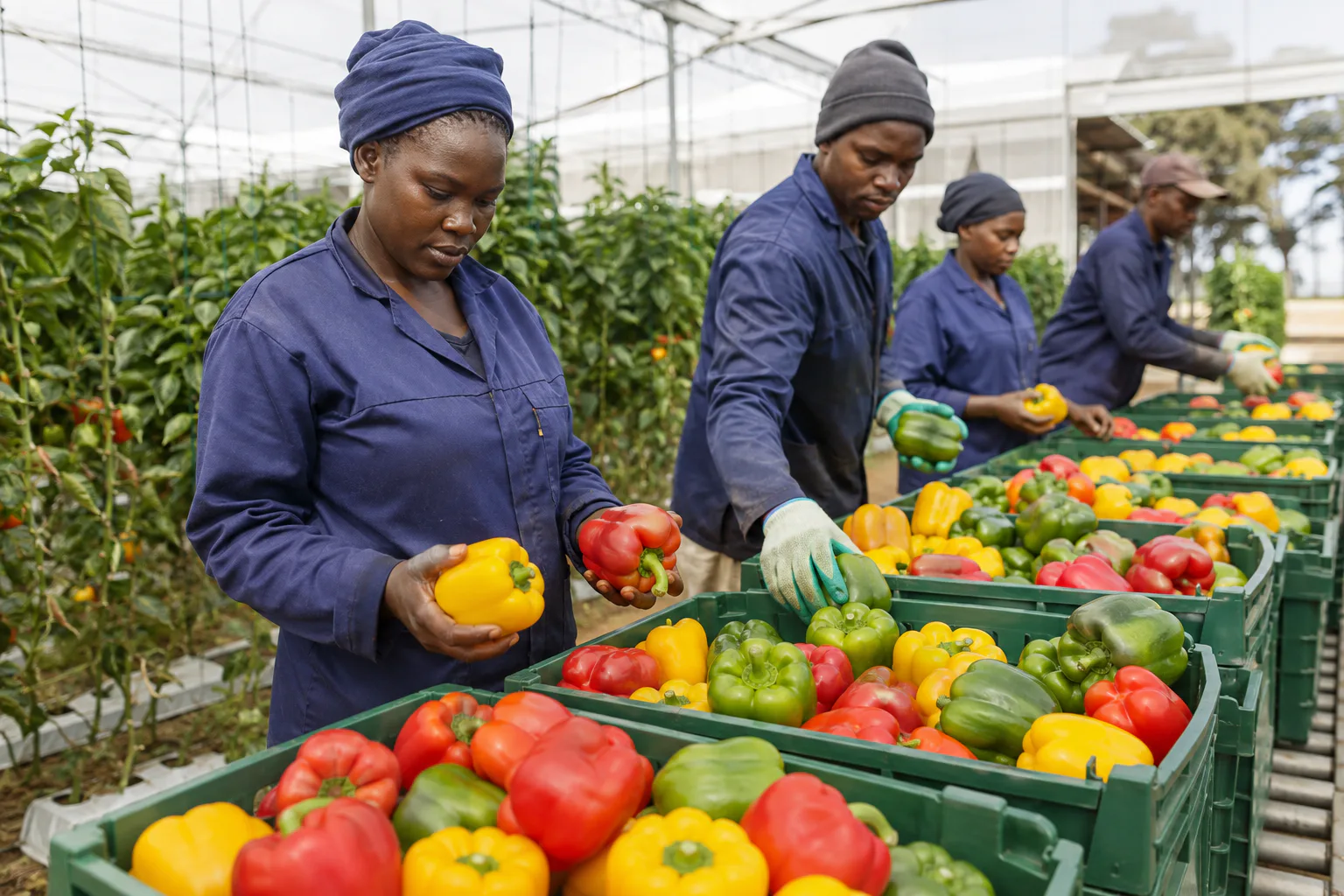
Harvest maturity depends on the buyer's colour and ripeness requirement. Some buyers accept green (physiologically mature but not yet coloured) sweet peppers; others require full colour development (red, yellow, or orange depending on cultivar), which typically requires leaving fruit on the plant longer and accepting a longer crop cycle and a higher disease-exposure window per fruit.[5] Confirm the buyer's colour and size requirement before harvest planning, not after. Post-harvest handling should minimise mechanical damage (bruising, punctures) and manage field heat promptly, since fresh sweet pepper quality - firmness and skin condition in particular - degrades with poor handling and delayed cooling; specific cold-chain requirements should be confirmed with the buyer or, for export, with current phytosanitary and market-access guidance.
Marketable yield versus total yield
Total fruit produced by a crop cycle is not the same as marketable yield. Fruit affected by blossom-end rot, sunscald, misshapen development, disease lesions, or mechanical damage may be unsellable or only sellable into a lower-value channel. Because no verified Uganda-specific figures for the proportion of total yield that is typically marketable were found, this guide does not provide a number - growers should track this ratio themselves from their own pilot planting (see below) rather than assume a figure from another country's greenhouse operation transfers directly.
A pilot before scaling
Given the number of variables that are genuinely uncertain for a first-time Ugandan greenhouse sweet pepper project - local pest and disease pressure, actual achievable marketable-yield ratio, buyer reliability, and real operating costs - running a pilot on a limited area through at least one full crop cycle, with careful records, is a reasonable way to validate the concept before committing to a larger structure or additional capital. A pilot should be treated as a genuine test, with willingness to revise the plan (or stop) if the results do not support scaling, not as a formality on the way to a predetermined larger investment.
Records to keep
- Transplant source, date, and any disease/pest observations at establishment.
- Pruning and training actions and dates.
- Irrigation schedule and any interruptions.
- Fruit disorders observed (blossom-end rot, sunscald, misshapen fruit), with counts where practical.
- Harvest dates, quantities, and the proportion accepted versus rejected by the buyer, with reasons for rejection.
- Buyer feedback on quality, size, and colour.
Local Ugandan considerations
Greenhouse sweet pepper performance depends heavily on the interaction between the structure's climate management (see Article 8) and Uganda's local conditions - altitude, ambient humidity, and seasonal rainfall vary substantially between, for example, the Lake Victoria basin, highland districts such as Kabale, and drier cattle-corridor areas, and each will present different disease pressure and ventilation needs even in an identical greenhouse design. Input availability (certified seed, appropriate fertiliser and calcium sources, pest-control products) and access to agronomic advisory support also vary by district and should be checked locally before finalising a production plan. Farm scale matters: a small trial greenhouse has different capital, labour, and buyer-relationship requirements than a larger commercial structure aimed at export or supermarket supply.
Common mistakes
- Treating "pepper" as one crop without distinguishing sweet from hot pepper in planning, sourcing, and buyer discussions.
- Building a greenhouse before confirming a buyer and that buyer's specific quality specification.
- Delaying plant support installation until the canopy is already unmanageable.
- Allowing irrigation to become inconsistent, contributing to blossom-end rot.
- Assuming total fruit produced equals marketable, sellable yield.
- Scaling directly to a large structure without a pilot cycle to validate local performance.
When professional support is required
- An agronomist should confirm cultivar choice, spacing, pruning regime, and fruit-load targets appropriate to your specific site and market.
- A buyer or market-access adviser should confirm current quality specifications, grading standards, and (for export) current phytosanitary and inspection requirements before planning proceeds.
- An irrigation engineer (see Article 7) should be involved in system design to support the irrigation consistency this crop requires.
- A greenhouse climate specialist or agronomist (see Article 8) should help set ventilation and humidity management appropriate to your structure and location.
- A soil or growing-media laboratory (see existing Article 5) should be used to assess fertility and calcium status before planting.
Limitations of this guide
This article does not provide yield, cost, or profit figures, because no verifiable Uganda-specific data was found; any figures quoted elsewhere should be treated with caution unless their source can be confirmed. The grading criteria described are from a US standard, cited to illustrate the kind of specification a buyer may apply, not as the specification a Ugandan grower will necessarily face; the actual applicable specification must come from the buyer. The EU import-control status was verified against the current regulation at the time of writing but is periodically updated, so it must be reconfirmed before any export decision. This guide does not constitute agronomic prescription for a specific site; it is a planning framework.
What to do next
- Confirm whether your project is sweet (bell) pepper or hot/chilli pepper, and align seed, spacing, and buyer research accordingly.
- Identify and speak directly with your intended buyer(s) about quality, size, colour, and volume requirements before building.
- Commission a soil/growing-media assessment (see existing Article 5) and an irrigation plan (see Article 7) before construction.
- Plan greenhouse ventilation and humidity management appropriate to your location (see Article 8).
- Run a pilot planting through at least one full crop cycle, keeping the records listed above, before committing to a larger structure.