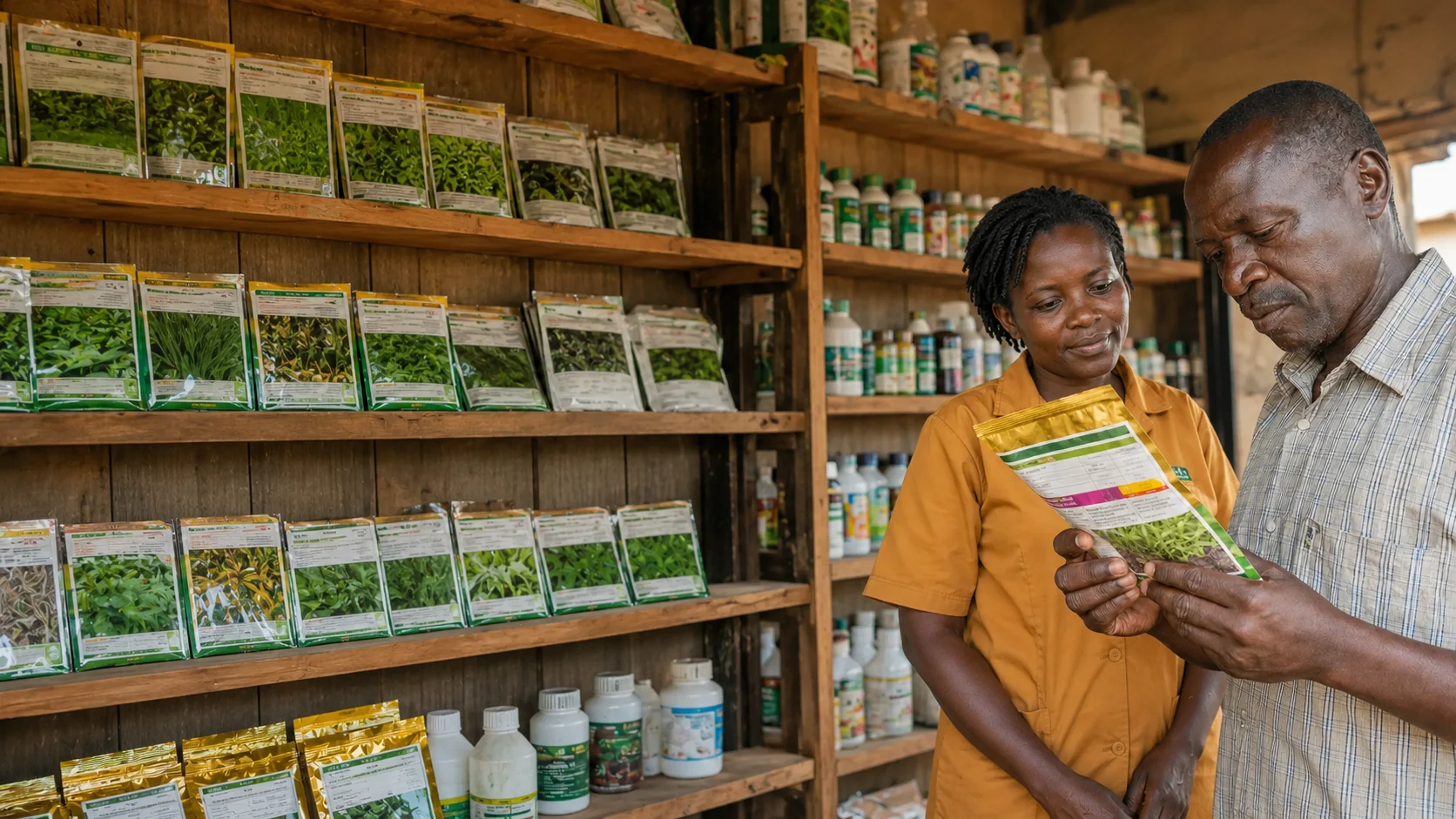
A sealed packet with a bright label and a familiar variety name does not, by itself, tell you whether the seed inside will germinate, grow true to type, or perform as implied. Uganda's seed market includes fully certified seed produced under formal quality control, a separately regulated Quality Declared Seed category that is inspected and laboratory-tested rather than simply self-declared, and a substantial volume of uncertified or counterfeit material sold alongside genuine product at markets, roadside stalls, and even some registered stockists. This guide sets out what to check before you buy, for both packeted seed and vegetatively propagated material such as cuttings, suckers, and seedlings.
Direct answer
Before buying seed or planting material in Uganda, check four things: the seller is a registered, identifiable dealer, not an unmarked source; the label or packet carries the information regulations require for its size - crop, variety, class, lot number, certifying-agency detail, correct class colour; the class matches your purpose, since certified seed, Quality Declared Seed, and standard seed each carry their own legally defined assurance system; and, where offered, the seed verifies through Uganda's seed-tracking system or direct NSCS confirmation. Sealed packets under five kilograms may legally print this information on the packet itself, so a small packet without an attached tag is not automatically suspicious. For cuttings, suckers, and seedlings, sold loose, verification instead depends on the source's registration, inspection tags, and traceability records, not appearance or a verbal answer. No single check is foolproof - this guide reduces the risk of an easily avoidable loss, not a guarantee against counterfeit material.
Who this guide is for
This is written for Ugandan smallholder and emerging-commercial farmers buying seed or planting material, nursery operators and cooperative buyers purchasing for others, and extension workers and agriculture students who need to explain Uganda's seed-quality framework in practical terms.
The problem this guide solves
A buyer at a stockist or market stall rarely has the time or background to interpret a seed label against the underlying regulation, and most available advice either repeats general principles that ignore Uganda's actual legal requirements, or describes the certification system in policy language without a usable checklist. This guide closes that gap: after reading it, you can look at a label or a seedling source and decide whether it meets a reasonable verification standard before committing money and a season's planting window.
Understanding Uganda's seed classes and labels
Uganda's seed system is legally structured under the Seeds and Plant Act, 2006, with labelling and testing requirements in the Seeds and Plant Regulations, 2017, and the QDS certification chain specifically governed by the Seeds and Plant (Quality Declared Seed) Regulations, 2020 (Statutory Instrument No. 5 of 2020).[1][2][8] The Act designates the National Seed Certification Service (NSCS) as responsible for seed certification, including registering and licensing seed merchants, conditioners, and dealers, and testing new varieties for release; NSCS operates through MAAIF's Department of Crop Inspection and Certification (DCIC), whose current mandate confirms responsibility for "registration and certification of seeds, planting materials, plant and plant products and agro-chemicals."[1][9] A National Variety Release Committee approves new varieties for the National Variety List, and a National Seed Board provides policy oversight, both under the same Act.[1]
The regulations set out six seed classes, each with its own label colour, from the earliest multiplication stage through to the categories most farmers actually buy:[2]
| Seed class | Label colour | What it generally means |
|---|---|---|
| Pre-Basic Seed | White with a violet diagonal stripe | Earliest multiplication stage from breeder seed; rarely sold directly to farmers |
| Basic Seed | White | Produced by breeding units; used mainly to produce certified seed |
| Certified Seed (1st generation) | Blue | Progeny of basic seed, meeting the prescribed certification standards |
| Certified Seed (2nd generation) | Red | A further multiplication generation from certified seed, still under certification standards |
| Standard Seed | Yellow | A lower formal category with less rigorous quality control than certified seed |
| Quality Declared Seed (QDS) | Green | Produced by a registered producer under NSCS-supervised field inspection and laboratory testing, from verified parent seed of a listed variety (see below) |
What certification labels must show
A full certification label, attached to larger seed containers, must state the crop, variety, seed class, seed lot number, net weight, a warning naming any poisonous seed dressing, the certifying agency's name and address, and the testing date; where applicable, the conditioner must also stamp a "plant by" date onto the packet.[2] A label missing several of these elements, or showing a mismatched colour, is a reason to ask direct questions before buying.
The regulations also set minimum standards by crop for germination, purity, and moisture - for example, maize requires at least 90% germination and 99% purity with a maximum 13% moisture, sorghum's minimum germination is lower at 80%, and moisture limits vary by crop (carrot seed is capped at 9%).[2] These are illustrative, not exhaustive, and not something a buyer verifies by eye - they show a defined, crop-specific standard exists and can be asked about.
What to check on small packets (under 5kg)
For containers under five kilograms, the regulations permit the core identifying information - lot number, date of sampling, cultivar and species name, any dressing warning, and the NSCS certification mark - to be printed directly on the packet, drawn from an already-tested bulk container, rather than requiring a separately attached label.[2] A small packet lacking a physically attached tag is therefore not, by itself, a warning sign - what matters is whether the printed information is present, legible, and consistent. A packet missing that information entirely, or showing no certification mark, remains a genuine concern.
Quality Declared Seed - how its assurance system actually works
Quality Declared Seed is a distinct, formally regulated certification category under the 2020 QDS Regulations, materially more than a producer's own unverified declaration, and sits within the broad concept recognised internationally by the FAO, though the procedures below are Uganda's own.[3] To produce QDS, a farmer or district-recognised farmer group must register with NSCS through their district agricultural officer's recommendation; NSCS reviews the application within fourteen days and, once satisfied on land, technical knowledge, facilities, and access to qualifying parent seed, issues a certificate of registration.[8] Production must start from verified basic seed of a National Variety List variety, with documentary records of that seed's origin, and is limited to one or two multiplication generations before a fresh parent-seed source is required.[8]
While the crop grows, an NSCS inspector must inspect the field at least once, covering at least ten percent of the declared acreage, checking isolation distance, off-type plants, weeds, and disease against published field tolerances - for cassava, this includes a zero-tolerance field standard for cassava mosaic disease and cassava brown streak disease.[8] After harvest, an NSCS inspector or sampler - not the producer - draws the sample under ISTA-based procedures for separate laboratory analysis of physical purity, germination rate, and moisture content at the National Seed Testing Laboratory.[8] Only once both the field inspection and the laboratory results meet these standards does NSCS issue a green, tamper-proof label, attached under an inspector's supervision and remaining government property.[8]
What genuinely differs from conventional certified seed is producer structure and scope, not the presence of testing: QDS is authorised for individual or small-group producers rather than larger seed companies, follows its own generation-limit rules, and is restricted to sale within the producer's registered district unless NSCS approves wider sale.[8] Validity periods are broadly comparable across categories - commonly twelve months for cereals, six for several other crops - so this is not a genuine point of difference. None of this makes QDS an unsupported self-declaration - it is a genuine, inspected and laboratory-tested pathway, scaled for smaller producers.
Step-by-step verification before you buy
- Confirm the seller is identifiable and, ideally, registered. A stockist with a fixed address and a traceable relationship to a seed company or the certification system is materially lower risk than an unmarked market seller.
- Read the label or packet against the checklists above. Check the full label on a larger container, or the equivalent printed information on a packet under five kilograms - crop, variety, class, and lot number should be present, legible, and consistent with the certification mark. A mismatched class name and colour is a specific, checkable red flag.[2]
- Match the class to your purpose. For the highest confidence in genetic purity, blue or red certified seed is more conservative than yellow standard seed; green QDS is a reasonable, government-inspected choice where certified seed of your variety is unavailable locally, provided you understand its narrower district sale restriction.
- Ask for, or attempt, digital verification where offered. MAAIF, NSCS, and partners have reported piloting a Seed Tracking and Traceability System letting a buyer verify a lot by QR code or USSD, the latter without internet access.[4][5] This remained a pilot with selected companies, so its absence does not itself mean the seed is fake - but use it where offered.[4][5]
- Ask for documented lot information rather than a verbal figure, such as a test certificate, label detail, or digital result, or ask whether NSCS can confirm the lot directly; not every dealer will have this, but one with nothing at all is a weaker source.
- Inspect the seed itself where possible. Uniform size and colour, no mould, insect damage, excess broken material, or unusual odour - useful as a warning sign, but seed that looks fine is not thereby proven genuine.
- Keep your receipt, the label or packet, and a photograph of both as evidence if a problem emerges after planting (see Records to keep, below).
Verifying vegetatively propagated planting material (cuttings, suckers, seedlings)
Cassava cuttings, banana suckers, sweet potato vines, and grafted fruit-tree seedlings are typically sold loose, so the checklist above does not apply in the same physical form. That does not mean this material sits outside Uganda's certification system: DCIC's mandate expressly covers "seeds, planting materials," and MAAIF publishes a Manual for Vegetatively Propagated Planting Materials alongside crop-specific manuals for cassava, sweet potato, and potato.[9][10] Genuine verification rests on that framework, not appearance or a verbal answer:
- Confirm the nursery or producer is registered with DCIC, evidenced by an official signpost at a registered mother garden or nursery; its absence is a genuine warning sign, not a neutral unknown.[10]
- Ask for the colour-coded certification tag - blue for certified/registered material, yellow for foundation stock, white for nuclear stock - carrying producer name, species/clone, and lot number.[10] Material with no tag where one is expected deserves the same caution as a missing seed label.
- Ask to see traceability and disease-indexing records (scion/rootstock source, pest control, disease-indexing results, sales); an inability to reference any such history is a materially weaker position.[10] A verbal "no disease problems" assurance is not sufficient - many relevant diseases are not visible at the cutting stage, which is why formal indexing exists.
- Check variety identity against the seller's claim, and for crops with known disease risk, consult the relevant crop-specific Falcon guidance on cassava disease and banana bacterial wilt management.
- Where value justifies it, consider a small trial planting first - see the low-risk testing approach below, though early growth cannot fully substitute for disease-indexing evidence.
Counterfeit seed in Uganda: scale and context
Uganda's National Seed Strategy and National Seed Policy, both 2018, state that an estimated 30 to 40 percent of seed sold in the country is counterfeit, and identify NSCS as lacking sufficient resources to fully enforce against this alone.[6][7] This figure is still cited in Ugandan press as recently as May 2026, with no updated measured replacement identified, so it should be read as a long-standing official estimate rather than a precisely current statistic; it remains a reasonable basis for treating verification as a useful precaution.[4][7]
The Seeds and Plant Act provides real consequences: a court may order forfeiture or destruction of substandard seed without compensation to the seller, and a conviction carries a fine or up to four years' imprisonment, or both.[1] Counterfeit seed is a legal matter in Uganda, not only a quality complaint - but this does not guarantee a specific case will be resolved quickly.
Warning signs
- No label or printed information at all, or missing several required elements (crop, variety, class, lot number, certifying-agency detail) - not just a missing attached label on a legitimate small packet, which regulations permit.
- A label or packet colour that does not match the stated seed class.
- A seller who cannot say who they are registered with, or avoids the question.
- A price unusually low relative to other sellers of the same variety and class, unexplained.
- Visible mould, insect damage, unusual odour, or excess broken material.
- Pressure to buy quickly, or reluctance to let you inspect the label closely first.
- For vegetative material, no registration signpost, certification tag, or traceability/disease-indexing records.
Common mistakes
- Assuming a professional-looking sealed label is automatically genuine.
- Treating a small packet's lack of a separately attached label as proof of a problem, rather than checking the printed information the regulations allow.
- Buying the cheapest option without checking whether class and certification match your purpose.
- Not keeping the label, packet, receipt, or a photographic record.
- Treating QDS as an unsupported self-declaration rather than a distinct, inspected and laboratory-tested pathway with its own scope and limits.
- Sourcing cuttings, suckers, or seedlings on price alone, without checking registration, tags, or traceability records.
- Planting an entire field from an unfamiliar source without a small trial first.
A low-risk way to test seed yourself
Before committing a full field to a new lot, especially from an unfamiliar source, a simple farmer-level germination check can be done at low cost. University extension guidance on the wet-paper-towel method describes counting out a random sample (commonly around 100 seeds, without culling damaged-looking ones), laying them on a thoroughly damp paper towel, covering with a second damp towel with an air gap, and keeping the sample sealed at a stable temperature out of direct sunlight; a seedling with a reasonable shoot and one strong root counts as a success, and the percentage is successes divided by total sample.[11] This is normally done after obtaining a sample, not as a guaranteed pre-purchase step; conditions differ by crop, and a small-sample home test is a useful estimate, not an official laboratory result.[11] A poor result is a genuine warning sign but does not alone prove counterfeiting, since poor storage after certification can also reduce germination - ask further questions rather than concluding fraud automatically. Do not assume you can return already-opened seed unless the seller's policy expressly allows it.
Records to keep
| Record | Why it matters |
|---|---|
| Seller name, location, registration status (if known) | Who to return to if a problem arises |
| Photograph or copy of the seed label | Primary evidence of class, lot number, certifying agency |
| Receipt with date, quantity, price | Proof of purchase and timing |
| Digital or NSCS verification result, if obtained | Shows authenticity was actively checked |
| Germination or field-performance result, if trialled | Compares actual performance against the claim |
| Correspondence with seller or certifying agency | Supports a complaint if material underperforms |
Questions to ask a supplier, laboratory, or extension officer
- Supplier: Are you a registered dealer, and with whom? Can you show documented lot information - a test certificate or certification label detail? Does this lot verify through the seed tracking system, or with NSCS directly?
- Nursery or vegetative-material source: Are you registered with DCIC, and can I see your signpost or certificate? Can you show the colour-coded certification tag and any traceability or disease-indexing records?
- NSCS or DCIC: Can you confirm this dealer, nursery, lot number, or variety is currently registered? What is the correct procedure for reporting suspected counterfeit or uncertified material?
- District agricultural or extension officer: Can you identify or confirm currently registered dealers or nurseries for this crop in this district, and is there a known local disease risk I should factor in?
Frequently asked questions
What do the colours on a Ugandan seed label mean? White with a violet stripe marks Pre-Basic Seed, plain white marks Basic Seed, blue marks first-generation Certified Seed, red marks second-generation Certified Seed, yellow marks Standard Seed, and green marks Quality Declared Seed, tied respectively to the 2017 Regulations and, for green QDS, the 2020 QDS Regulations' inspection and testing chain.[2][8] A separate colour system applies to vegetative planting material under MAAIF's nursery-stock manual: blue for certified/registered material, yellow for foundation stock, white for nuclear stock.[10]
What should I do if I think I have bought fake seed in Uganda? Keep the packet or label, your receipt, and any photographs, and report the concern to NSCS or DCIC, or raise it with your district agricultural office, which can direct you to the correct channel.[9] The Seeds and Plant Act allows a court to order forfeiture or destruction of substandard seed and a fine or up to four years' imprisonment for an offence, showing counterfeit seed is treated as a legal matter in Uganda - but this guide cannot promise how quickly, or whether, a specific complaint will be resolved.[1]
Study and field application
For students, lecturers, and trainee extension workers using this guide as a teaching resource:
- Obtain (or photograph, without opening) a certified seed label and a QDS label from two sources. Identify every element required under the 2017 Regulations, and note which, if any, are missing or unclear.
- Using the seed classes table above, explain why a lower-numbered certified-seed generation (blue) carries a different reliability profile from a higher one (red), and what this implies for how many seasons a farmer should re-use farm-saved seed from an originally certified lot.
- As a field exercise, run the farmer-level germination test on two seed lots, using obtained samples or legitimately purchased small quantities, and compare the estimated rate against the regulatory minimum for that crop. Discuss what conclusions can, and cannot, be drawn from a small-sample farmer test.
Local Ugandan considerations
Access to registered dealers and nurseries varies by district - buyers near major towns typically have more registered stockists than those in remote areas, where informal markets may be the most practical source despite higher risk. Crops also differ in how much supply moves through the formal system: staple cereals such as maize have a more developed commercial seed sector, while many legumes, root crops, and vegetatively propagated crops rely more on informal, farmer-to-farmer, or QDS-level systems. Where digital verification is not yet available, source and label verification remain the primary tools.
Limitations, risks and when to seek professional support
This guide describes a verification framework based on Uganda's current legal labelling and certification requirements; it does not guarantee detection of counterfeit or substandard material, and does not replace direct confirmation from NSCS, DCIC, or your district agricultural office. The commonly cited 30-40% counterfeit-seed estimate is a 2018 figure still referenced in 2026 press, not a precisely current statistic, and the digital tracking system remained a pilot with selected companies as of the most recent reporting, so coverage may be incomplete. Not every registered dealer or office can necessarily produce documented lot figures on demand - asking is reasonable, not guaranteed to succeed. For vegetative material, disease risk often cannot be confirmed by visual inspection or a verbal assurance alone; where crop-specific risk is significant, consult a plant-health professional before large-scale purchase, and do not treat registration or a general recommendation as equivalent to confirmed disease-testing evidence. This article offers no legal opinion on any specific supplier or transaction; report a suspected violation to NSCS, DCIC, or your district agricultural office directly.
What to do next
- Before your next purchase, review the label and packet checklists above and decide in advance which seed class suits your purpose.
- Ask your intended supplier whether they are a registered dealer and whether the lot can be verified through the seed tracking system or NSCS directly.
- For vegetative planting material, ask about nursery registration, certification tags, and traceability or disease-indexing records before buying, and consult the relevant crop-specific Falcon guide where one exists.
- Where practical, obtain a small sample or quantity first and run a farmer-level germination test before committing a full field, particularly from an unfamiliar source.
- Keep the label or packet, receipt, and any verification result as a simple record for at least one season after purchase.