
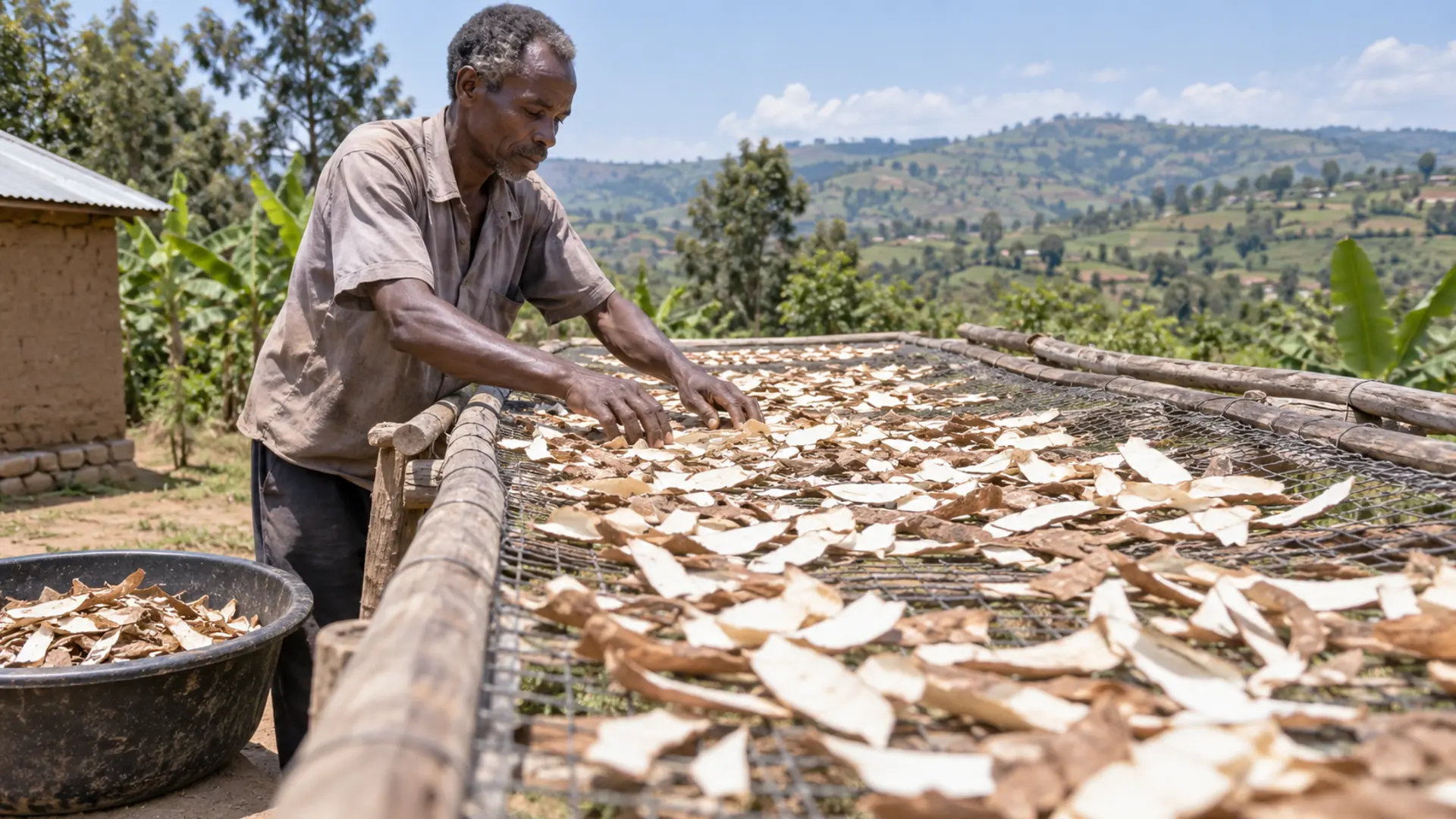
The peelings go in a basin and the basin goes to the animals. It has always worked, more or less, and it costs nothing.
The trouble starts when the quantity goes up. A farm that used to give a goat a handful of cassava peel now has sacks of it from a season’s harvest, and feeds it the same way. Or the cassava is a bitter variety this year. Or the peel sat in the sun for two days before anyone got to it.
These are the most abundant free feeds in Uganda and they are also the ones where the difference between a useful feed and a dangerous one is a processing step nobody was told about.
What this guide helps you decide
By the end you should know, for each part of each crop, what it is worth, what processing it needs, which animals it suits, and how long you have before it spoils. And you should understand why with cassava the controlling safety variable is the processing method rather than how much you feed.
It does not cover cereal residues or urea treatment, which have their own guides. It does not give the underlying toxicology in depth. And it deliberately gives no universal inclusion percentages, for reasons the cassava section explains.
The short answer
Cassava peel must be processed before it is fed, and drying is the practical method. Spread it thin, in the sun, in a single layer, for as long as it takes to go properly dry and brittle. Sun drying is documented to remove more than 86 per cent of the cyanide present.
Cassava leaf is a genuinely valuable protein feed and it must be wilted or dried first, never fed fresh in quantity.
Banana peel is best fed ripe rather than green, and is a modest energy feed rather than a protein one. Banana pseudostem is almost entirely water and cannot carry an animal on its own at any inclusion. Banana leaf is worth more than the pseudostem.
Sweet potato vine is the best of the whole group on protein and ensiles well. Sweet potato peelings spoil fast and mouldy ones are a real hazard.
All of these are supplements to a ration, not rations. Introduce every one of them gradually.
Why these materials matter in Uganda
The scale is not an impression. Uganda’s own agricultural statistics for 2024 record national production of plantain bananas at 11,797 thousand metric tonnes and cassava at 7,419 thousand metric tonnes.
The geography matters too, because it tells you which by-product you are likely to have. A geospatial study published in 2022 found that in 2016 banana cultivation was concentrated in the western region at 44 per cent and the central region at 36 per cent, against 18 per cent eastern and 2 per cent northern, and noted that in some eastern districts annual crops including cassava had replaced banana. An FAO country case study on cassava names Mbale, Iganga, Apac, Kamuli, Lira, Tororo and Kumi among the leading producers, and observes that the central region historically produced less because bananas and plantains have been the traditional staples.
Banana in the west and centre, cassava in the north and east, with the eastern districts shifting. That is the pattern behind which of these materials is sitting on your farm.
Cassava: why the processing method is the whole question
Cassava contains cyanogenic glycosides, compounds that release hydrogen cyanide when the plant tissue is damaged. The amount varies enormously by variety, plant part, maturity and how the material has been handled.
The peel is the dangerous part. FAO’s expert consultation on roots and tubers in animal feeding gives figures that make this concrete: in bitter varieties the peel measured 650 parts per million against 310 in the pulp, and in sweet varieties 200 parts per million in the peel against 38 in the pulp. Roughly double in the bitter case and more than five times in the sweet.
Peel is exactly what a livestock keeper ends up with, because the flesh goes to people.
Why ruminants are especially at risk. This is not obvious and it matters. Veterinary reference material explains that beta-glucosidase and hydroxynitrile lyase are present in rumen microbiota, and that a rumen pH of approximately 6.5 to 7 favours conversion of cyanogenic glycosides to cyanide. The rumen itself activates the toxin. An intact glycoside that would pass through another digestive system is broken down in the rumen into free cyanide.
What each processing method achieves. All figures below are from the FAO expert consultation, with the plant part and duration as stated there:
| Method | Reduction | Time | Note |
|---|---|---|---|
| Sun drying | More than 86 per cent of HCN lost, residual 10 to 30 per cent of the fresh sample | 1 to 3 days in the dry season, up to 8 days in the rains | The practical smallholder method |
| Soaking | About 20 per cent of free cyanide after 4 hours; much larger reductions over 3 to 5 days with the water changed | Hours to days | A short soak is not enough |
| Retting, meaning prolonged soaking then sun drying | About 98.6 per cent of the initial content in roots | Days | The most complete of the traditional methods |
| Ensiling chips | Reduced to 36 per cent of the initial value | 26 weeks | Slow, and less complete than often claimed |
| Ensiling roots with poultry litter | About 98 per cent of free cyanide lost | 8 weeks | A specific documented combination |
| Boiling | About 90 per cent of free cyanide in 15 minutes, but only 55 per cent of bound cyanide after 25 minutes | Minutes | Fast on free cyanide, poor on the bound fraction |
Two things follow from that table. First, boiling is not the answer it appears to be, because the bound fraction resists it. Second, the two ensiling figures are not the same and should not be quoted interchangeably: plain chip ensiling over 26 weeks left 36 per cent of the original cyanide, while ensiling with poultry litter over 8 weeks removed about 98 per cent of the free cyanide. Different materials, different durations, different measures.
The targets. The international feed database gives the benchmarks: well-processed cassava peels should have generally acceptable levels, below 50 milligrammes per kilogramme, and roots containing less than 0.01 per cent, meaning 100 milligrammes per kilogramme of hydrogen cyanide in the dry matter, are safe for use in animal diets.
Why we give no inclusion percentage. Because the numbers above make it meaningless. Correctly retted peel and peel that sat in a heap for a day are the same material with a tenfold difference in cyanide. A percentage cannot tell those apart. Process it properly and then feed it as part of a mixed ration, introduced gradually. That is the honest instruction.
Cassava leaf is the prize, and it needs handling too. Fresh cassava leaves contain approximately 24.9 per cent crude protein, and FAO’s figure for cassava leaf meal is an average of 21 per cent crude protein of which 85 per cent is true protein. That is a serious protein feed on a continent where protein is the binding constraint.
But fresh leaf cyanide runs from 80 to 2,000 milligrammes per kilogramme of dry matter depending on variety, maturity and handling. The FAO consultation documents that three days of wilting combined with chopping reduced HCN from 1,045 to 53 milligrammes per kilogramme of dry matter, a 96.3 per cent reduction. Ensiling for 21 days with 5 per cent sugar-palm syrup reduced fresh leaf from 508 to 70.7 milligrammes per kilogramme.
The feed database notes that for ruminants, fresh cassava foliage is a satisfactory protein supplement but should be wilted before feeding. Wilt it. Chop it. Do not cut a bundle of leaf and throw it straight to the animals in quantity.
Cassava root and root residue. An energy feed and nothing else: dehydrated root at 2.9 per cent crude protein against a metabolisable energy of around 14.2 megajoules per kilogramme of dry matter for ruminants. It must be paired with a protein source. The feed database notes ruminants can replace cereal grains with it up to 30 to 40 per cent of the diet, which is a figure from that source for that comparison and not a general licence.
Banana, Cassava and Sweet Potato By-Products: Which Part, Which Animal, What Processing
Cassava processing decision panel showing the cyanide reduction achieved by each method with its duration, beside the poisoning signs and the veterinary escalation instruction
Cyanide poisoning: what it looks like
Read this before you process your first batch.
How fast. Veterinary reference material states that clinical signs of acute cyanide poisoning generally occur within 15 to 20 minutes to a few hours, and that survival after onset of clinical signs is rarely more than two hours.
What you see. Distress, laboured and rapid breathing, staggering, collapse, convulsions. Animals are often simply found dead.
Chronic exposure. The same veterinary source describes chronic cyanogenic exposure being associated with syndromes involving posterior incoordination progressing to irreversible flaccid paralysis and urinary incontinence, and with late-term abortion. The FAO consultation reports chronic intake effects including reduced growth rate and elevated thiocyanate, which depletes sulphur amino acids and acts as a goitrogenic factor inhibiting thyroid function.
That chronic picture is the one to worry about on a farm feeding under-processed peel every day for months. It does not announce itself.
What to do. Call a qualified veterinarian immediately. This article gives no treatment. Stop feeding the batch, move other animals off it, and keep a sample.
Banana: three different materials
Banana peel. Dry matter content ranges from 13.1 to 17.9 per cent as fed, so it is 82 to 87 per cent water. Crude protein sits at 6 to 9 per cent of dry matter, and mature peel has a metabolisable energy around 9.5 megajoules per kilogramme of dry matter for ruminants.
The antinutritional factor is tannin, at 7 to 15 per cent of dry matter depending on ripening, higher when unripe. Ripening degrades it, and in green plantain peel the starch is fully transformed into sugars after ripening. So feed it ripe. Green peel is more astringent, less palatable and higher in tannin.
The feed database records dairy cows fed up to 21 kilogrammes of fresh ripe banana peel increasing milk production, which is a real and encouraging result.
And here is the Ugandan evidence that qualifies it. A Makerere University trial fed banana peel to steers on a basal elephant grass diet at 0, 20, 40 and 60 per cent inclusion. Rumen pH dropped to 5.8 and 5.9 at the 40 and 60 per cent levels respectively, and the researchers concluded that higher banana peel levels negatively affected feed degradability and the rumen environment.
That is a Ugandan trial on Ugandan animals showing a dose-dependent problem. It is not a universal ceiling, because it was one basal diet and one set of animals, but it tells you the direction: banana peel is fine as a component and becomes a problem as it approaches half the ration.
Banana pseudostem. Contains mostly water, 92 to 95 per cent, and very little protein at 3 to 4.5 per cent of dry matter. Neutral detergent fibre runs 50 to 70 per cent. Interestingly its digestibility, around 75 per cent, is higher than that of banana leaf at around 65 per cent.
It is easily ensiled if chopped and mixed with an easily fermentable carbohydrate source such as molasses or rice bran. Dried banana stalks have been fed to goats at 20 per cent of diet dry matter and to sheep up to 50 per cent with no adverse effects, though weight gains stayed low.
Understand what that means. Pseudostem is bulk and water. It fills an animal. It cannot meet requirements at any inclusion level without nitrogen and energy supplied alongside it.
Banana leaf. About 85 per cent water but 10 to 17 per cent protein on a dry matter basis, which is markedly better than the pseudostem. If you are cutting a plant down, the leaf is worth more than the stem.
Sweet potato: the best of the group, and one hazard
Sweet potato vine. Fresh forage averages 16.5 per cent crude protein, with dried vine at 13.2 per cent, and the protein content depends heavily on the leaf to stem ratio. The feed database notes it contains trypsin inhibitors but at relatively harmless levels and does not contain notable quantities of other antinutritional factors.
That combination, decent protein and no serious toxicity concern, makes it the easiest material in this article.
It ensiles well, and there is a Ugandan manual for it. A silage manual produced by Uganda’s National Livestock Resources Research Institute with ILRI, CIP and Makerere University gives a method smallholders can actually follow: spread the residues for at least half a day to reduce moisture, chop into 2.5 centimetre lengths, mix 5 kilogrammes of maize bran per 95 kilogrammes of chopped vine or sprinkle 1 litre of molasses diluted in 3 litres of water, pack into a sealed tube silo, and wait 21 to 30 days for fermentation to complete.
The international feed database gives a comparable method: chop to 0.2 to 0.5 centimetres, prewilt for one to four hours in the sun, and mix with 10 per cent rice bran or cassava meal and 0.5 per cent salt.
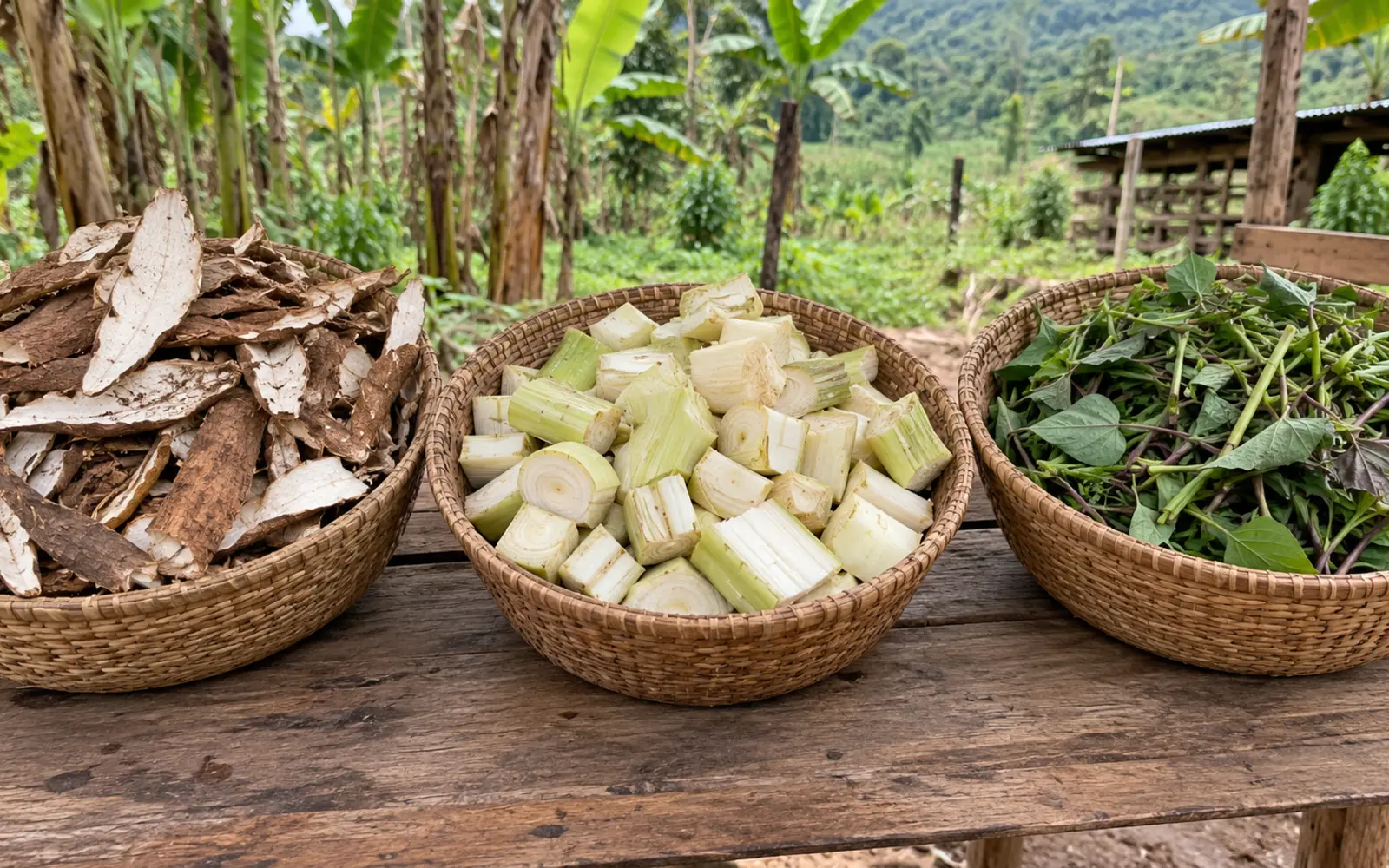
Does it work? An ILRI trial fed sweet potato vine silage with wheat bran to lactating dairy cows as a substitute for commercial concentrate. Milk yield was somewhat lower, at 6.2 against 7.5 litres per day in late lactation, but the margin over feed cost was substantially higher. That trial reported its costs in Kenyan shillings, so it appears to have been conducted in Kenya rather than Uganda, and should be read as regional evidence.
Less milk, more money. That is a real and useful finding for a farmer whose constraint is cash rather than production.
Sweet potato peelings and root residue. Fresh peelings run 26.8 to 31 per cent dry matter with crude protein averaging around 6 per cent and metabolisable energy for ruminants around 12.2 megajoules per kilogramme of dry matter.
The hazard is spoilage, and it is specific. The feed database states that moulds and bacteria develop readily in these materials, impairing their safety as feed ingredients, and that contaminated tubers produce compounds causing respiratory problems in animals. High moisture limits how far they can be hauled and how long they keep.
There is also a Ugandan farmer-reported caution worth passing on with its status attached. A Makerere survey of goat feeding in semi-arid Uganda recorded farmers saying that goats are known to die when they eat large quantities of potato peelings and then drink water, and that for this reason only small quantities are fed. That is a farmer observation recorded in a survey, not a controlled toxicology finding, and the mechanism is not established in that source. We report it because Ugandan goat keepers said it, and because it argues for the same rule as everything else here: small quantities, introduced gradually.
That same survey found sweet potato peels, banana peels and cassava peels together making up around 12 per cent of the goat diet, with crop residues another 15 per cent, and recorded that most farmers do not supplement, conserve or treat goat feeds. That is the practice this article is trying to change.
The material table
Everything above condenses into one page. The table sets each by-product against the six things you actually need to know before you carry a basin of it to the animals: how wet it is, what it is worth, what you must do to it first, which animals it suits, what to be careful of, and how long you have.
Banana, Cassava and Sweet Potato By-Products: Which Part, Which Animal, What Processing
Material table listing each by-product with its water content, processing needed, species suited and storage limit
Read it alongside two rules that apply to every row.
Everything here is wet. With the exception of dried products, every material in this article is between 70 and 95 per cent water. That governs how far you can carry it, how fast it spoils, and how much dry matter an animal actually gets from a basin that looks generous.
Introduce everything gradually. The feed database’s guidance on sweet potato roots applies across the group: they should be gradually introduced into the diet and offered with roughages to minimise the risk of digestive disturbances. A sudden change of feed is a risk in its own right, separately from any toxin.
Cost categories
These materials are free. The costs are all handling.
- Labour for collection, which is the real constraint and competes with harvest work
- Chopping, by panga or chaff cutter
- Drying space and racks, and the labour of spreading and turning
- Polythene tubing or a pit for ensiling, plus molasses or maize bran as the additive
- Transport from field or kitchen to the animals
- A trough, so material is not trodden into the ground
- Losses to spoilage, which on wet materials are routine rather than exceptional
- A protein or energy source to pair with the low-protein materials
Common mistakes
Feeding cassava peel unprocessed. The single most consequential error in this article. The peel carries several times the cyanide of the flesh.
Assuming a short soak is enough. About 20 per cent of free cyanide after four hours. It takes days with the water changed.
Trusting boiling. Fast on free cyanide, poor on the bound fraction.
Feeding cassava leaf fresh in quantity. Wilt and chop it. Three days of wilting with chopping cut cyanide by over 96 per cent in the documented case.
Feeding banana peel green. Higher tannin, lower palatability.
Pushing banana peel to half the ration. Ugandan trial data records rumen pH falling and degradability suffering at 40 and 60 per cent inclusion.
Treating pseudostem as feed rather than as bulk. Three to 4.5 per cent protein and over 90 per cent water.
Feeding mouldy sweet potato peelings. Named in the literature as producing compounds that cause respiratory problems.
Letting wet by-products sit. They spoil in hours in Ugandan heat, not days.
Changing the diet suddenly. Gradual introduction is the rule for every material here.
Warning signs and escalation points
Call a qualified veterinarian immediately if any animal shows distress, laboured breathing, staggering or collapse after eating cassava-derived material. The window between signs and death is short.
Investigate before feeding if:
- Cassava peel is still soft, bendy or smells fresh rather than being dry and brittle
- Any material shows visible mould, or smells musty, sour or sharp
- Sweet potato peelings have been standing more than a few hours in the heat
- Banana peel has blackened and gone slimy
- Animals that ate readily yesterday refuse the same material today, which usually means it has spoiled
- An animal shows unsteadiness in the hindquarters, or a cow aborts late in pregnancy, on a farm feeding cassava material regularly
Where this works, and where it does not
It works on a mixed farm growing these crops and keeping ruminants, where somebody will do the chopping, drying or ensiling. That labour is the whole cost and the whole barrier.
It works less well in three situations. Where nobody can commit to processing cassava properly, the honest answer is not to feed cassava peel at all rather than to feed it half-processed. Where the animals are young, pregnant or in peak production, these bulk feeds cannot carry them and the ration needs building around something else. And where the material has to travel any distance, the water content makes it uneconomic before it makes it unsafe.
An evidence note. Most of the composition figures in this article come from a compiled international feed database that aggregates many underlying trials, and the ranges are wide because varieties, maturity and handling genuinely differ. We have not traced every underlying study. The Ugandan primary work we could open is from Makerere University, and the sweet potato silage manual is a joint institute product. We found no Ugandan study of mould or mycotoxins in these materials specifically. Where a figure came from one trial, we have named the trial rather than presenting it as a general rule.
A low-risk first step
Take one material, the one you have most of, and process one batch properly. Not everything at once.
If it is cassava peel, spread a single thin layer on a raised rack in full sun and leave it until it is genuinely dry and snaps rather than bends. If it is sweet potato vine, wilt it half a day, chop it, mix in maize bran and tube it. If it is banana leaf, cut and wilt it.
Then feed that batch as a small part of the ration, to a few animals, alongside what they normally eat, and watch them for two days.
One batch done properly teaches you the labour it takes, whether the animals will eat it, and whether you can keep it up. It also limits what a mistake costs.
What to do next
- Work out which of these materials you actually have most of, by season.
- Choose one and commit to processing it properly rather than feeding several half-processed.
- Build a raised drying rack if cassava peel is your material, and use single thin layers.
- Set a household rule that no cassava-derived material is fed unless it has been dried or retted.
- Keep the low-protein materials, pseudostem and root residues, separate from the protein materials, leaf and vine, and ration them differently.
- Introduce anything new gradually over a week, alongside the existing feed.
- Put a trough in, so wet material is eaten rather than trodden.
- Read the cyanide poisoning signs to whoever feeds the animals, and put a veterinarian’s number somewhere visible.
Related reading: the published guides to year-round fodder planning for goats and cattle and integrated crop and livestock farming cover the system these materials fit into. Within the programme, see taking a local feed resource inventory - scheduled in this programme for finding what else is available, anti-nutritional factors in alternative feeds - scheduled in this programme for the underlying science, and getting real value from stover, straw and haulms - scheduled in this programme for the cereal side.
About the author
This guide was researched and written by the Falcon Foundation Ltd Editorial Team. Falcon Foundation Ltd is a privately owned Ugandan agricultural company producing greenhouse crops, livestock and honey. Our Knowledge Hub is written for Ugandan farmers making practical decisions with incomplete information. We give no treatment guidance, we give no universal inclusion percentages where processing decides the safety, and we distinguish farmer-reported observations from controlled findings.