Somebody tells you climbing beans give three or four times more from the same piece of land. That is broadly what the evidence shows, and on a small holding it is a serious argument.
Then the season starts and you discover that a plot of climbing beans needs several thousand stakes, that the eucalyptus you counted on belongs to somebody else, and that cutting and carrying stakes takes labour you do not have at exactly the moment you also need to plant.
This is the real decision. Not which bean yields more, but which bean system your land, your trees and your household labour can actually support.
What this guide helps you decide
This guide helps you answer one question: should I plant bush beans or climbing beans on this piece of land, this season?
It sets out the yield difference honestly, then works through the four things that decide whether you can capture it: altitude, land availability, staking material and labour. It ends with a staking material stocktake to complete before you buy seed.
It does not diagnose bean diseases, which our root rot guide covers, and it does not cover maize and bean intercropping in detail, which is a published guide of its own.
The yield difference is real, and it is large
NARO's own impact study on bean and maize technologies gives potential yields of up to 3,300 kilogrammes per hectare for bush types and up to 4,500 kilogrammes per hectare for climbing types [1].
A PABRA feature on climbing bean production in Uganda puts the difference more sharply, reporting climbing bean yields up to four times higher than bush types with farm gate prices around three times higher [2]. Evidence from Rwanda, where climbing beans have been adopted at scale, reports climbing beans yielding three to four times more than bush varieties, with adopters gaining around 270 kilogrammes per hectare more than non-adopters, and modelling that non-adopters could gain around 657 kilogrammes per hectare by switching [3].
Two cautions before you act on those numbers. First, "potential yield" is what a variety can do under good management, not what your field will do. Second, the PABRA price comparison is a feature article rather than a market survey, so treat it as an indication that climbing beans can attract a premium, not as a price you can plan on.
There is one further advantage that is easy to overlook. Staked beans can be harvested over a more continuous period than bush beans, and staking is associated with faster, healthier growth and reduced anthracnose [4]. For a household eating from the plot as well as selling from it, a longer picking window has real value.
Where climbing beans already work in Uganda
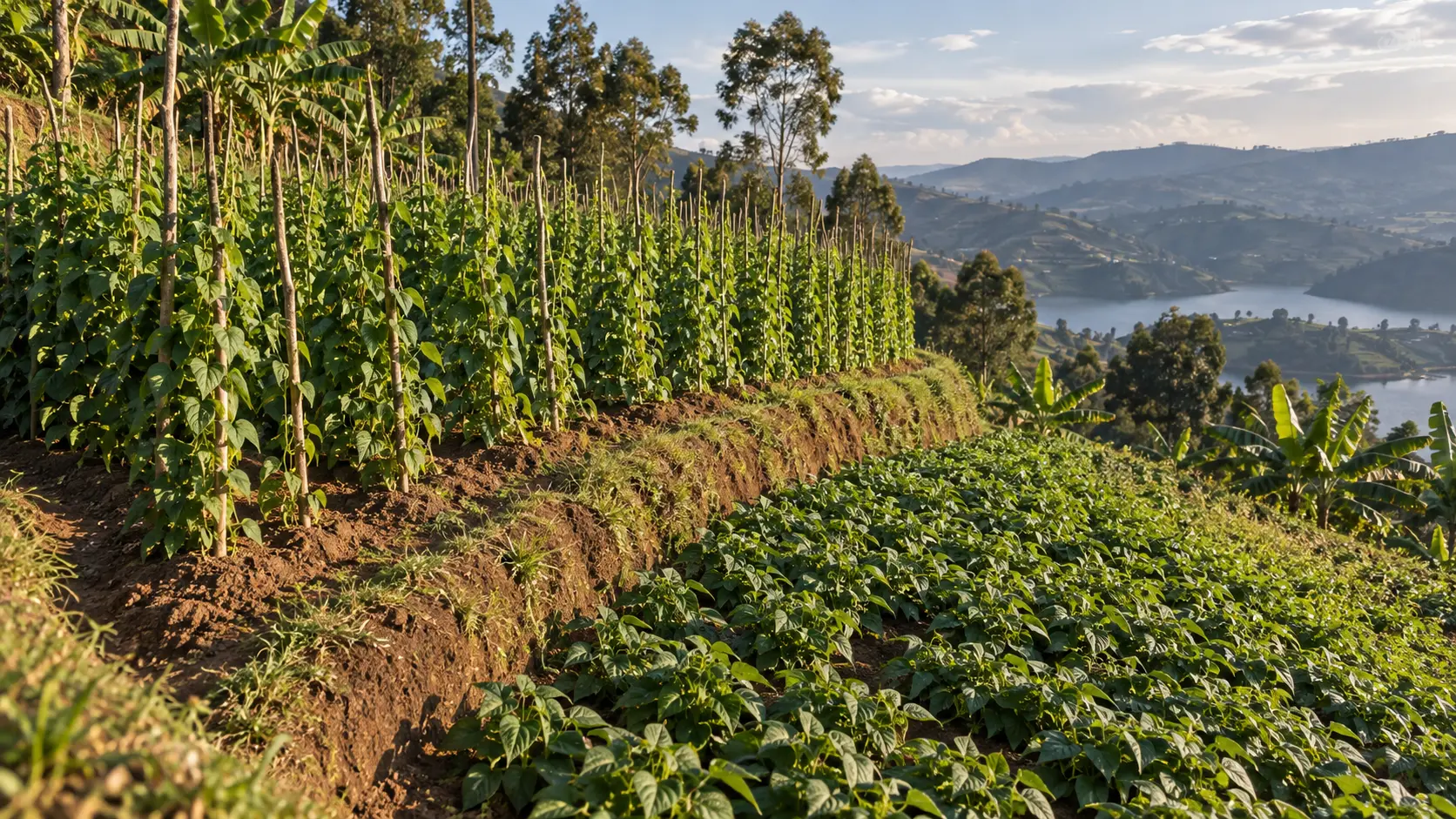
Climbing beans are concentrated where land is scarce and altitude is high. In the south west, a study of smallholder farmers found 72.7 per cent of surveyed households ranked climbing beans as their primary source of income [5]. PABRA reporting identifies major production in Masaka, Kabale and Mbale districts, with large-scale fresh bean cultivation in central Uganda [2].
The driver is land pressure, not fashion. Between 84 and 92 per cent of Ugandan farmers surveyed valued climbing beans specifically for their suitability to areas with limited land [5]. Work in Rwanda identifies elevation, population pressure on available land, and drought shocks as the three critical adoption drivers [6], and reports that about half of Rwanda's bean-producing households, some 785,714 families, now grow climbing beans on 43 per cent of the national bean area, with typical households farming under one hectare [3].
If you have plenty of land and lower altitude, the case for climbing beans weakens considerably.
The constraint that decides it: staking material
This is where most climbing bean plans fail, and the Ugandan evidence is unambiguous.
In the same south-western study, staking materials were cited as the primary and most limiting obstacle by 45 per cent of farmers in Kisoro and 59 per cent in Kabale. Other constraints varied by district: in Kisoro, diseases were named by 49 per cent and pests by 45 per cent, while in Kabale labour scarcity was named by 49 per cent [5].
That study's own recommendation to researchers was an urgent need to develop staking alternatives [5]. When the leading published study on climbing beans in Uganda concludes that the staking problem is unsolved, a farmer should treat it as the central question rather than a detail.
What the staking options actually are
A field trial in the Burundi highlands across ten sites over two seasons compared three staking systems directly [7]:
- Sticks, meaning conventional single stakes, gave the highest grain yield.
- Strings gave yield equivalent to sticks, and the study concluded strings can substitute for sticks without a reduction in production.
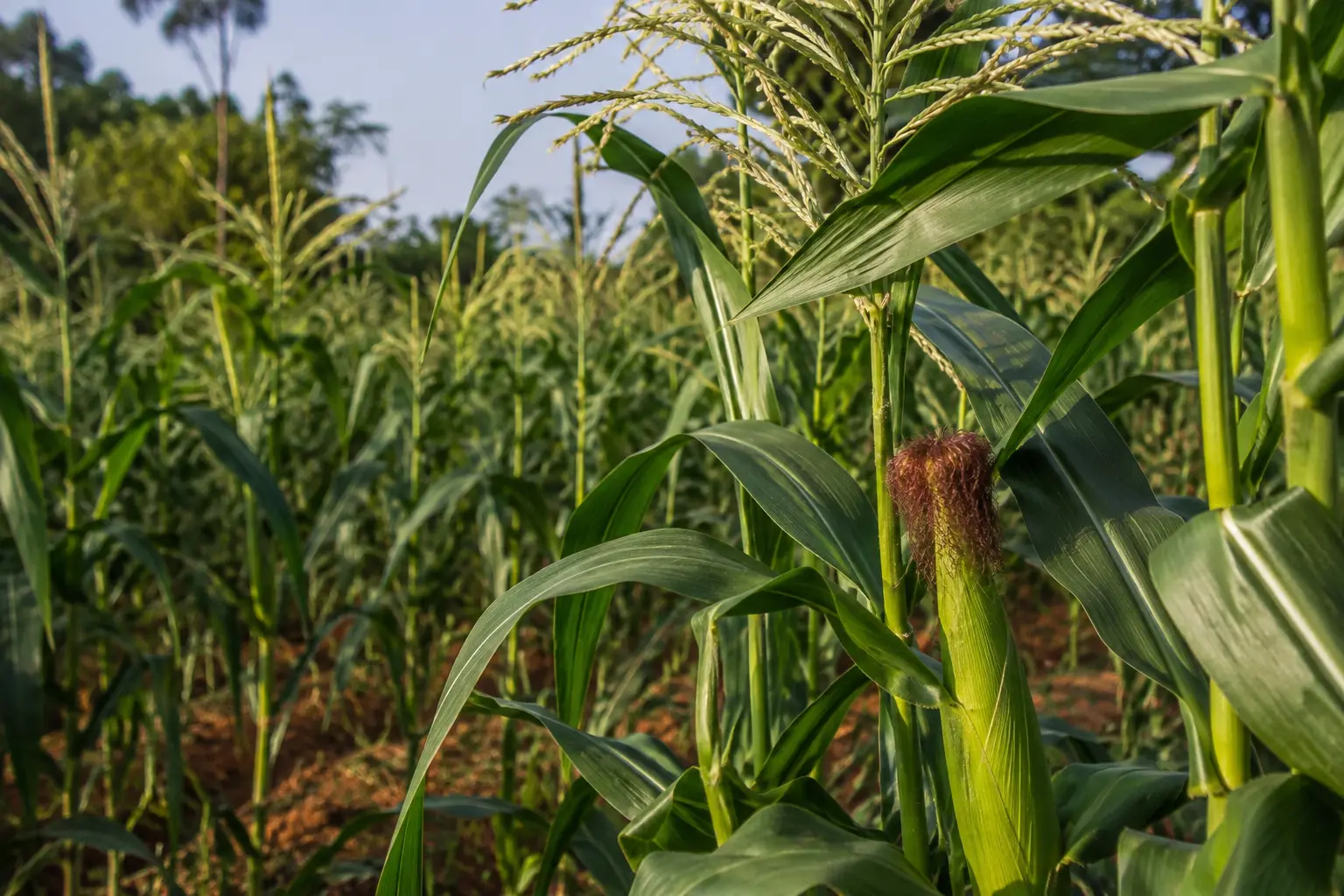
- Maize intercropping, using a live maize plant as the support, yielded less grain than sticks but was the most economically efficient option overall.
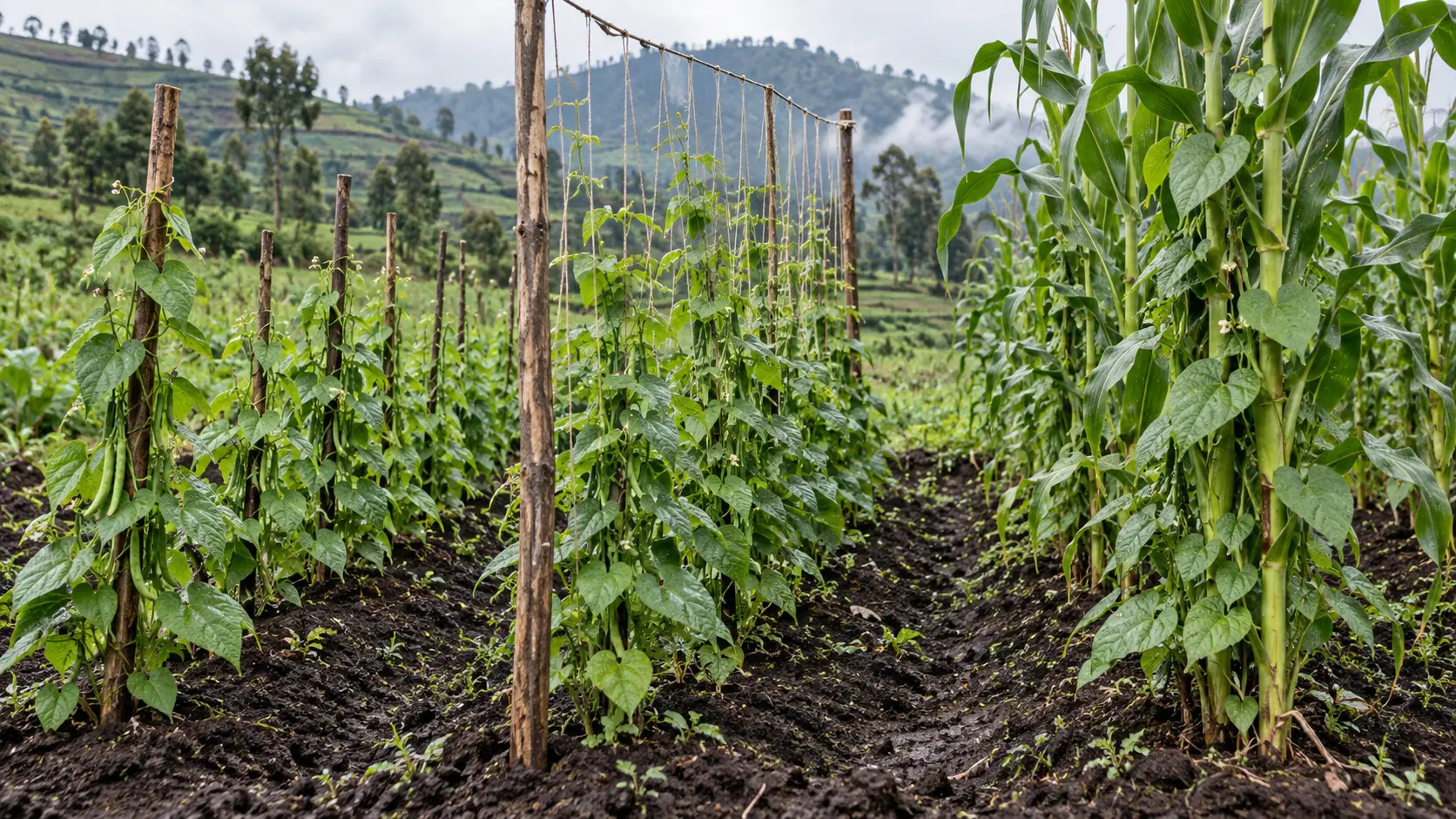
That is a genuinely useful result for a Ugandan farmer with no woodlot. If you can rig a string system with a few strong end posts and a wire, the evidence says you need not sacrifice yield. If you cannot, letting beans climb maize costs you some bean yield but may still be the best return on what you actually have.
Our published guide to maize and bean intercropping covers that system in detail.
On timing, the bean cultivation handbook produced by the Alliance of Bioversity International and CIAT instructs that staking should be done two weeks after germination, when the plants start forming tendrils for climbing [4]. Late staking wastes the crop's early growth and damages roots.
We looked for institutional guidance on tripod and trellis systems specifically for Uganda and did not find any in a source we could open. Sticks, strings and live maize supports are what the published trial evidence covers.
Working through the decision
Answer these five in order.
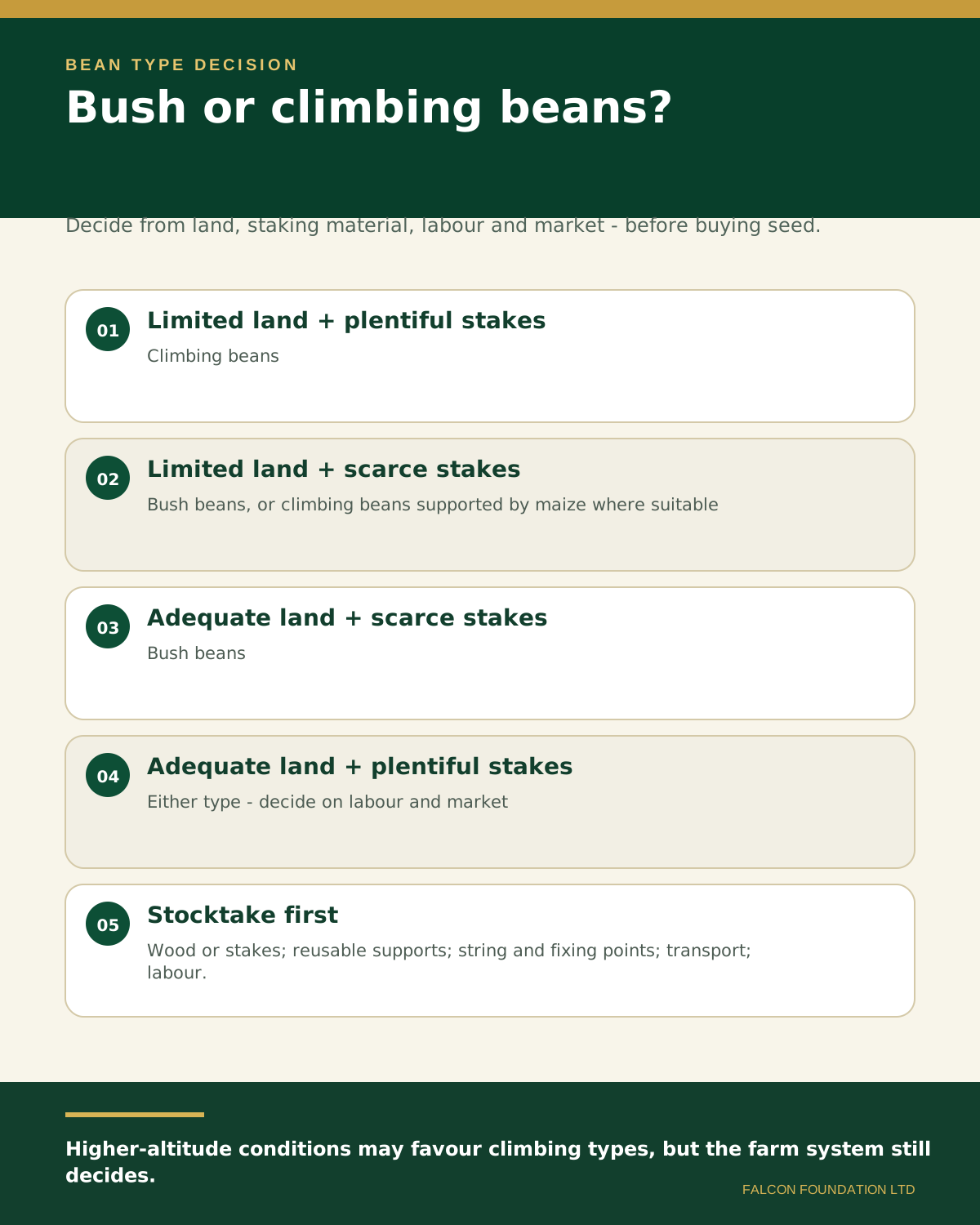
1. What is your altitude? Climbing beans in Uganda are concentrated in the higher, cooler districts of the south west and around Mount Elgon, and that is where the documented adoption and income evidence comes from [2] [5]. At lower altitude the case for the extra work is weaker, and bush beans are the more usual choice.
2. How much land do you have for beans? If land is the binding constraint and you are trying to feed a household from a small plot, climbing beans are worth real effort to make possible [3] [5] [6].
3. Can you actually get stakes? Count them before you buy seed. If the honest answer is no, your options are a string system or letting beans climb maize [7]. Both are legitimate.
4. Where is your labour peak? Staking falls two weeks after germination [4], which collides with weeding and, in a bimodal area, with land preparation for other crops. Labour scarcity was the top constraint in Kabale [5]. Map the calendar before you commit.
5. What does your market want? This is dealt with next.
Match the variety to the market, not only to the field
A 2024 study of consumer preferences in rural and urban Uganda found red mottled and speckled beans dominate consumption at 60 per cent, followed by black at 14 per cent and yellow at 7 per cent [8].
The regional detail matters. In northern Uganda, black beans are locally preferred for drought tolerance, faster cooking and taste, but remain rarely marketed because darker grains are commercially disadvantaged, particularly in urban markets where lighter coloured varieties are more competitive [8].
The same study found a disconnect worth knowing about: consumers select beans visually by colour, but base the actual purchase decision on taste and short cooking time [8]. So colour gets your beans looked at, and cooking time gets them bought again.
Ask your buyer, before you choose seed, what colour and grain type they want.
Varieties: what we can and cannot confirm
NARO's National Crops Resources Research Institute has released both series that Ugandan farmers know. NARO's impact study on bean and maize technologies names NABE 15, NABE 17, NAROBEAN 1, NAROBEAN 2, NAROBEAN 3, NAROBEAN 6 and NAROBEAN 7 among the improved bean cultivars it covers [1].
For climbing types specifically, PABRA reporting identifies NABE 12C, popularly known as Masavu or Nabudaama, as the most commonly grown climbing bean type, particularly on small landholdings [2]. The south-western study also calls for improved climbing varieties beyond NABE 12C, which tells you how narrow the current climbing variety base is [5].
Here is what we could not verify. We could not open NARO's own community seed bank variety pages, and we could not confirm from an accessible official source which specific NABE and NAROBEAN numbers are bush types and which are climbing types. Variety lists circulate online that make that split confidently. We are not repeating them, because we could not read the source.
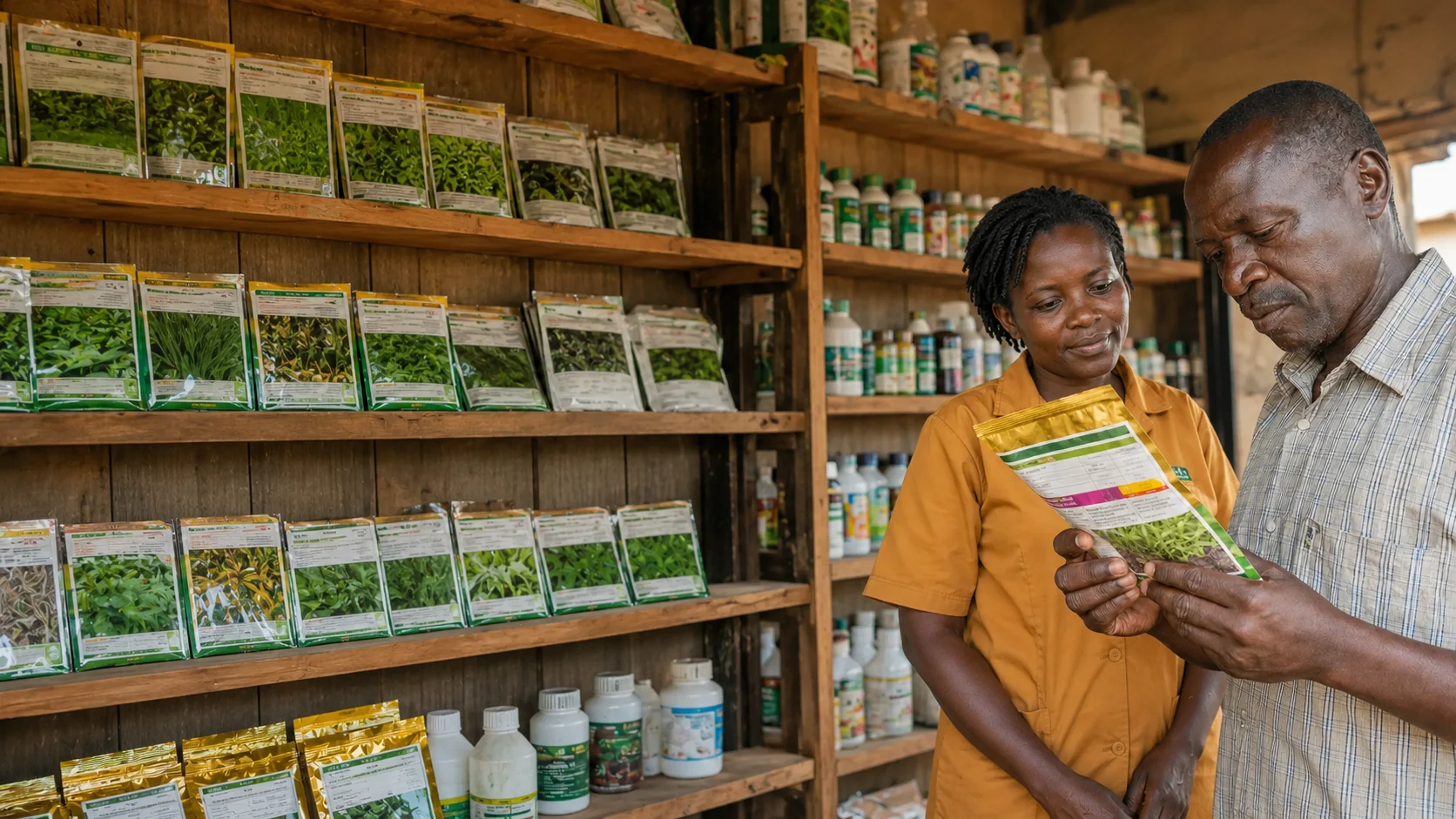
Ask your seed supplier to state in writing whether a variety is bush or climbing, and confirm it with a district agricultural officer or NaCRRI before buying in quantity. Our guide to verifying seed and planting material quality covers how to judge a seed source.
Spacing and seed rate
The Alliance and CIAT bean cultivation handbook gives bush bean spacing as 50 centimetres between rows by 10 centimetres within the row with one seed per hole, or 50 by 20 centimetres with two seeds per hole. It gives a general seed rate of 25 to 30 kilogrammes of seed per acre, producing an approximate plant population of 80,200 plants per acre [4].
The handbook does not give a separate climbing bean spacing figure distinct from that, and we did not find one in an institutional source we could open. Do not assume the same spacing applies. Ask your seed supplier or extension officer for the spacing recommended for the specific climbing variety you are buying.
Limitations and when to get help
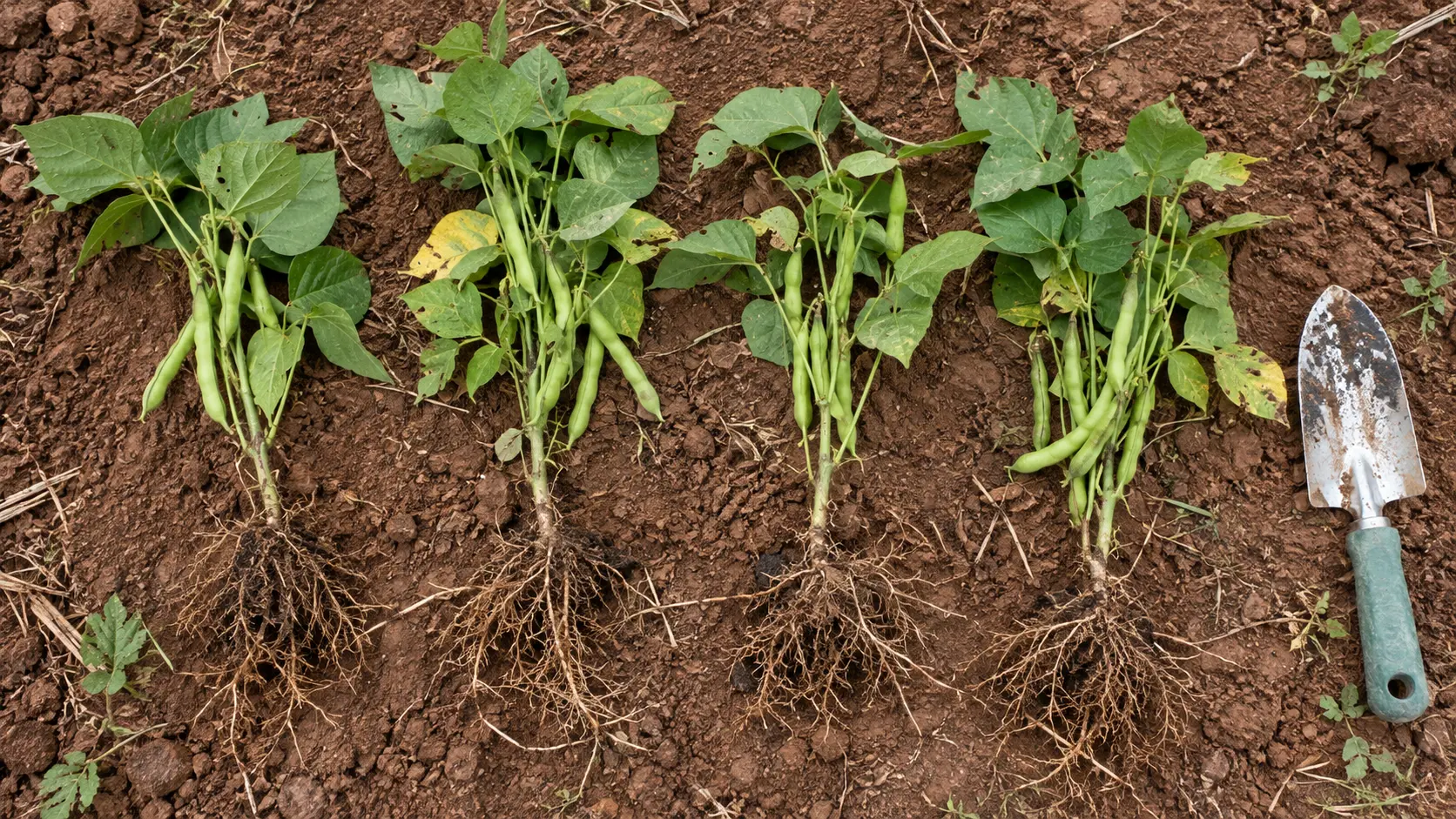
This guide compares two bean systems. It does not cover disease management, and beans in Uganda face serious soil-borne disease pressure that variety choice alone will not solve. See our guide to bean root rot diagnosis and management.
The yield figures quoted are potential yields and trial results from Uganda, Rwanda and Burundi, each labelled with its origin. They are not predictions for your field.
If your beans have performed poorly for several seasons regardless of type, the problem may be soil rather than variety. Long-cultivated Ugandan soils are frequently acid, and on an acid soil legumes fix nitrogen poorly no matter which variety you plant. See our guide to acid soils and liming, and consider a soil test before spending more on seed.
What to do next
- Write down your altitude and your available bean area.
- Count your available stakes, honestly, before buying any seed.
- If stakes are short, price a string system and compare it with letting beans climb maize [7].
- Mark on a calendar when staking would fall, two weeks after germination, and check it against your other labour peaks [4] [5].
- Ask your buyer which grain colour and type they want, and how quickly it should cook [8].
- Ask your seed supplier, in writing, whether the variety is bush or climbing, and confirm with an extension officer [5].
- If beans have underperformed for several seasons, get a soil test before changing variety.