You planted good seed. The beans came up well. Then, three or four weeks later, plants began to yellow, wilt and die, first a few, then a spreading area. You pulled one up and the roots were dark and rotten. You replanted the same field the next season, with the same seed, and it happened again.
This is the most common way bean root rot is experienced in Uganda, and it is also the reason it keeps happening. Root rot is not one disease. At least four different soil-borne pathogens cause root rot in Ugandan beans, they look almost identical from a distance, and they do not all respond to the same changes. Until you know which one you are dealing with, you are guessing.
What this guide helps you decide
This guide helps you answer one question: which root rot is in my field, and what single change should I make before I plant beans there again?
It shows you what to dig up, what to look for on the stem base and roots, and what each pattern tells you. It then sets out the management changes that the evidence supports, and it is honest about which ones are well proven and which are not.
It does not cover bean variety choice, which is dealt with in a separate guide, and it does not recommend any fungicide or seed dressing product.
Root rot in Uganda is four diseases, not one
The most useful piece of Ugandan evidence on this comes from a survey of 1,117 bean fields across seven agro-ecological zones over three seasons in 2013 and 2014, published in Experimental Agriculture. It found four root rot pathogens and ranked them by how often they appeared [1].
Southern blight, caused by the fungus Sclerotium rolfsii, was the most prevalent. In most surveyed areas it was found in 77 to 90 per cent of fields, and in Bugiri district it reached 100 per cent [1].
Fusarium root rot came second. A 2025 study by researchers at NARO's National Crops Resources Research Institute went further and identified twelve different Fusarium species from Ugandan bean roots across six agro-ecological zones. Fusarium oxysporum was the most common, found in 37 of 80 strains examined, followed by Fusarium solani in 13 [2].
Pythium root rot was third overall, but it is not evenly spread. In the Teso Farming Zone it was found in up to 87.5 per cent of fields [1]. A regional technical brief from CIAT and the Pan-Africa Bean Research Alliance describes Pythium as the most prevalent soil-borne bean pathogen across the region, with eleven pathogenic species identified [3].
Rhizoctonia root rot, caused by Rhizoctonia solani, was the least prevalent of the four in the Ugandan survey [1].
The practical point is that these are different organisms with different habits, and the same field can carry more than one.
Where you farm changes what you are most likely to have
The Ugandan survey found a clear pattern by climate. Cool, humid highland areas favoured Fusarium and Pythium. Warm, moist lowland areas favoured southern blight [1].
That does not mean you can diagnose by district alone. A 2026 study characterised 188 Sclerotium rolfsii strains collected from seven Ugandan agro-ecological zones and found genuine variation between them, including five distinct genetic clusters and disease severity indices ranging from 10.1 to 93.3 per cent depending on the strain [4]. In other words, southern blight in one part of Uganda does not behave exactly like southern blight in another. Your own field is the only reliable evidence.
The field diagnosis: what to dig up and what to look for
Do this while plants are still dying, not after the field has been cleared. Choose plants at the edge of a dying area rather than in the middle, because plants in the middle are usually too far gone to read.
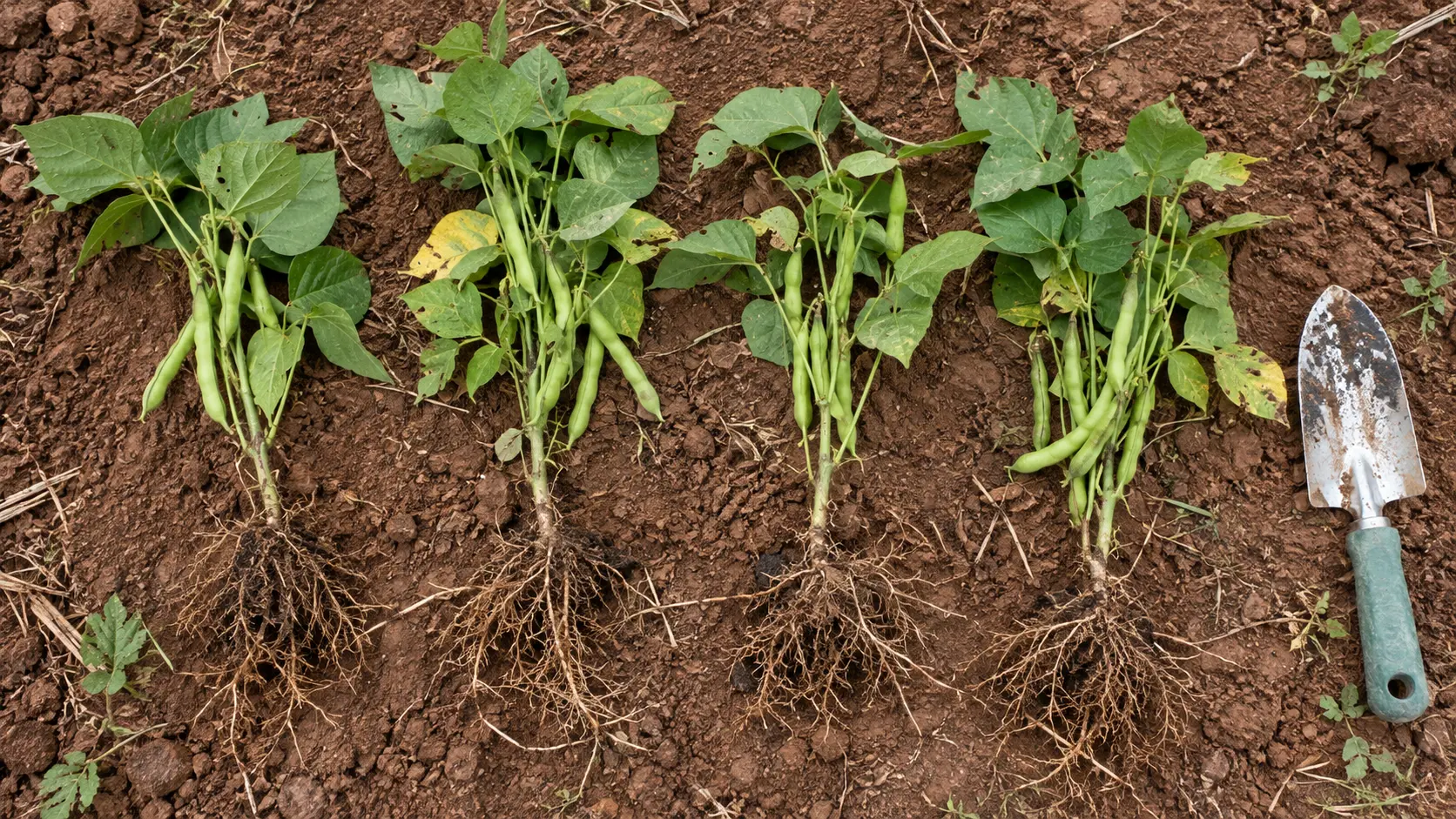
Dig, do not pull. Pulling breaks the roots off and leaves the evidence in the ground. Push a hoe or trowel in about 15 centimetres away from the stem, lift the whole root ball, and shake the soil off gently. Lay several plants side by side, including one healthy plant from an unaffected part of the field for comparison.
Then look at the stem base, which is the section between the soil line and the first roots, and at the roots themselves.
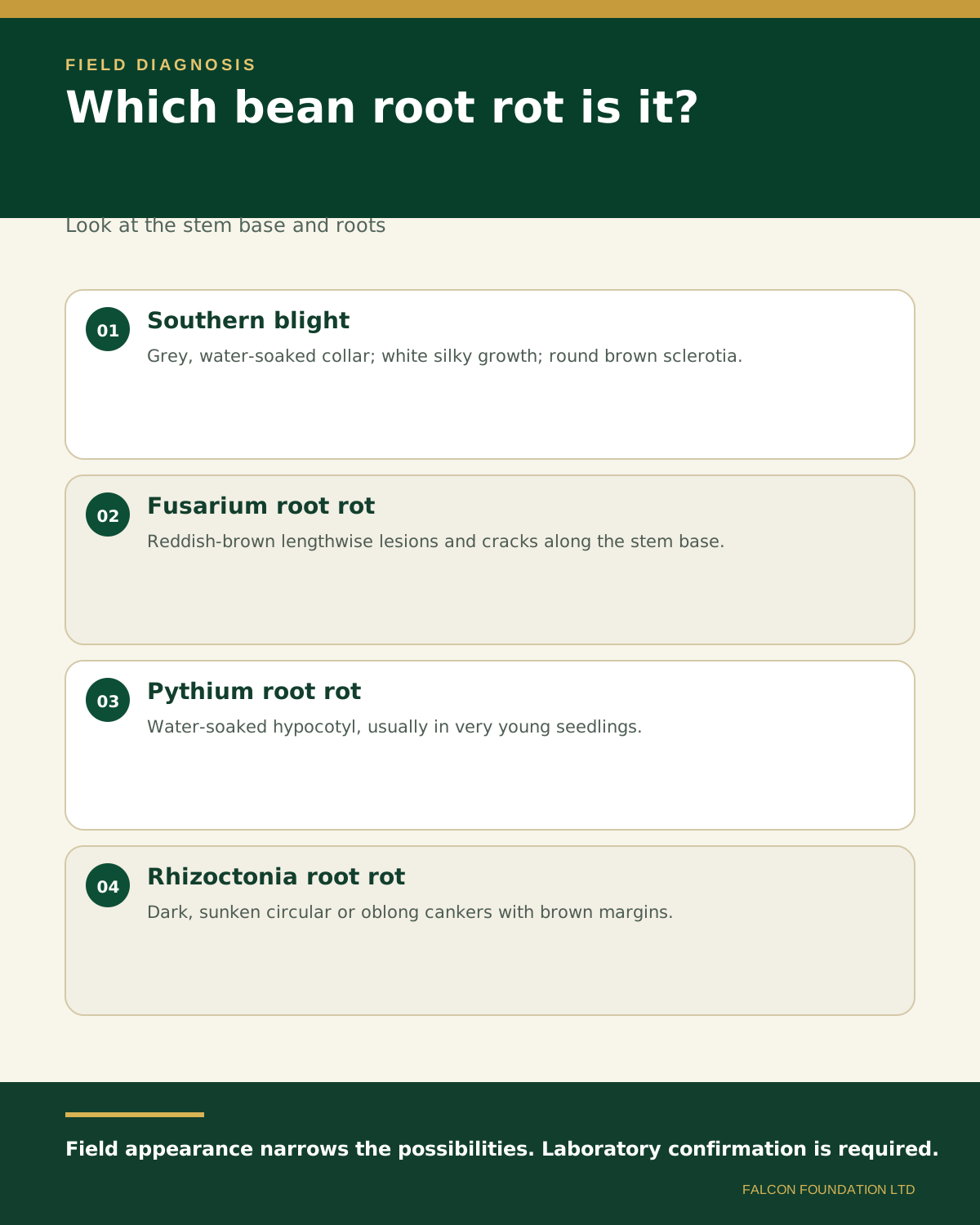
The four patterns
Southern blight. Look for a grey, water-soaked lesion on the stem base just below the soil line. The strongest identifying feature is abundant silky white fungal growth on the collar and roots, together with large, round, brown bodies called sclerotia at the base of the plant [1] [4]. Sclerotia are survival structures. If you can see them, you have your answer.
Fusarium root rot. Look for narrow, reddish-brown lesions running lengthwise along the stem base, accompanied by lengthwise fissures or cracks. Dying root tissue turns reddish-brown. Where Fusarium oxysporum is involved, the dark brown lesion may extend along the vascular bundle and past the collar [1] [2].
Pythium root rot. Look for elongated, water-soaked areas on the stem base. This one shows up early, typically one to three weeks after planting, and often presents as damping-off of young seedlings rather than collapse of established plants [1].
Rhizoctonia root rot. Look for dark, circular and oblong sunken cankers on the stem base, each with a clear brown margin [1].
Two cautions before you act on this. First, these descriptions come from published field surveys, and field appearance alone is not proof. Laboratory confirmation is the only way to be certain which organism is present. Second, the evidence base did not report a reliable within-field distribution pattern for each pathogen, so do not treat patchiness or scattering as diagnostic.
Do not confuse root rot with bean stem maggot
Bean stem maggot, also called bean fly, tunnels into the stem base and causes wilting and death that looks similar from above. If you split the stem lengthwise with a knife and find a tunnel or a small larva, you have an insect problem, not a fungal one, and the response is completely different.
The two do appear to travel together. A study in Embu, Kenya found a positive statistical association between root rot occurrence and bean stem maggot presence, with a correlation coefficient of 0.495 [5]. That study was carried out in Kenya, not Uganda, and no equivalent Ugandan study was found. Treat it as a reason to check for both, not as a Ugandan finding.
What actually causes it to build up
Root rot is a soil problem before it is a plant problem. The regional CIAT and PABRA brief is direct about the mechanism in East Africa: shrinking land holdings force continuous bean cropping on the same ground, which drives soil fertility decline and a build-up of pathogen inoculum in the soil [3].
A 2021 study covering Ugandan trial sites lists the conditions that favour root rot as poor soil drainage, low fertility, high temperature and humidity, and inadequate crop rotation [6].
Read that list again. Three of the four are things you can change. That is where the work is.
What to change before you plant beans there again
Break the rotation properly
Continuous beans is the single strongest driver. Kenyan extension guidance recommends a long rotation excluding legumes, with six to eight years cited for Fusarium root rot, together with deep ploughing of crop residue [7]. That is a long time and few Ugandan smallholders can hold land out of beans for that period, but the direction is clear: the longer the break, and the more completely you exclude legumes from it, the better.
Choose the break crop carefully. The CIAT and PABRA brief reports that a number of Pythium species associated with crops grown alongside beans were found to be pathogenic on beans, sorghum and peas, and describes those crops as alternative hosts that may help the pathogen survive in the soil [3]. Putting sorghum in as your rotation crop may therefore not break a Pythium problem.
Fix drainage and planting position
Where the problem is water-related, and Pythium and southern blight both are, raising the plant above standing water helps. Planting on ridges or hills is specifically recommended for heavy soils [7].
Build organic matter and address fertility
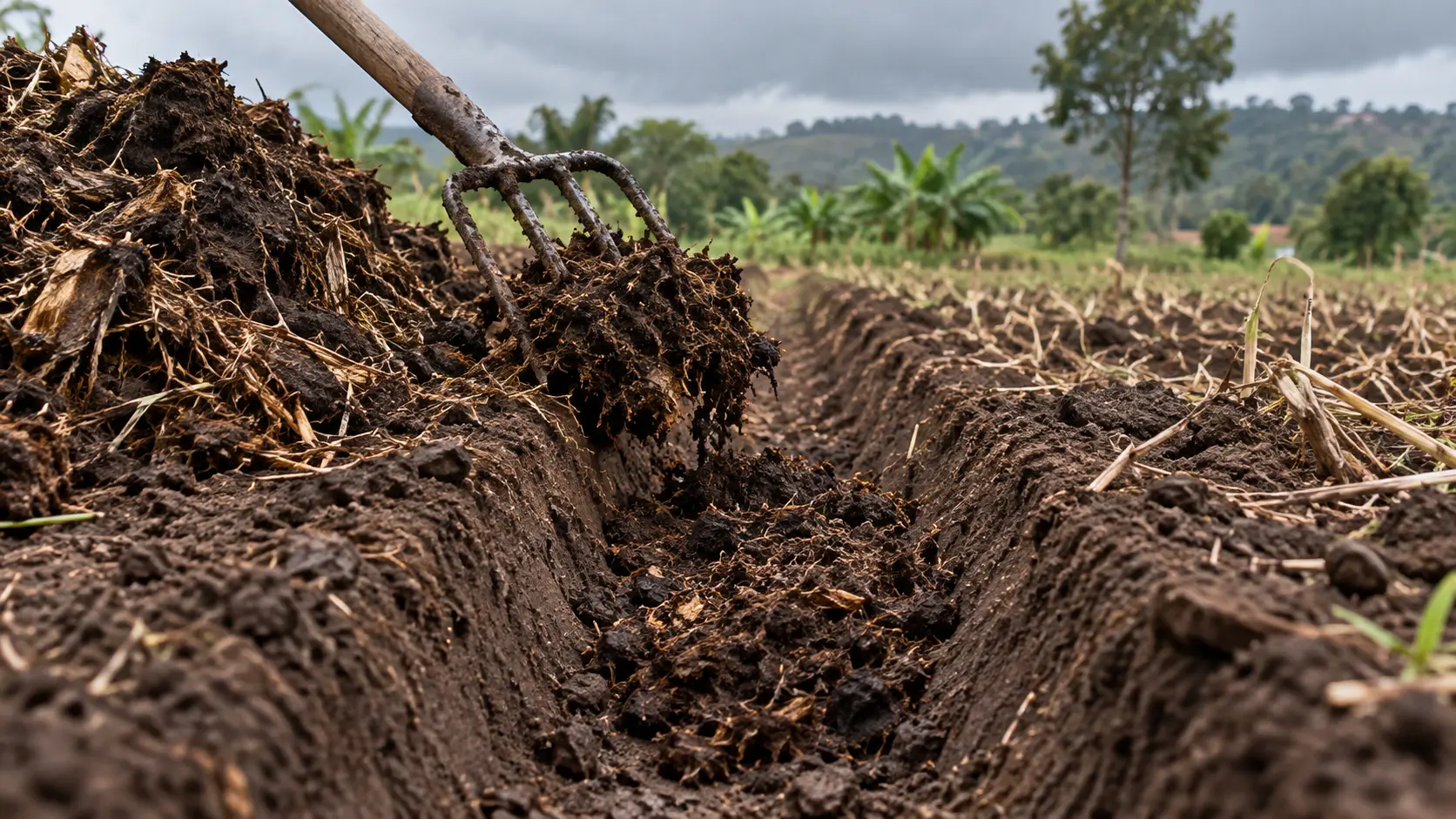
Organic amendments, including farmyard manure, compost and green manures, are the management response named in the regional brief, and they work by addressing the fertility decline that accompanies inoculum build-up [3]. This is slow work and it is not a cure, but it is the intervention with the best supporting logic for a smallholder with no other options.
Our guides on crop rotation and cover crops and on soil testing and fertility set out how to plan both of these.
Stop moving the problem around
One specific and easily overlooked practice: Kenyan extension guidance advises against feeding livestock old bean straw when the resulting manure will go back onto bean fields, because it returns inoculum to the soil [7].
Consider tolerant planting material
Several bean lines have been identified as tolerant. Work at NARO's National Agricultural Research Laboratories at Kawanda screened 147 bean lines against Fusarium and found MLB-49-89A had the lowest disease severity in both controlled screening and field trials, with RWR2075 also performing well in the field [8]. The same study found that large seed size and green hypocotyl colour were associated with greater susceptibility.
The regional CIAT and PABRA brief lists RWR 719, MLB-49-89A, AND 1062, AND 1055, SCAM 80CM/15, Vuninkingi (G685), G4795 and G2333 as resistant lines, and records that RWR 1946 and RWR 2075 were grown or released in Uganda through farmer participatory variety selection [3].
Two honest cautions here. First, we could not verify a NARO release announcement linking any NABE or NAROBEAN variety specifically to root rot resistance, so do not assume a variety is root-rot tolerant because it is improved. Second, resistance to root rot is quantitative, meaning it is controlled by many genes and expressed as reduced damage rather than immunity [6]. A tolerant line in a badly managed field will still fail.
Newer Ugandan screening work has identified KWP 9, KWP 12, KWP 17 and ALB 171 as resistant to Sclerotium rolfsii under screen house conditions, with RRA 41 identified as a new source of resistance [9]. These are breeding lines under evaluation, not released varieties, and should not be sought on the market. That study also records that all varieties released in Uganda to date lack resistance to this disease [9], which is worth knowing before you pay a premium for improved seed on the assumption that it will solve a root rot problem.
What to measure and record
Keep this simple. For each bean field, in each season, record:
| What to record | Why it matters |
|---|---|
| Date of first wilting | Early wilting points to Pythium |
| Symptom seen on stem base | Your working diagnosis |
| Previous three crops | Tells you if the rotation is real |
| Drainage after heavy rain | Identifies wet spots to ridge |
| Seed source and variety | Separates seed problems from soil problems |
Three seasons of this will tell you more about your own field than any general guide can.
Limitations and when to get help
Field diagnosis narrows the possibilities. It does not confirm them. If beans are a significant part of your income and the problem is recurring across several seasons, submit affected plants and a soil sample to a plant health laboratory for confirmation before committing to a long rotation.
Contact your district agricultural officer or a NARO institute. Do not apply a fungicide on the basis of a field guess. Soil-borne fungi are poorly controlled by foliar sprays, the money is usually wasted, and product registration status in Uganda must be checked before any chemical is used. Our guide to integrated pest management scouting and thresholds explains how to build a monitoring routine that supports these decisions.
What to do next
- Before the field is cleared, dig up six affected plants from the edge of a dying area and one healthy plant, and lay them out side by side.
- Split two stems lengthwise with a knife to rule out bean stem maggot.
- Match the stem base appearance to the four patterns above and write down your working diagnosis.
- Write down the last three crops grown in that field. If two of them were legumes, the rotation is your first change.
- Mark any part of the field that holds water after heavy rain, and plan to ridge it.
- Decide now, not at planting time, where next season's bean seed will come from.
- If the problem has recurred for three seasons, arrange laboratory confirmation before investing in a long rotation.
Read next: bush beans or climbing beans, and how to choose covers the variety and bean type decision that follows this one, and acid soils and liming covers the fertility constraint that often sits underneath a root rot problem.