The direct answer
Integrated pest management is not a list of organic-sounding methods. It is a decision rule about when to act.
FAO defines IPM as "the careful consideration of all available pest control techniques and subsequent integration of appropriate measures that discourage the development of pest populations", combining "biological, chemical, physical and crop specific (cultural) management strategies and practices to grow healthy crops and minimize the use of pesticides".
Read that definition carefully. It does not say do not spray. It says decide, from the full range of options, rather than reaching for one option by reflex.
The decision turns on two ideas from the pest management literature. The economic injury level is defined as "the lowest population density that will cause economic damage". The economic threshold is "the population density at which control action should be determined (initiated) to prevent an increasing pest population (injury) from reaching the economic injury level".
In plain terms: the injury level is the point where the pest costs you more than the control would. The threshold is the earlier point at which you must act so the population never reaches it. Spraying below the threshold spends money to prevent a loss that was not going to happen. Waiting past the threshold means the loss happens before the spray works.
Almost no Ugandan farm can produce a locally calibrated economic threshold number for its own crop, variety, price and cost. That is a real limitation and this article does not pretend otherwise. What every farm can do is run the routine that makes threshold thinking possible: scout on a fixed schedule, count rather than glance, write it down, and set a written action rule in advance instead of deciding in the middle of a panic.
Practical summary
- Prevent first: healthy planting material, rotation, sanitation, timing, and field hygiene.
- Scout on a fixed day every week, in a fixed pattern, counting on a fixed number of plants.
- Write the counts down on the same sheet every time, whether or not you find anything.
- Set a written action rule before the season, using the best threshold source you can find for that pest and crop.
- When the rule is met, choose the least disruptive effective option first.
- Record what you did, when, and what happened afterwards.
- Review the sheet at the end of the season and adjust the rule.
Why the routine matters more than the product
Two farms with the same pest and the same chemical get different results, and the difference is usually timing, not product. Timing is a function of when you noticed. When you noticed is a function of whether you were looking on a schedule or only when something looked wrong.
By the time a pest problem is obvious from the field edge, the population has usually been building for one or more generations. A weekly count on marked plants finds it earlier, at the point where a smaller and cheaper intervention still works, and where a non-chemical option is still capable of holding it.
There is a second reason, which matters for anyone selling into a formal chain. MAAIF's Department of Crop Protection supports "plant health inspection and certification services, to ensure that Uganda's exports are free of pests and diseases", and manages and monitors the availability and use of major agricultural chemicals. A farm that can produce a dated scouting record and a spray record has evidence. A farm that sprayed on instinct has an assertion.
Step 1: prevention, decided before planting
Everything in this section is a decision made before there is a pest to see, and together these decisions do more than any spray programme.
Planting material. Clean, verified planting material is the single largest lever, particularly for vegetatively propagated crops where disease travels with the material itself. Where a tolerant or resistant released variety exists for a pest that regularly costs you, choosing it removes the problem rather than managing it.
Rotation and sequence. Continuous cropping of the same family in the same field builds pest and pathogen populations in the soil and in crop residue. Rotation breaks that cycle. This is covered in detail in the Falcon article on rotation and cover crop planning.
Timing. Planting date changes which growth stage coincides with peak pest pressure. Where an early or synchronised planting window is recommended locally for a specific pest, it is a control measure, not a convenience.
Sanitation. Crop residue, volunteer plants, infected material left at field edges and unwashed tools all carry problems into the next season. Removing and destroying infected material is unpaid work that substitutes for paid inputs.
Field hygiene and boundaries. Movement of people, tools and vehicles moves pests and pathogens. Whole-farm entry control is covered in the Falcon article on farm biosecurity, and it is part of pest management, not separate from it.
Habitat. Natural enemies exist in most Ugandan fields and are killed by broad-spectrum applications along with the target. FAO notes that IPM "promotes the growth of a healthy crop with the least possible disruption to agro-ecosystems and encourages natural pest control mechanisms". Preserving that free control is a management decision.
Step 2: the scouting routine
The routine below is deliberately simple, because a complicated routine is not run.
Fix the day. One day a week, the same day, whatever the weather. Pests do not respect a busy week.
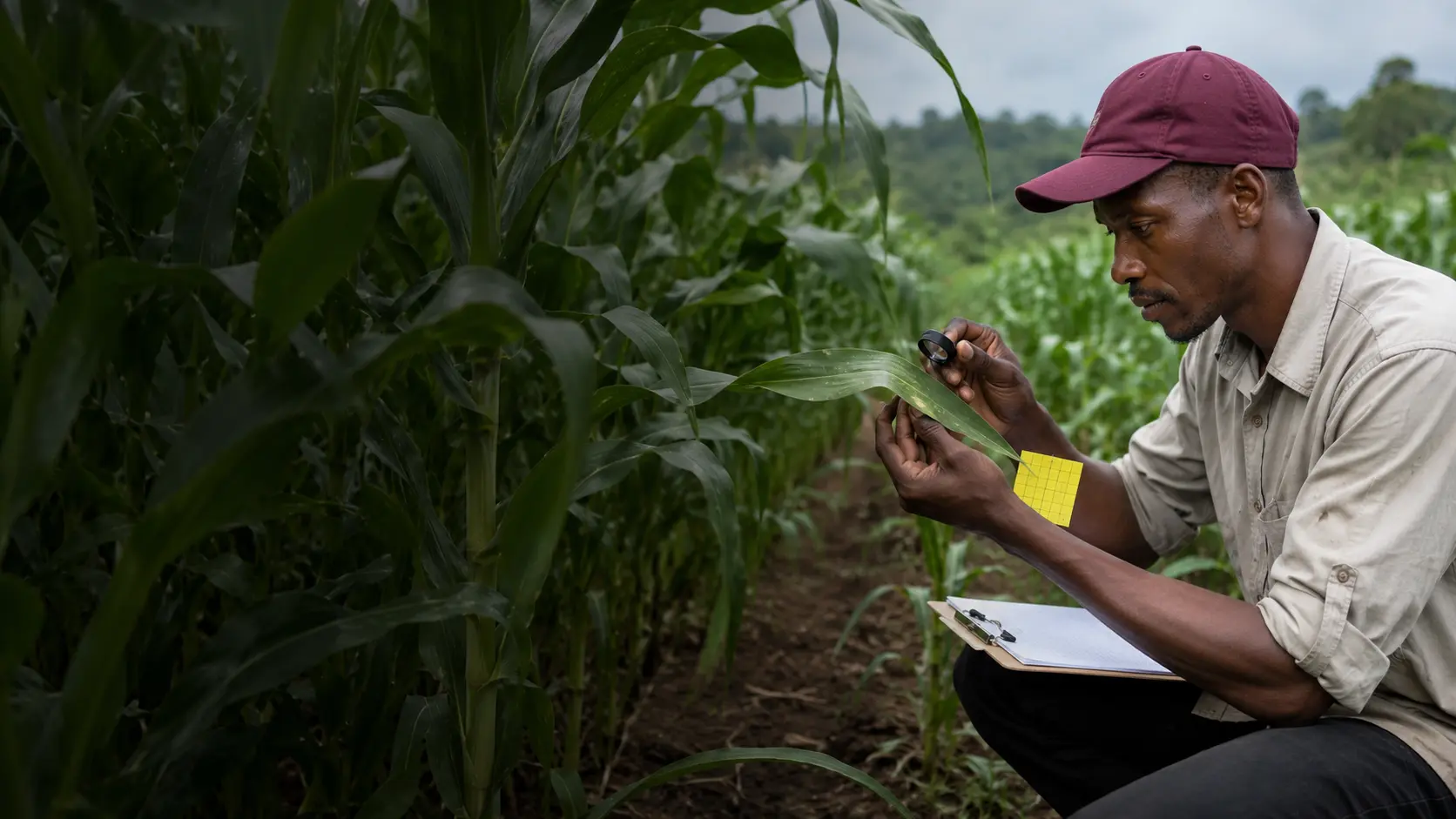
Fix the pattern. Walk a consistent path through the field, not the edges. A zigzag or W-shaped route across the block reaches the interior, where problems start and where edge inspection never looks. Use the same route each week so counts are comparable.
Fix the sample. Decide in advance how many plants you will examine at each stop and how many stops you will make. Five stops of ten plants gives fifty plants; ten stops of five gives the same total spread more widely. Consistency matters more than the exact number, because the point is comparison week to week.
Fix what you look at. For each plant, look at the growing point, the underside of leaves, the leaf axils, the stem base and any fruiting structure. Most early damage is on the underside and in the whorl, which is exactly where a walk-past inspection does not look.
Count, do not judge. Write the number of plants out of the sample showing the pest or the damage. "A few" is not a record. "7 of 50" is, and next week's "19 of 50" tells you something "a few" never could.
Record zero. A week with no finding is data. Sheets with gaps cannot show a trend.
Take a sample when you cannot identify it. Photograph it, and where identification matters, take affected material to your sub-county or district production office. MAAIF states that it conducts "field and laboratory investigations of crop pests and disease outbreaks" and undertakes training of District Extension Officers on a quarterly basis, and it refers to the interactive Plantwise Knowledge Bank through Uganda's collaboration with CABI. Guessing an identity and treating for the wrong thing is a common and expensive error.
Step 3: setting an action rule before you need it
An action rule is one sentence, written before the season, in this shape:
If, at a weekly scout, more than [X] plants out of [sample size] show [named pest or damage] at [named growth stage], then [named action] within [number] days.
Three things make it work.
It is written in advance. A rule decided calmly in the planning week is not the same as a decision made standing in a field looking at damage.
It names a growth stage. The same count means different things at different stages. Damage to a growing point before a crop has established is not equivalent to the same count on a mature plant.
It names an action, not a product category. "Then apply the registered product recommended for this pest on this crop, according to its label" is an action. "Then spray" is not.
Where do you get X? In descending order of reliability:
- A published threshold for that pest and crop from a research or extension institution, ideally Ugandan or from comparable conditions.
- A threshold in the guidance issued for a specific outbreak by the Ministry or by a recognised technical body.
- A threshold used locally by extension officers who work with the crop in your area, recorded with the officer's name and the date.
- Your own farm's history, from previous seasons' scouting sheets, where you can see the count at which damage began to matter.
Be honest about which of these you are using. A number from source 4 is your farm's working rule, not a scientific threshold, and it should be written that way on the sheet. It is still far better than no rule, because it is at least consistent and reviewable.
If you have no defensible number at all for a given pest, use a written escalation rule instead: "if the count rises in two consecutive weeks, seek identification and advice before acting". That is a real rule and it beats guessing.
Step 4: choosing the action
When the rule is met, work through the options in order of disruption, and stop at the first one that will actually hold.
Physical and mechanical. Hand removal, destruction of infested plants or plant parts, trapping, barriers. Effective at low populations and on small areas, and the only option with no residue and no effect on natural enemies.
Cultural. Adjusting irrigation, removing alternative hosts, altering canopy density, harvesting early where the crop is close enough.
Biological. Conserving natural enemies, and where available and registered, biological products. Uganda's paid competition data for biopesticide terms was the only Medium reading in Falcon's crop protection keyword set, indicating a commercial category that is being actively marketed to Ugandan searchers. That is a reason to check registration status and evidence carefully, not a recommendation.
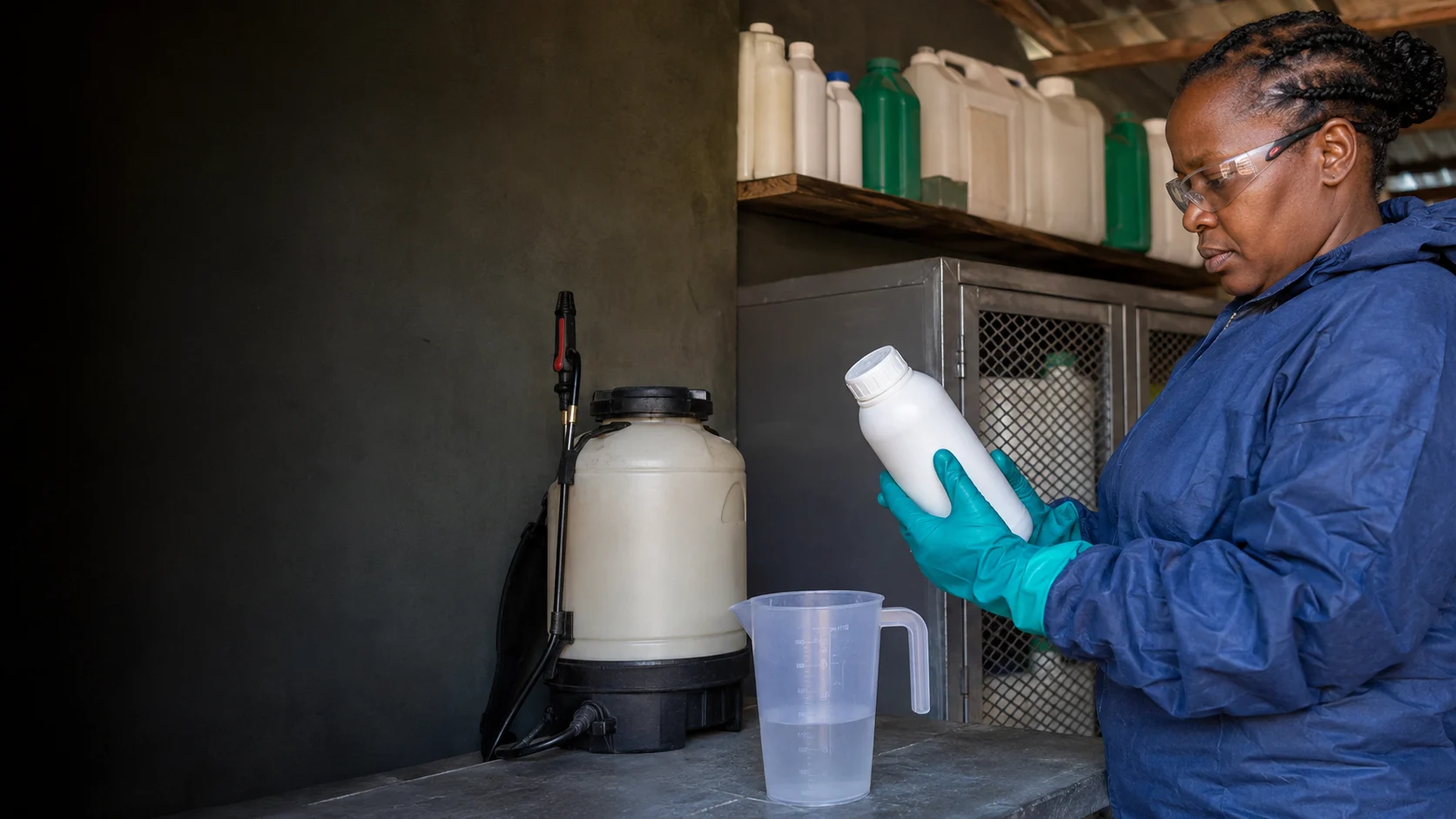
Chemical, last and deliberately. If a chemical is the answer, the selection, mixing, application and safety rules are a separate subject covered in Falcon's published article on safe pesticide use. Three things belong here because they are IPM decisions rather than handling decisions.
- Use only a product registered for that pest on that crop in Uganda, and follow its label. The label is the legal instruction, not a suggestion.
- Spot-treat where the problem is spotted. Whole-field application for a problem confined to one corner spends money and removes natural enemies from the rest of the field.
- Respect the pre-harvest interval on the label. A residue failure at the point of sale costs the crop, not the spray.
Field record: weekly scouting sheet
One sheet per field per season. Keep it in a plastic sleeve and keep it in the field, not in the office.
| Week | Date | Field | Crop and stage | Stops and plants per stop | Pest or damage seen | Count out of sample | Natural enemies seen | Weather note | Rule met | Action taken | Product and rate if used | Result checked on |
|---|
Two columns are usually left blank and should not be. Natural enemies seen is the only way to notice that a spray removed your free control. Result checked on forces a return visit, which is the only way to learn whether the action worked or whether you simply stopped looking.
Season review sheet, one page at the end:
| Pest | Weeks present | Peak count | Rule used | Times rule was met | Actions taken | What I would change next season |
|---|
Decision framework: what to do with this week's count
| What the sheet shows | Interpretation | Action |
|---|---|---|
| Zero, several weeks running | No detectable pressure | Continue scouting. Do not spray preventively without a specific documented reason |
| Present, low, stable across weeks | Population is being held, possibly by natural enemies | Continue scouting. Protect natural enemies. No action |
| Present, rising in one week only | Could be sampling variation or the start of a build | Scout again mid-week. Do not act on one reading alone unless the rule is clearly met |
| Rising in two consecutive weeks | A build is under way | Confirm identification. Prepare the action named in the rule |
| Rule met | The decision was made before the season | Take the named action within the stated number of days. Record it |
| Unknown organism, any level | You cannot manage what you cannot name | Seek identification before acting. Do not treat speculatively |
| Damage widespread and severe at first sighting | You were not scouting, or it arrived fast | Get identification and advice urgently. Record the failure and fix the routine for next season |
Search evidence for this article
In Google Keyword Planner with the location set to Uganda, the exact term integrated pest management returned an average monthly search band of 100 to 1K. That is above the median band measured across Falcon's Uganda keyword set for this portfolio. Bands are reproduced exactly as returned; this account returns ranges rather than exact figures, and none has been converted into a single number. The related term biopesticides returned a band of 10 to 100 with Medium paid competition, the only Medium competition reading in Falcon's crop protection keyword set.
A Uganda-geolocated Google search for integrated pest management uganda returned a commercial greenhouse supplier's page in first position, MAAIF's crop pest control knowledge page in second, a Kampala training provider in third, a grain council training report in fourth and an academic PDF on IPM adoption in fifth. The result set carried videos, short videos, images and people also search for.
The gap is clear from that mix. Two of the five leading results sell something, one is an institutional overview, and one is an academic study. Nothing in the observed set gives a Ugandan farmer a weekly routine, a written action rule and a record sheet. That is what this article provides.
Uganda-specific importance
Three conditions make threshold discipline unusually valuable in Uganda.
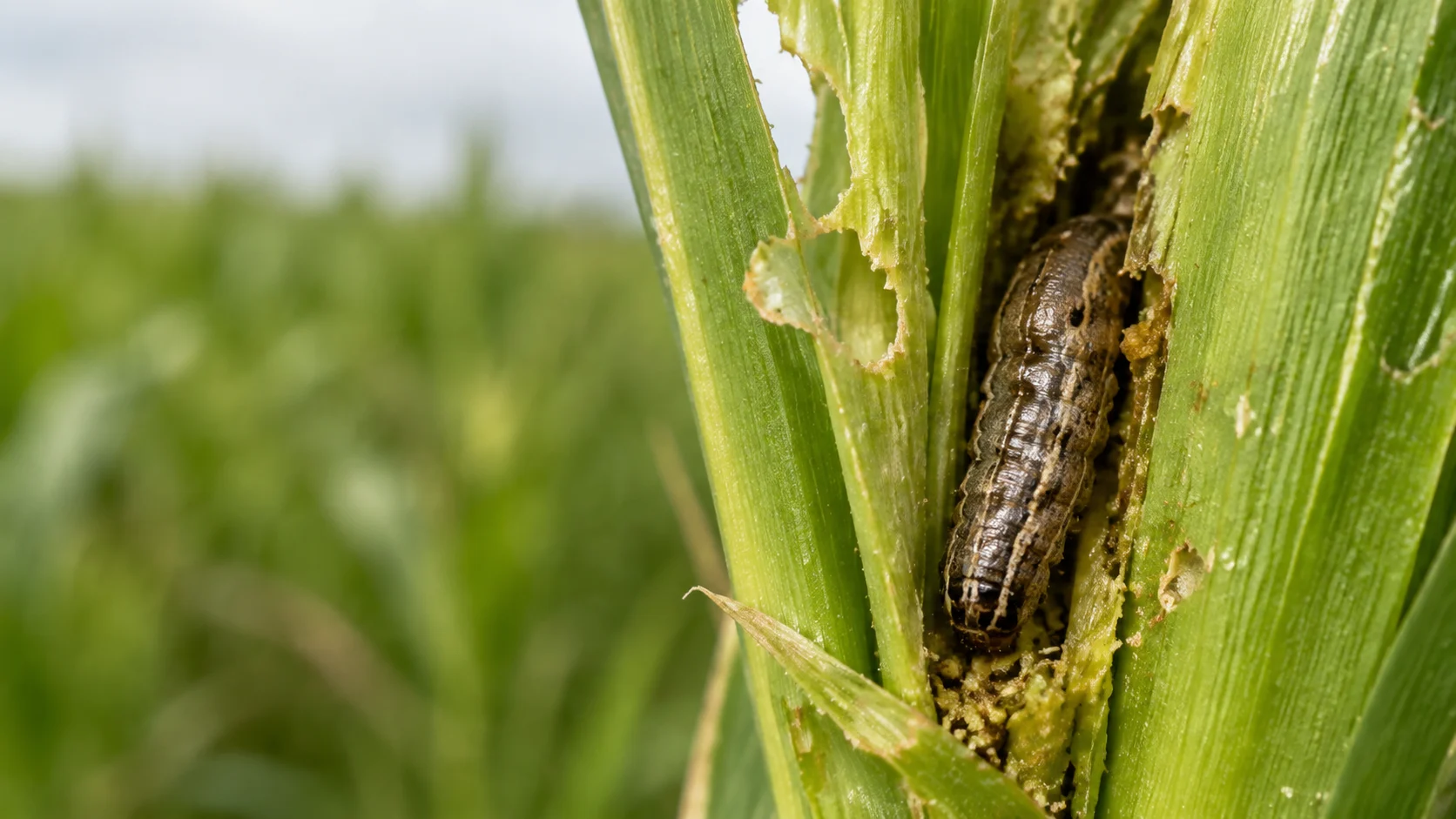
Pressure is continuous. MAAIF names Fall Army Worm, tsetse flies and Banana Bacterial Wilt Disease among the problems it addresses, and states that it undertakes "continuous forecasting of Crop Pest and Disease Trends for purposes of ensuring preparedness", reinforces laboratory diagnostic capacity, and operates a post-entry quarantine regime established at various border posts. Warm conditions and overlapping seasons mean populations are rarely reset by a hard winter.
Inputs are a large share of cash cost. A spray that was not needed is not a small waste on a smallholding; it is a meaningful share of the season's cash. Threshold discipline is one of very few corrections that reduces cost and risk at the same time.
Residues affect market access. MAAIF's plant health inspection and certification function exists to keep Uganda's exports free of pests and diseases. Applications made without records, at the wrong time, or too close to harvest are a market risk as well as an agronomic one.
Limitations and common mistakes
Limitations. This article teaches a method. It does not publish threshold numbers for any pest or crop, because no verified Ugandan threshold table was obtained in this research, and publishing an unsourced number would be worse than publishing none. It does not identify pests, does not recommend or name any product, does not state any rate, dose, interval or price, and does not cover pesticide selection, mixing, application or personal protective equipment, which are covered in Falcon's published safe pesticide use article. It does not cover fall armyworm specifically, which has its own published Falcon article, or greenhouse scouting, which is a separate article.
Common mistakes.
- Calendar spraying. Applying on a fixed schedule regardless of what is in the field is the practice IPM exists to replace.
- Scouting only when something looks wrong. By then the decision window has usually closed.
- Walking the edges. Field margins are not representative of the interior.
- Recording impressions instead of counts. "Quite a lot" cannot be compared with last week.
- Not recording zeros. A sheet with gaps cannot show a trend.
- Treating an unidentified organism. The wrong treatment costs money, loses time and can make the problem worse.
- Spraying the whole field for a corner problem. It removes natural enemies from the ninety percent that had none.
- Ignoring the pre-harvest interval. The consequence appears at the point of sale, when nothing can be done.
- Never checking whether the action worked. Without a follow-up count you have no evidence and will repeat the same choice next year.
When to bring in a professional
- Your sub-county or district production office, for identification you cannot make confidently, and for referral to laboratory diagnosis.
- A qualified agronomist, before adopting a threshold you intend to use across a whole enterprise.
- The regulator and the product label, for any question about whether a product may be used on a crop, at what stage and with what interval before harvest.
- Medical attention immediately, for any suspected exposure incident during a chemical application. Handling and first response are covered in Falcon's published safe pesticide use article and in the farm safety article.