Fall armyworm does not arrive once and leave; it is now a resident pest across Uganda's maize-growing districts, and the moths can fly in again each season regardless of what happened the season before. That single fact changes the question a farmer needs answered. It is not "how do I get rid of it," but "how do I check for it often enough, judge correctly when it is serious, and respond in a way that protects yield without spraying more than the field actually needs." This guide sets out that working system.
Direct Answer
Fall armyworm in Ugandan maize is managed by combining regular field scouting from early whorl stage, a clear decision rule based on the proportion of plants showing fresh damage rather than spraying on a fixed schedule, cultural practices that reduce moth survival and larval shelter, conservation of naturally occurring predators and parasitoids, and pesticide use only when scouting shows the threshold is met, applied to label instructions and rotated by mode of action to slow resistance. According to MAAIF's Department of Crop Protection guidance, action is warranted when about 20 percent of plants show fresh damage at early whorl stage or about 40 percent at late whorl stage; Uganda-based field research further indicates that spraying frequency alone does not reliably predict lower damage, which supports scouting-led decisions over calendar-based spraying.
Who this guide is for: Smallholder and commercial maize farmers in Uganda, extension officers advising them, and agriculture students who need a field-usable, evidence-checked scouting and decision system rather than a generic pest fact sheet.
The problem it solves: Many farmers either spray reactively at the first sign of any leaf damage (which can be caused by several pests, not just fall armyworm) or spray on a fixed weekly schedule regardless of infestation level, both of which raise cost, resistance risk and non-target harm without reliably protecting yield.
What the reader will decide or do: After reading, a farmer or extension worker should be able to correctly identify fall armyworm versus look-alike pests, run a repeatable scouting routine at the right growth stages, apply MAAIF's stated action thresholds to decide whether to act, choose cultural and biological options first, and, if a pesticide is genuinely warranted, make that decision with proper safeguards rather than habit.
Identification: Is It Fall Armyworm?
Correct identification matters because several maize pests produce similar-looking damage to an untrained eye, and treating the wrong pest wastes money and delays the right response.
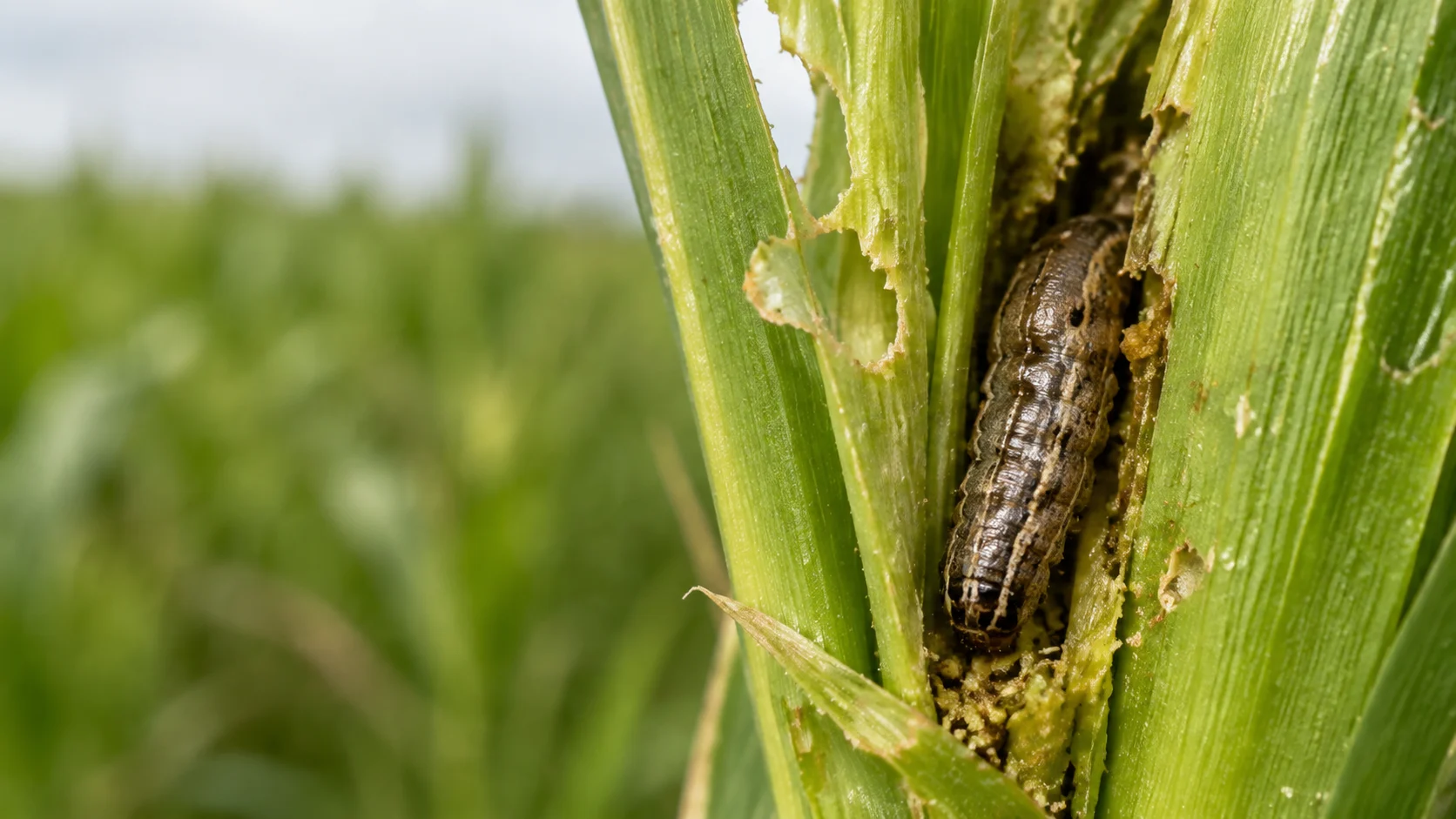
Fall armyworm signs, as described in MAAIF's Department of Crop Protection guidance, include cream or grey egg masses on the underside of leaves, covered in grey scales from the female moth; light green to dark brown larvae with three thin yellowish-white stripes down the back; and a distinct white, inverted "Y" mark on the head capsule. Feeding damage progresses from small "window pane" holes in young leaves to large, ragged, elongated holes, typically concentrated in and around the whorl, and larvae often leave visible frass (moist sawdust-like droppings) in the whorl.
Distinguishing it from other maize pests. African armyworm (Spodoptera exempta) larvae lack the head-capsule Y-mark and tend to move in large, synchronised groups across a field rather than feeding hidden inside individual whorls. Maize stalk borers (Busseola fusca and related species) bore into stems, producing tunnelling and "deadheart" (a dead central shoot) rather than window-pane leaf holes. Cutworms damage seedlings at or below soil level, cutting young plants off near the base - a different pattern from whorl feeding on established plants. When in doubt, extension or a NARO/NaCRRI contact can confirm identification, and MAAIF's and FAO's fall armyworm resources both include annotated images for field comparison.
Scouting Framework: What to Check, and When
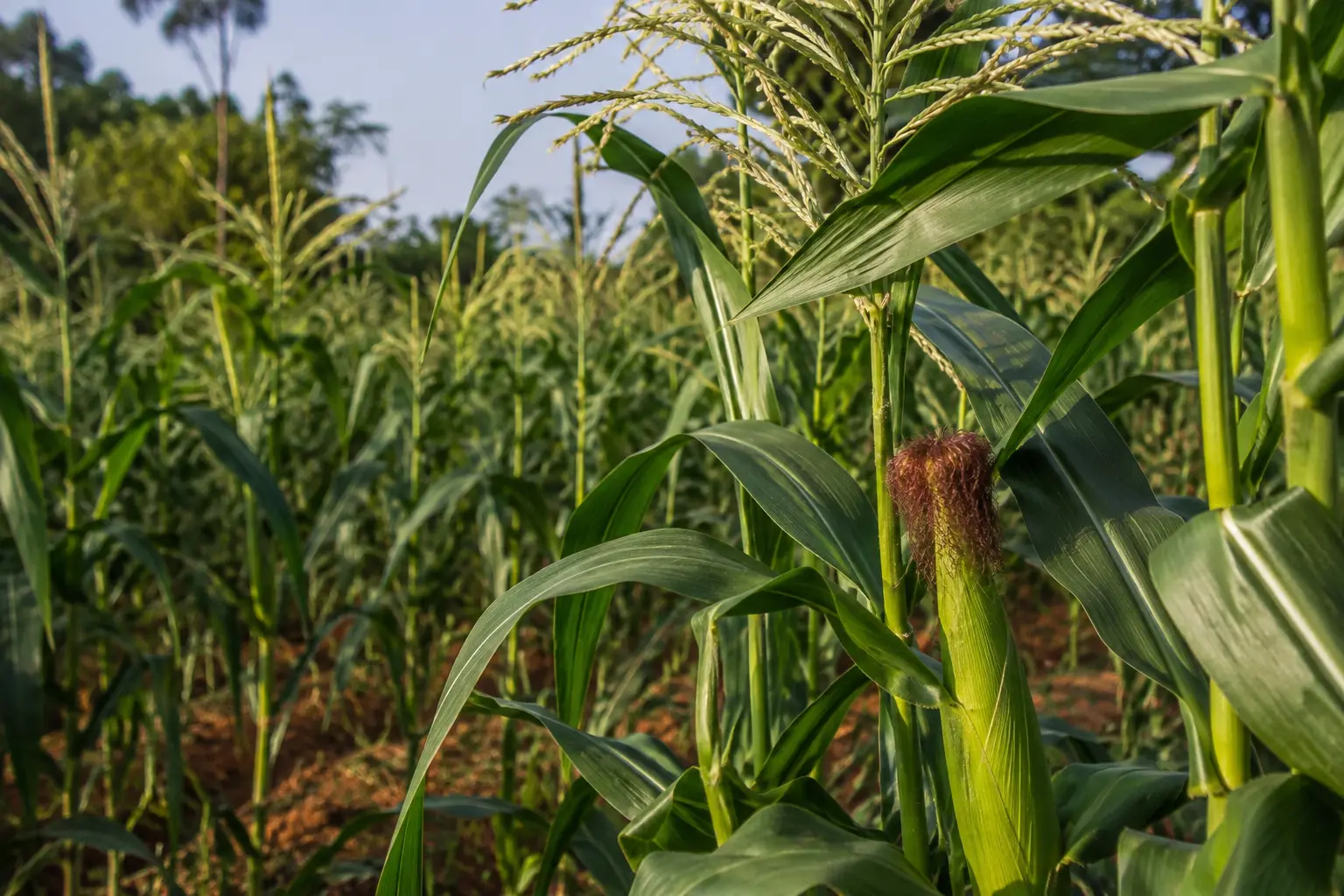
Scouting is the foundation of IPM: without it, every subsequent decision is a guess. MAAIF guidance recommends starting scouting from around two to three weeks after planting, once seedlings are established, and continuing at regular intervals through the vulnerable vegetative and whorl stages.
How to scout. Examine 10 to 20 plants from randomly selected sites across the field rather than only the edges (edge effects can overstate or understate infestation). At early whorl stage, focus on the newest two to three leaves emerging from the whorl, where fall armyworm feeds and lays eggs. At late whorl stage, extend the check to the newest three to four leaves plus the emerging tassel, since this is where late-stage larvae concentrate. Record whether each plant checked shows fresh damage (not old, healed damage) and whether live larvae or egg masses are present, not damage alone, since old scars from a resolved infestation should not trigger a fresh decision to spray.
When to scout. Scout at least weekly during early vegetative and whorl stages, when the crop is most vulnerable and infestations can build quickly; Uganda-based field research recorded peak larval abundance and leaf damage during late vegetative and tasselling stages, which reinforces the case for closer monitoring through that window rather than assuming risk falls once plants are established.
Action-Threshold Decision Logic
The core IPM discipline is separating "I saw a caterpillar" from "this field needs action now." MAAIF's stated thresholds give a concrete rule: consider action when infestation reaches approximately 20 percent of plants showing fresh damage at early whorl stage, or approximately 40 percent at late whorl stage. Below those levels, a healthy maize crop can typically tolerate some feeding without a meaningful yield penalty, and natural enemies may still bring the population down without intervention.
Applying the threshold in practice:
- Complete the scout of 10-20 plants as described above.
- Calculate the proportion of plants with fresh whorl damage and live larvae or egg masses present, not just any historic scar.
- Compare against the growth-stage-specific threshold (20 percent early whorl, 40 percent late whorl).
- If below threshold, record the result and re-scout within the following week rather than treating "not yet at threshold" as "no further action needed."
- If at or above threshold, move to the cultural, biological and pesticide-decision sections below, in that order of preference, rather than defaulting straight to a spray.
This is a decision rule, not a guarantee: local conditions, crop stage, variety tolerance and weather can shift how much damage a field can carry, so treat thresholds as a strong starting guide that extension advice and field judgement can refine, not an absolute cut-off.
Cultural Controls
Cultural practices reduce fall armyworm pressure before it starts, or make the environment less favourable to the pest, and they carry lower cost and resistance risk than repeated spraying.
MAAIF's guidance recommends several practices directly: deep ploughing to bury or expose larvae and pupae in the soil; planting early at the onset of rains, to avoid the peak period of adult moth immigration; destroying crop residues by burying or burning, since they can shelter and feed caterpillars between seasons; and removing weeds and surrounding host vegetation promptly and regularly, since these can act as alternative hosts and refuges.
A genuine nuance is worth flagging rather than smoothing over: Uganda-based field research found conservation tillage (a minimum-disturbance approach, in some tension with "deep plough to bury pupae") had the highest larval parasitism rates observed in that study, suggesting reduced tillage may support natural enemies even as it reduces direct pupal destruction. This illustrates why cultural choices should be weighed with local extension advice and field results, not applied as one universal rule.
Other cultural options with research support in East Africa include intercropping maize with certain legumes as part of a "push-pull" style system, and using verified, locally adapted seed. Maize-bean intercropping is covered in Falcon's dedicated intercropping article and is not duplicated here. For sourcing seed of fall-armyworm-tolerant or locally adapted varieties, and verifying it is genuine before buying, see Falcon's seed-and-planting-material verification guide.
Biological Controls and Natural Enemies
Fall armyworm has natural enemies already present in African maize systems, and protecting them is a genuine, low-cost management lever, though it is not a substitute for scouting.
Research reviewed by CABI has identified at least a dozen biocontrol agents already attacking fall armyworm on the African continent, and the organisation frames conservation, augmentation and classical biological control as components of a broader IPM approach rather than standalone solutions. In Uganda-based field research, fields under conservation tillage recorded measurable larval parasitism, indicating natural parasitism is already occurring under some Ugandan farm conditions, even where it has not been deliberately engineered.
Elsewhere in East Africa, research partners including Kenya's icipe have mass-reared and released specific egg and larval parasitoid species against fall armyworm; as of the sources checked, those documented mass releases were reported in Kenyan counties, with Uganda's national research organisation named as a collaborating partner and further expansion described as planned rather than confirmed as already implemented at farm scale in Uganda. Treat "biological control is being actively deployed in my district" as something to confirm locally, not as an assumption.
What a farmer can do now, without waiting for formal releases:
- Avoid unnecessary, broad-spectrum spraying, since this can kill the predators, parasitoid wasps and parasitic flies that already suppress fall armyworm populations naturally.
- Where a pesticide is genuinely warranted, favour products and application methods that are more selective or targeted, following label guidance (see the pesticide-safety article linked below for how to evaluate this).
- Encourage habitat for natural predators (for example, avoiding blanket removal of all non-crop vegetation at field margins) while still managing weeds that directly compete with the crop or shelter the pest, as MAAIF guidance recommends.
- Report unusual pest pressure or interest in biological control options to a local NARO/NaCRRI contact or extension office, since this is an active and evolving area of Ugandan and regional research.
Pesticide Decision Safeguards
Pesticides remain a legitimate tool within IPM when scouting shows the action threshold has been met and cultural and biological options are not sufficient on their own, but the decision needs safeguards, not habit.
Before spraying:
- Confirm the threshold has actually been reached through scouting (see above), not through a single alarming observation.
- Check whether the product under consideration is currently registered and legitimately sourced. Uganda's institutional oversight of agricultural chemicals has been in transition: Parliament moved to fold the Agricultural Chemicals Control Board's functions into MAAIF, and a Food and Agriculture Regulatory Authority Bill, 2026 was tabled in Parliament in August 2026 to consolidate chemical, veterinary medicine and food regulation under a single new authority; at the time of writing this Bill had not yet passed into law. Do not assume a product, seller or regulator name from an older source is still correct; confirm current status with MAAIF's Department of Crop Protection or district extension before purchase.
- Recognise that older published product lists (including MAAIF's own 2018 brochure) named formulations current at that time; product registration and recommended status can change, so a formulation named in an older document should not be treated as a current, guaranteed recommendation without verification.
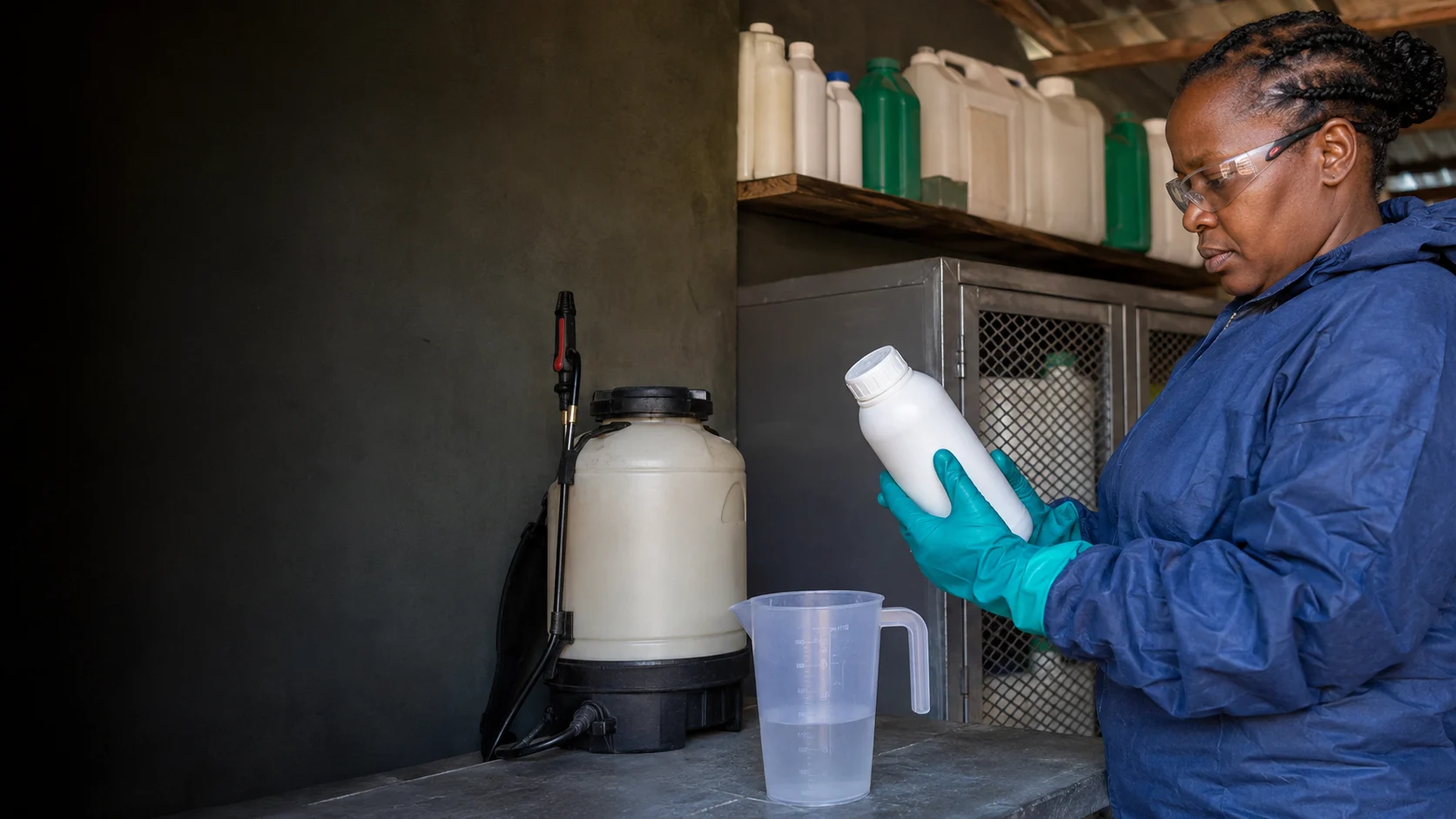
Full mixing, PPE, application timing, re-entry interval, pre-harvest interval, storage, disposal and record-keeping detail is not repeated here. For that complete, step-by-step safety and compliance system, see Falcon's dedicated article, Safe Pesticide Selection, Mixing, Application and Record-Keeping in Uganda.
After spraying: Re-scout within the following week to check whether the intervention actually reduced fresh damage and live larvae, rather than assuming a single application resolved the problem; record the product category used, the date, and the field result in the log table below, since this record is what makes rotation and resistance-risk management possible over multiple seasons.
Resistance-Risk Management
Repeated use of the same insecticide mode of action against the same pest population increases the risk that resistant individuals survive and multiply, reducing the product's future effectiveness. This risk applies to fall armyworm as it does to other insect pests managed with chemical controls.
Practical steps, consistent with FAO guidance framing low-risk pesticides as a last resort within a broader IPM approach, include: spraying only when scouting confirms the threshold, since unnecessary applications increase selection pressure with no corresponding benefit; avoiding repeated use of the same active ingredient or mode-of-action group across a season where genuinely needed alternatives exist (verified through the pesticide-safety article's product-verification process, not chosen informally); combining chemical control with cultural and biological measures so it is not the sole selection pressure on the pest population; and keeping records of what was applied and when, so repeated reliance on one product is visible and can be corrected.
This article does not name which active ingredients to alternate, since that requires knowing what is currently registered - detail readers should verify through the pesticide-safety article and current extension advice rather than a fixed list that may go out of date.
Records and Scouting-Log Table
A simple field log turns scattered observations into a decision history that supports threshold decisions, resistance management and season-to-season learning.
| Date | Growth stage | Plants checked | Plants with fresh damage / live larvae | Percentage affected | Threshold met? (Y/N) | Action taken | Product category (if any) | Re-scout date | Result observed |
|---|---|---|---|---|---|---|---|---|---|
Recommended use: complete one row per scouting visit per field or block. Keep at least one full season of records, since a single season's data is not enough to spot a resistance-risk pattern (repeated reliance on one product category with declining effectiveness) or to judge whether a cultural change (such as adjusted planting date or residue management) made a measurable difference.
Warning Signs Requiring Faster Action
Move to more frequent scouting, or seek extension/NARO input sooner than the routine schedule, if: infestation is rising sharply between consecutive weekly scouts rather than holding steady; damage is concentrated at a growth stage flagged as high-risk (late vegetative through tasselling); a large proportion of plants show fresh whorl damage alongside visible live larvae, not just old scarring; or damage patterns do not match the identification signs above, which may indicate a different pest or disease needing specific confirmation.
Common Mistakes
- Spraying based on any visible leaf damage, without confirming it is fresh fall armyworm damage above the stage-specific threshold, rather than another pest or old, resolved damage.
- Treating a fixed weekly or calendar-based spray schedule as a substitute for scouting, when Uganda-based field research found that spraying frequency alone did not reliably predict lower damage.
- Assuming a pesticide product or formulation named in an older document (including MAAIF's own 2018 brochure) is still currently registered and available without verifying current status.
- Removing all field-margin vegetation in the name of "tidiness," which can reduce the habitat that supports natural predators and parasitoids, instead of managing only the vegetation that directly competes with the crop or shelters the pest.
- Failing to keep any written scouting or spray record, which makes it impossible to judge, season over season, whether a particular practice is working or whether the same product is being relied on repeatedly.
- Assuming biological control agents released elsewhere in East Africa are already active at scale in a specific Ugandan district without checking with NARO or extension.
When These Methods Work, and When They Do Not
Scouting-and-threshold logic works well where a farmer or trained scout can visit the field at least weekly through the vulnerable growth stages and apply the thresholds consistently; it is less reliable where scouting is sporadic, since infestations can build between infrequent visits. Cultural controls tend to reduce baseline pressure across seasons rather than resolving an active, above-threshold infestation immediately, so they work best as standing practice, not an emergency response once damage is already severe. Biological control through conserving existing natural enemies can suppress low-to-moderate infestations over time but is not a fast, certain fix for a fast-building outbreak, and deliberately released biocontrol agents were not confirmed, in the sources checked, to be operating at farm scale across Uganda as of the access date. Pesticide use, applied correctly and only at threshold, can address an acute infestation but does not reduce the following season's reinfestation risk and carries resistance and non-target risk if relied on alone.
Cost Categories to Plan For
Without inventing specific prices, budget across these categories: scouting time (own labour or a hired scout, especially during the weekly-check window through vegetative and whorl stages); cultural control implementation (labour for deep ploughing or residue destruction, and any change in planting-date logistics); seed cost if choosing a verified, locally adapted or tolerant variety (see the seed-verification article); pesticide product cost only where threshold-based spraying is warranted, plus PPE and application equipment covered in the pesticide-safety article; and the opportunity cost of yield loss if action is delayed past the point where cultural or biological options remain effective. Actual costs vary by district, season, product availability and farm scale and should be checked locally.
Questions to Ask Extension or NARO
- What is the current, verified fall armyworm infestation pattern and pressure in my specific district or agro-ecological zone this season?
- Which pesticide products are currently registered and recommended for fall armyworm in Uganda, and has that list changed recently given the ongoing regulatory transition?
- Are any biological control releases or trials active in my district, and how can I find out or participate?
- Does NaCRRI or another NARO institute have a locally adapted, fall-armyworm-tolerant maize variety recommended for my area, and where can I verify and buy genuine seed of it?
- Given my specific tillage and cropping system, does the conservation-tillage-versus-deep-ploughing trade-off noted in this guide apply differently to my field?
A Low-Risk Pilot/Validation Approach
Before committing an entire farm to a new element of this system (a changed planting date, a new scouting routine, or an untried cultural practice), consider piloting it on a defined block for one season, keeping the scouting-log table for that block specifically, and comparing outcomes against a block managed under the previous approach. This is not a substitute for the MAAIF thresholds, which should be applied uniformly for the spray decision itself, but it is a low-risk way to build farm-specific evidence for choices this guide has flagged as locally variable, such as tillage approach, before changing practice farm-wide.
Next Actions
- Start or restart weekly scouting from around two to three weeks after planting through late whorl/tasselling stage, using the 10-20 plant random-sample method described above.
- Record every scouting visit in a log (paper or digital), using the table format provided.
- Apply MAAIF's stated thresholds (approximately 20 percent at early whorl, approximately 40 percent at late whorl) to decide whether action is warranted, rather than acting on any single observation.
- Review and, where appropriate, adopt the cultural controls listed above as standing practice, not only as an emergency response.
- If threshold-based pesticide use is genuinely warranted, verify current product registration and follow the full safety and compliance system in Falcon's pesticide-safety article before purchase and application.
- Contact local extension or a NARO/NaCRRI office with the specific questions listed above, particularly to confirm current product registration status and any local biological control activity.
Limitations, Risks and When to Seek Professional Support
This article is a general, evidence-checked guide and is not a substitute for direct advice from MAAIF, NARO/NaCRRI, or a local extension officer who can see the specific field, crop stage and district conditions. Action thresholds, cultural practices and product registration status can vary by agro-ecological zone and change over time; this guide reflects sources reopened and read as of the access dates in Section E and should be re-checked periodically, particularly given Uganda's ongoing agrochemical regulatory transition. Where an infestation is severe, spreading rapidly, or does not match the identification signs described here, or where pesticide poisoning is suspected in a person or animal, seek professional support immediately: contact local health services for suspected human poisoning, and MAAIF's Department of Crop Protection, a NARO/NaCRRI office, or district extension for pest identification and management questions beyond this guide's scope. This article does not provide emergency medical guidance and does not replace the full safety procedures in Falcon's dedicated pesticide-safety article.