A pesticide bought from an unverified source, mixed by guesswork, or applied without protective equipment does not simply risk a wasted spray. It risks poisoning the operator, contaminating produce destined for the household or the market, and breaking Ugandan law under the Agricultural Chemicals (Control) Act. Yet many of the practical questions farmers and spray operators actually face, such as which body to check a product against, how long to stay out of a sprayed field, or what to do with an empty container, are rarely answered together in one place written for Uganda specifically. This guide sets out a verification and safety system, not a shortcut, for the full sequence from purchase decision to farm record.
Direct Answer
Before using any pesticide in Uganda, verify that it is registered under the Agricultural Chemicals (Control) Act (the current legal regulator is the Agricultural Chemicals Board operating under the Ministry of Agriculture, Animal Industry and Fisheries, MAAIF) and that the seller and premises are also registered. Read the full label, confirm the crop and pest are listed, and never use a product off-label. Wear the PPE the label specifies, mix only in the concentration stated, apply only to the listed crop at the listed rate, and observe the label's re-entry interval and pre-harvest interval before people re-enter the field or the crop is harvested. Store unused product locked, ventilated and separate from food; dispose of empty containers and leftover mix according to label instructions and Uganda's environmental chemical-management regulations, never by burning near water sources or reusing containers. Keep a written record of every application. This system depends on local verification, since product registration status and regulatory arrangements can change.
Who this guide is for: Farmers who buy and apply their own pesticides, hired spray operators and farm supervisors managing a labour team, agro-input dealers advising customers, extension workers training farmer groups, and agriculture students studying crop protection.
The problem it solves: It replaces fragmented, brand-driven advice with a single, ordered, Uganda-referenced procedure covering verification, protection, mixing, application, timing restrictions, storage, disposal, exposure response and documentation, so that pesticide use is legal, safer and defensible if questioned by a buyer, inspector or health worker.
What the reader will be able to decide or do: Check whether a product and seller can reasonably be trusted before buying; assemble and use appropriate PPE; mix and apply a labelled product correctly; calculate re-entry and pre-harvest waiting periods from the label; store and dispose of chemicals and containers correctly; recognise signs of exposure and respond; and keep a field-log record that supports both good practice and traceability.
Step 1: Verify the Product and the Seller Before You Buy
Uganda's Agricultural Chemicals (Control) Act defines "agricultural chemicals" broadly to include insecticides, fungicides, herbicides, nematicides, miticides, bactericides, rodenticides, molluscicides, avicides, fertilisers, growth regulators, bio-rationals and bio-pesticides. Under Section 4 of the Act, it is unlawful to import, sell or use an agricultural chemical in Uganda unless it has been registered, packed and labelled in accordance with regulations, and sellers themselves, together with the premises they trade from, must also be registered. This means two separate checks are required at the point of purchase: is the product registered, and is the seller registered to sell it.
In practice this means:
- Buy only from a seller who can show registration and, ideally, a printed or digital registration/agro-dealer certificate.
- Ask to see the product's registration number and compare it against MAAIF's published Register of Agricultural Chemicals, or ask the Department of Crop Protection or your district agricultural office to confirm current status, since published registers are periodically updated and a printed copy can be out of date.
- Be suspicious of unusually cheap products, unlabelled repackaged chemicals, damaged or resealed containers, labels in a language you cannot read, or a seller who cannot explain the product's registered crop and pest use.
- Do not buy or accept a product recommended for a crop or pest it is not labelled for; this is off-label use and is both unsafe and outside this guide's scope to recommend.
Uganda's institutional arrangements for agricultural chemical regulation were in transition at the time this article was reviewed. The Agricultural Chemicals Board, established under Section 5 of the Act and sitting under MAAIF, is the body currently responsible in law for registering agricultural chemicals and ensuring they are used consistent with their labelling. Uganda's National Drug Authority, which regulates human pharmaceuticals, does not regulate agrochemicals; a 2023 cabinet decision moved veterinary medicines, food and agrochemical oversight away from the NDA toward a proposed dedicated body. As of late August 2026, a Food and Agriculture Regulatory Authority Bill, 2026 had been tabled in Parliament and referred to the Committee on Agriculture, Animal Industry and Fisheries for review, with a mandate to report back within 45 working days; it had not been passed into law at that date. Readers should confirm the current regulator with MAAIF before relying on any named authority, since this position may change after publication. The Uganda National Bureau of Standards (UNBS) additionally tests agricultural inputs and produce for chemical parameters such as pesticide residues through its regional food safety laboratories, but registration of the chemical itself sits with the Agricultural Chemicals Board process described above, not UNBS.
Step 2: Read and Interpret the Label
Before opening the container, read the full label, not only the front panel. A usable label check covers:
- The registered crop(s) and pest(s) the product may legally be used on.
- The recommended rate and dilution, and whether it is given per unit area or per unit volume of water.
- The pre-harvest interval (PHI), the minimum time between the last application and harvest.
- The re-entry interval (REI), the minimum time before people may re-enter the treated area without PPE.
- Required PPE for mixing and for application, which may differ.
- Storage and disposal instructions specific to that product.
- First-aid and emergency information, including any antidote information for a doctor.
- The registration number, batch number and expiry date.
If any of this information is missing, illegible, or in a form you cannot verify, do not use the product. A product without a legible, complete label cannot be used safely or legally under this system.
Step 3: Personal Protective Equipment (PPE)
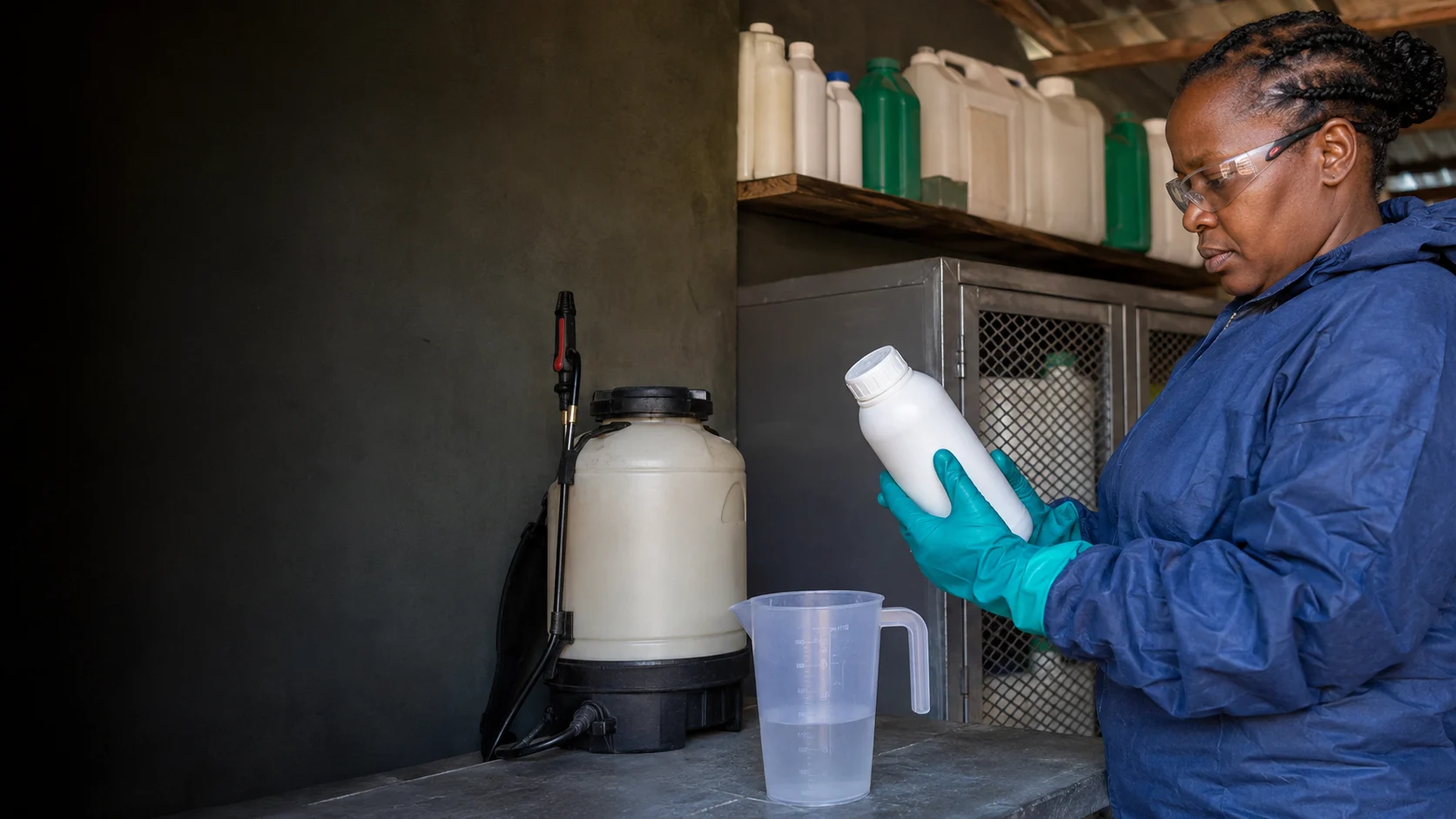
International guidance from FAO and WHO on personal protection when handling and applying pesticides, together with general industry mixing-and-application guidance, converges on covering exposed skin and protecting the respiratory tract, eyes and hands, calibrated to what the specific label requires:
- Long-sleeved shirt and long trousers, or a coverall, covering most of the body.
- Chemical-resistant gloves (not absorbent fabric or leather) that extend above the wrist.
- Boots that do not absorb spray, worn with trousers over the boot top, not tucked in.
- A wide-brimmed hat or hood, and eye protection, particularly when mixing concentrate or applying overhead.
- A respirator or face mask where the label specifies inhalation risk, matched to the hazard, not a generic dust mask assumed to be adequate for a chemical it was not designed to filter.
PPE should be put on before opening any container and removed, in reverse order, after application is finished and before eating, drinking or smoking. Contaminated clothing should be washed separately from other laundry, and hands and exposed skin washed thoroughly with soap and water immediately after removing PPE. Where the full PPE set specified on a label is genuinely unavailable, the safer decision is to delay application and source the equipment, not to spray without it; this is a resourcing gap to solve, not a risk to accept.
Step 4: Mixing Safely
- Mix outdoors or in a well-ventilated area, never in an enclosed room, and never near a water source, well or borehole.
- Measure using the equipment specified or a dedicated, clearly marked measuring container used only for that purpose; do not estimate by eye.
- Add the correct dose to the correct volume of water in the order the label specifies; do not assume "more is better," since over-concentration increases both operator exposure and residue risk without a proven benefit, and under-dosing wastes the application without controlling the target pest.
- Prepare only the volume of mixed spray you intend to use in that application; avoid mixing surplus that then requires disposal.
- Keep children, other workers not involved in mixing, and animals away from the mixing area.
- Never eat, drink or smoke while mixing.
Step 5: Application
- Apply only to the crop and at the growth stage specified on the label, using calibrated equipment appropriate to the product and target (knapsack sprayer, boom sprayer, or other listed method).
- Check wind direction and avoid spraying in strong wind, which increases drift onto people, water sources, non-target crops, and beneficial insects such as pollinators.
- Avoid spraying immediately before rain unless the label specifically allows it, since rain can wash the product off the target before it has acted, wasting the application and increasing runoff into soil and water.
- Mark or fence treated areas where farm workers, children or livestock might otherwise enter before the re-entry interval has passed.
- Clean application equipment after use in a designated area away from water sources, following label instructions for equipment cleaning.
Step 6: Re-Entry Intervals and Pre-Harvest Intervals
These are two distinct, both legally and practically important, waiting periods, and confusing them is a common and serious mistake:
- Re-entry interval (REI): the minimum time after application before anyone may enter the treated area without the PPE required for application. This protects people, including hired labour, from contact with wet or recently dried residue.
- Pre-harvest interval (PHI): the minimum time between the last application and harvest of the crop. This allows the residue on the edible or marketable part of the crop to decline to the level assumed safe by the product's registration.
Both intervals are set per product and sometimes per crop, and are stated on the label; they cannot be assumed or copied from a different product, even one in the same general chemical class. Where a label does not clearly state either interval, treat this as a reason to seek clarification from the seller, MAAIF's Department of Crop Protection, or an extension officer before use, not as permission to guess.
Step 7: Storage
- Store pesticides in their original, labelled containers in a dedicated space that is dry, well-ventilated, and out of direct sun and temperature extremes that can degrade the product.
- Keep the storage area locked or otherwise inaccessible to children, and separated from food, animal feed, seed and drinking water.
- Keep stored volumes as low as practical; avoid accumulating unused stock beyond what will be used within the product's shelf life.
- Store products that could react dangerously together (check label compatibility warnings) apart from each other.
- Keep an inventory of what is stored, matching Step 8's record-keeping practice.
Step 8: Disposal of Leftover Mix and Containers
- Avoid generating leftover mixed spray by preparing only what is needed (Step 4); where a small surplus remains, apply it, within label limits, to the labelled crop and area rather than discarding it into a drain, pit or water body.
- Empty containers should never be reused for food, water or any other purpose.
- Where a container is plastic and the label and any locally available take-back or recycling scheme permit it, rinse it (commonly by a triple-rinse method: partially fill with water, replace the lid, shake, then pour the rinsate into the spray tank as part of the next compatible application, repeated three times) before puncturing to prevent reuse and handing it to an approved collection or disposal point.
- Where no approved collection point is accessible, follow the label's disposal instructions and Uganda's environmental regulations on hazardous chemicals and their containers under the National Environment Act framework; burning containers in the open or dumping them near water sources is not an acceptable substitute and creates a separate environmental and health hazard.
- If in doubt about disposal of a specific product or a larger quantity, ask the seller, MAAIF's Department of Crop Protection, or NEMA rather than improvising.
Recognising and Responding to Pesticide Exposure
A peer-reviewed study of pesticide poisoning cases across rural and urban health facilities in Uganda found that organophosphorus insecticides accounted for the large majority of poisonings identified, and that unintentional, largely occupational-pattern exposure was the dominant circumstance in rural settings, in contrast to urban cases which were more often self-harm related. This is a strong signal that occupational exposure during ordinary farm handling and application is a real and recurring cause of harm in Uganda, not a remote risk.
Warning signs of acute pesticide exposure can include headache, dizziness, nausea, vomiting, excessive sweating or salivation, blurred vision, muscle twitching or weakness, difficulty breathing, and confusion. If any of these occur during or after mixing or applying a pesticide:
- Stop work immediately and move the affected person away from the treated area and into fresh air.
- Remove contaminated clothing and PPE, and wash affected skin thoroughly with soap and water; flush eyes with clean water if they were exposed.
- Do not attempt to induce vomiting or give anything by mouth unless the label's first-aid section specifically instructs it.
- Take the product label or container with you and seek medical care promptly, since it identifies the active ingredient and any antidote information the treating clinician will need.
- Report the incident to your supervisor or farm owner and record it, since a pattern of exposure incidents on one farm is itself a signal that PPE, product choice or procedure needs review.
The same Ugandan study found meaningfully better recovery outcomes at better-resourced urban facilities than in rural settings, reflecting real gaps in rural emergency care capacity rather than a reason to delay seeking help; getting the person to the nearest health facility as quickly as possible remains the correct response regardless of location.
Records and Field-Log Table
Keeping a written record for every application supports safe re-entry and harvest timing, gives evidence of compliant, on-label use if a buyer, certifier or inspector asks, and helps identify any pattern of exposure or poor product performance. A simple field log can use these columns:
| Date | Field/plot | Crop and growth stage | Product name and registration number | Target pest/disease | Rate/dilution used | Operator name | PPE used | Weather (wind/rain) | Re-entry interval end (date/time) | Pre-harvest interval end (date) | Notes/incidents |
|---|---|---|---|---|---|---|---|---|---|---|---|
Keep completed logs for at least one full cropping season, and longer where the produce supplies a buyer with traceability requirements. A blank template like this, printed and kept at the storage point, is more likely to be completed consistently than a notebook kept elsewhere.
Common Mistakes
- Buying from an unregistered or unfamiliar seller because the price is lower, without checking the product or seller's registration.
- Using a product on a crop or against a pest not listed on its label, on the assumption that "it worked for a similar problem before."
- Estimating dose by eye instead of measuring, in either direction.
- Treating REI and PHI as interchangeable or ignoring them because the field "looked dry."
- Reusing empty pesticide containers for water, food or seed storage.
- Storing pesticides in the kitchen, under a bed, or anywhere accessible to children.
- Spraying without PPE "just this once" due to heat, cost or time pressure.
- Keeping no written record, so that re-entry and harvest timing rely on memory.
When This System Works, and Its Limits
This system works when the product is genuinely registered and correctly labelled, when PPE appropriate to the label is available and used, and when the operator has time to follow the mixing, application, interval and disposal steps rather than compressing them under pressure. It does not work, and should not be relied on, where the product itself is counterfeit or mislabelled (no amount of correct procedure make an unverified product safe), where PPE cannot be sourced at all, where the label is missing, illegible or in an unreadable language, or where storage and disposal infrastructure (a lockable store, an approved collection point) genuinely does not exist locally. In each of those cases, the correct response is to address the gap, by sourcing a verified product, obtaining PPE, or seeking extension advice, rather than proceeding without it.
Alternatives and Complementary Approaches
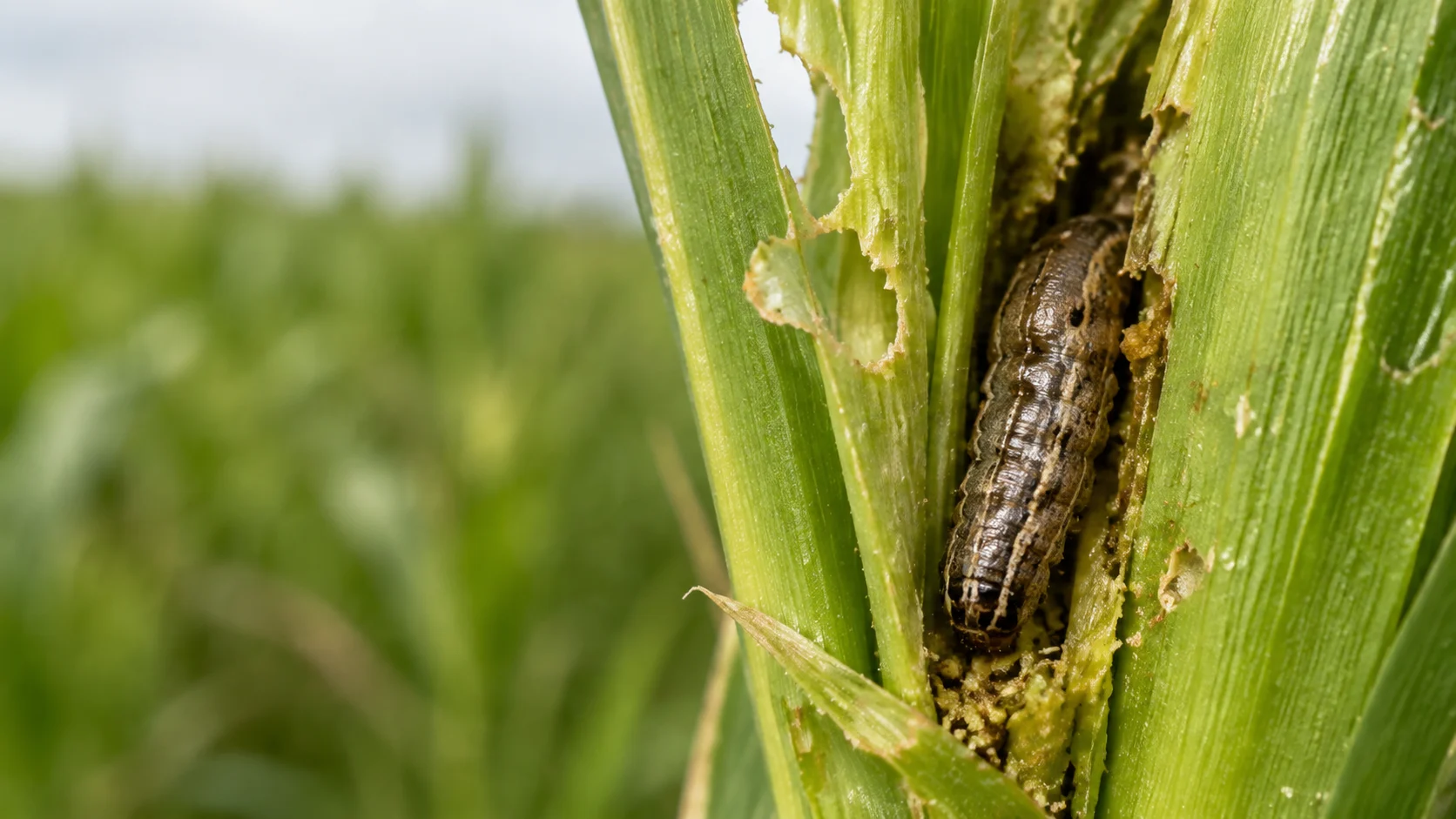
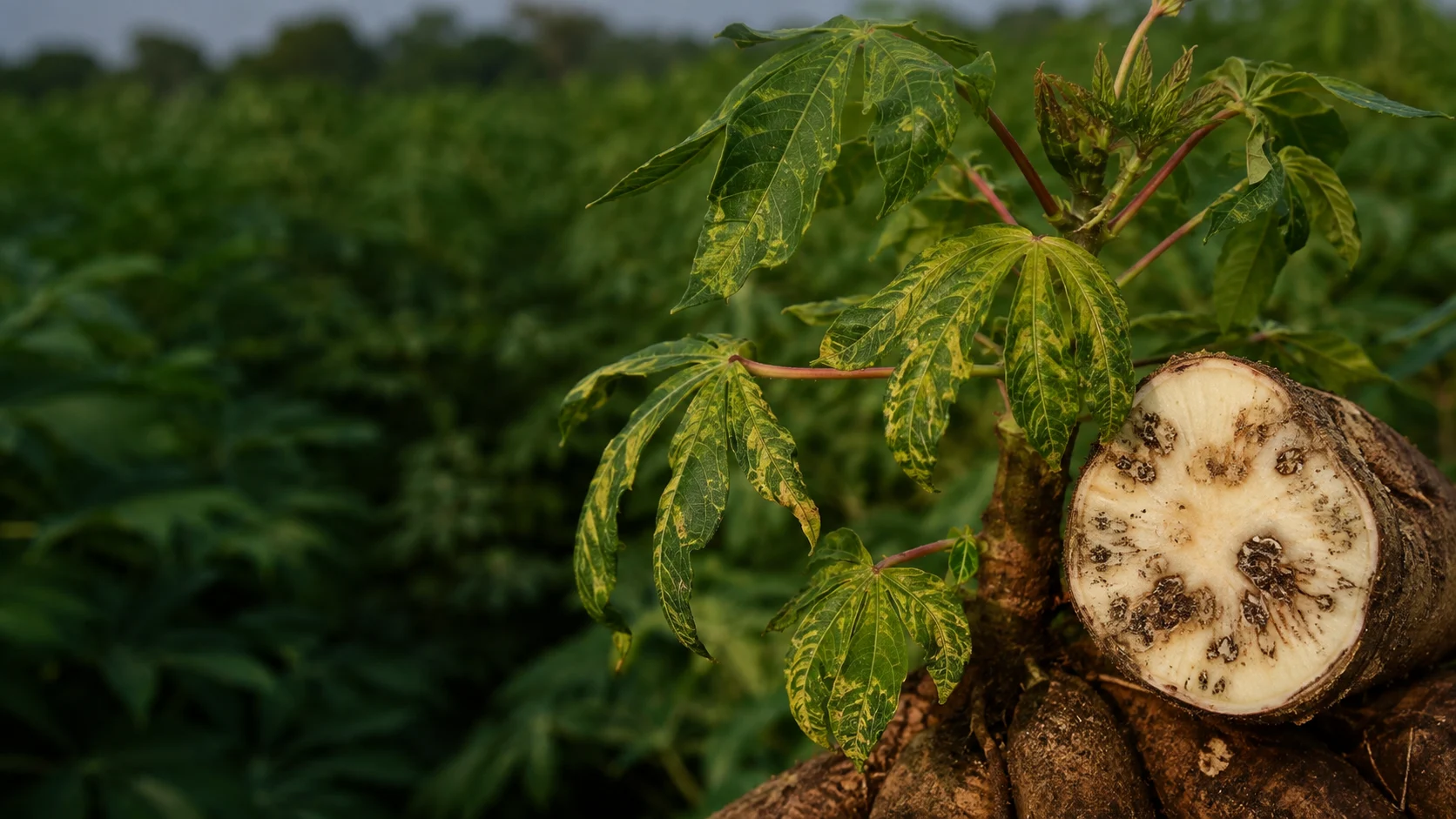
Pesticides are one tool within a wider pest and disease management approach, not a stand-alone programme. Complementary, non-chemical practices, such as field sanitation, resistant or tolerant planting material, crop rotation, timely planting, and monitoring-based (rather than calendar-based) spray decisions, can reduce how often and how much pesticide is needed. Falcon's companion articles on fall armyworm, cassava disease and banana bacterial wilt cover crop-specific integrated management options; this article intentionally does not repeat pest-specific control choices, since its scope is the safety and verification system that applies once a chemical option has been chosen.
Cost Categories to Plan For
Rather than quoting prices, which vary by location, season and supplier, plan for these cost categories:
- The registered product itself, purchased in the quantity actually needed rather than in bulk beyond safe storage capacity.
- PPE (gloves, boots, protective clothing, eye protection, and a respirator where specified), including replacement as items wear out.
- Application equipment (sprayer purchase, maintenance, calibration) and its cleaning.
- Safe storage infrastructure (a lockable, ventilated store or cabinet).
- Disposal or container return costs where a collection scheme charges a fee or requires transport.
- Time and labour for correct mixing, application and record-keeping, which is a real cost against shortcuts but is the basis of the safety system described here.
Questions to Ask Your Supplier, Extension Officer or Laboratory
- Can you show me this product's current registration number and confirm it is still valid?
- Is your business and this premises registered to sell agricultural chemicals?
- What is the pre-harvest interval and re-entry interval for this product on my specific crop?
- What PPE do you recommend for this product, and where can I obtain it locally?
- Where is the nearest approved point to return or dispose of empty containers?
- Who is the current district or sub-county extension contact I can reach if I have a problem with this product?
A Low-Risk Way to Pilot a New Product or Practice
Before adopting a new product or supplier across a whole farm, apply the verification and procedure described here to a small, clearly marked trial area first. Record the outcome (pest/disease control achieved, any operator symptoms, any crop response) in the field log, and only extend use to the rest of the farm once the product's identity, the correct rate, and the practical PPE and interval requirements have been confirmed to work under your own conditions. This limits the consequence of a mistaken product choice or an unworkable procedure to a small area rather than the whole crop.
Limitations, Risks and When to Seek Professional Support
This article is a general safety and verification system; it is not a substitute for the specific label of the product you hold, the product's Safety Data Sheet, or direct advice from MAAIF's Department of Crop Protection, the Agricultural Chemicals Board, a registered agro-input dealer, or a district extension officer. It does not identify or recommend any specific pesticide, active ingredient or dose, and readers must not treat any example in this article as a product endorsement. Uganda's regulatory institutions for agricultural chemicals were in transition at the time of writing, and the named regulator, registration process or applicable regulations may change; always confirm current status directly with MAAIF before purchase or use. Seek immediate professional medical support for any suspected pesticide poisoning, do not wait to see if symptoms resolve on their own, and take the product container or label with the affected person to the health facility. Seek professional agronomic or extension advice before using any pesticide on a crop, pest or scale you have not used it on before, before combining two or more chemicals, and before disposing of quantities larger than routine household or small-farm amounts.