Banana bacterial wilt, known scientifically as banana Xanthomonas wilt (BXW), has been present in Uganda since it was first confirmed in Mukono district in 2001, and it has re-emerged in different districts at different intensities in the years since. Farmers who search for a fix often find two conflicting messages: one telling them to cut out only the diseased stem, and an older one telling them to uproot the entire mat. Neither message on its own tells a farmer what evidence supports each choice, what it costs in labour, or why control that worked in a trial plot sometimes fails to hold on a real farm over several seasons. This guide sets out a hygiene and decision system built on what the research and Ugandan institutions actually document, including where that evidence is strong and where it is still limited.
Direct Answer
Banana bacterial wilt spreads mainly through contaminated cutting tools, infected planting suckers, and insect visits to open male flower buds. No single technique guarantees control. Single diseased stem removal (cutting the infected stem at ground level, destroying the bud, and disinfecting tools) has reduced disease incidence sharply in documented trials in Uganda, Kenya and DR Congo, but Ugandan farmer studies a decade later report recurrence in the majority of cases, mainly where neighbouring plots stayed untreated or monitoring lapsed. Complete mat removal is more disruptive but leaves less residual inoculum. The practical approach for most Ugandan smallholdings is a combination: accurate recognition, consistent tool hygiene, a removal method matched to infection severity, movement controls, clean replanting material, and a simple written record, escalated to district extension or NARO when uncertain.
Who this guide is for
This guide is written for smallholder and commercial banana farmers in Uganda, farm managers overseeing mixed or banana-dominant plots, extension workers advising farmer groups, and agricultural students studying plant pathology or extension practice. It assumes the reader can access a panga, basic cleaning materials and, where possible, contact with a district agricultural office, but it does not assume laboratory access.
The problem it solves
It answers a narrower question than "how do I grow bananas": specifically, once BXW is suspected or confirmed, what should a farmer physically do, in what order, and how should that decision change with severity, resources and confidence in diagnosis. It is not a general banana husbandry guide.
What the reader will decide and do
By the end of this guide, a reader should be able to: tell the difference between an observed symptom and a confirmed diagnosis; choose between single-stem removal, complete mat removal or a combined sanitation package based on documented conditions for each; disinfect tools between plants using accessible materials; control the movement of tools, suckers and people between infected and clean areas; source and verify replanting material; keep a basic field log; and know the specific point at which to call in district extension or NARO rather than continuing alone.
Recognising banana bacterial wilt: observation from confirmed diagnosis
Visible field symptoms
Typical external symptoms described in the technical literature include progressive yellowing and browning of leaves that can look as though they have wilted from heat, leaves that snap rather than hanging normally, premature and uneven ripening of bunches with rust-coloured internal staining, and drying, blackened rot in the male bud. Unlike Fusarium wilt, where yellowing typically starts in older, lower leaves and moves upward, Xanthomonas wilt symptoms can appear on any leaf, a useful field distinguishing point.
The internal check
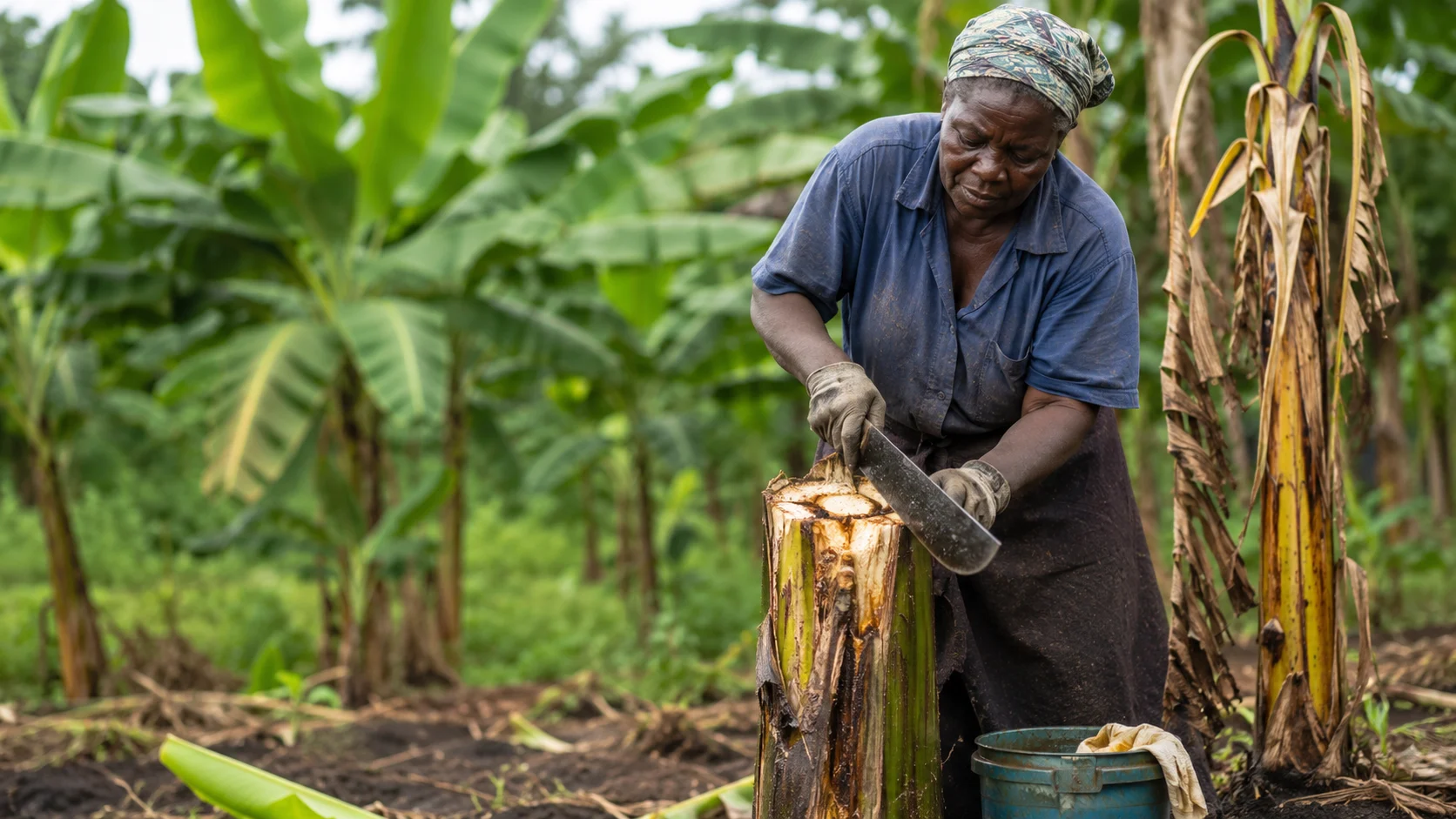
A stronger field indicator is cutting into the pseudostem: yellow-orange streaking of the internal vascular tissue, often with a yellowish bacterial ooze when the cut surface is pressed, is characteristic of BXW and not typical of most other banana wilts. This should still be treated as a strong field indicator rather than laboratory confirmation.
Observation versus confirmed diagnosis
A farmer's or extension worker's field assessment based on external symptoms and the internal ooze test is a reasonable basis for immediate hygiene precautions, because delaying action while awaiting formal confirmation can allow further spread. It is not, however, equivalent to laboratory confirmation. Where doubt exists, where symptoms are atypical, or where a large-scale response (such as a community by-law or coordinated removal campaign) is being considered, samples and a formal assessment through district agricultural staff or NARO's banana research programme at the National Agricultural Research Laboratories, Kawanda, should be sought before wide-reaching decisions are finalised. Treat "I observed symptoms consistent with BXW" and "BXW has been confirmed" as two different statements throughout record-keeping and communication with neighbours or buyers.
Understanding how the disease spreads
The bacterium responsible is understood to spread mainly through three routes documented in the research literature: insects (including honeybees, stingless bees and various flies) visiting and contaminating open male buds and then carrying bacteria to healthy plants' buds; contaminated cutting tools such as pangas and knives moved between infected and healthy stems without disinfection; and symptomless but infected planting suckers moved from an infected garden or nursery to a new site. Understanding these three routes is what shapes every practical control measure that follows: bud management to reduce insect-vector risk, tool hygiene to break the mechanical transmission route, and planting-material verification to close the propagation route.
Decision framework: choosing a removal and sanitation approach
There is no single universally correct removal method. The choice should depend on how many stems and mats are affected, how much labour and monitoring capacity the farmer or group can sustain over multiple seasons, and how much confidence exists in ongoing neighbourhood-level cooperation, because the evidence suggests cooperation and consistency matter as much as the technique chosen.
Single diseased stem removal (SDSR)
SDSR involves cutting only the visibly diseased stem at soil level, destroying the growing point (apical meristem) of the cut stem so it cannot regrow, covering or removing the cut stump, and disinfecting the tool immediately before moving to the next plant. The rest of the mat, including healthy-looking stems on the same rootstock, is left in place. This approach exists because researchers found the bacterium does not always spread systemically to every stem on a mat, so a mat is not automatically a total loss once one stem shows symptoms.
Documented trial evidence for SDSR is genuinely encouraging: field trials in Uganda, Kenya and DR Congo recorded diseased-plant proportions falling to roughly 3 to 20 percent within nine months of consistent application, and separate DR Congo trials recorded incidence below 0.5 percent after one year (Alliance Bioversity-CIAT; Blomme et al., 2017, European Journal of Plant Pathology). This is the evidence base that has made SDSR the most widely promoted BXW response across the Great Lakes region over roughly the past decade and a half.
However, this evidence should be read alongside longer-run Ugandan studies. A 2022/2023 Phytobiomes Journal review of two decades of BXW spread and management in Uganda notes that early campaign-level success (bringing incidence to very low levels through coordinated, externally supported action) has not always been maintained once external technical support, monitoring and community by-law enforcement reduce over time. A separate farmer-survey study covering districts in the south-western agro-ecological zone roughly ten years after the original epidemic found that although the large majority of farmers still rated SDSR-based practices as effective in principle and intended to keep using them, around 83 percent reported disease recurrence, attributed mainly to untreated infected plants on neighbouring farms and to the loss of the coordinated monitoring that had originally driven success. Labour intensity, cost of repeated tool sterilisation, and reduced capacity among elderly, female-headed or resource-constrained households to sustain the physical work were also cited as reasons consistent application lapsed.
The practical implication: SDSR is a reasonable first-line response for isolated, early-stage, low-incidence cases where the farmer or group can sustain regular monitoring and where neighbours are also managing the disease, but it should not be presented, and this guide does not present it, as an automatic default that alone guarantees lasting control, particularly where surrounding farms are not also managing the disease.
Complete mat removal
Complete mat removal involves uprooting the entire mat, including the underground rhizome, and destroying or safely disposing of all plant material, followed by replanting only after a period without banana material at that spot and with disinfection of any tools used. This was the original recommended response before SDSR evidence emerged, and it remains a reasonable choice for severe, multi-stem infections within a single mat, for isolated new outbreaks where a farmer wants to remove all residual inoculum from a specific spot, or where the mat has already shown extensive systemic infection across several stems. It is more labour-intensive and results in a longer replanting gap than SDSR, but it leaves less residual bacterial material at that specific site.
Combined sanitation packages
Neither removal method works reliably in isolation. The literature consistently frames removal (whichever form) as one part of a package that also includes: removing or bagging the male bud before it opens, to reduce insect-vector exposure; consistent tool disinfection between every plant, not only between farms; restricting movement of untreated tools, suckers and plant material between infected and clean areas; and community-level coordination so that removal on one farm is not undone by untreated infection on an adjoining one. Farmers and extension workers should treat the removal decision as inseparable from this wider hygiene package rather than as a standalone fix.
When to simply monitor rather than remove
Where a suspected case is unconfirmed, isolated to a single leaf-level symptom without the internal ooze indicator, or atypical in presentation, it can be reasonable to mark the plant, restrict tool and hand contact with it, seek confirmation, and hold off on removal until diagnosis is clearer, provided this monitoring period is short and the plant is not producing an open male bud that insects can visit.
Tool and equipment hygiene procedures
Tool hygiene addresses the mechanical transmission route directly and is one of the better-evidenced, most farmer-accessible parts of the control package.
Research specifically testing farmer-accessible sterilisation options (Frontiers in Agronomy, 2021, using products sourced from Ugandan local markets) found that washing tools in cold water with ordinary laundry soap or detergent eliminated the bacterium as effectively as standard 3.5 percent sodium hypochlorite (bleach) solution, across a range of common brands. Boiling water immersion for at least 40 seconds also eliminated the bacterium. Fire/flame heating required around 60 seconds of direct exposure to be reliably effective, longer than some previously recommended exposure times, and repeated flaming risks damaging tool edges over time.
Practical hygiene steps for a Ugandan farm:
- Carry a dedicated bucket or basin of soapy water, detergent solution, or diluted bleach to the field whenever cutting or handling suspect plants.
- Disinfect the cutting tool between every individual plant, not only when moving between farms or plots. Wipe or dip the blade, working the solution into the cutting edge.
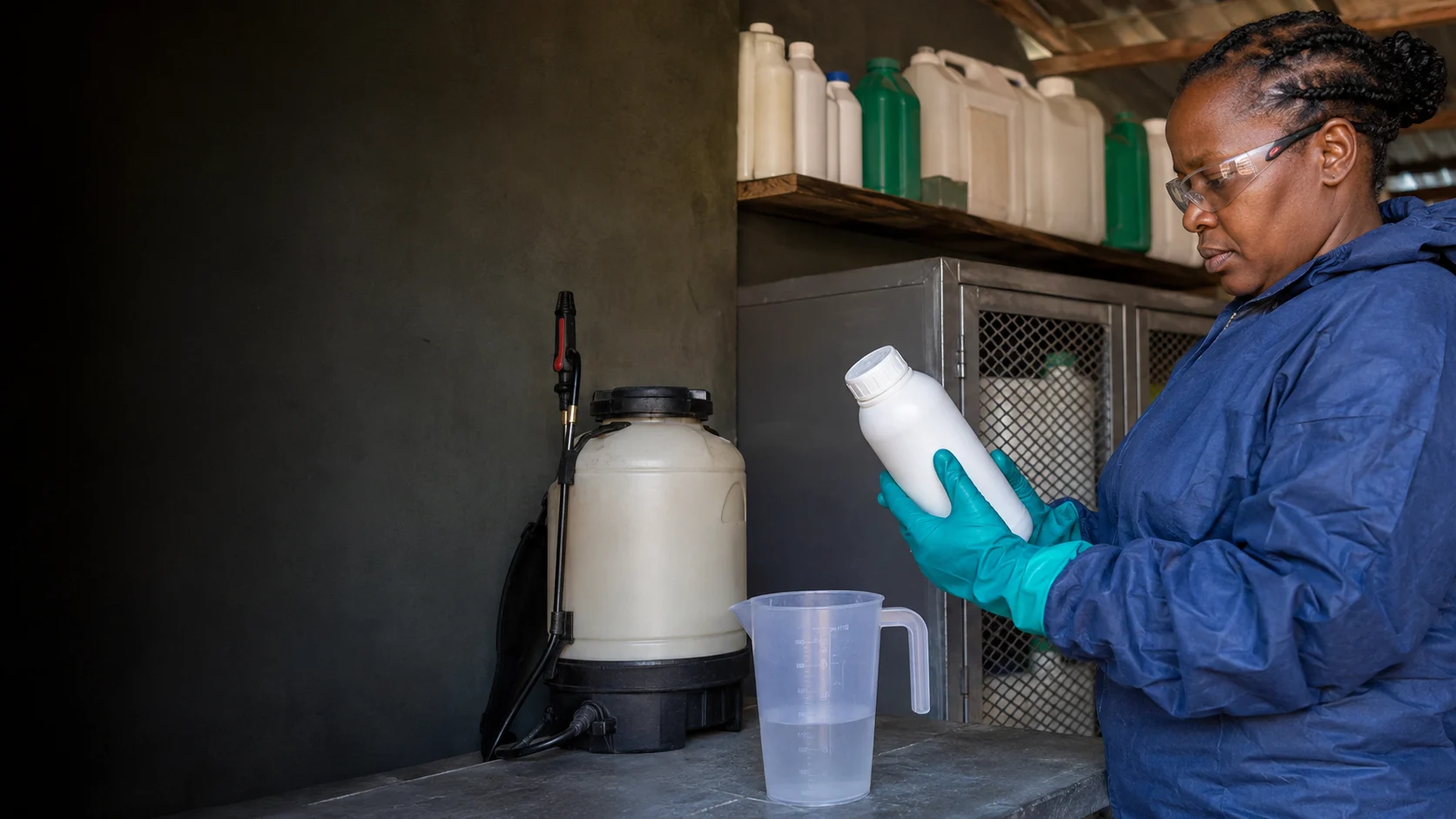
- If using bleach-based disinfectant, follow product-label dilution and handling guidance, and store and mix it away from children and livestock; see the Falcon guide on Safe Pesticide Selection, Mixing, Application and Record-Keeping in Uganda for general chemical-handling and record practices that apply equally to disinfectants.
- Where soap, detergent or bleach is unavailable, boiling water (minimum 40 seconds' immersion of the cutting edge) or a full minute of direct flame exposure are documented working alternatives, accepting the trade-off of tool wear with repeated flaming.
- Avoid moving a single uncleaned tool between an infected plant and unaffected plants even within the same visit; treat every diseased stem as a fresh contamination point.
- Keep separate tools, where feasible, for known-infected areas versus the rest of the plantation, clearly marked.
Movement controls on and around the farm
Because suckers and tools are documented spread routes, movement control matters as much as the removal decision itself. Practical measures include: restricting movement of banana planting material out of a plot with suspected or confirmed infection until cleared by extension or NARO guidance; discouraging casual tool-sharing with neighbouring farms during an active outbreak, or disinfecting shared tools before and after use; controlling foot and hand traffic through infected rows, particularly avoiding unnecessary handling of open male buds; and communicating with immediate neighbours about a confirmed case, since the farmer-survey evidence above shows untreated neighbouring plots are a major driver of recurrence. Movement control is a community-level as well as an individual-farm measure.
Replanting precautions
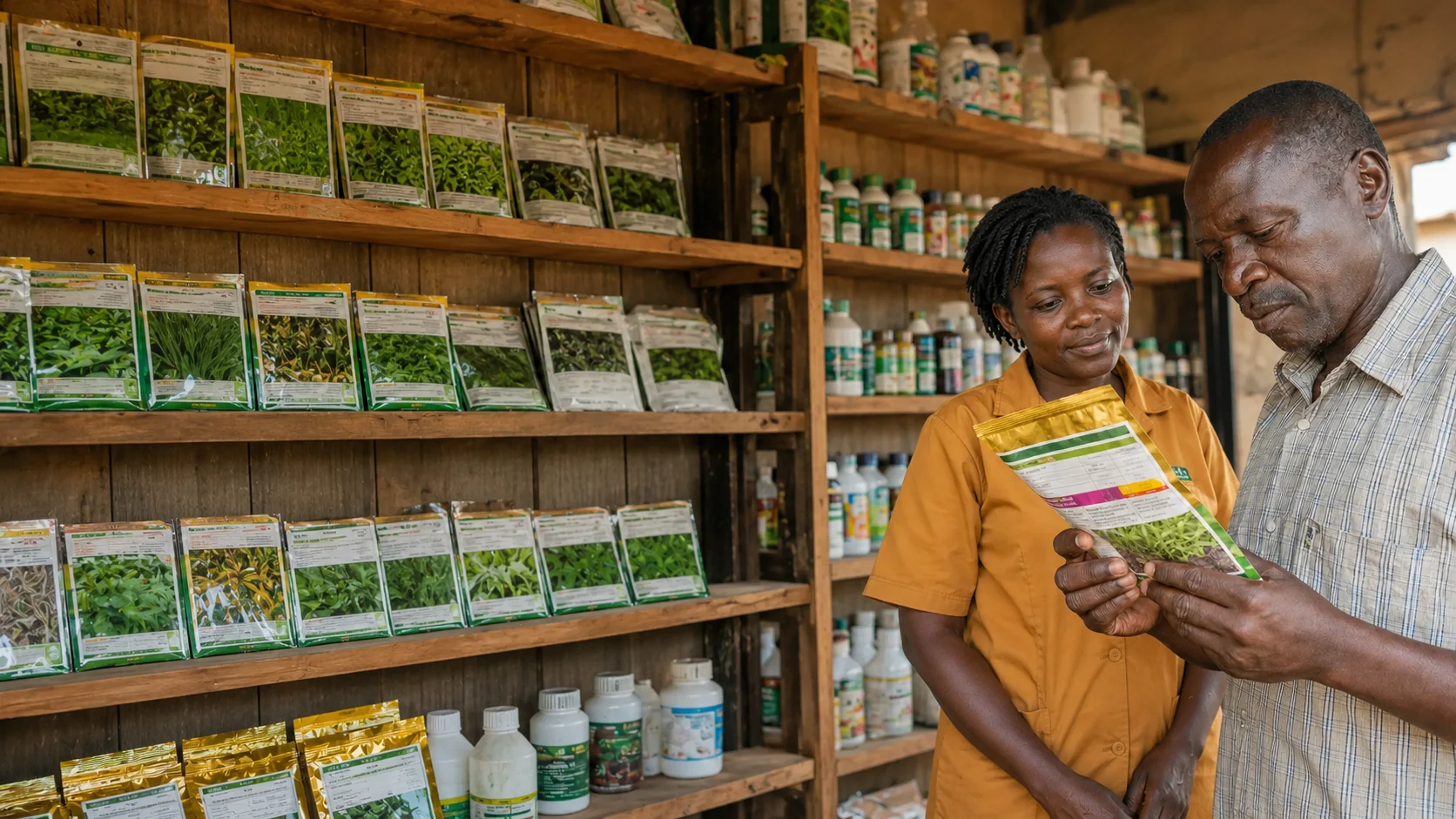
Replanting decisions should be treated with the same evidence-based caution as removal decisions. Source planting suckers or tissue-culture plantlets only from verified, reputable sources, and inspect visually for any wilting, discoloration or unusual internal streaking before planting; the Falcon guide "How to Verify Seed and Planting-Material Quality Before Buying in Uganda" (https://falconfoundation.co.ug/insights/verify-seed-planting-material-quality-uganda) sets out a general verification checklist that applies directly to banana sucker and tissue-culture sourcing. Avoid replanting bananas immediately into a spot where a heavily infected mat was completely removed; allow a reasonable interval and consider an alternative short-term crop, recognising that exact safe intervals are locally variable and best confirmed with district extension or NARO rather than assumed. Disinfect any tools used for planting-hole preparation in a previously infected area before reusing them elsewhere. Where an entire plantation has suffered repeated, severe outbreaks, consider seeking current guidance from NARO's National Banana Research Program on any resistant or tolerant planting material becoming available, since research reviewed for this article explicitly identifies resistant-genotype deployment as an area still being developed rather than something already resolved.
Records and field-log table
A simple written record supports both on-farm decision-making and any conversation with extension staff. Suggested columns for a field log:
| Date | Plot/mat ID | Symptom observed | Internal ooze check (Y/N) | Action taken | Tool disinfection method used | Confirmed by extension/NARO (Y/N/pending) | Follow-up date | Notes |
|---|---|---|---|---|---|---|---|---|
| example | example | example | example | example | example | example | example | example |
Keeping this log consistently, even in a simple exercise book, makes it possible to see whether a chosen approach is holding over several months, and gives extension staff or NARO something concrete to review if the case is escalated.
Warning signs that management is failing
Treat the following as signals to reassess the approach rather than simply continuing the same routine: new symptomatic stems appearing on mats previously treated with SDSR within a short period; symptoms spreading in a pattern that follows tool-use order rather than random distribution, suggesting a hygiene breakdown; recurrence concentrated near a shared boundary with an untreated neighbouring plot; and a rising proportion of affected mats across successive log entries despite continued removal effort. Any of these should prompt a call to district extension or NARO rather than an assumption that more of the same activity will eventually work.
Common mistakes
Common mistakes documented or implied across the sources reviewed include: treating SDSR as a one-off action rather than an ongoing monitoring commitment; failing to disinfect tools between individual plants, not just between visits; leaving the male bud un-managed; replanting into recently cleared infected ground without a suitable interval or verification of new planting material; acting alone without engaging neighbours, when isolated single-farm action is less durable; and confusing a strong field indicator with confirmed diagnosis when communicating with buyers or authorities.
When these methods work, and when they do not
These methods work best under conditions similar to those in the original successful trials and campaigns: early-stage or isolated infection, consistent and sustained application of the full hygiene package (not removal alone), and coordinated action across neighbouring plots, ideally with some level of external monitoring or community by-law support. They are less likely to hold where infection is already widespread across many mats before action starts, where neighbouring farms are not managing the disease, where labour or resource constraints prevent consistent tool disinfection and monitoring over multiple seasons, or where external technical support and monitoring are withdrawn without a community structure to sustain the practice. No method reviewed in the sources for this article is described as permanently eradicating the pathogen from a farm or landscape; all are described in terms of reducing incidence and managing risk on an ongoing basis.
Cost categories to plan for
Rather than invented figures, plan for the following cost categories, which vary by farm size, location and current input prices: labour time for regular inspection, cutting and tool disinfection; disinfectant materials and replacement or maintenance of cutting tools; potential loss of productive stems or, for complete mat removal, loss of the full mat and replanting cost; cost or time of sourcing verified clean planting material; and, where relevant, transport cost of engaging district extension or NARO. Farmers assessing whether a coordinated, community-level response is worthwhile may also want to review the risk-assessment approach in Falcon's Agricultural Investment Due Diligence in Uganda guide when weighing these costs against expected production value.
Questions to ask extension staff or NARO
When engaging district agricultural staff or NARO's relevant banana research programme, useful questions include: can you confirm whether this is BXW rather than another wilt or nutrient-related symptom; given the number of mats affected and my available labour, would you recommend single-stem removal, complete mat removal, or a mixed approach for my specific case; what disinfectant and contact time do you currently recommend, and has this changed recently; are there active community-level control efforts or by-laws in my area that I should coordinate with; is there any resistant or tolerant planting material currently available or being trialled in my district; and what is the appropriate interval and precaution before replanting bananas at a site where an infected mat was fully removed.
A low-risk pilot and validation approach
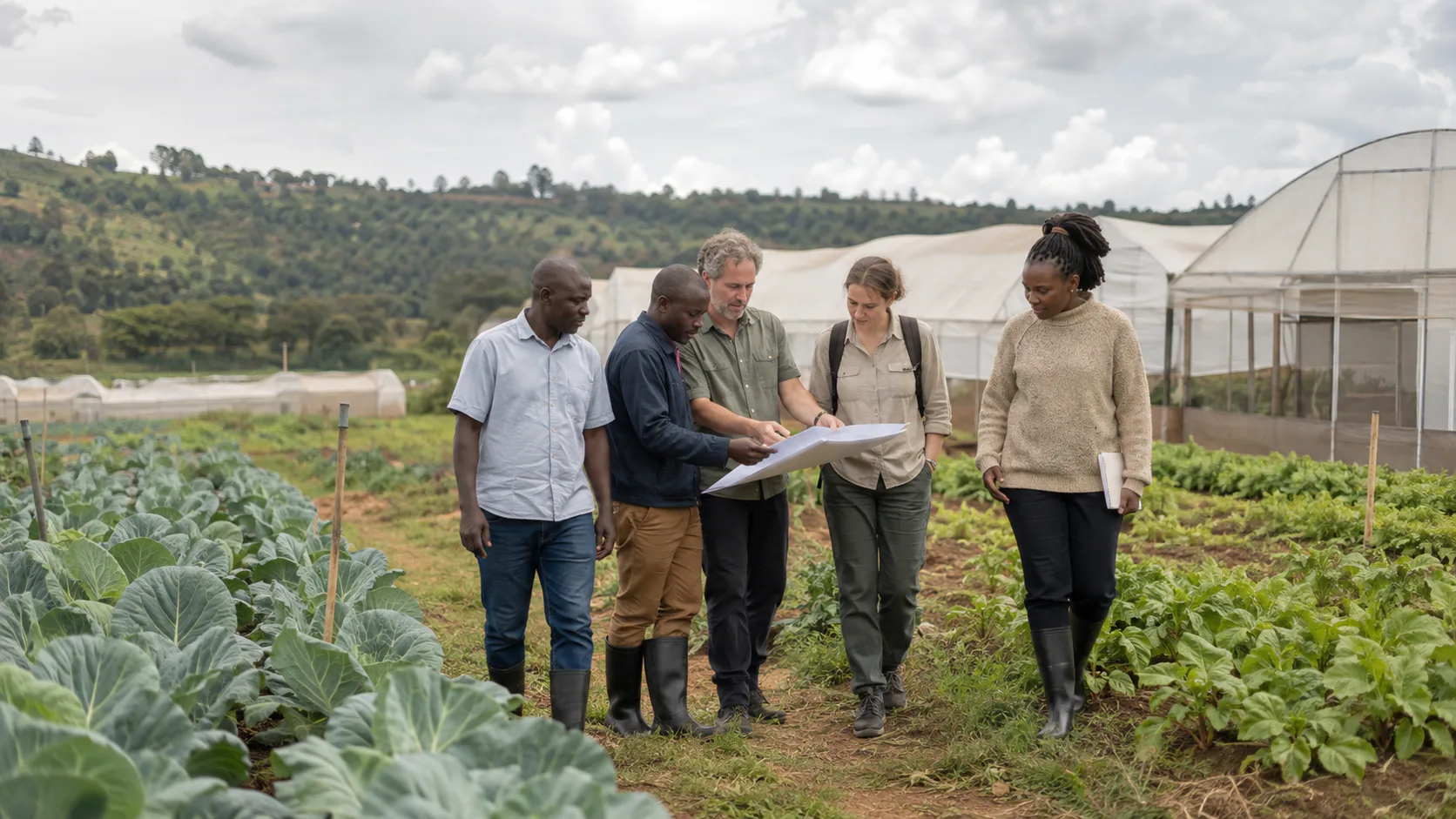
Rather than committing an entire plantation to one removal strategy immediately, a lower-risk approach is to select a defined section of the plantation, apply the full hygiene package (chosen removal method, tool disinfection, bud management, movement control) consistently there for one to two seasons, keep the field log described above, and compare recurrence against untreated or less-intensively-managed sections. This mirrors, at smallholder scale, the kind of structured comparison used in the trials referenced in this article, and it allows a farmer or group to see whether the approach is holding under their own labour and monitoring constraints before scaling it across the whole farm or coordinating a wider community effort.
Next actions
- Inspect suspect plants using both the external symptom check and the internal ooze/streaking check, and record findings in a field log.
- Where confirmed or strongly suspected, begin tool disinfection immediately using soap, detergent, bleach, boiling water or flame, choosing whichever is most accessible.
- Decide between SDSR, complete mat removal or continued monitoring based on the severity, your capacity to sustain follow-up, and neighbouring farms' status, using the decision framework above.
- Manage male buds and restrict movement of tools and planting material out of affected areas.
- Contact district agricultural extension staff or NARO's National Banana Research Program for confirmation and current local guidance, particularly before any community-wide or large-scale response.
- Source any replacement planting material through verified channels and maintain the field log across at least one to two full seasons to check whether control is holding.
Limitations, Risks and When to Seek Professional Support
This guide is an information resource, not a diagnostic service, and it does not replace confirmation by qualified plant health personnel. Field symptoms, including the internal ooze test, are strong indicators but not equivalent to laboratory diagnosis, and other conditions can sometimes produce partially overlapping symptoms. No removal or hygiene method described here is guaranteed to eliminate banana bacterial wilt from a farm or prevent its return; published evidence shows disease incidence can be reduced substantially under consistent, well-supported conditions, but Ugandan studies also document recurrence where neighbouring farms remain untreated or where monitoring lapses over time. Costs, timeframes and appropriate replanting intervals vary by location, farm scale and current conditions, and this article deliberately avoids invented prices, yields or trial results specific to any farm; readers should verify current figures locally. Farmers, farm managers or extension workers should seek direct professional support from district agricultural or veterinary authorities, or from NARO's National Banana Research Program at the National Agricultural Research Laboratories, Kawanda, in any of the following situations: symptoms are unclear or atypical; a large number of mats are affected or the outbreak covers multiple farms; a community-level or by-law response is being considered; resistant or tolerant planting material information is needed; or a chosen approach has been applied consistently for a full season without any reduction in new symptomatic stems. This article does not provide legal, regulatory or veterinary advice and does not substitute for a site visit by qualified personnel where the situation warrants one.