The direct answer
There is no single place to get farming advice in Uganda, and anyone who tells you there is has something to sell. There are four kinds of source, each good at a different thing, and one test that applies to all of them.
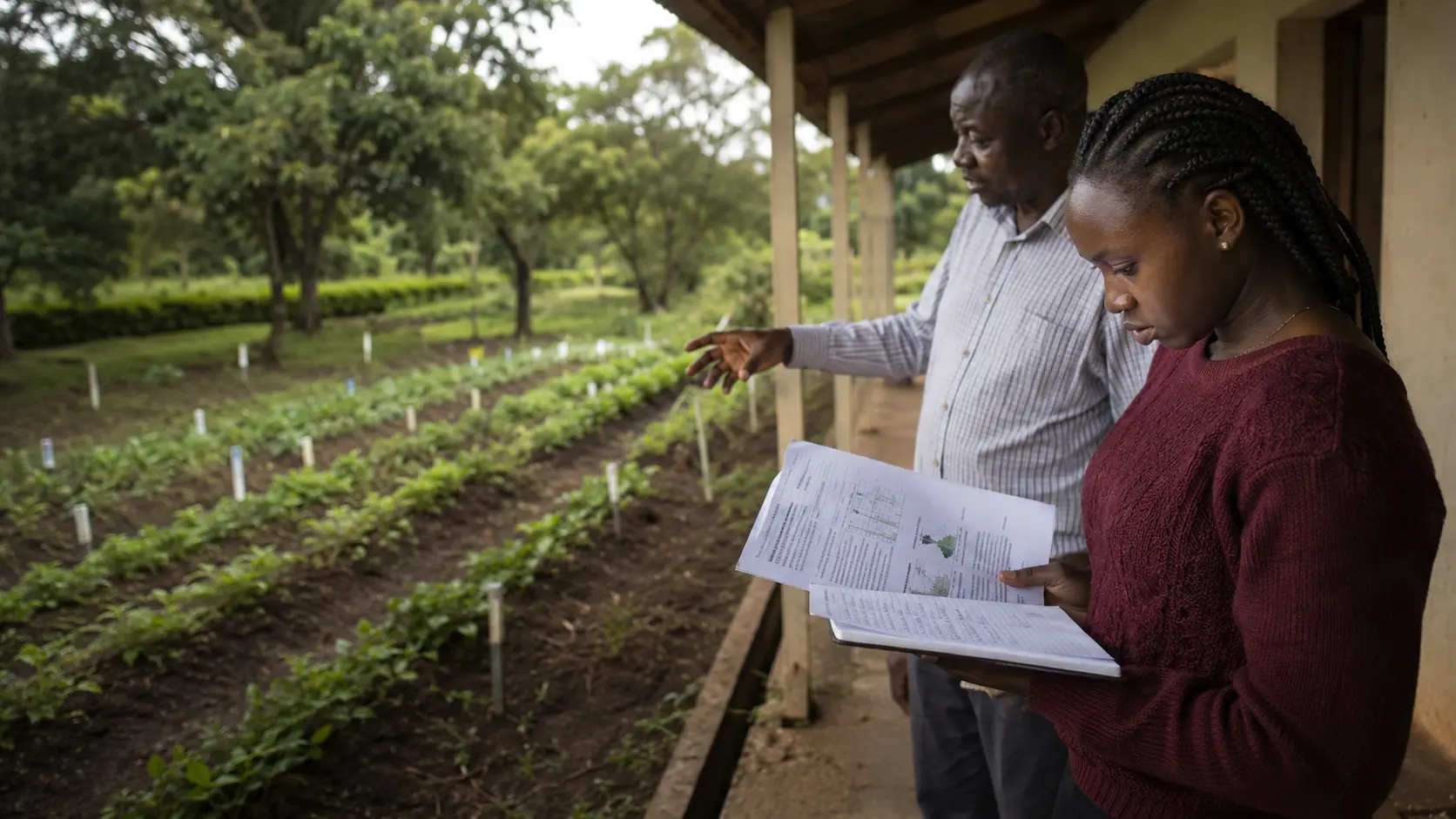
Public extension answers "what should I do on my farm, here, this season". It is delivered through the Ministry of Agriculture, Animal Industry and Fisheries and through district and sub-county production structures.
Public research answers "what has actually been tested, and under what conditions". In Uganda that is the National Agricultural Research Organisation and its institutes.
Regulators and standards bodies answer "what am I allowed to do, and what must my produce meet". These are the only correct source for a rule.
Private and commercial sources answer "what can I buy, and how is it used". They are useful and they are interested parties, which is not the same as dishonest, but it is a difference you must hold in mind.
The test that applies to all four is short: who is saying it, what is it based on, does it apply here, and who gains if I believe it. If you cannot answer all four, you do not yet have advice, you have an opinion.
One thing has changed recently and matters more than anything else in this article. Several well-known Ugandan agricultural agencies were folded back into the Ministry during 2024. A great deal of published material, including material still online, describes arrangements that no longer hold. That is covered in full below, because it is the single biggest source of confidently wrong advice in Uganda right now.
Practical summary
- Decide what kind of question you have: a practice question, an evidence question, a rules question, or a product question.
- Route it to the kind of source that owns that question.
- Start with your sub-county or district production office for practice questions.
- Use NARO and its institutes for evidence questions.
- Use the regulator, never a shop or a social media page, for rules questions.
- Apply the four-question test to whatever you are told.
- Check the date on anything you read, and check whether the institution named in it still holds that mandate.
What changed in 2024, and why it matters to you
Parliament passed legislation during 2024 merging several agricultural agencies into the Ministry of Agriculture, Animal Industry and Fisheries.
On 22 October 2024, Parliament approved the merger of the Cotton Development Organisation, the Dairy Development Authority and the National Agricultural Advisory Services into the Ministry, through the Cotton Development Organisation (Amendment) Bill 2024, the Dairy Industry (Amendment) Bill 2024 and the National Agricultural Advisory Services (Amendment) Bill 2024. On 7 November 2024, Parliament passed the National Coffee (Amendment) Bill 2024, which the Parliament of Uganda described as "integrating the Uganda Coffee Development Authority (UCDA) into the Ministry of Agriculture, Animal Industry and Fisheries (MAAIF)".
Why this matters practically:
- Advice that tells you to "go to NAADS" or "contact the Dairy Development Authority" describes a superseded arrangement. The function may still exist; the door has moved.
- Older printed and online material is now unreliable on institutions even where it remains sound on agronomy. A 2019 guide on dairy hygiene may still be technically correct and institutionally out of date in the same paragraph.
- Ministry material itself has not caught up everywhere. At the access date for this article, MAAIF's own website still listed several of the merged bodies in its agencies list. That is not a reason to distrust the Ministry; it is a reason to treat every institutional reference, including the Ministry's own, as something to confirm rather than assume.
What to do about it. When any source names an institution, ask when the source was written and whether that institution still holds that mandate. If the answer is unclear, go to the Ministry or to your district production office and ask who now handles the function.
Source one: public extension, for practice questions
MAAIF's Directorate of Agricultural Extension Services holds the mandate to "promote adoption of appropriate information, knowledge, and technological innovations for commercialization of agriculture". It contains two departments: the Department of Extension and Skills Management, with divisions covering information and communication, skills management, and agricultural extension coordination; and the Department of Agricultural Investment and Enterprise Development.
Delivery runs through the approved structure and functions at national, district and sub-county levels, with production departments established at district local government headquarters and at sub-county level.
For a farmer, that structure has one practical consequence: your entry point is the sub-county, not the ministry. The production department at your sub-county, and the district production office above it, are the part of the system designed to answer a question about your field, your animals and your season. Going straight to national level with a local question is slower and usually returns you to the same officer.
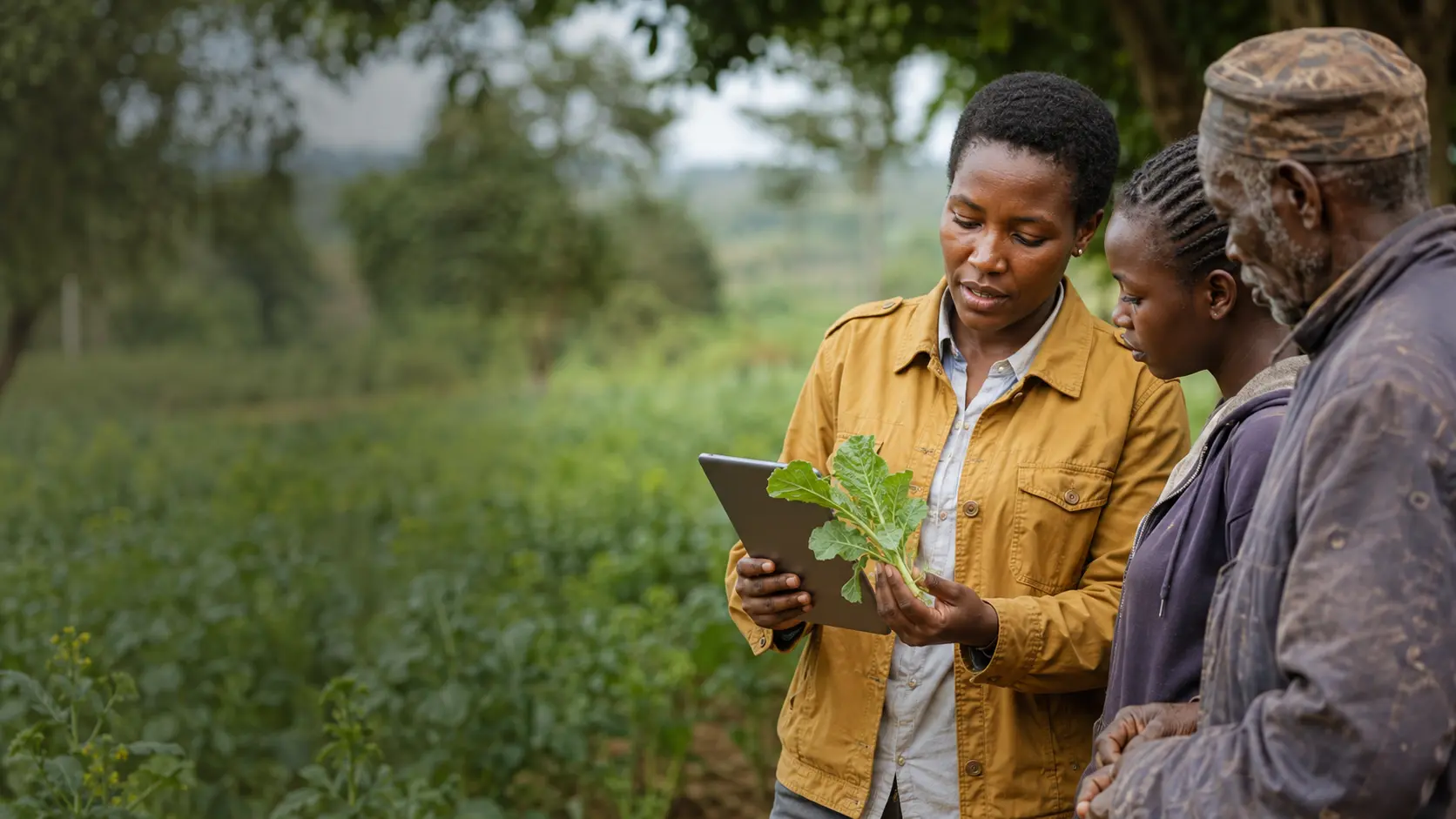
What extension is good at. Locally adapted practice. Knowing what has been failing in your area this season. Connecting you to demonstrations and to other farmers. Referring you upward when a problem needs diagnosis.
What extension cannot be. A substitute for a diagnostic laboratory, a veterinary surgeon, an advocate or an accountant. Extension coverage per farmer in Uganda is thin, and an officer covering many parishes cannot visit every farm. Prepare your question, bring records and photographs, and be specific, because the officer's time is the scarce resource.
Source two: public research, for evidence questions
The National Agricultural Research Organisation was established as a body corporate by the National Agricultural Research Act of 2005, with the mandate to "coordinate and oversee all aspects of public-funded agricultural research in Uganda". NARO states that it comprises a Governing Council, a Secretariat and 16 Public Agricultural Research Institutes spread across the country.
Seven national institutes are listed by NARO by name and acronym:
| Acronym | Institute |
|---|---|
| NaCRRI | National Crops Resources Research Institute |
| NaCORI | National Coffee Resources Research Institute |
| NaSARRI | National Semi-Arid Resources Research Institute |
| NaFIRRI | National Fisheries Resources Research Institute |
| NaFORRI | National Forestry Resources Research Institute |
| NARL | National Agricultural Research Laboratories |
| NaLIRRI | National Livestock Resources Research Institute |
How to use them. Route the question to the institute whose subject matches it. A cassava variety question belongs with the crops institute. A soil or diagnostic question belongs with the laboratories. A livestock question belongs with the livestock institute. NARO also publishes books and manuals through its e-library, which was the first result in a Uganda-geolocated search for how to read agricultural research.
What research is good at. Telling you what was tested, where, under what management, and what happened. Variety information. Diagnostic confirmation.
What research is not. A prediction of what will happen on your farm. Trial conditions are not farm conditions, and the difference is measurable rather than theoretical. That difference is the subject of a separate Falcon article on reading research, and it is the reason a trial result should be treated as evidence to be adapted rather than an instruction to be followed.
Source three: regulators and standards bodies, for rules questions
If the question begins with "am I allowed", "must I", or "what must it meet", the answer comes from the body that holds the rule and from nowhere else.
- Plant health, pest control and export inspection. MAAIF's Department of Crop Protection states its responsibility as "sustainable crop pests and diseases control for improved food security and household incomes in Uganda", and lists functions including conducting field and laboratory investigations of outbreaks, monitoring outbreaks and prevalence, conducting surveillance and disseminating epidemiological data, and supporting "plant health inspection and certification services, to ensure that Uganda's exports are free of pests and diseases". It also manages and monitors the availability and use of major agricultural chemicals.
- Animal disease. The Ministry's animal resources directorate and the veterinary structure at district level. Reporting duties for suspected disease are set in law, and a shop or a neighbour is not a lawful substitute for notification.
- Product standards and certification. The national standards body, for anything you intend to sell processed, branded or into a formal chain.
- Business registration, tax and licensing. URSB, URA and your local licensing authority respectively.
The rule for rules. Never accept a legal or regulatory statement from an input shop, a training provider, a social media page or an article, including this one, without confirming it with the body that holds the mandate. Regulatory statements in secondary sources go out of date silently.
Source four: private and commercial advice
Input suppliers, agro-dealers, private agronomists, training providers, off-takers and equipment sellers all give advice. Much of it is competent and some of it is the only advice available in a given place. The point is not to avoid it; the point is to read it correctly.
Ask three things.
- What does this person sell? Advice that always ends in a purchase from the adviser is a sales process with technical content, which can still be useful information.
- What is the recommendation based on? A supplier who can name the trial, the label, the standard or the institution is giving you something checkable. A supplier who says "it works, everybody uses it" is not.
- Would they say the same if the answer were "do nothing"? The best commercial advisers in Uganda will tell a farmer not to buy something. That is the signal worth paying attention to.
MAAIF states that Uganda participates in a global collaboration with the Centre for Agriculture and Bioscience International and refers to the interactive Plantwise Knowledge Bank, which is a documented example of publicly backed technical information sitting alongside commercial channels.
The four-question test
Apply this to anything, from any source, before you spend money or change a practice.
1. Who is saying it? Name the institution or the person and their role. "Someone on a farming group" is not a source. If you cannot name it, stop here.
2. What is it based on? A trial, a standard, a law, a label, direct experience, or nothing stated. Each of these is worth something different. Direct experience from a farmer in your own area with your own soils is genuinely valuable evidence, and it is not the same kind of evidence as a multi-season trial.
3. Does it apply here? Different rainfall, altitude, soil, variety, scale and market change outcomes. A recommendation developed for irrigated conditions is not a recommendation for rain-fed conditions with the word "irrigated" removed.
4. Who gains if I believe it? Not an accusation, a disclosure question. Answer it about every source, including public ones, which have their own programme targets.
A claim that survives all four is worth acting on. A claim that fails question 3 is the most dangerous, because it is usually true somewhere else.
Decision framework: routing your question
| Your question sounds like | Route it to | Bring with you |
|---|---|---|
| "Something is eating my crop, what is it" | Sub-county or district production office; laboratory diagnosis if referred | Photographs, affected plant material, the field's history |
| "Which variety should I plant" | District production office, then the relevant NARO institute | Your location, season, soil information, intended market |
| "Is this chemical allowed on this crop" | The regulator and the product label | Product name, registration details, crop and intended use |
| "My animals are sick" | District veterinary structure; report first, treat second where reporting is required | Numbers affected, signs, dates, any recent movement onto the farm |
| "What must my produce meet to be sold to this buyer" | The standards body and the buyer's own specification | The buyer's written specification |
| "Is this research finding real" | The publishing institution; then the reading method in FF-801 | The full source, not a screenshot of a headline |
| "Should I buy this input" | The commercial supplier, then a second opinion from extension | The supplier's stated basis for the recommendation |
| "Do I need to register or license this" | URSB, URA, or your local licensing authority | A written description of what you actually do |
Field record: advice log
One page, kept with the farm records. It costs a minute per entry and it is the only way to find out, over a season, whose advice actually worked.
| Date | Question | Source consulted, by name and role | What was advised | Basis given | What I did | Outcome, recorded later |
|---|
Two columns do the work. Basis given exposes advice that has none. Outcome, recorded later is what turns a season of guesses into a personal evidence base, and it is the column everyone skips.
Search evidence for this article
In Google Keyword Planner with the location set to Uganda, the exact term agricultural extension services returned an average monthly search band of 10 to 100. Bands are reproduced exactly as returned; this account returns ranges rather than exact figures, and no range has been converted into a single number. The related term agriculture courses in uganda returned 100 to 1K, indicating a substantial Ugandan audience seeking structured agricultural learning.
A Uganda-geolocated Google search for agricultural extension services uganda returned two MAAIF pages in the top two positions, followed by two development organisation pages about digital extension and a Ugandan research repository item on extension performance. The result set carried videos, short videos, people also ask, images and people also search for.
The gap in that result set is specific. The ministry pages describe the ministry's own structure. The development organisation pages describe their own projects. The repository item is an academic assessment. Nothing in the observed results tells a farmer which door to knock on for which question, and nothing addresses the institutional changes of 2024. That is what this article does.
Uganda-specific importance
Two things make advice quality unusually consequential in Uganda.
The first is coverage. Extension officers cover large numbers of farmers across wide areas, and the gap is filled by whoever is nearest, which is frequently a seller.
The second is institutional change. When agencies merge, the names in circulation stop matching the doors that exist. Uganda went through exactly that during 2024, and the result is a period in which confident, well-intentioned, out-of-date institutional advice circulates widely. A farmer who does not know that NAADS, DDA, CDO and UCDA functions were brought into the Ministry can spend a great deal of time looking for the wrong office.
The correction is cheap. Ask when a source was written. Ask whether the named institution still holds the mandate. Route the question to the kind of body that owns it. Those three habits remove most bad advice before it costs anything.
Limitations and common mistakes
Limitations. This article maps kinds of source and how to test them. It does not evaluate, rank or recommend any individual adviser, company, project or officer. It does not list contact details, offices or officers, because those change and were not verified. It does not describe how the merged functions are organised inside the Ministry in operational detail, because that arrangement was still settling at the access date. It does not teach the method for reading a research paper, which is a separate Falcon article.
Common mistakes.
- Treating an institution's name as proof of currency. Names outlive mandates. Check the date.
- Going national with a local question. The sub-county and district production structures exist precisely for field-level questions.
- Taking a regulatory statement from a shop. Rules come from the body that holds the rule.
- Treating a trial result as a farm prediction. Trial conditions are managed conditions.
- Rejecting commercial advice outright. A supplier who can name the label, the standard or the trial is giving you checkable information. Test it, do not dismiss it.
- Trusting a screenshot. A headline separated from its source cannot be tested against any of the four questions.
- Not writing anything down. Without an advice log you will repeat the same mistake with a different adviser.
When to bring in a professional
- A veterinary surgeon or the district veterinary structure, for any suspected notifiable animal disease, immediately and before treatment.
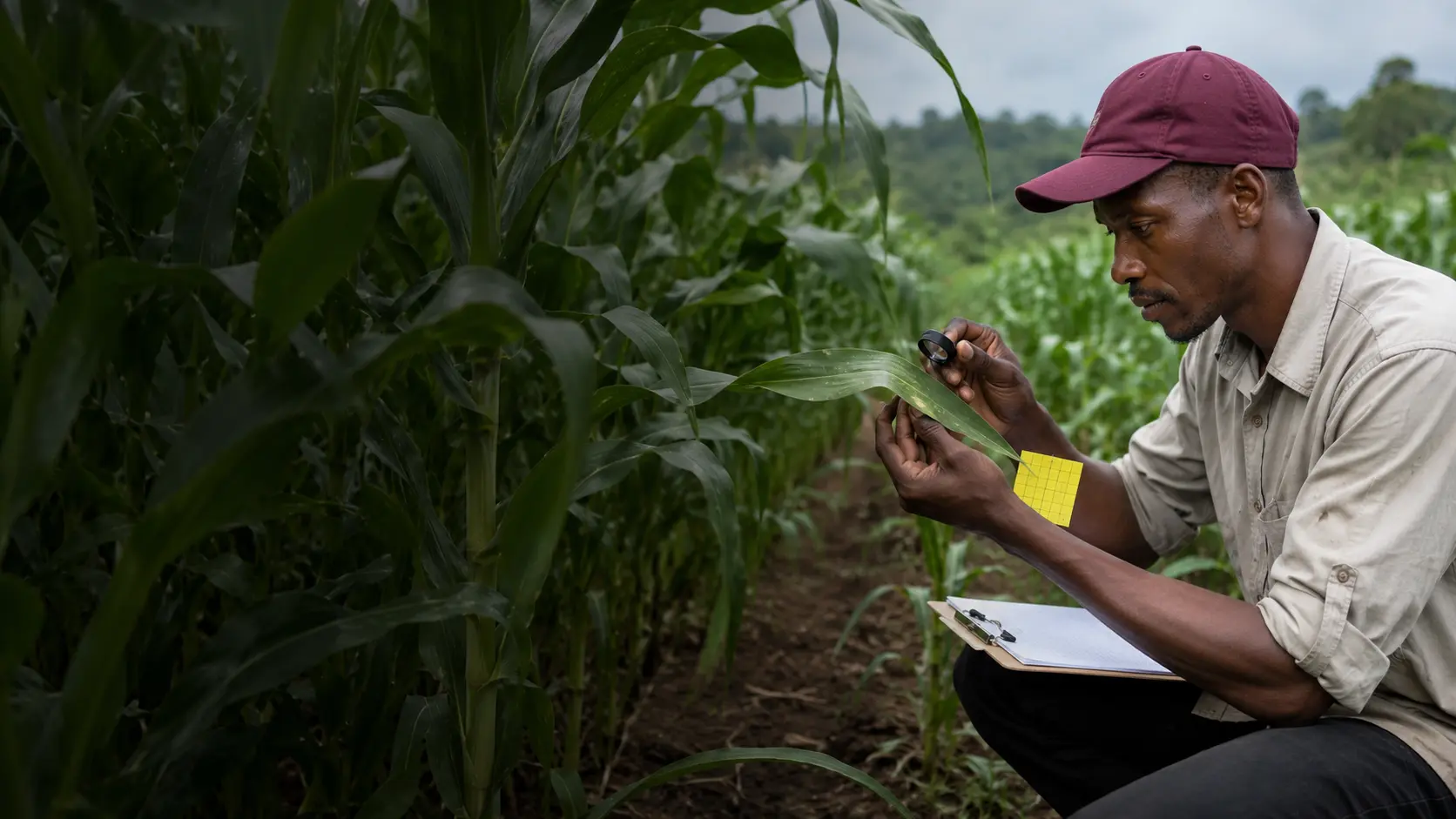
- A laboratory, through referral, for any pest, disease or soil question that identification by eye cannot settle.
- An advocate registered in Uganda, for any contractual or land question that advice cannot resolve.
- The regulator directly, for any question about what is permitted, in writing where the answer will affect a purchase or a sale.