The direct answer
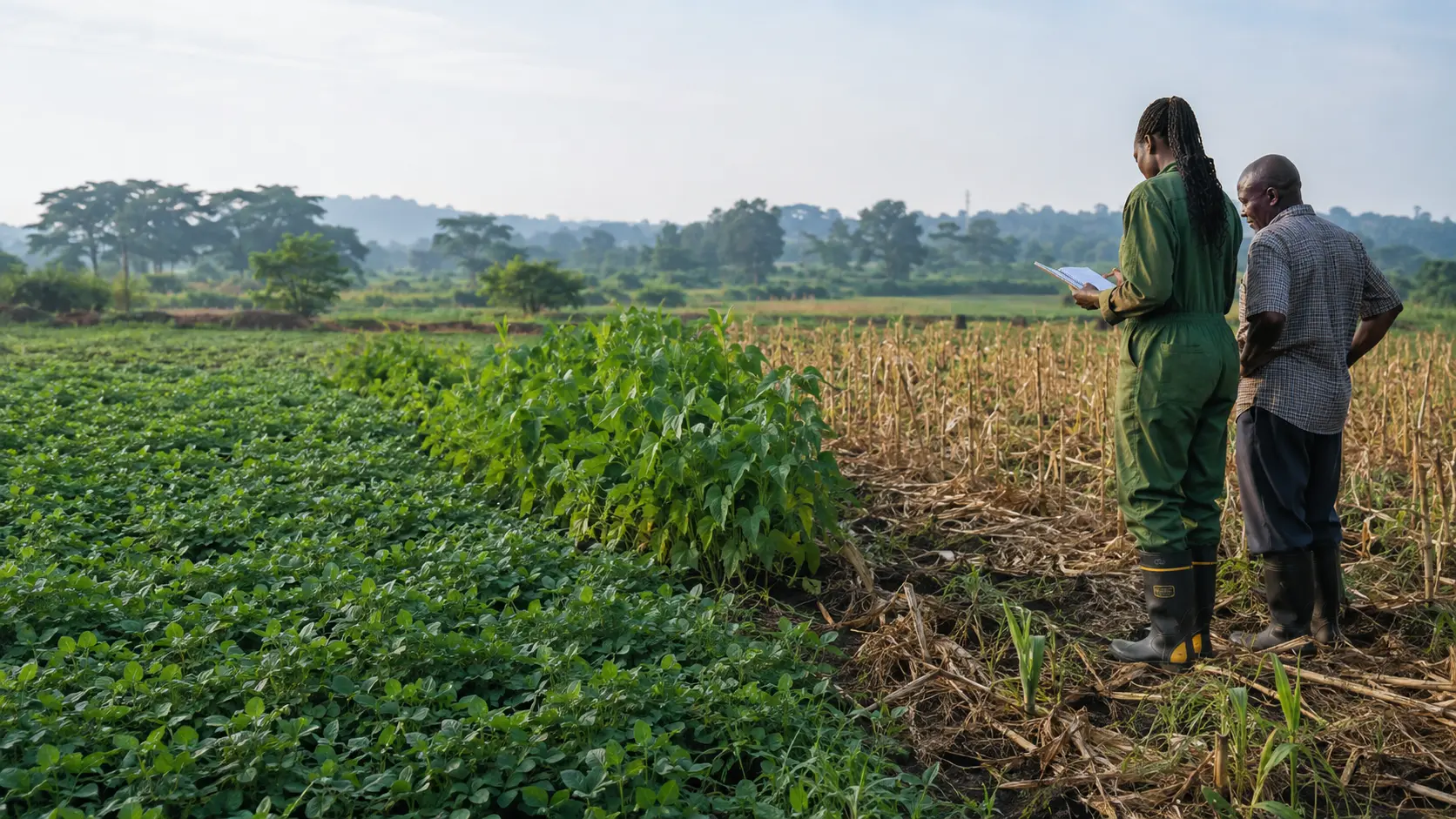
Rotation is a sequence decision, not a season decision. You are deciding what follows what, on a named field, for the next four to six seasons.
Three principles do the work, and one caveat undoes most of the overclaiming you will read elsewhere.
Principle one: diversify the sequence. FAO's conservation agriculture guidance sets species diversification as one of three principles and puts a number on it: "Rotation/association should involve at least 3 different crop species". The other two principles are "Minimum mechanical soil disturbance" and "Permanent soil organic cover", the latter with categories of "30-60%, >60-90% and >90% ground cover", or on FAO's landing page "at least 30 percent with crop residues and/or cover crops".
Principle two: legumes carry the nitrogen. FAO Soils Bulletin 72's chapter on sustainable crop rotations states plainly: "To sustain nitrogen levels, crop legumes are essential."
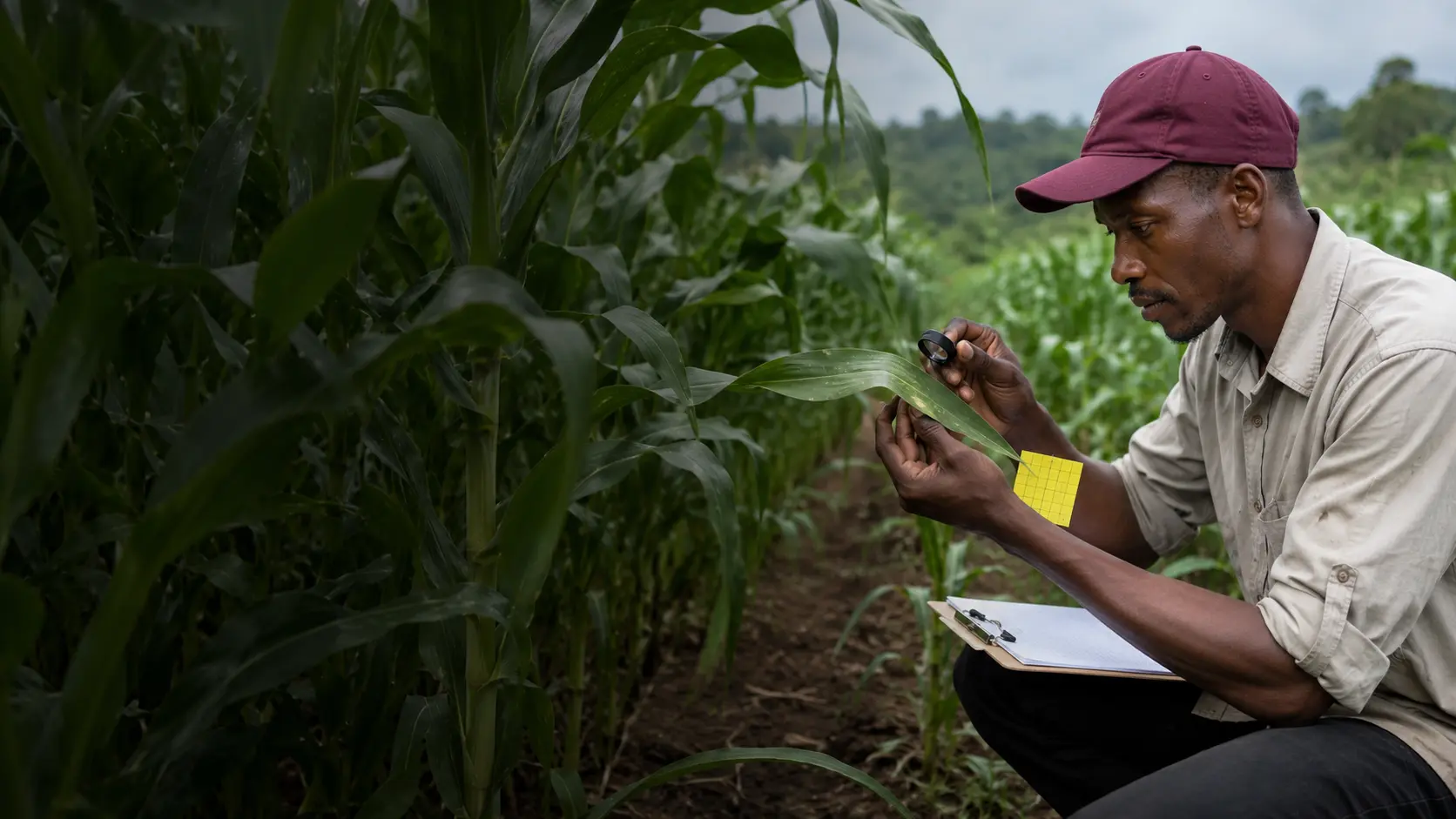
Principle three: rotation breaks what is specific to a crop. Where a soil-borne problem builds under one crop, putting a non-host in its place starves it. There is East African field evidence for this, quoted below.
And the caveat, from the same FAO source, which matters more than any of the three principles: "For cropping systems to be sustainable, nutrients other than nitrogen need to be imported."
Read that carefully. Rotation can look after your nitrogen. It cannot create phosphorus and potassium that left the farm in a harvested crop. Anyone who tells you that rotation alone will restore a depleted Ugandan field is either mistaken or selling something. The same FAO chapter adds a second uncomfortable line: "Fallow as such does not restore soil structure, biological activity or nutrient status", and even that "There is no reason why a well-managed continuous cropping system should be less sustainable than one including unmanaged short fallows."
So the honest summary is this. Rotation is a management tool with a specific job: nitrogen, and breaking crop-specific pest and disease cycles. It is not a fertility programme.
Who this article is for
Farmers and farm managers planning what to plant next, on land that is already in production. Students learning the reasoning. Extension officers advising on sequence. Programme professionals designing interventions that will meet the constraints described below.
If your question is what to plant alongside something in the same season, the published Falcon article on maize and bean intercropping owns that and this one deliberately does not repeat it. If your question is when to spray, that is a scouting and threshold question and Falcon's integrated pest management article owns it.
The problem this solves
Two things drive Ugandan interest in rotation, and they are different problems.
Nutrient depletion. Work presented to the London Group on environmental accounting, with the Uganda Bureau of Statistics as a project partner, reported 2018 NPK balances by agricultural research zone including minus 138 kilograms per hectare per year at Buginyanya, minus 75 at Nabuin and minus 42 at Ngetta. Uganda's National Fertiliser Policy of August 2016 records that the country "loses approximately 80 kg of nutrient per hectare per year through topsoil erosion", against fertiliser application of "only between 1-1.5 kg" per hectare at the time of writing. World Bank data put Ugandan fertiliser consumption at 3.33 kilograms per hectare of arable land in 2023, against a Sub-Saharan Africa average of 19.59.
Pest and disease build-up under continuous cropping. Here Falcon must be honest with you. The best Ugandan field evidence it could verify on continuous cropping is from 1969. A study of sixteen factorial field trials in Uganda reported that "yields declined during the first four years of cropping following a resting period under grass", that "responses to K and farmyard manure increased", and that "potassium deficiency may seriously limit yields, especially of sweet potatoes". That is real Ugandan evidence and it is more than half a century old.
Falcon could not verify any post-2000 Ugandan trial on continuous maize or continuous cassava yield decline, and does not assert one. What follows uses East African evidence, labelled by country, and FAO principles, labelled as principles.
The decision you are making
For each named field, you are fixing:
- The crop sequence for the next four to six seasons.
- Which season, if any, carries a cover crop or green manure.
- Which specific problem the rotation is intended to break.
- What happens to the residues.
- Where purchased or on-farm nutrients enter the sequence.
- How you will know whether it worked.
Point 3 is the discipline. A rotation designed to break nothing in particular is just variety.
Uganda-specific context
Two seasons in most of the country, one in the north-east. FEWS NET's reporting describes a "March-May 2022 first rainy season in bimodal Uganda" and an "October-December 2021 second rainy season", with the "second season harvest in November-December" and "Green harvest consumption ... expected in May/June, starting in the south". For unimodal Karamoja and the north it describes the "start of the main harvest in August/September".
Those months come from one FEWS NET outlook and are year-specific. Falcon could not verify an official MAAIF or UBOS statement of Uganda's season months, so treat these as typical rather than as a published calendar, and use your own local planting dates.
The practical consequence is large. A bimodal farm gets two decision points a year and can run a four-crop rotation in two years. A unimodal farm gets one, and the same rotation takes four years. Rotations should be planned in seasons, not in years.
Holdings are small, which is the real constraint. The Uganda Bureau of Statistics Annual Agricultural Survey 2020 reports a national average landholding of 1.2 hectares, an average operated parcel of 0.6 hectares, two parcels per household on average, and about 40 percent of agricultural households holding less than 0.5 hectares. On that scale, taking a season out of food production for a green manure is a food security decision, not an agronomic one, and this article treats it as such.
Seed availability decides adoption, not knowledge. A CGIAR source on green manure cover crops states it directly: "Unavailability of seeds is the number one reason farmers do not adopt GMCCs". That is the constraint to solve first.
Step 1: name the problem the rotation must break
Write one sentence per field. "This rotation exists to break X."
Common candidates on Ugandan farms:
| The problem | Why rotation helps | What the evidence shows |
|---|---|---|
| Soil-borne bacterial wilt in potato or tomato | The pathogen persists in soil under host crops. A non-host break starves it | A Kenyan field trial across three consecutive seasons found "Pre cropping potato with spring onion and barley resulted to a significantly lower wilting incidence compared to all other crop rotation sequences with a mean of 8.3%" |
| Striga in cereals | Continuous cereals build the seed bank | A 2025 peer-reviewed review of push-pull technology across Kenya, Uganda and Malawi reported a "Median reduction in infestation relative to cereal monocrops was 91.6%" |
| Cereal stem borers | Continuous cereals maintain the host | The same review reported that "Maize PPT significantly reduces stemborer infestation compared with monocrops", with a "median reduction in stemborer infestation was 76.8%" |
| Fall armyworm damage | Diversification and companion planting alter pest behaviour | The same review reported a "Median reduction in FAW damage on maize was 46.4%" |
| Declining nitrogen | Legumes fix nitrogen biologically | See the caution on figures below |
| Falling yields with no obvious cause | Multiple, and rotation is a diagnostic as much as a treatment | The 1969 Ugandan study found declining yields and rising potassium and manure responses over four years of continuous cropping |
Two warnings on the numbers in that table. The push-pull percentages are medians pooled across Kenya, Uganda and Malawi, so they are not Uganda-specific figures. The bacterial wilt trial was conducted in Kenya, at Njoro and Kabete, using a two-season break, which is shorter than the multi-year break often advised for that pathogen. Do not treat it as a general recommendation.
Step 2: build the sequence
The rules
Do not follow a crop with a close relative. Tomato after potato, or cabbage after kale, keeps the same soil-borne problems fed. Group your crops by family and make the sequence move between families.
Put a legume in the sequence. FAO: "To sustain nitrogen levels, crop legumes are essential."
Aim for at least three species across the rotation. That is FAO's conservation agriculture threshold.
Follow a heavy feeder with a legume or a lighter feeder. Maize followed by a grain legume is the standard East African pattern for good reason.
Put the deep-rooted crop where compaction is a problem, and the shallow-rooted crop after it.
Plan residues at the same time as crops. FAO's second conservation agriculture principle is permanent soil organic cover of at least 30 percent, and residues are where that comes from. Deciding to rotate and then burning or removing the residue undoes half the point.
Worked sequence patterns
These are patterns, not prescriptions, built from Ugandan crops and the rules above. Adapt them to what you can actually sell and eat.
| Pattern | Season 1 | Season 2 | Season 3 | Season 4 | Breaks |
|---|---|---|---|---|---|
| Cereal-legume alternation | Maize | Grain legume such as beans, groundnut or soybean | Maize | Grain legume | Cereal-specific pests; adds nitrogen; keeps food and cash crops in every season |
| Three-family rotation | Maize | Grain legume | Root crop such as sweet potato or cassava | Vegetable or a second legume | Meets FAO's three-species threshold; moves between families each season |
| Solanaceous break | Potato or tomato | Non-host, for example a cereal or an allium | Non-host | Return to potato or tomato | Soil-borne bacterial wilt. Note the Kenyan trial found spring onion and barley effective as pre-crops |
| Green manure insertion | Maize | Green manure cover crop, incorporated | Maize | Grain legume | Organic matter and nitrogen, at the cost of one season's harvest |
| Unimodal, four-year | Cereal | Grain legume | Root crop | Legume or fallow with cover | Same logic, stretched over four years because there is one season a year |
Choose based on what you can sell. A rotation crop with no market is a rotation crop that will not be planted twice.
Step 3: choose a cover crop, honestly
Cover crops and green manures are the part of rotation planning most often recommended and least often adopted, and the reasons are practical rather than agronomic.
A CGIAR source from the Alliance of Bioversity International and CIAT gives species-by-species practical notes.
| Species | What the source says | The practical read |
|---|---|---|
| Mucuna pruriens, velvet bean | "dual-purpose: they provide green manure, and their seeds can also be harvested and consumed"; caution that they "grow quite vigorously and can suppress the main crop if planted too early" | Strong biomass and a harvestable seed, but timing matters |
| Desmodium | "not that easy to establish, and management requires some experience"; "establishment of a good groundcover with Desmodium can be a problem" | Central to push-pull systems, but not a beginner's cover crop |
| Canavalia, Lablab, Stylosanthes, Aeschynomene | "tasty to livestock ... farmers risk losing all invested effort to somebody else's freely roaming animals" | The grazing risk is the binding constraint, not the agronomy |
| Pigeon pea | "dual- or even triple-purpose crops ... usually more popular amongst farmers" | Popular precisely because it does more than one job |
The pattern in that table is the lesson. Single-purpose cover crops lose to multipurpose ones, because a Ugandan farmer with 1.2 hectares cannot easily justify a season of ground that yields nothing to eat or sell.
Falcon deliberately does not list Crotalaria here, although it is often mentioned in cover crop discussions, because the CGIAR source Falcon opened does not name it and Falcon does not attribute species to sources that do not mention them.
Push-pull, for the cereal grower
If your main problem is Striga, stem borers or fall armyworm in cereals, push-pull is a documented East African system rather than a rotation. A 2025 peer-reviewed review describes it as "A repellent intercrop, termed the 'push' and a trap crop attracting insect pests away from the main crop, termed the 'pull'", using "Plant diversification and non-toxic semiochemicals from companion plants to manipulate pest behaviours".
The companion species by generation, as the review names them: first generation "Silverleaf desmodium (Desmodium uncinatum) and Napier grass (Pennisetum purpureum) or Molasses grass (Melinis minutiflora)"; second generation "Drought-tolerant greenleaf desmodium (Desmodium intortum) and Brachiaria hybrid Mulato II"; third generation "D. incanum as the push and B. brizantha cv Xaraés as the pull components".
The review reports an "Overall median increase" in yield "across countries" of 96.2 percent, and notes that in western Kenya "Yields steadily improved over time in the first-generation PPT" over 24 cropping seasons.
Three honest caveats. Those figures are medians pooled across countries and are not Uganda-specific. Desmodium is documented as difficult to establish. And push-pull is an intercropping system, so it interacts with, rather than replaces, your rotation.
Step 4: be realistic about nitrogen
This is where rotation articles routinely overclaim, so here is exactly what Falcon can and cannot support.
What is verified. A field trial at Nelspruit in Mpumalanga, South Africa, in the 2011/2012 season, measured nitrogen fixed in kilograms per hectare as: Bambara groundnut 83 plus or minus 7.8, groundnut 67 plus or minus 4.4, mung bean 39 plus or minus 3.6, black gram 36 plus or minus 1.2, and cowpea 32 plus or minus 4.5. In the same trial, maize following those legumes under a zero-nitrogen treatment yielded 2,449 kilograms per hectare after groundnut, a 47 percent increase over maize monoculture, 2,291 after Bambara groundnut, 2,204 after cowpea, 2,046 after mung bean and 1,671 after black gram.
A review reports broad published ranges, including averages of 20-200 kg of nitrogen fixed per hectare per year and another range of 21-389 kg per hectare. These figures are not Uganda-specific guarantees.
What is not verified, and this matters. Falcon could not locate any openable primary field study reporting kilograms of nitrogen fixed per hectare in Uganda or East Africa. The measured figures above are South African. The ranges are secondary, quoted inside a review rather than measured by it.
So the honest position is: legumes in a Ugandan rotation will fix nitrogen, the effect on a following cereal is real and has been measured in comparable African conditions, and no one should put a Ugandan kilogram-per-hectare figure in a farm plan on the strength of the evidence available here. Measure your own response instead, using the pilot method below.
Step 5: plan the residues and the nutrients
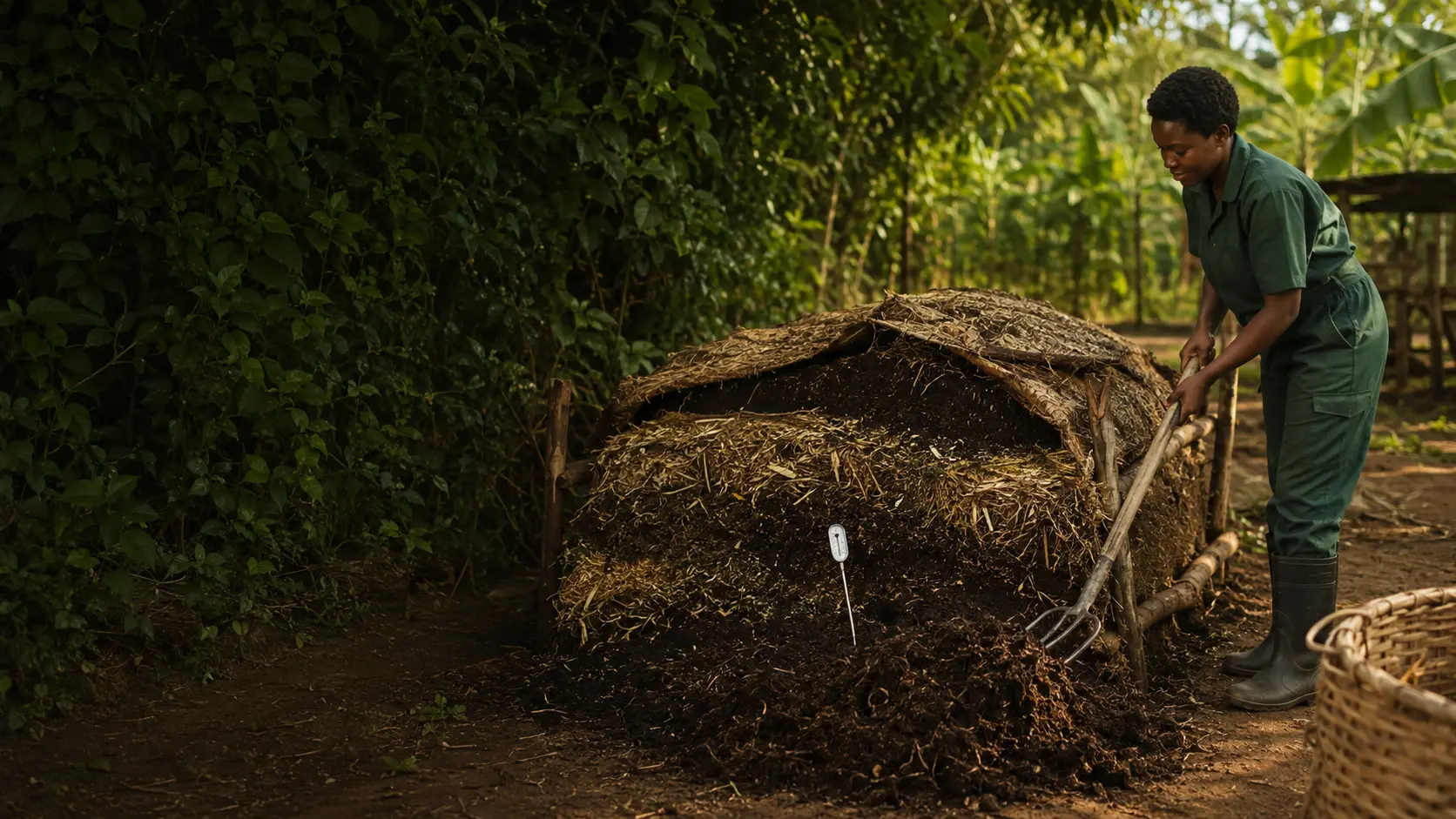
Residues. FAO's conservation agriculture threshold is at least 30 percent ground cover from crop residues or cover crops. In practice on a Ugandan mixed farm, residues compete with three other uses: livestock feed, fuel and construction. Decide the split deliberately rather than by default, and note that the CGIAR source identifies free-roaming livestock as a documented reason cover crops fail.
Nutrients. Rotation is not a nutrient programme. Modelled work on eastern African croplands found that applying manure and retaining crop residues, together with 90 kg of nitrogen per hectare, reduced the modelled loss of soil organic carbon by 29%. The study also found that retaining all residues and applying manure increased modelled yields for most croplands, but increased nitrogen losses. This is a planning warning, not a field prescription.
Read that as it is written. Manure plus residues plus fertiliser reduced carbon loss by less than a third. Rotation belongs inside a system that also includes a soil test, organic matter, and imported nutrients where a deficiency is diagnosed. Falcon's composting article and its article on verifying purchased fertiliser cover the two halves of the nutrient side.
Field record: the rotation plan sheet
One sheet per field, kept for the life of the rotation. This is the deliverable of the whole article.
| Item | Entry |
|---|---|
| Field name and area | |
| The problem this rotation exists to break | |
| Season 1: crop, variety, planting date, residue destination | |
| Season 2: crop, variety, planting date, residue destination | |
| Season 3: crop, variety, planting date, residue destination | |
| Season 4: crop, variety, planting date, residue destination | |
| Season 5, if planned | |
| Season 6, if planned | |
| Number of distinct species in the sequence | |
| Legume seasons in the sequence | |
| Cover crop or green manure season, if any, and species | |
| Where seed for each rotation crop will come from | |
| Where the market for each rotation crop is | |
| Organic matter applied, when and how much | |
| Purchased nutrients applied, when and what | |
| Soil test date and reference | |
| Observed change in the target problem, season by season | |
| Yield of the main crop, season by season | |
| Deviation from plan, and why |
Two rows predict whether the plan survives contact with reality: "where seed will come from" and "where the market is". A rotation that fails those two will be abandoned in season two, whatever its agronomy.
Costs
Rotation costs little in cash and a great deal in flexibility. Falcon publishes no prices.
| Cost category | What sits inside it | Notes |
|---|---|---|
| Seed for the rotation crop | Often the binding constraint | Identified in the CGIAR source as the number one reason cover crops are not adopted |
| Opportunity cost of a green manure season | The food or income that season would have produced | On a 1.2 hectare average holding this is the real cost, and it is not small |
| Labour | Establishing and incorporating a cover crop; managing a less familiar crop | Cover crops are documented as competing with peak labour periods |
| Knowledge and management | Learning a crop you have not grown | Desmodium is specifically documented as needing experience |
| Protection from grazing | Fencing or agreement with neighbours | Documented as a reason farmers "risk losing all invested effort to somebody else's freely roaming animals" |
| Market development for the rotation crop | Finding a buyer for something you did not previously grow | Do this before season 1, not during season 2 |
Common mistakes
- Rotating without naming the problem. Variety is not rotation.
- Following a crop with a close relative. Tomato after potato feeds the same soil-borne organisms.
- Planning in years on a bimodal farm. You have two decision points a year; plan in seasons.
- Assuming rotation replaces fertiliser. FAO is explicit that nutrients other than nitrogen must be imported.
- Planting a cover crop you have no seed source for next season. Seed availability is documented as the number one adoption barrier.
- Planting a cover crop where animals roam freely. The CGIAR source is blunt about this outcome.
- Choosing a single-purpose cover crop on a small holding. Multipurpose crops are documented as more popular for a reason.
- Planting mucuna too early. The source warns it "can suppress the main crop if planted too early".
- Starting with desmodium as a first cover crop. It is documented as difficult to establish.
- Removing or burning all residues, then claiming to practise conservation agriculture. Ground cover is one of the three principles.
- Planting a rotation crop with no market. It will be planted once.
- Copying a temperate rotation. Wheat, barley and clover sequences from other continents are not Ugandan rotations.
Warning signs and escalation points
| Warning sign | What it means | What to do |
|---|---|---|
| The same problem returns in season 2 of the rotation | The break was too short, or the replacement crop is also a host | Check host status. The Kenyan bacterial wilt trial used a two-season break; some pathogens need far longer |
| Yields fall in the rotation crop's season | It may be poorly suited to that field, or nutrient-limited | Do not abandon the rotation. Get a soil test and check variety suitability |
| The cover crop is grazed off before incorporation | The documented failure mode for palatable species | Fence it, or switch to a less palatable species, or accept it as fodder and change the plan |
| Seed for the rotation crop is unavailable at planting | The number one documented adoption barrier | Secure seed a season ahead. Consider a farmer group seed arrangement |
| Mucuna or another vigorous cover crop is smothering the main crop | Planted too early | Adjust the planting interval next season |
| Continued yield decline despite a good rotation | Nutrient depletion that rotation cannot fix | Get a soil test. See the published soil testing article. This is the escalation point that matters most |
| A soil-borne disease appears in a new field | Movement on tools, boots or planting material | See Falcon's whole-farm biosecurity article. This is a hygiene problem, not a rotation problem |
| Household food supply is threatened by a green manure season | The opportunity cost has become real | Reduce the green manure to part of the field, or drop it. Food security comes first |
When rotation works and when it does not
It works where the problem is crop-specific and soil-borne or host-dependent, where you have enough land or enough seasons to move crops around, and where every crop in the sequence has a use or a market.
It works partially on very small holdings, where the sequence must be compressed. On a half-hectare parcel you can still alternate cereal and legume across seasons even if you cannot run four species. A two-species alternation is worth far more than no rotation, even though it does not meet FAO's three-species threshold.
It does not work as a fertility programme. This is the article's central caution and FAO states it directly: nutrients other than nitrogen must be imported.
It also does not work as a substitute for hygiene. A disease brought in on planting material or tools does not care about your sequence.
And it does not solve a problem inside a season. Rotation is a between-season tool. Deciding whether a pest infestation this week justifies action is a scouting and threshold decision, and Falcon's integrated pest management article owns it.
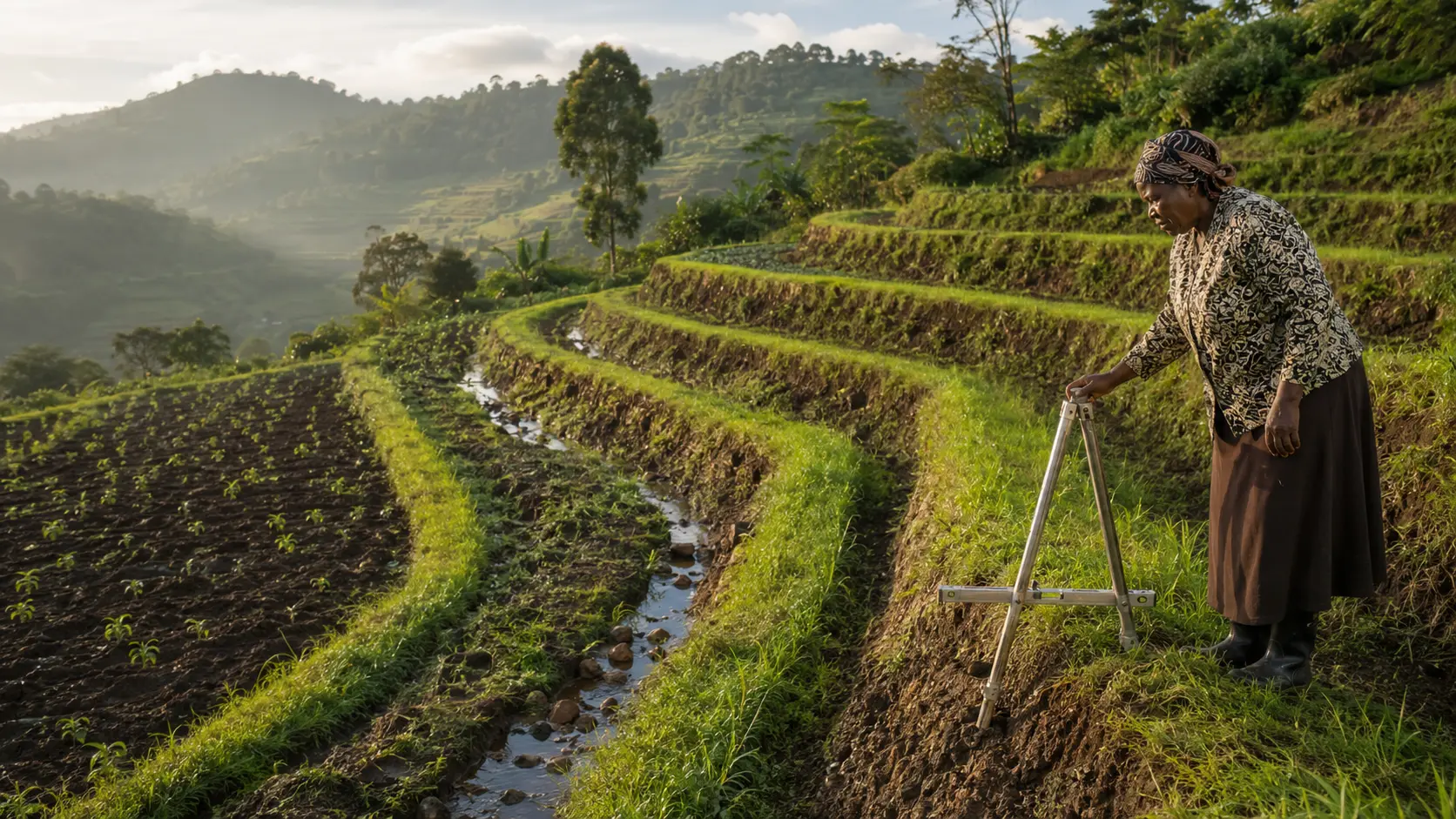
One further honest note. A review of cross-slope conservation techniques found that crop yield effects "vary with rainfall and slope, with most of the CSB-SWC techniques improving crop yields in low rainfall areas". Much of Uganda's cropland is not low-rainfall. Expect rotation to protect you from decline rather than to deliver an immediate yield increase.
A low-risk pilot
You can test a rotation without committing the farm to it.
- Choose one field and write the one-sentence problem statement.
- Split the field in two. Keep your existing practice on one half.
- Run the new sequence on the other half for a full cycle, which is four seasons on a bimodal farm and four years on a unimodal one.
- Keep both halves identical in everything else: same variety, same planting date, same organic matter, same weeding.
- Weigh the harvest from each half separately, every season. Not estimated. Weighed.
- Record the target problem too, not only yield. If the rotation exists to break bacterial wilt, count wilted plants in both halves.
- Secure the rotation crop's seed for the whole cycle before you start, because seed availability is the documented reason these trials get abandoned.
- Decide at the end of the cycle, not at the end of season one. A rotation judged in one season has not been judged.
Limitations and professional-support triggers
What this article does not do. It states no yield figure for any Ugandan rotation, no nitrogen fixation figure for Uganda or East Africa, no seeding rate, no price, and no recommended rotation for your specific field. It does not interpret a soil test, does not cover intercropping in one season, and does not cover trees.
Three evidence gaps, stated openly.
- No post-2000 Ugandan trial on continuous maize or continuous cassava yield decline was verified. The Ugandan continuous-cropping evidence quoted here dates from 1969.
- No East African field measurement of biological nitrogen fixation in kilograms per hectare was verified. The measured figures used are South African; the ranges are secondary.
- No official MAAIF or UBOS statement of Uganda's growing-season months was verified. The months quoted come from a single year-specific FEWS NET outlook.
Where evidence is Kenyan, South African or pooled across countries, the article says so at the point of use. That labelling is deliberate and should not be removed in editing.
Bring in a professional when:
- The published soil testing route and an agronomist, if yields continue to fall despite a sound rotation. That is a nutrient question, not a sequence question.
- Your district production office or sub-county extension officer, for locally proven sequences and for help sourcing rotation crop seed.
- The relevant NARO institute, for variety suitability and for diagnostic confirmation of a soil-borne disease.
- A plant health specialist, before designing a rotation around a specific pathogen, because required break lengths differ sharply by organism.
- Your cooperative or a buyer, before committing a season to a crop you have never sold.
Clear next actions
- List your fields and, for each, write one sentence naming the problem a rotation should break.
- Group the crops you grow by plant family, so you can see which sequences are actually breaks.
- Draft a four-season sequence for one field, aiming for at least three species and at least one legume season.
- Check, before committing, where the seed and the market for every crop in that sequence will come from.
- Decide what happens to residues in each season, and write it in the plan.
- Book a soil test for that field, so the rotation sits alongside a nutrient picture rather than substituting for one.
- Split the field and run the sequence against your current practice.
- Start the rotation plan sheet, and weigh both halves separately every season.