The direct answer
Composting is not complicated, but it is exact. Four numbers control whether a heap works, and all four come from FAO's on-farm composting guidance.
- Carbon to nitrogen ratio of what you put in: between 25:1 and 30:1. FAO states that "The optimal C:N ratio of raw materials is between 25:1 and 30:1 although ratios between 20:1 and 40:1 are also acceptable", and that above 40:1 "the growth of micro-organisms is limited, resulting in a longer composting time", while below 20:1 you get "underutilization of N".
- Moisture: 40 to 65 percent. FAO: "Composting materials should maintain a moisture content of 40-65 percent", and "a moisture content in excess of 65 percent develops anaerobic conditions". In practice, "start the pile with a moisture content of 50-60 percent, finishing at about 30 percent."
- Temperature: it must get hot, and how hot decides what dies. FAO: "While the ideal temperature for the initial composting stage is 20-45 °C, at subsequent stages with the thermophilic organisms taking over, a temperature range of 50-70 °C may be ideal", and critically, "Pathogens are normally destroyed at 55 °C and above, while the critical point for elimination of weed seeds is 62 °C."
- Finished C:N ratio: 10:1 to 15:1. FAO: "The C:N ratio of the final product should be between about 10:1 and 15:1."
Time to maturity is not a single number. Across the methods FAO documents, it runs from about two weeks with daily turning to six or eight months for an unturned anaerobic pit. Turning frequency is the variable that decides where in that range you land.
Two Ugandan realities modify all of this and are covered in detail below: heavy rain leaches your heap and termites eat it. Both have documented countermeasures.
And one honest limitation up front. Falcon could not verify a general per-hectare compost or manure application rate for Uganda, and does not state one. What it can give you is the rate actually used in a Ugandan field trial, with its conditions attached, and a method for deciding where your limited compost goes first.
Who this article is for
Farmers with animals, crop residue, or both, who want to convert what they already have into something that improves their soil. Extension officers teaching the method. Students learning why the parameters are what they are. Women's and youth groups running composting as an enterprise or a shared activity.
You do not need livestock. You do need a source of nitrogen-rich material, which is usually manure but can be fresh green material.
The problem this solves
Ugandan soils are losing organic matter and nutrients, and purchased fertiliser is used at a very low rate.
The scale of the nutrient gap is documented. Work presented to the London Group on environmental accounting, with the Uganda Bureau of Statistics as a project partner, reported 2018 NPK balances by agricultural research zone including minus 138 kilograms per hectare per year at Buginyanya, minus 75 at Nabuin and minus 42 at Ngetta. Uganda's own National Fertiliser Policy of August 2016 states that the country "loses approximately 80 kg of nutrient per hectare per year through topsoil erosion".
On the input side, the same policy records that Ugandan "farmers are adding only between 1-1.5 kg" per hectare, "making Uganda the least in fertiliser use almost in the whole world", against "the average of 8 kg per hectare in Sub-Saharan Africa (SSA)". World Bank World Development Indicators put Uganda's fertiliser consumption at 3.33 kilograms per hectare of arable land in 2023, against a Sub-Saharan Africa average of 19.59 and a world average of 137.65. The two series are measured differently and should not be mixed, but they point the same way.
Organic matter is therefore the most accessible fertility lever most Ugandan farms have. It is also the one most often done badly, because the parameters are invisible and the feedback is slow.
There is a second reason to care. Modelled work on eastern African croplands found that applying manure and retaining crop residues, together with 90 kg of nitrogen per hectare, reduced the modelled loss of soil organic carbon by 29%. Read that carefully: manure plus residues plus fertiliser reduced soil carbon loss by less than a third. It did not stop it. Compost is a powerful tool, but it is not a complete answer.
The decision you are making
By the end of this article you should have decided:
- Which composting method fits your labour, your rainfall and your materials.
- Where the heap or pit goes on the farm.
- What goes into it, in roughly what proportions.
- Your turning schedule.
- How you will know it is ready.
- Which field or block gets the first batch, and why.
Point 6 is the one most people never decide, and it is where the value is. Compost is always scarce relative to need. Deciding where it goes is a management decision, not an afterthought.
Uganda-specific context
Three conditions change how composting behaves here compared with the temperate manuals most farmers encounter online.
Rain leaches heaps. FAO Soils Bulletin 56, written for tropical and subtropical environments, states: "If the heap is inadequately protected during periods of heavy rain, water-soluble nutrients can be leached out of the heap into the soil." A tropical composting guide is blunter: "The heap should be covered to protect it against evaporation and heavy rain as this will wash away all the nutrients."
Heat and wind dry heaps. The same FAO bulletin warns that "Care must be taken to ensure an adequate moisture content at all times." A dry heap simply stops working, and a heap that has stopped is not composting; it is storing.
Termites are a real management problem. The practical countermeasure documented in tropical composting guidance is trench composting, which is "especially useful against termite attack as most species live above ground level."
There is also a nitrogen point that matters where heaps are built with a lot of ash or lime. FAO Soils Bulletin 56 notes that "Highly alkaline conditions will lead to excessive loss of nitrogen as ammonia", and the on-farm composting guidance adds that "the pH level should not exceed eight" because "At higher pH levels, more ammonia gas is generated and may be lost to the atmosphere."
The single design conclusion from all of this: in Uganda, cover the heap. Grass, banana leaves or a simple shelter. It addresses leaching and drying at the same time and it costs nothing.
Step 1: choose the method
FAO documents several small-scale methods with different labour and time profiles. The choice is almost entirely a labour-versus-time trade.
| Method | Structure | Turning | Time to maturity | Suits |
|---|---|---|---|---|
| Above-ground heap, Indore type | Heap "about 2 m wide at the base, 1.5 m high and 2 m long" | "at intervals of 6 and 12 weeks" | "about four months to complete" | Farms with bulky residue and low labour availability |
| Pit, Indore type | Pit "about 1 m deep, 1.5-2 m wide" | Three times: after 15 days, another 15 days, then a month | Several months | Drier areas, and sites where drying is the main risk |
| Pit, Coimbatore type | Pit "360 cm long x 180 cm wide x 90 cm deep" | One turning after four weeks | "ready for use after four months" | Low labour |
| Anaerobic pit, Bangalore type | Pit, filled and sealed | None | "six to eight months to obtain the finished product" | Where labour is very scarce and time is not |
| Rural pit, Chinese type | Pit | Three turnings, at one month, two months and two and a half months | "three months and produces about 8 tonnes of compost per pit" | Farms wanting a known output per pit |
| High-temperature method, Chinese type | Heap | First turning after two weeks | "ready for use within two months", with temperature rising to "60-70 °C" within four to five days | Where pathogen and weed-seed kill matters |
| Rapid method, Berkeley type | Pile "at least 90 cm x 90 cm x 90 cm" | Daily, or every other day | "two weeks or a little longer" daily; "about three weeks" every other day; temperature "about 71 °C" | Small volumes, high labour, urgent need |
| Trench composting | Trench in the ground | Minimal | Varies | Termite-prone sites, because most termite species live above ground level |
| Vermicomposting | Beds or troughs with worms | Not turned; worms do the work | See below | Manure and food waste, where a saleable product is wanted |
The practical Ugandan default for a mixed farm with animals is a covered above-ground heap of roughly the Indore dimensions, turned two or three times, sited where it can be covered and where runoff will not enter it. Where termites are a persistent problem, move it into a trench.
Step 2: site the heap
This is a layout decision as much as an agronomy one, and it connects to Falcon's article on planning a farm layout.
- Downwind of the dwelling, on the same logic FAO applies to livestock housing.
- Close to the animals whose manure feeds it and close to the fields it will serve. Compost is heavy and gets carried twice.
- On ground that does not flood and does not receive runoff. Water arriving from upslope leaches the heap.
- In partial shade if possible, which slows drying without stopping the process.
- Where it can be covered. This is the non-negotiable one in Uganda.
- Where a wheelbarrow can reach it in the wet season. A heap you cannot reach in April is a heap that will not be turned in April.
- Not immediately upslope of a shallow well or water point. Leachate travels downhill.
Step 3: build the heap
Materials, in two categories. Carbon-rich, or "brown": dry crop residues, maize stover, dry grass, straw, dry leaves, sawdust, coffee husks, banana pseudostem once dried. Nitrogen-rich, or "green": animal manure, fresh green weeds, fresh leguminous foliage, kitchen waste, green banana leaves.
Get the ratio roughly right. You are aiming for 25:1 to 30:1 overall. You cannot measure this on a farm, so use volume as a proxy: roughly two to three parts brown material to one part green material by volume, adjusted by what happens next. If the heap smells of ammonia, there is too much green. If it never heats up, there is too much brown or not enough moisture.
Layer it. Alternate thin layers of brown and green material rather than dumping each in a block. Thin layers mix better and heat more evenly.
Chop the material. Smaller pieces decompose faster because there is more surface for the organisms to work on.
Water each layer as you build. FAO's practical target is starting at "50-60 percent" moisture. The field test used in tropical composting guidance is to squeeze a handful: it should feel like a wrung-out cloth, damp but not dripping. A related guide describes the test as: place your hand in the heap, and "When removed, after five minutes, it should feel damp. If it does not, water needs to be added to the heap."
Aerate it. FAO notes that "Aerobic composting requires large amounts of O, particularly at the initial stage. Aeration is the source of O, and, thus, indispensable for aerobic composting." A vertical stick or a bundle of stalks pushed into the centre creates a channel; some builders leave a hollow core.
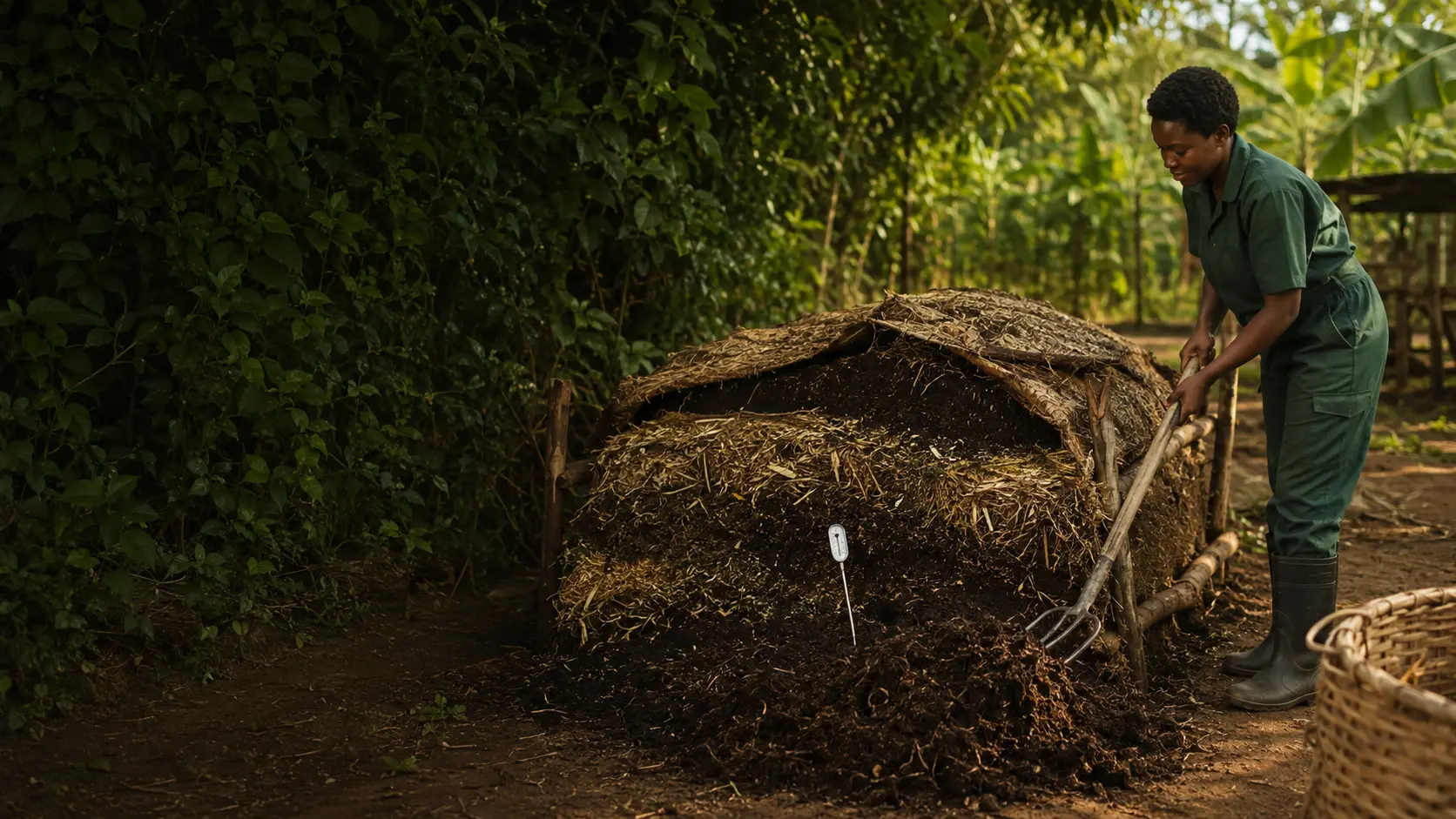
Cover it. Grass, banana leaves, or a simple roof. Tropical guidance is explicit: "Cover with grass or leaves (such as banana leaves) to prevent water loss", and to protect against heavy rain washing nutrients away.
Put a test stick in. Push a stout stick into the centre at an angle. Pull it out after a few days and feel it. Tropical composting guidance describes the target: "The stick should feel slightly too hot to touch when removed after a few days." That is your temperature meter and it costs nothing.
Step 4: manage it
Turn on your chosen schedule, and turn properly. Turning means moving the outside to the inside. Material on the outside never reaches thermophilic temperature and therefore never has its weed seeds or pathogens killed.
Check moisture at every turn. Add water if the squeeze test fails. In a Ugandan dry season a heap can go from correct to inert in a fortnight.
Watch the temperature curve. It should rise within days, hold, and then fall. A heap that never heats has a moisture or nitrogen problem. A heap that heats and then cools quickly may simply be small, since small heaps lose heat.
Recover the volume loss as a signal. One documented rapid method notes that "After the first week, the volume of the pile should be reduced by one-third. After two weeks, the volume of the pile should be reduced to one-half". Volume falling is the process working.
Step 5: know when it is ready
FAO Soils Bulletin 56 gives the principle: "When the composting material has passed through the temperature peak, the heap reaches stability at which the easily converted materials have been broken down and most of the high level of oxygen demand has been met. The material is no longer attractive to flies and vermin and should not give off bad odours."
The practical indicators FAO's on-farm methods document lists include a "pleasant odour", "white fungi on the decomposing organic material", "reduction of volume", "materials changing colour to dark brown", and that the "temperature drops and ... little or no heat is produced". A tropical guide puts the field test simply: compost is usable "as soon as most of the original material is no longer recognisable and has turned into a blackish brown colour, with a pleasant smell."
The readiness checklist:
| Indicator | Ready | Not ready |
|---|---|---|
| Temperature | Ambient, no heat from the centre | Still hot |
| Smell | Earthy, pleasant | Ammonia, sour, or putrid |
| Appearance | Dark brown to black, crumbly | Original material still recognisable |
| Volume | Roughly half or less of the starting volume | Little change |
| Flies and vermin | Not attracted | Still attracted |
What is actually in it
Be realistic about concentration. FAO Soils Bulletin 56, written for tropical and subtropical conditions, gives ranges for matured compost of organic matter 20 to 40 percent, nitrogen 0.5 to 1.5 percent, phosphorus 0.4 to 0.8 percent, potassium 0.8 to 1.5 percent, and a C/N ratio of 10 to 15 to 1. Falcon notes honestly that it could not confirm from the source table whether those percentages are on a dry-matter or fresh-weight basis, and the organic-matter figure suggests dry matter, so treat them as indicative.
For farmyard manure, FAO's integrated nutrient management guidance states that "Average, well-rotted FYM contains 0.5-1.0 percent N, 0.15-0.20 percent P2O5 and 0.5-0.6 percent K2O", on a dry basis, with a desired C:N ratio of 15 to 20 to 1. That is global guidance, not East African.
A Ugandan measurement exists. A study at the Makerere University Agricultural Research Institute Kabanyolo measured total nitrogen in stored cattle manure at 18.5 and 19.6 grams of nitrogen per kilogram of dry matter across two seasons, which is roughly 1.85 and 1.96 percent on a dry basis.
The number that matters more than any of these is the comparison with nothing. In that same Ugandan study, maize yields per 15 square metre plot in the first season were 15.79 kilograms for stored manure, 18.79 for digestate and 21.87 for vermicompost, against 5.51 for the unfertilised control. In the second season the figures were 43.70, 43.95 and 41.13 against a control of 12.82. The study concluded that there was "No significant difference (P > 0.05) in the different organic fertilizers ... in both the growth and yield of maize in each season. However a significant difference (P < 0.05) in both crop growth and yield was noted when the organic fertilizers were compared with the control."
Read that as the practical finding it is: in Ugandan conditions, which organic amendment you use mattered far less than whether you used one at all. The same study also noted that farmer groups interviewed "generally preferred using stored manure and vermicompost".
How much, and where it goes first
This is the question every farmer asks and the one where honesty is most important.
Falcon could not verify a general per-hectare compost or manure application recommendation for Uganda, and does not state one. What can be stated is this.
A field trial in central Uganda applied composted manure at 0 and 2.5 tonnes per hectare, and found that improved manure management raised manure quality over farmers' standard practice by 48 to 55 percent for total organic carbon, 21 to 36 percent for total nitrogen, 42 to 52 percent for total phosphorus and 44 to 67 percent for total potassium, and that "Improved manure management practices increased maize grain yields significantly by (p < 0.05) by 10% and 18%, respectively". The same study found that "Cattle manure quality was significantly (p < 0.05) superior during the wet season".
So 2.5 tonnes per hectare of composted cattle manure is a rate that was used, in Uganda, on maize, with measured results. It is one study. It is not a recommendation for your soil, your crop or your compost, and it should not be treated as one.
A separate number sometimes quoted is 25 tonnes per hectare. That figure appears in FAO Soils Bulletin 56 only inside a water-demand illustration: "A dressing of 25 t/ha of compost would thus require 62 500 litres/ha which is equivalent to an irrigation of 6.25 mm". It is an example used to make a point about water, not FAO's recommended rate, and it should not be repeated as one.
The allocation method
Since you will never have enough compost, decide where it goes using a rule rather than habit.
| Priority | Where the compost goes | Why |
|---|---|---|
| 1 | Nursery and seedling beds | Smallest area, highest value per kilogram, most responsive |
| 2 | The cut upper bench of any new terrace | FAO warns terracing exposes infertile subsoil, and this is measured in south-western Uganda. See FF-106 |
| 3 | The field block with the lowest organic matter and the highest value crop | Biggest measurable response |
| 4 | Land going into a demanding crop next season | Applied ahead of the need, not during it |
| 5 | Everything else, in rotation across years | Build the whole farm slowly rather than one field completely |
Apply and incorporate, do not leave it on the surface. Surface-applied compost in Ugandan sun loses nitrogen and moisture and feeds termites.
Vermicomposting
Worth a separate note, because it is well documented in Uganda.
FAO's guidance notes that Eudrilus eugeniae, the African night crawler, tolerates higher temperatures but "cannot survive at temperatures below 7 °C", that the "optimum moisture level for maintaining aerobic conditions is 40-45 percent", and that operating temperature should be maintained "at less than 35 °C". The bed dimensions FAO cites come from the Philippines, Cuba and India, so treat them as examples rather than East African practice.
A Kampala study set up a vermicomposting system using Eudrilus eugeniae on cow manure and food waste and monitored it for 172 days. It found "The material reduction was 45.9% and the waste-to-biomass conversion rate was 3.5% ... on a total solids basis", concluded that "Vermicomposting was found to be a viable manure management method in small-scale urban animal agriculture", and calculated a return on investment of 280 percent for treating the manure of a 450 kilogram cow.
One important safety caveat from the same study, and it is the reason vermicompost is not simply better than hot composting: "The vermicompost was not sanitised, although hygiene quality could be improved by introducing a post-stabilisation step in which no fresh material is added."
Vermicomposting runs cool. It therefore does not reach the 55 degrees that FAO says destroys pathogens, or the 62 degrees that eliminates weed seeds. If your input material carries a hygiene risk, or is full of weed seeds, hot compost it first.
Field record: compost batch sheet
One sheet per batch. Six months later this is the only way to know why one batch worked and another did not.
| Item | Entry |
|---|---|
| Batch number and start date | |
| Method used | |
| Location on the farm | |
| Brown materials and rough volumes | |
| Green materials and rough volumes | |
| Rough brown to green ratio by volume | |
| Covered? With what | |
| Turn 1 date, stick test result, moisture action | |
| Turn 2 date, stick test result, moisture action | |
| Turn 3 date, stick test result, moisture action | |
| Date it stopped producing heat | |
| Date judged ready, and against which indicators | |
| Approximate volume produced | |
| Where it was applied, and how much | |
| Crop and field response observed, with date | |
| What I would change next batch |
Costs
Composting is mostly labour and time. Falcon publishes no prices.
| Cost category | What sits inside it | Notes |
|---|---|---|
| Labour, building | Collecting, chopping, layering, watering | The largest single input |
| Labour, turning | Two to three turns for a standard heap; daily for rapid methods | This is the labour-versus-time trade |
| Water | Establishing and maintaining moisture | FAO's illustration puts a 25 t/ha dressing at 62,500 litres per hectare, which is the water in the compost, not water applied to the heap |
| Covering material | Grass, banana leaves, poles, iron sheets | Usually on-farm; the highest return per shilling of anything on this list |
| Tools | Fork, spade, wheelbarrow, a test stick | |
| Transport | Moving the finished product to the field | Reduced by siting the heap correctly |
| Worms and bedding, if vermicomposting | Stock, containers, shade | One Kampala study calculated a 280 percent return on investment for a single cow's manure |
Common mistakes
- Not covering the heap. In Ugandan rainfall this is the most expensive omission on the list. Tropical guidance states plainly that rain "will wash away all the nutrients".
- Letting it dry out. A dry heap is a stored heap. Check moisture every time you pass it.
- Too much brown material. The heap never heats. FAO: above a 40:1 ratio, microbial growth is limited and composting takes longer.
- Too much green material. Ammonia smell, and nitrogen lost to the air.
- Adding a lot of ash. FAO notes pH should not exceed eight, because higher pH generates more ammonia gas that is lost.
- Never turning. The outside of an unturned heap never reaches temperature, so weed seeds and pathogens survive in it.
- Applying it before it is ready. Immature compost competes with the crop for nitrogen.
- Spreading it thinly over the whole farm. A small quantity concentrated where response is highest beats the same quantity spread everywhere.
- Leaving it on the soil surface. Nitrogen loss, moisture loss and termites.
- Building the heap where runoff crosses it. Water arriving from upslope leaches it.
- Assuming compost replaces a diagnosed deficiency. It does not, and the next section says why.
- Treating vermicompost as sanitised. It runs cool. The Kampala study says explicitly that it was not sanitised.
Warning signs and escalation points
| Warning sign | What it means | What to do |
|---|---|---|
| The heap never gets hot | Too dry, too small, or not enough nitrogen | Check moisture with the squeeze test first, then add green material, then rebuild larger |
| Strong ammonia smell | Excess nitrogen, or pH too high; nitrogen is escaping | Add brown material and turn. Stop adding ash |
| Sour or putrid smell | Anaerobic, usually too wet or compacted | Turn it, add bulky brown material, improve drainage under it |
| Flies and vermin still attracted after months | Not stabilised | Do not apply it. Turn and continue |
| Termite runs and hollowed material in the heap | Termite attack | Move to trench composting, which the tropical guidance identifies as useful because most termite species live above ground |
| Compost applied and the crop looks nitrogen-starved | Immature compost immobilising nitrogen | Stop applying that batch. Let it finish |
| Crop shows a persistent deficiency despite good compost use | A nutrient the compost cannot supply in the quantity needed | Get a soil test. See the published soil testing article. Do not simply add more compost |
| Anyone handling manure or compost develops illness | A hygiene issue | Seek medical advice. Use gloves, wash hands, and do not use uncomposted human waste |
When composting works and when it does not
It works where you have both carbon-rich and nitrogen-rich material on the farm, where labour for two or three turns exists, where the heap can be covered, and where the area you intend to improve is realistic relative to the volume you can make.
It works partially where material is available but labour is not. Choose an unturned pit method and accept six to eight months.
It does not work as a nutrient replacement at scale. FAO's own position on cropping systems is unambiguous: "To sustain nitrogen levels, crop legumes are essential" but "For cropping systems to be sustainable, nutrients other than nitrogen need to be imported." Every kilogram of grain, milk or produce that leaves the farm takes nutrients with it, and compost made on the farm cannot create phosphorus and potassium that were never there.
Nor is it a complete answer to soil carbon decline. The modelled eastern African work found that manure plus residue retention plus 90 kilograms of nitrogen fertiliser per hectare reduced soil carbon loss by 29 percent. Reduced, not reversed.
The honest position, therefore, is this. Compost is the cheapest and most accessible fertility tool available to most Ugandan farms, the Ugandan trial evidence shows a very large response against doing nothing, and it should be part of a system that also includes a soil test, appropriate purchased nutrients where a deficiency is diagnosed, and erosion control so that what you build stays where you put it.
A low-risk pilot
- Build one heap, not a composting system. Roughly 2 metres by 2 metres by 1.5 metres high, following the Indore dimensions FAO documents.
- Cover it. Grass or banana leaves. This single step tests the most important Ugandan variable.
- Put a test stick in it and check it every few days for the first two weeks.
- Turn it twice, at roughly six and twelve weeks, and note the moisture each time.
- Split the finished compost between two plots, applying to one and leaving the other untreated, with the same crop, planted the same day, in the same field.
- Weigh the harvest from each plot separately. This is your own local evidence and it is worth more to you than any published rate.
- Repeat for a second season before scaling. One season is one weather pattern.
Limitations and professional-support triggers
What this article does not do. It states no per-hectare application rate as a recommendation, because none was verified for Uganda. It states no price. It does not interpret a soil test, does not recommend a fertiliser product, and does not cover slurry systems. It does not cover human waste composting, which raises health questions outside its scope.
Provenance notes. FAO's compost nutrient ranges are for tropical and subtropical environments and Falcon could not confirm whether they are on a dry-matter or fresh-weight basis. The farmyard manure figures are global FAO guidance rather than East African. The vermicomposting bed dimensions FAO cites come from the Philippines, Cuba and India. All of that is labelled in the text.
Bring in a professional when:
- The published soil testing route and an agronomist, if a crop shows a persistent deficiency despite good organic matter management. Compost is not a diagnosis.
- Your district production office, for locally used rates and for a working example of a method you have not built before.
- A veterinary officer, before composting material from animals that were sick, because pathogen survival depends on reaching and holding temperature.
- Medical advice, for any illness in someone handling manure or compost.
- An extension officer or a specialist, before starting vermicomposting as an enterprise, given the sanitation caveat in the Kampala study.
Clear next actions
- Walk the farm this week and list every carbon-rich and nitrogen-rich material you already have.
- Choose a method from the table using your honest labour availability, not your intended labour availability.
- Site the heap using the seven siting rules, and confirm it is reachable by wheelbarrow in the wet season.
- Build one heap, layered, watered and covered.
- Push a test stick into the centre.
- Diarise your turn dates now, before you forget.
- Decide, in writing, which block gets the first batch and why.
- Start the compost batch sheet with this batch.