The direct answer
Uganda has no dedicated fertiliser statute. Fertiliser is regulated because it sits inside the definition of "agricultural chemicals" in the Agricultural Chemicals (Control) Act, Chapter 35, whose interpretation section lists "fertiliser" and "bio-fertilisers" among agricultural chemicals.
That Act gives you three things worth knowing before you buy.
- Section 2(2): "A person shall not package, label or advertise any agricultural chemical in a manner that is false, misleading or deceptive or is likely to create an erroneous impression regarding its character, value, quality, composition, merit or safety."
- Section 3(1): "A person shall not import into or sell in Uganda any agricultural chemical unless that chemical has been registered, packed and labelled in accordance with regulations made under this Act and conforms to the standards specified in the regulations."
- Section 3(3): "A person shall not sell in Uganda any agricultural chemical unless he or she is registered and has premises registered in accordance with the regulations made under this Act."
Read section 3(3) again. The seller and the seller's premises must be registered. That single sentence is the most useful verification lever an ordinary farmer has, because it turns "do I trust this shop" into a question with a documentary answer.
On the products themselves, the picture is well documented. An IFDC and AFAP assessment of Ugandan fertiliser distribution reported 2016 consumption by product as NPK 17:17:17 at 29,698 tons, "Other" at 15,058, urea 9,785, CAN 2,856, ammonium sulphate 1,321 and DAP 1,184, and noted that "The compound 17:17:17 accounts for most of the fertilizer use". So the practical Ugandan market is a compound NPK, urea, CAN, ammonium sulphate and DAP, with NPK 17:17:17 dominant.
On quality, three published studies disagree about the scale of the problem, and this article reports the disagreement rather than averaging it away. That disagreement is itself the finding: quality is variable, not uniformly bad, which is exactly why a per-purchase verification routine beats a general suspicion.
This article does not tell you which fertiliser your soil needs. That is a soil test question and it belongs to Falcon's published soil testing article. This one is about buying safely once you know what you want.
Who this article is for
Farmers buying fertiliser, whether one bag or a lorry. Cooperatives and producer groups buying collectively. Agro-dealers who want to be on the right side of the law. Extension officers advising buyers. Programme professionals designing input support.
You will get most from this if you already know what nutrient you need. If you do not, the soil test comes first, and applying the wrong nutrient correctly is just as wasteful as applying the right nutrient badly.
The problem this solves
Ugandan farmers use very little fertiliser, and part of the reason is that the ones who tried it were burned.
The usage figures. World Bank World Development Indicators put Uganda's fertiliser consumption at 3.33 kilograms per hectare of arable land in 2023, against a Sub-Saharan Africa average of 19.59 and a world average of 137.65. Uganda's own National Fertiliser Policy of August 2016 recorded that "farmers are adding only between 1-1.5 kg", making Uganda "the least in fertiliser use almost in the whole world", against "the average of 8 kg per hectare in Sub-Saharan Africa (SSA)". The two series are constructed differently and should not be mixed, but both say the same thing.
The quality problem is officially acknowledged. The same National Fertiliser Policy names, as part of its own problem statement, the "prevalence of counterfeit/fake fertilisers that are difficult to detect by farmers", and sets out as a guiding principle that products should be "properly labelled with a guaranteed analysis, net weight, and quality control of the products".
And it is measured. Three studies, three different pictures.
- A peer-reviewed study published in the Quarterly Journal of Economics tested products bought covertly from 129 randomly sampled local retail shops in two main maize-growing regions of Uganda in 2014, taking 369 fertilizer samples. Its abstract states: "Testing modern products purchased in local markets, we find that 30% of nutrient is missing in fertilizer". The paper reports that "on average, retail fertilizer contained 31% less nutrient than authentic fertilizer or 31.8% N per kilogram (95% CI: 31.3-32.4)".
- An Economic Policy Research Centre policy brief, sampling 170 samples across eight districts in four regions between September and November 2014, covering urea, NPK, DAP, CAN and MOP, found that "Nitrogen content in the NPK fertiliser was in the range of 6-9.4 percent well below 17 percent indicated on the labels", and that CAN nitrogen ranged "from 8.5 - 19.7 percent against the labelled value of 26 percent".
- An IFDC market diagnostic published in 2018 found a much smaller problem on some products: "Ten percent of the fertilizer bags used for weight verifications presented weight shortages beyond the 0.5-kilogram tolerance limits", with urea nitrogen out of compliance in 10 percent of samples, DAP nitrogen in 0 percent and phosphorus in 6 percent, NPK 17-17-17 nitrogen in 13 percent, NPKS 25-5-5+5S nitrogen in 27 percent, and CAN showing "total nitrogen shortages in 4 of 10 samples".
Do not average these. They used different samples, different years, different products and different methods. What they establish together is that a Ugandan farmer cannot assume a bag contains what the label says, and that the risk varies by product and by seller. The IFDC and AFAP assessment adds the market mechanics: quality failures were "associated with underweight bags and high moisture levels", and it noted that "Low chemical analysis on the major NPKs is likely due to NPK 16:16:16 being imported into Kenya and sold as triple 17."
That last sentence describes a market pattern. It names no company and this article makes no accusation against any seller.
The decision you are making
For one purchase, you are deciding:
- Which product, given what your soil test said.
- Which seller.
- What you will check before paying.
- What evidence you will keep.
- What you will do if something is wrong.
Points 3, 4 and 5 are the whole article. Point 1 belongs to the soil test.
Uganda-specific context: who regulates what
Four institutions matter and they do different things.
MAAIF, through the Department of Crop Inspection and Certification. Its stated mandate is to "Support sustainable inspection and certification in conformity with national and international phytosanitary, seed/planting materials and agro-chemicals control requirements, for improved food security, nutrition and household income." Among its listed functions are to "Enforce legislation, regulations and standards on plants/plant products (phytosanitary), seeds, planting materials and agro-chemicals", to "Establish and maintain plant quarantine facilities, seed and agro-chemical analytical laboratories", to carry out "Registration and certification of seeds, planting materials, plant and plant products and agro-chemicals", and to "Train and gazette plant inspectors in seeds, phytosanitary and agro-chemicals". Its divisions include an Agrochemicals Control Division.
The Agricultural Chemicals Board, established under section 4 of the Act, with an Agricultural Chemicals Technical Committee under section 7, under the Minister responsible for agriculture.
UNBS, the Uganda National Bureau of Standards. UNBS describes itself as "a statutory body responsible for developing, promoting and enforcing standards in protection of public health and safety, and the environment against dangerous and sub-standard products", established in 1989 to "enhance the competitiveness of local industries, promote fair trade, protect the health and safety of the consumers including prevention of trade in sub-standard goods".
UNBS operates a certification mark scheme. Under the Uganda National Bureau of Standards (Certification) Regulations, 2021, SI No. 68 of 2021, made under the UNBS Act Cap. 327, "certification mark" means "a standards mark and a distinctive mark", and regulation 23 provides that the certification mark set out in the regulations may be applied only to commodities covered by a valid permit and only from facilities specified in that permit. UNBS's own form CERT/PC/F18, "Distinctive Mark Certification Requirements", sets out four tiers referred to as the Q-Mark: Scheme A Bronze, Scheme B Silver, Scheme C Gold and Scheme D Platinum, with Gold requiring companies to have been on the UNBS product certification scheme for at least three years, with annual "Market sampling and testing" and a "Full factory evaluation every 3 years".
For imports, UNBS operates a pre-export verification programme: "PVoC is an inspection and verification programme carried out on goods by appointed inspection agents in the country of export", where "The CoC is issued per shipment", and goods without a valid and traceable certificate of conformity "are subject to a surcharge of 15% CIF Value and comprehensive destination inspection."
Weights and measures. Uganda's Weights and Measures Act provides at section 27 that "any statement by the seller whether by words or in writing, as to the weight of any goods shall be deemed, unless otherwise expressed, to be a statement as to the net weight", and section 26(1) makes it an offence to sell or deliver "a lesser quantity than that purported to be made up, sold or delivered". Section 25(1) makes it an offence to use, possess for trade, expose or sell "any weighing or measuring equipment which is false or unjust". Section 35 provides for the appointment of inspectors of weights and measures, and section 37(2) empowers them to "inspect or weigh or otherwise measure or count any such goods".
In plain terms: a short bag is not just annoying, it is an offence, and the scale in the shop is regulated too.
Two honest gaps in this picture
First, Falcon could not verify that fertiliser-specific regulations have actually been made under the Act. Section 17(1)(m) gives the Minister power to make regulations on "the types, formulation, quality, registration, storage and use of fertilisers". The power exists. Falcon found no statutory instrument made under it and does not assert that fertiliser registration regulations are in force. Ask MAAIF's Agrochemicals Control Division directly.
Second, Falcon could not verify any Uganda Standard number for fertiliser. The Uganda Standards Catalogue that Falcon opened contained none, and the UNBS webstore was inaccessible. East African Community draft standards for fertilisers exist and were adopted by Kenya in December 2024, but Falcon could not confirm a corresponding Ugandan designation and therefore does not print one. If a seller cites a standard number, ask them to show you the standard.
What is actually on the Ugandan market
| Product | What it supplies | Typical use | Note |
|---|---|---|---|
| NPK 17:17:17 | Nitrogen, phosphorus and potassium in equal proportion | The most-used product in Uganda by volume | IFDC and AFAP recorded 29,698 tons in 2016. The same source flags a documented risk of 16:16:16 being sold as triple 17 in the regional market |
| Urea | Nitrogen only, in the highest concentration of the common products | Top dressing on cereals | 9,785 tons in 2016. Both the QJE study and IFDC tested urea and found nitrogen shortfalls, at very different rates |
| CAN, calcium ammonium nitrate | Nitrogen, with calcium | Top dressing, and where soil acidity matters | 2,856 tons in 2016. The EPRC brief found label-declared 26 percent nitrogen against measured 8.5 to 19.7 percent in its samples |
| DAP, di-ammonium phosphate | Phosphorus with some nitrogen | Planting fertiliser where phosphorus is limiting | 1,184 tons in 2016. IFDC found 0 percent of DAP samples out of compliance on nitrogen and 6 percent on phosphorus |
| Ammonium sulphate | Nitrogen with sulphur | Where sulphur is also needed | 1,321 tons in 2016. IFDC found 0 percent out of compliance |
| Blends and "other" | Varies by blender | Increasingly available | 15,058 tons recorded as "Other" in 2016, and the source notes some of it may also be 17:17:17 |
| Organic and bio-fertilisers | Varies | See Falcon's article on composting for on-farm organic matter | "bio-fertilisers" fall within the Act's definition of agricultural chemicals |
One structural fact worth knowing before you buy. The same IFDC and AFAP assessment records that "44.1kt (66%) of the fertilizers used in Uganda are used by the estates on an estimated 542,000 ha (81 kg/ha). The remaining 22kt is used by small holder farmers on 2,456,000 ha of cultivated crops (11 kg/ha)". Two thirds of Uganda's fertiliser goes to estates. The retail market that most farmers buy from is the smaller, more fragmented and less scrutinised part of the trade.
These tonnages are 2016 figures published in 2018 and are not current. They describe the shape of the market, not today's volumes.
The verification routine
Run this every time. It takes a few minutes and it is the only part of this article that will actually save you money.
Before you leave home
1. Know what you are buying and why. Nutrient, product, quantity. Written down. A buyer who does not know what they want is the easiest buyer to sell the wrong thing to.
2. Know roughly what it should cost. Ask two other farmers what they paid recently. Falcon publishes no prices, because none was verified and a stale price is worse than none. A price far below the going rate is the single most reliable warning sign there is.
At the shop, before you pay
3. Check that the seller and the premises are registered. Section 3(3) of the Act requires it. Ask to see the registration. A legitimate dealer will have it and will not mind being asked. Note the name of the business and the registration reference in your record.
4. Read the label properly. Uganda's National Fertiliser Policy sets out the principle that products should be "properly labelled with a guaranteed analysis, net weight, and quality control of the products". So the label should tell you, at minimum:
- The product name and the guaranteed analysis, meaning the declared percentage of each nutrient.
- The net weight.
- The manufacturer or packer, and where.
- A batch or lot number.
- A manufacturing or packing date.
A bag with no batch number and no date is a bag whose history cannot be traced. That is a reason to walk away, and it is not an accusation against anyone.
5. Look for a certification mark and treat it correctly. UNBS's Distinctive Mark, marketed as the Q-Mark, is applied under a permit and only from facilities specified in the permit. A mark is evidence, not proof, and its absence is not proof of a problem either, because Falcon could not verify whether fertiliser is on any mandatory certification list. Ask the dealer which certification the product carries and note the answer.
6. Inspect the bag itself. Is it intact, or has it been opened and restitched? Restitching is not evidence of wrongdoing, and it is a reason to look harder. Is the printing crisp or blurred? Is the bag damp?
7. Look at the product. Ugandan quality studies repeatedly link failures to moisture. The IFDC and AFAP assessment states that quality problems were "associated with underweight bags and high moisture levels". Granular fertiliser should be free-flowing, not caked into lumps. Caking indicates moisture, and moisture means you are paying fertiliser prices for water.
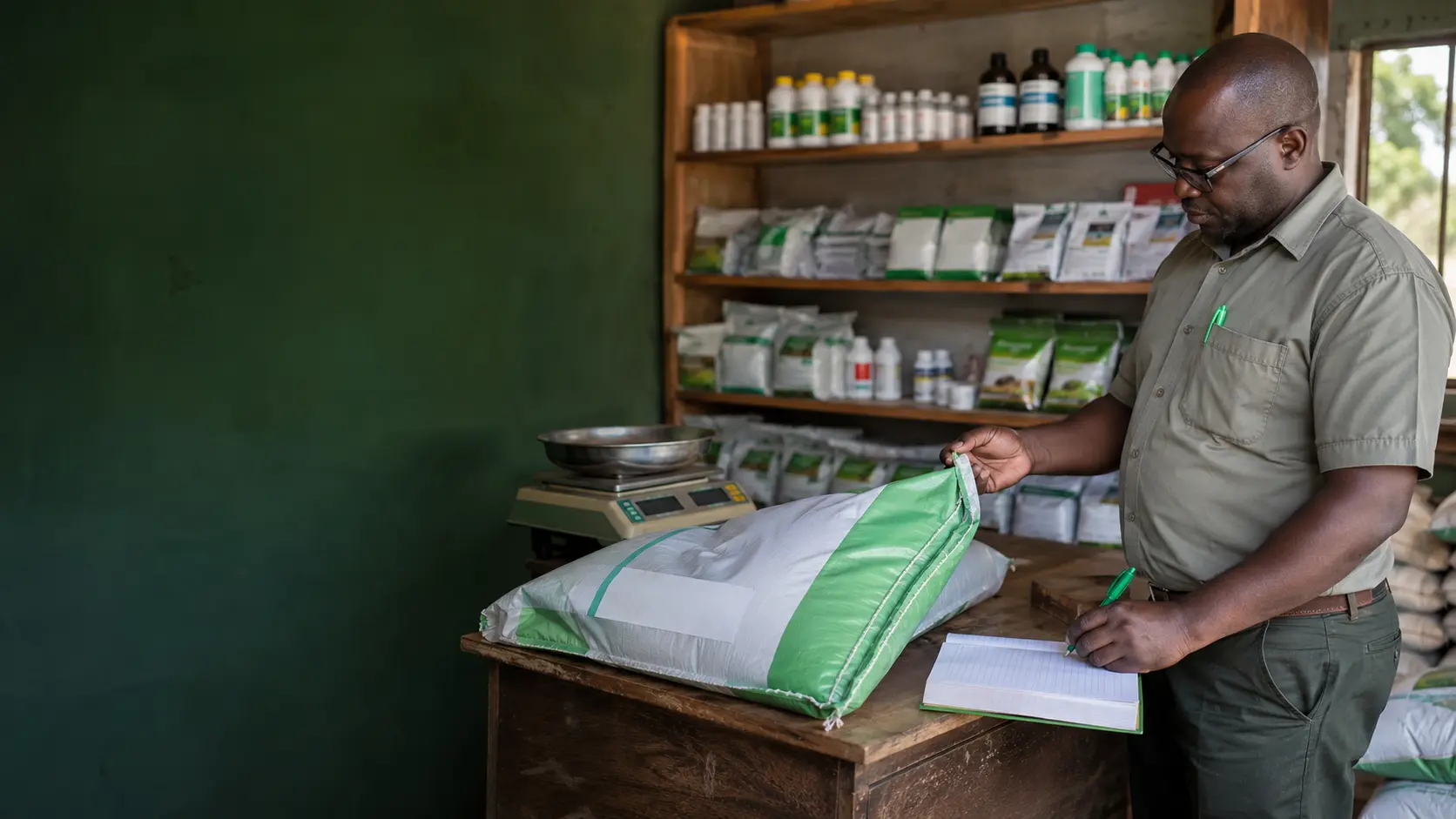
8. Weigh it. This is the check almost nobody does and the one with the clearest legal backing. IFDC found that "Ten percent of the fertilizer bags used for weight verifications presented weight shortages beyond the 0.5-kilogram tolerance limits". Under the Weights and Measures Act a stated weight is a statement of net weight, and delivering less than purported is an offence. Ask for the bag to be weighed in front of you. If the shop's scale looks unreliable, that is itself covered by section 25.
9. Get a receipt with everything on it. Date, seller name and location, product, declared analysis, net weight, batch or lot number, quantity, and price paid. Without a receipt naming the batch, you have no complaint later. This is the step that converts a bad purchase into a claim.
After you buy
10. Keep a sample. Take a handful from the bag, seal it in a clean labelled bag with the date, the batch number and the seller, and keep it dry. If the crop response is wrong, that sample is your evidence.
11. Store it properly. Dry, off the ground, out of the sun, away from feed and food. Moisture is the enemy of both quality and weight.
12. Record the response. Field, rate applied, date, weather, and what happened. Over three seasons this becomes the only genuinely local evidence you will ever have about a supplier.
Field record: fertiliser purchase and verification sheet
One line per purchase. Keep it with the farm records, not in your head.
| Item | Entry |
|---|---|
| Date of purchase | |
| Seller name and physical location | |
| Seller registration sighted? Reference and date | |
| Product name and declared guaranteed analysis | |
| Declared net weight per bag | |
| Batch or lot number | |
| Manufacturing or packing date on the bag | |
| Certification mark present? Which one | |
| Bag condition: intact, restitched, damp, damaged | |
| Product condition: free-flowing, caked, discoloured | |
| Weighed in front of me? Actual weight recorded | |
| Receipt obtained, with batch number on it? | |
| Retained sample taken and labelled? | |
| Price paid per unit | |
| Field applied to, rate and date | |
| Crop response observed, with date | |
| Any complaint made, to whom, reference and date |
The three rows that decide whether you have a case are batch number, receipt and retained sample. Everything else is good practice; those three are evidence.
What to do if you suspect a problem
Act on process, not on anger, and be careful about what you say publicly.
1. Stop using it. Do not apply the rest of the consignment.
2. Secure the evidence. Keep the remaining bags, the receipt, the retained sample and any photographs of the label and batch number.
3. Go back to the seller first, with the receipt, in writing where possible. Many problems are storage or handling problems that a dealer will resolve.
4. Report it to the regulators. UNBS publishes, on its own domain, a "toll free line 0800133133" and states that queries and reports can also be made via "WhatsApp number; 0713227580 and UNBS social media pages". MAAIF's Department of Crop Protection publishes switchboard numbers "0414-320115/0414-320187/0414-320801".
Two honest caveats. UNBS describes its toll-free line as being for "any queries" rather than specifically for agro-input complaints, and Falcon could not verify any dedicated MAAIF complaints hotline for suspected fake inputs. MAAIF's own contact page was unreachable at the access date. Use the numbers above as the best verified route and ask to be directed to the Agrochemicals Control Division.
5. Do not make public accusations against a named business. Section 2(2) of the Act deals with false or misleading representations, and a public accusation you cannot prove carries its own legal risk. Report it through the channels and let the regulator test the product.
6. Falcon could not verify any laboratory that a farmer can independently send a fertiliser sample to for testing. MAAIF's Crop Inspection department states a mandate to "Establish and maintain plant quarantine facilities, seed and agro-chemical analytical laboratories", which is a mandate rather than a named, contactable facility. Ask MAAIF or your district production office where a sample can be tested.
Costs
Falcon publishes no fertiliser prices, no bag prices and no testing fees, because none was verified and any figure would date within a season.
| Cost category | What sits inside it | How to manage it |
|---|---|---|
| The product | Price per bag or per tonne | Compare at least three sellers. A price far below the going rate is a warning, not a bargain |
| Transport | Getting it to the farm | Often the difference between two sellers' real cost |
| Storage | Dry, raised, secure space | Moisture destroys both quality and weight |
| Verification | Your time, and the weighing | Effectively free. It is the highest-return activity in this article |
| Independent testing | A laboratory analysis, where one is available | Falcon could not verify an accessible facility. Ask MAAIF |
| Loss from a bad purchase | The bag, the season, and the labour applied with it | This is the cost the routine exists to avoid |
Buying together changes the arithmetic. A cooperative or producer group buying in volume can insist on batch documentation, can weigh a sample of bags rather than one, and has a stronger position if something is wrong.
Common mistakes
- Buying without knowing what the soil needs. The correct application of the wrong nutrient is a wasted season.
- Buying on price alone. A price far below the going rate is the strongest warning signal available.
- Not asking whether the seller and premises are registered. Section 3(3) requires registration. Asking is free.
- Not reading the guaranteed analysis. The declared percentages are the product. The brand is not.
- Ignoring the absence of a batch number or date. Without them the bag has no traceable history and no complaint is possible.
- Not weighing. IFDC found 10 percent of bags short beyond the tolerance limit, and short weight is an offence.
- Accepting caked or damp product. You are paying fertiliser prices for water, and moisture is linked to quality failure in the Ugandan studies.
- No receipt, or a receipt without the batch number. This is the difference between a complaint and a grievance.
- Keeping no retained sample. Without it, nothing can be tested later.
- Storing it badly at home, which can create the very problem you were checking for.
- Assuming all fertiliser in Uganda is fake. The studies disagree sharply on scale, and IFDC found 0 percent non-compliance on DAP nitrogen and on ammonium sulphate. Blanket suspicion is as unhelpful as blanket trust.
- Naming a business publicly on suspicion. Report it instead.
Warning signs and escalation points
| Warning sign | What it means | What to do |
|---|---|---|
| Price far below what other sellers quote | The most reliable single indicator of a problem | Do not buy. Ask why it is cheaper and note the answer |
| No batch or lot number, or no packing date | The bag cannot be traced | Do not buy. There is no complaint route without it |
| Bag opened and restitched | Possibly repackaged or adulterated, possibly innocent | Ask. If the answer is unclear, choose another bag or another seller |
| Product caked, damp or unusually coloured | Moisture, which Ugandan studies link to quality failure | Do not buy. You are paying for water |
| Seller refuses to weigh the bag in front of you | Short weight is an offence under the Weights and Measures Act | Do not buy. Report the refusal |
| Seller cannot show registration of the business or premises | Section 3(3) requires it | Do not buy. Report it |
| Seller will not give a receipt with the batch number | You will have no evidence | Do not buy |
| Crop shows no response to a correctly applied product | Possible under-strength product, or a wrong diagnosis | Stop using the consignment, secure the sample and receipt, and report. Also review the soil test |
| The same seller produces poor results across seasons | A pattern rather than an incident | Change seller and report through the regulator, not publicly |
| Anyone develops symptoms after handling a product | A safety matter | Seek medical advice. Handling is covered in the published safe pesticide use article |
When this method works and when it does not
It works for any purchase from a fixed premises where you can see the bag, read the label, weigh it and get a receipt. That is the majority of formal purchases and effectively all cooperative purchases.
It works partially for repackaged small quantities. The EPRC study sampled both "81 bulky bags and 89 small packs" for exactly this reason. A one-kilogram repack rarely carries a full label, a batch number or a certification mark, and a farmer buying small quantities has fewer checks available. Where possible, buy from a sealed manufacturer's bag, even if that means buying jointly with neighbours.
It does not work for informal roadside or market-day sales with no premises, no receipt and no traceable product. There is no verification route there, and no complaint route either. That is a business decision, not a technical one, and this article's honest advice is that the saving rarely covers the risk.
And it does not substitute for a soil test. Verifying that a bag contains what it says does nothing about whether your soil needed that nutrient. The published soil testing article owns that question and it comes first.
A low-risk pilot
- Run the routine once, on a small purchase, before you need to run it on a large one. Ask for the registration, read the label, weigh the bag, get the receipt with the batch number, keep a sample.
- Note which of those steps the seller found normal and which caused friction. That tells you a great deal about the seller.
- Split one field. Apply the product to one half at the rate your soil test indicated, and leave the other half untreated, same crop, same day.
- Record and weigh the harvest from each half separately. This is your own evidence about that supplier and that product.
- Repeat with the same supplier next season before increasing your order.
- If you are in a group, agree the routine as a group rule. A cooperative that always weighs is treated differently from a farmer who occasionally does.
Limitations and professional-support triggers
What this article does not do. It states no fertiliser price, no application rate, no fee and no testing cost. It names no product, brand or business as fraudulent or substandard. It does not interpret a soil test, and it does not cover pesticides.
Four verification gaps, stated openly, because you need to know what Falcon could not confirm.
- Falcon could not verify that fertiliser-specific regulations have been made under section 17(1)(m) of the Act. The regulation-making power exists. Whether the regulations exist was not confirmed.
- Falcon could not verify any Uganda Standard number for any fertiliser product. East African draft standards adopted by Kenya in December 2024 exist, but no corresponding Ugandan designation was confirmed and none is printed here.
- Falcon could not verify whether fertiliser is on Uganda's pre-export verification or mandatory certification product list. The relevant UNBS pages were inaccessible at the access date.
- Falcon could not verify any laboratory a farmer can independently use to test a fertiliser sample.
A currency note. The Agricultural Chemicals (Control) Act is cited here as Chapter 35, following the current consolidation Falcon opened; an older consolidation is indexed as Cap. 29, and Uganda's National Fertiliser Policy refers to it as the "Agricultural Chemical (Control) Act, 2006". The Weights and Measures Act text used here is a consolidation as at 31 December 2000 and its stated fines are almost certainly superseded, which is why no penalty amount is quoted in this article. Confirm current citations before relying on a section number.
Bring in a professional when:
- The published soil testing route and an agronomist, before deciding which product to buy.
- MAAIF's Agrochemicals Control Division, to confirm current registration and regulation requirements, and to ask where a sample can be tested.
- UNBS, to confirm which certification a product should carry and to report a suspected substandard product.
- Your district production office, for a view on local suppliers and on where testing is available.
- An advocate registered in Uganda, before making any public statement about a named business, or before pursuing a claim of any size.
Clear next actions
- Get a soil test before your next purchase, if you have not had one. See the published soil testing article.
- Write down the product, the analysis and the quantity you intend to buy, before you go.
- Ask two other farmers what they paid recently, so you know the going rate.
- At the shop, work through the twelve-step routine and do not skip the weighing.
- Get a receipt with the batch number on it.
- Take and label a retained sample from every consignment.
- Start the purchase and verification sheet with this purchase.
- If you buy as a group, propose the routine as a standing group rule at your next meeting.