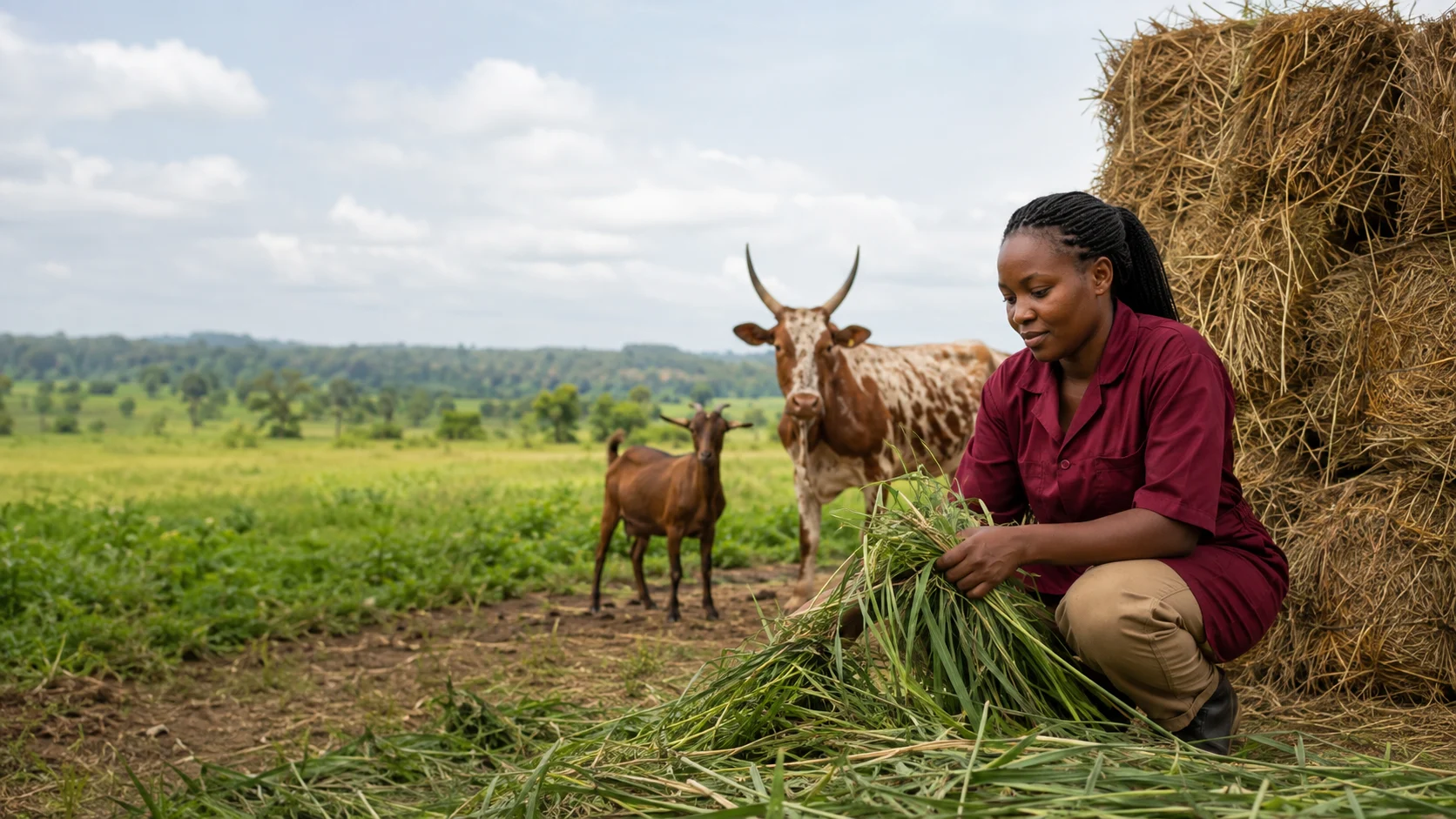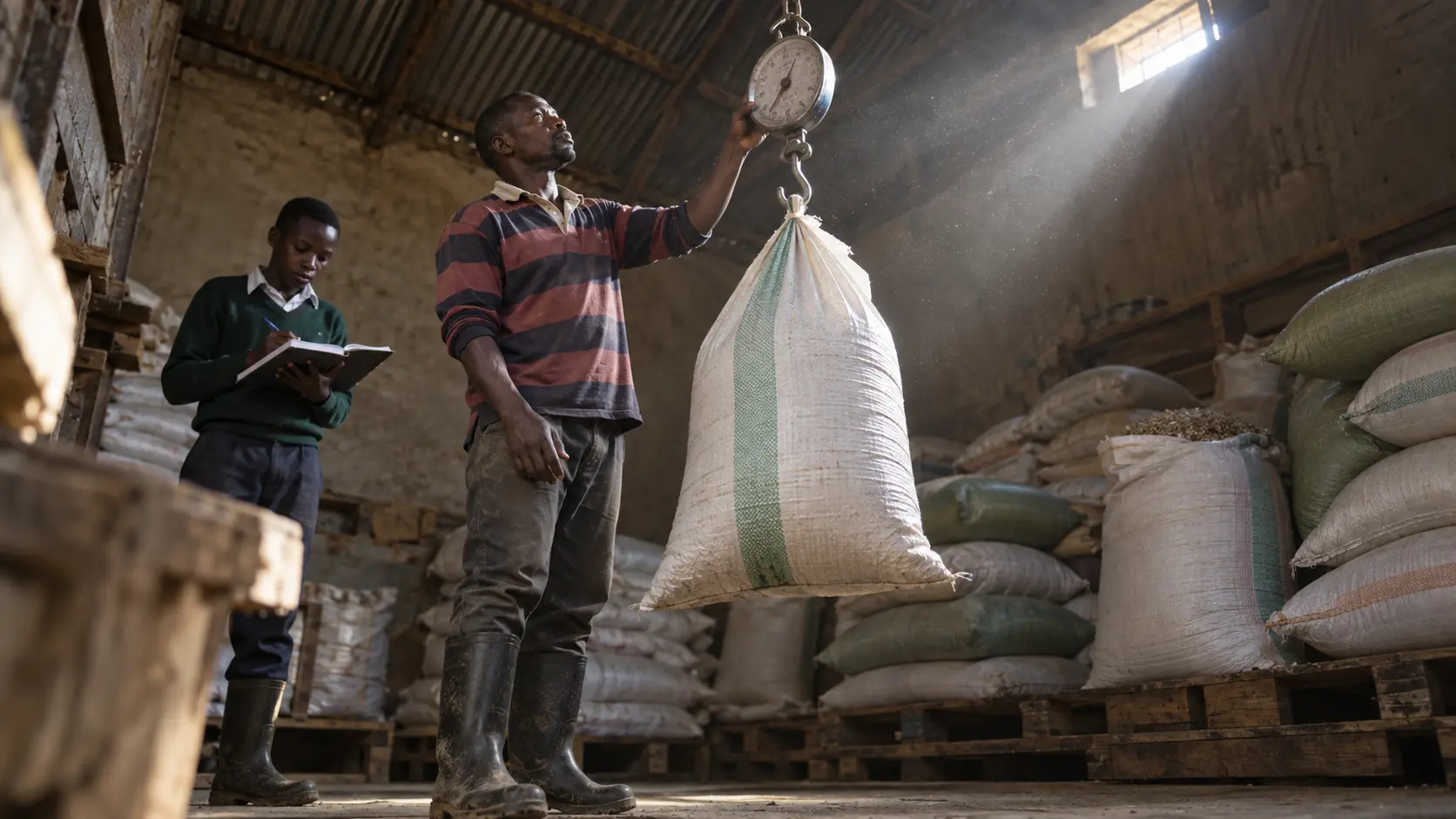
The feed bill has gone up. The obvious move is to find a cheaper feed, and there is usually somebody at the trading centre ready to sell you one.
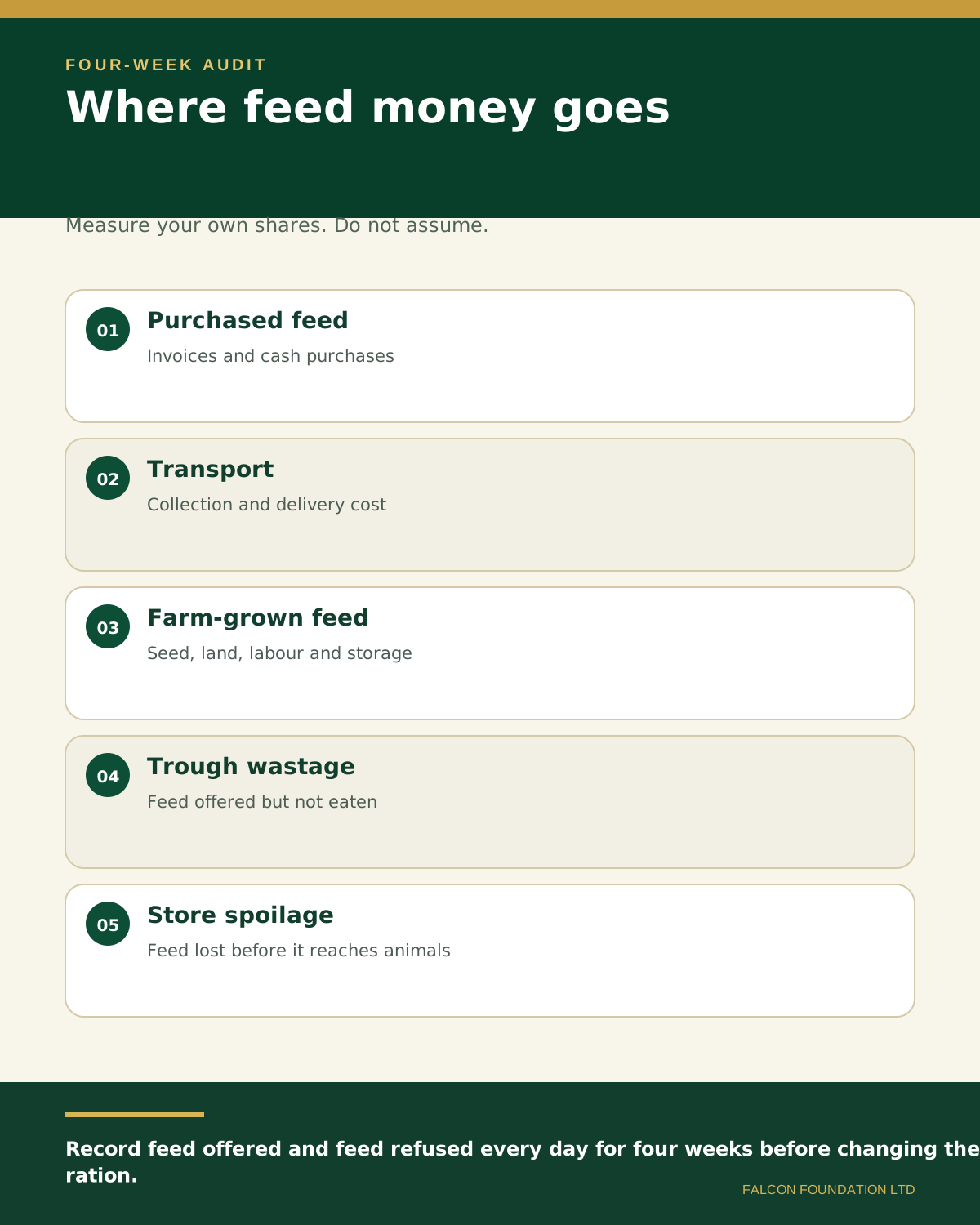
Hold on for four weeks. In most livestock enterprises the total feed cost is not one number, it is five, and the one you can see on the receipt is rarely the one that is moving. Farmers who switch feeds before measuring often end up paying the same money for a worse ration, and the real leak carries on untouched.
This guide is about measuring first.
What this guide helps you decide
This guide helps you answer one question: which part of my feed cost is actually the problem?
It gives you a four-week tracking method that splits your feed cost into its real components, and a simple way to work out what feed is costing you per animal and per unit of output.
It applies to dairy and beef cattle, goats, sheep and poultry. It does not tell you which feed to buy, how to formulate a ration, or how to make silage. Those are separate decisions and they only make sense after this one.
Feed is usually the biggest cost, and Uganda's own policy says so
Uganda's National Animal Feeds Policy states that animal feeds account for 70 per cent of production costs in intensive livestock systems [1]. That figure has continued to be used publicly by government, and was repeated by the Minister of State for Animal Industry in trade press coverage of Uganda's feed sector [2].
A review of smallholder dairy in Kenya puts fodder and feed at 55 to 70 per cent of milk production costs [3]. That is a Kenyan review, not Ugandan data, but the direction is the same.
The useful implication is not that feed is expensive. It is that feed is where a small percentage improvement is worth more than a large improvement almost anywhere else on the farm. A five per cent saving on 70 per cent of your costs is worth far more than a five per cent saving on veterinary spending.
Feed cost is seasonal, and that is measurable
A 2023 Ugandan dairy market study carried out under the Pathways to Dairy Net Zero initiative recorded feed cost at 222.7 Ugandan shillings per litre in the wet season and 290.4 shillings per litre in the dry season, against a wet-season farm gate price of around 900 shillings per litre [4].
Those are figures from one study on one set of farms and they should not be treated as your farm's numbers. What they demonstrate is the shape of the problem: feed cost per unit of output rises in the dry season while the price you receive does not necessarily follow.
That has a direct consequence for how you measure. If you track feed cost for one month in April and draw conclusions, you have measured the easy season. The four-week exercise below should be repeated once in the wet season and once in the dry season before you act on it.
The five places feed money goes
1. Purchased feed
The visible cost. Concentrates, brans, cakes, compounded feed, mineral supplements. This is what most farmers mean when they say feed cost.
In an early Ugandan smallholder dairy study, 24 per cent of surveyed farmers named the high price of maize bran as a constraint, and another 24 per cent named expensive mineral lick, nutrimix and dairy meal [5]. So it is a real constraint. It is simply not the whole picture.
2. Transport
This is the cost most often folded invisibly into the purchase price. Work on Uganda's concentrate feeds value chain describes high fixed transaction costs and rising transport costs, with trader margins compressed to less than 15 per cent [6]. When transport rises, either the price you pay rises or the trader cuts something else, usually quality.
Record transport separately. If you are sending a boda boda to town for two sacks, that trip is part of your feed cost.
3. Feed grown on the farm
Napier, other planted fodder, crop residues, browse. Farmers routinely treat this as free because no money changed hands. It is not free. It used land, labour and sometimes fertiliser, and if you are not counting it you cannot tell whether growing it is cheaper than buying.
You do not need to be precise. Count the labour days and any inputs, and carry that as a cost.
4. Wastage at the trough
Feed that is offered and not eaten. Trampled, pushed out, soiled, or simply refused.
This is measurable and it is the component most farmers have never quantified. The method is called weigh-back: you weigh what you put out and weigh what is left before the next feeding, and the difference between the two, expressed as a share of what you offered, is your refusal rate.
Dairy extension guidance from the University of Minnesota describes managing to a refusal target of around 4 to 5 per cent for fresh and early-lactation cows, and illustrates the money involved: for a 250-cow herd at a feed cost of 7.50 US dollars per cow per day, the difference between running at 5 per cent refusals and 2 per cent refusals was 34,219 dollars against 13,688 dollars a year [7].
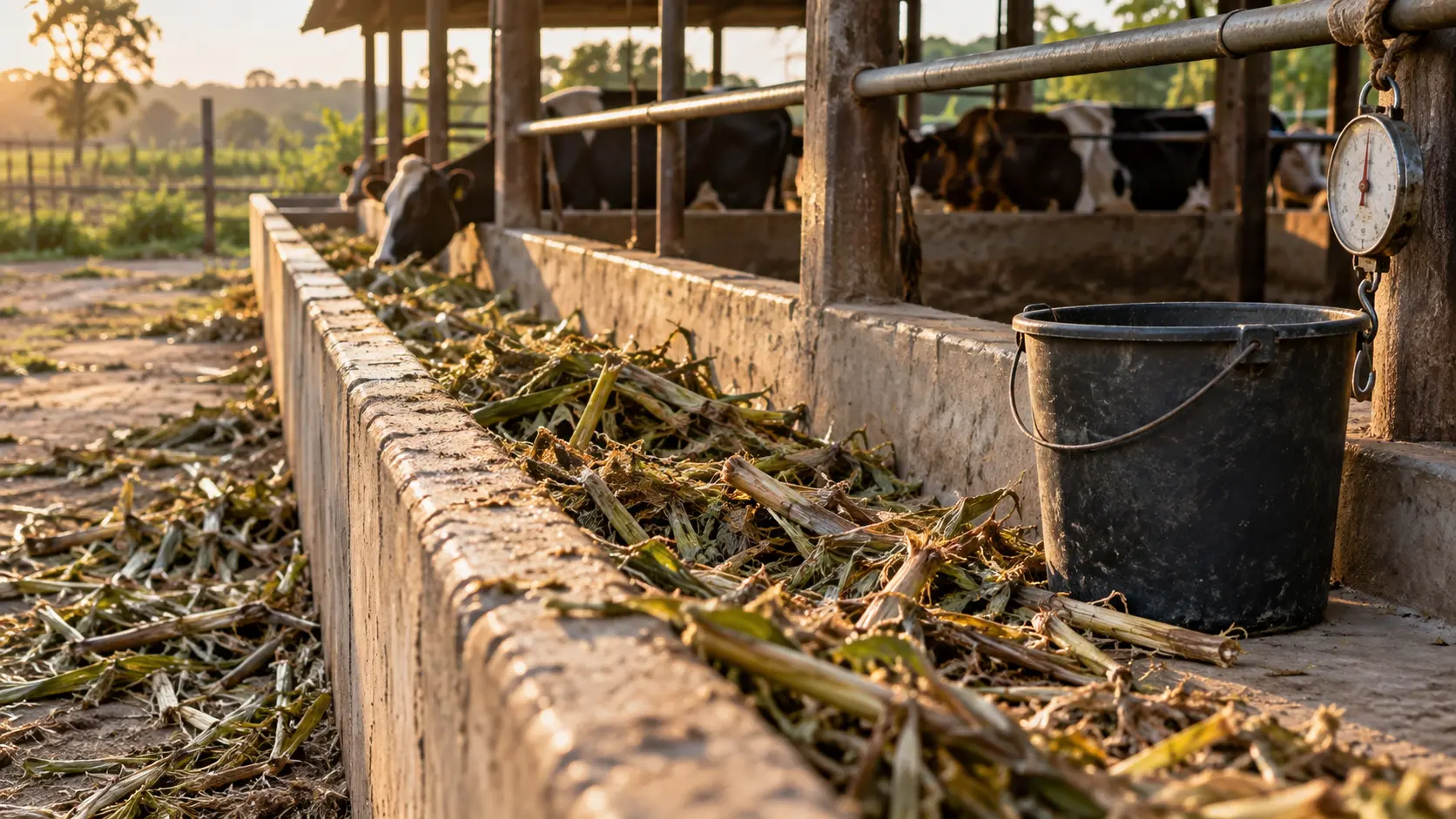
Those figures are from a United States herd and the shilling amounts do not transfer. The method does. Weighing refusals for a week will tell you something about your own farm that no article can.
5. Spoilage in store
Feed that was bought and never eaten because it went mouldy, was eaten by rodents, or was spilled.
Ugandan value chain work documents feed being carried exposed on bicycles, motorcycles and open trucks, with weather damage, spillage and contamination along the way, and it also documents deliberate adulteration with water, sand and sawdust to increase apparent weight [6]. Water added to feed is spoilage you have paid for.
Store losses in humid conditions are real and they are invisible unless you weigh what goes into the store and what comes out of it.
The four-week tracking method
Keep a single exercise book in the store. For four weeks, record five things.
| What to record | How often | Unit |
|---|---|---|
| Feed bought | Every purchase | kg and shillings |
| Transport paid | Every trip | Shillings |
| Feed offered | Daily | kg |
| Feed refused | Daily | kg |
| Feed discarded | When it happens | kg and reason |
At the end of four weeks you can work out four things.
Your refusal rate. Total refused divided by total offered, as a percentage. Anything consistently above about 5 per cent is worth investigating, using the general dairy guidance above as a reference point rather than a Ugandan standard [7].
Your delivered feed cost. Purchase cost plus transport, divided by kilograms received. This is what your feed actually costs, and it is usually higher than the price you quote to other farmers.
Your cost per animal per day. Total feed cost for the period divided by number of animals divided by days.
Your cost per unit of output. For dairy, total feed cost divided by litres produced. For a fattening enterprise, feed cost divided by liveweight gained if you are weighing, or per animal finished if you are not.
That last figure is the one that matters, because a cheaper feed that reduces output is not cheaper.
Working out whether the enterprise pays
Feed cost only means something inside a whole enterprise budget. FAO's farm management guidance defines gross margin simply as gross income less variable costs, calculated on a per head or per unit basis for livestock [8]. Feed is normally the largest variable cost, so once you know it you are most of the way to a gross margin.
Our guide to farm record keeping and gross margin analysis sets out how to complete that calculation.
Be careful about the scale you are operating at. Uganda's smallholder dairy farms average about 6.9 cattle and hold around 90 per cent of the national cattle stock, with reported farm level milk productivity of about 500 kilogrammes a year [9]. One Ugandan study found an average net margin of around 636,000 shillings per cow per year against an estimated household requirement of about 1,245,000 shillings a year, which is why that study concluded roughly two productive cows were needed to meet household cash needs [5]. Those figures are dated and specific to that study's farms. The lesson that survives is that a small number of unproductive animals eating feed can turn a workable enterprise into a losing one.
Records that make this repeatable
The Uganda farming press lists a dozen record types farmers should keep, including feed type and consumption records, and makes the point that records are what give you access to credit and let you detect losses [10]. Livestock record guidance from Infonet-Biovision groups records into six categories, one of which is feeding, covering type, quantity, quality and waste, and stresses that records must be simple enough to actually be used [11].
Keep it to one book and five columns. A complicated system that is abandoned in week three is worth nothing.
Limitations and when to get help
This guide gives you a measurement method, not a ration. Formulating a balanced ration for a specific class of animal is technical work that needs a qualified animal nutritionist or veterinary officer, and it needs to account for the animal's stage of production, body condition and the actual nutrient content of what you are feeding.
We have deliberately given no Ugandan feed prices. Prices vary by district, by season and by supplier, and any figure we published would be out of date before you read it. Use your own receipts.
If you suspect a purchased feed has been adulterated, that is a quality and regulatory matter. Uganda has enacted animal feeds legislation covering registration, licensing and packaging, and it has been reported on publicly [2]. Verify the current legal position with the Ministry of Agriculture, Animal Industry and Fisheries or the Uganda National Bureau of Standards before making a complaint, and see our separate guide on buying compounded feed.
For dairy specifically, the regulatory position has recently changed and older guidance is out of date. Parliament passed the Dairy Industry (Amendment) Bill in October 2024, abolishing the Dairy Development Authority as a semi-autonomous agency and transferring its functions to the Ministry of Agriculture, Animal Industry and Fisheries under the government's rationalisation of public agencies [12] [13]. Reporting in mid 2025 described that transition as still being worked through, with dairy inspection staffing below establishment [14]. Confirm the current arrangement with the ministry before relying on it.
What to do next
- Buy one exercise book and rule five columns in it today.
- Weigh one feeding out and weigh the refusals before the next feeding. Do this for seven days.
- Record every feed purchase with its transport cost separately.
- At four weeks, calculate your refusal rate, your delivered feed cost and your cost per animal per day.
- Repeat the same four weeks in the opposite season before drawing conclusions.
- Only then decide whether the problem is price, transport, wastage or spoilage, and act on that one thing.
Read next: taking stock of the feed resources you already have helps you find feed you are not currently using, and building a twelve-month fodder calendar turns a seasonal shortfall into a plan. Our guide to year-round fodder planning for goats and cattle covers the principle.