The direct answer
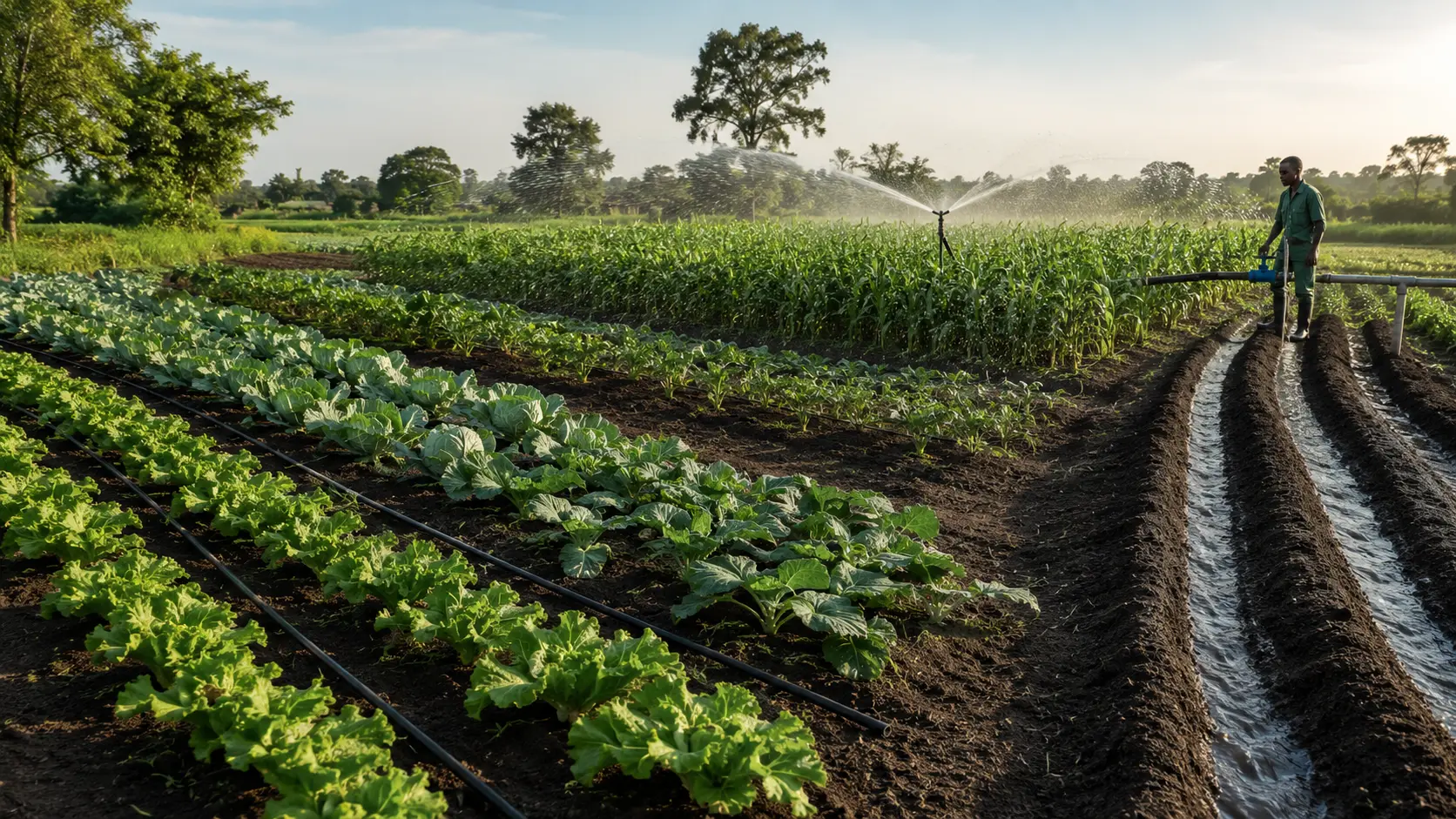
The method that suits your farm is decided by four things, in this order: water quality, slope, crop and labour. Cost comes fifth, and efficiency comes last, for reasons this article explains.
Water quality decides whether drip is possible at all. FAO Irrigation and Drainage Paper 29 sets clogging-hazard thresholds for localised irrigation. Suspended solids below 50 milligrams per litre present no restriction, 50 to 100 is slight to moderate, and above 100 is severe. Iron and manganese are severe above 1.5 milligrams per litre each. Bacterial populations are severe above 50,000 per millilitre. If your water fails those thresholds, drip is a maintenance problem before it is an efficiency gain.
Slope decides whether furrow is possible. FAO's irrigation methods training manual states that for furrow irrigation "Uniform flat or gentle slopes are preferred", and that these "should not exceed 0.5%", with "a gentle furrow slope ... provided up to 0.05% to assist drainage".
Crop decides what is worth the capital. FAO: "Surface irrigation can be used for all types of crops. Sprinkler and drip irrigation ... are mostly used for high value cash crops, such as vegetables and fruit trees."
Labour is the hidden cost. FAO: "Surface irrigation often requires a much higher labour input ... than sprinkler or drip irrigation", while "Sprinkler and drip irrigation require little land levelling; system operation and maintenance are less labour-intensive."
And now the efficiency figures, with the honesty they require. FAO's irrigation scheduling training manual gives field application efficiencies of 60 percent for surface irrigation, 75 percent for sprinkler and 90 percent for drip. Those are the numbers every supplier quotes. What suppliers do not quote is an FAO-hosted African-context brief which states: "Water efficiency at field level is by design between 50-60% for surface irrigation, 90% for drip irrigation, and 50% for sprinkler", and then adds, plainly, "However an increasing number of studies have shown that drip and sprinkler efficiencies can be as low as gravity."
Read that last sentence twice. Those headline efficiencies are design values. A badly maintained drip system with partially clogged emitters is not a 90 percent system. The efficiency gain is earned by maintenance, not conferred by purchase.
Who this article is for
Farmers about to spend money on an irrigation method. Investors assessing whether a proposal's method suits its site. Installers. Extension officers. Students.
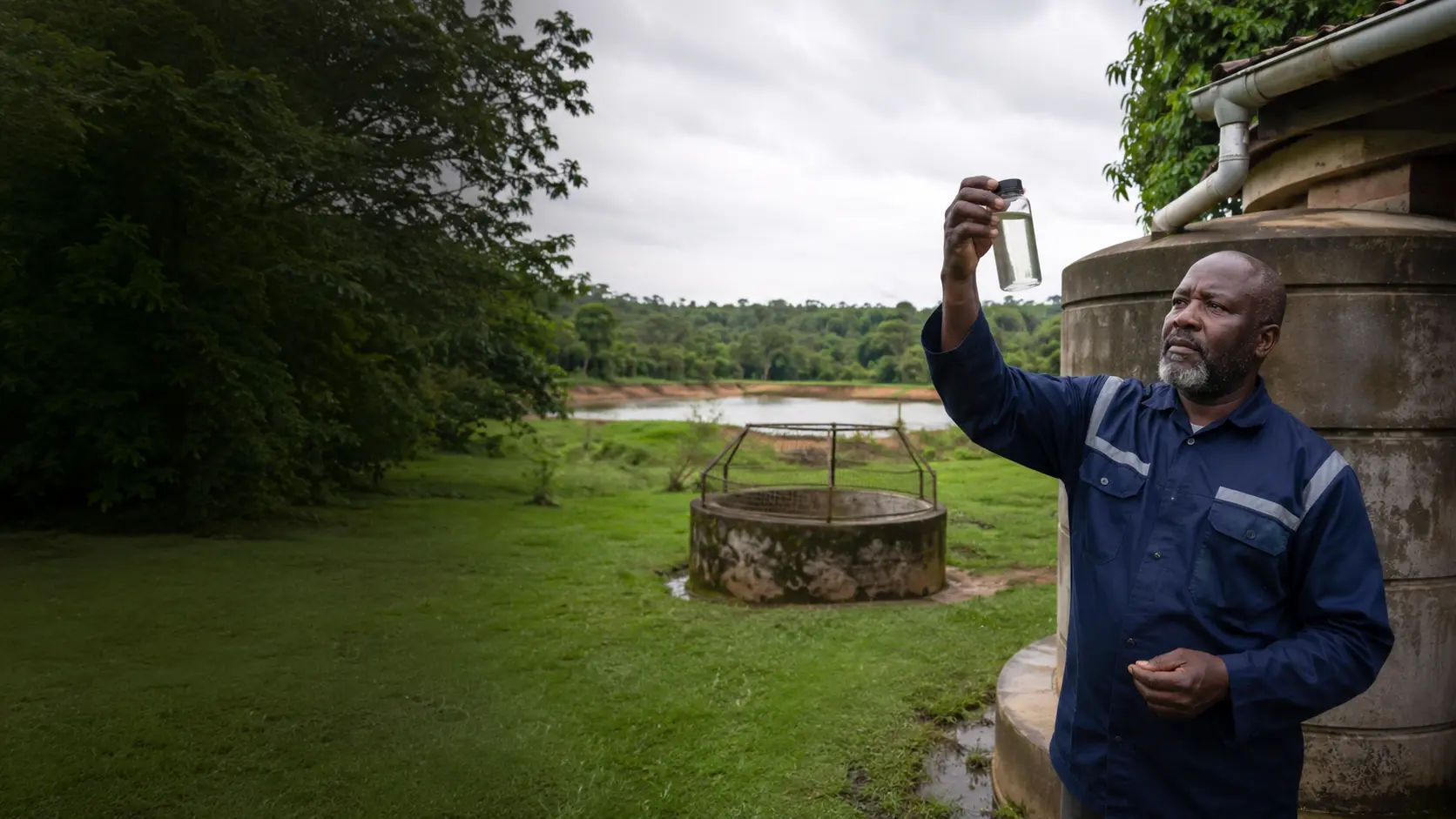
You should already know your water source and have had it tested, because the water quality thresholds below are the first gate. Falcon's article on on-farm water sources covers source selection and recommends the test.
The problem this solves
Drip irrigation is promoted heavily in Uganda, and it is frequently the wrong choice on the specific site where it is installed. Not because drip is bad, but because the promotion is done by people who sell drip, and the two conditions that most often defeat it, water quality and maintenance, are conditions that only the farmer will experience.
The evidence that method choice goes wrong in East Africa is documented. A Kenyan study of smallholders who abandoned low-cost drip kits found that "the majority of farmers who discontinued using micro-irrigation stopped due to lack of maintenance, irrelevant cultural background, and unreliable water supply."
Maintenance is first on that list. Not cost, not yield, not water availability. Maintenance.
At scheme level in Uganda, a peer-reviewed comparative assessment of the Mubuku and Doho pilot irrigation schemes found "that the schemes were not performing optimally with crop yields being far below the attainable potential", attributing this to "low water use efficiency and low agricultural output", where "Poor flow control, poor water distribution, and poor on-farm water application contributed to low water use efficiency", and where "The financial self-sufficiency indicator pointed to farmers' inability to operate and maintain irrigation schemes effectively."
On-farm water application and the ability to fund operation and maintenance appear in both findings. That is the pattern this article is written around.
The decision you are making
For one block of land and one crop, you are choosing one of three methods, on the basis of:
- A water quality result against the clogging thresholds.
- A measured slope.
- The crop's value and its tolerance of wet foliage.
- The labour you actually have at peak.
- Your honest assessment of whether the system will be maintained.
Then, and only then, cost.
Uganda-specific context
Water quality is the Ugandan constraint that matters most, and it cuts both ways. Ugandan groundwater from the basement complex commonly carries iron, and Ugandan surface water in the rainy season carries suspended solids. Both are directly on the FAO clogging table. A farm with turbid surface water or iron-rich borehole water should not buy drip without first solving filtration, or should choose sprinkler or improved furrow instead.
Slope is common. The 0.5 percent furrow limit is a real constraint on much Ugandan land, and it is measurable with the same A-frame or line level described in Falcon's soil erosion article.
Wind matters for sprinklers. FAO: "Strong wind can disturb the spraying of water from sprinklers. Under very windy conditions, drip or surface irrigation methods are preferred."
And the scale is small. With a national average landholding of 1.2 hectares and roughly 40 percent of agricultural households below 0.5 hectares, according to the Uganda Bureau of Statistics Annual Agricultural Survey 2020, the capital cost per hectare of a pressurised system falls on a very small area. That is not an argument against drip; it is an argument for sizing the irrigated block to the crop that justifies it, rather than to the whole holding.
The three methods compared
Furrow
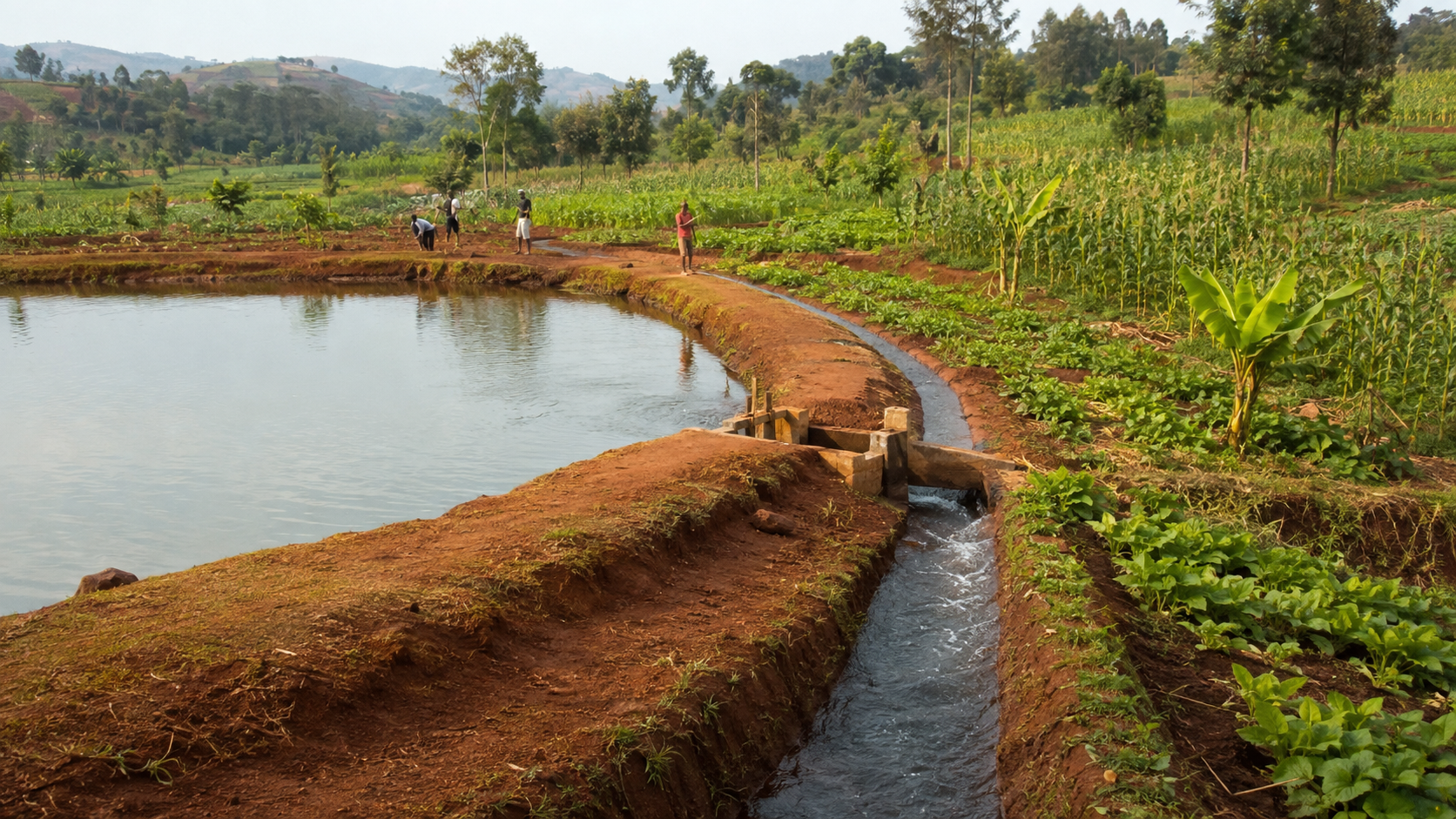
What it is. Water runs along channels between crop ridges and infiltrates sideways and downward into the ridge.
Where FAO says it suits. Slope: "Uniform flat or gentle slopes are preferred for furrow irrigation. These should not exceed 0.5%", with up to 0.05 percent provided "to assist drainage following irrigation or excessive rainfall with high intensity". Soils: "Furrows can be used on most soil types. However, as with all surface irrigation methods, very coarse sands are not recommended as percolation losses can be high", and "Soils that crust easily are especially suited to furrow irrigation because the water does not flow over the ridge, and so the soil in which the plants grow remains friable." Crops: "Furrow irrigation is suitable for many crops, especially row crops. Crops that would be damaged if water covered their stem or crown should be irrigated by furrows."
Where FAO says surface irrigation is actively preferred. On water quality: "Surface irrigation is preferred if the irrigation water contains much sediment." That single sentence is the reason furrow belongs in this comparison and is often the right answer in Uganda.
The costs. Land levelling, and labour. FAO: "Surface irrigation often requires a much higher labour input ... than sprinkler or drip irrigation."
Honest verdict. Furrow is the method with the lowest capital cost, the highest labour cost, the tightest slope constraint and the greatest tolerance of dirty water. On a gently sloping Ugandan field with sediment-laden surface water and available family labour, it is frequently the correct choice, and no supplier will tell you so.
Sprinkler
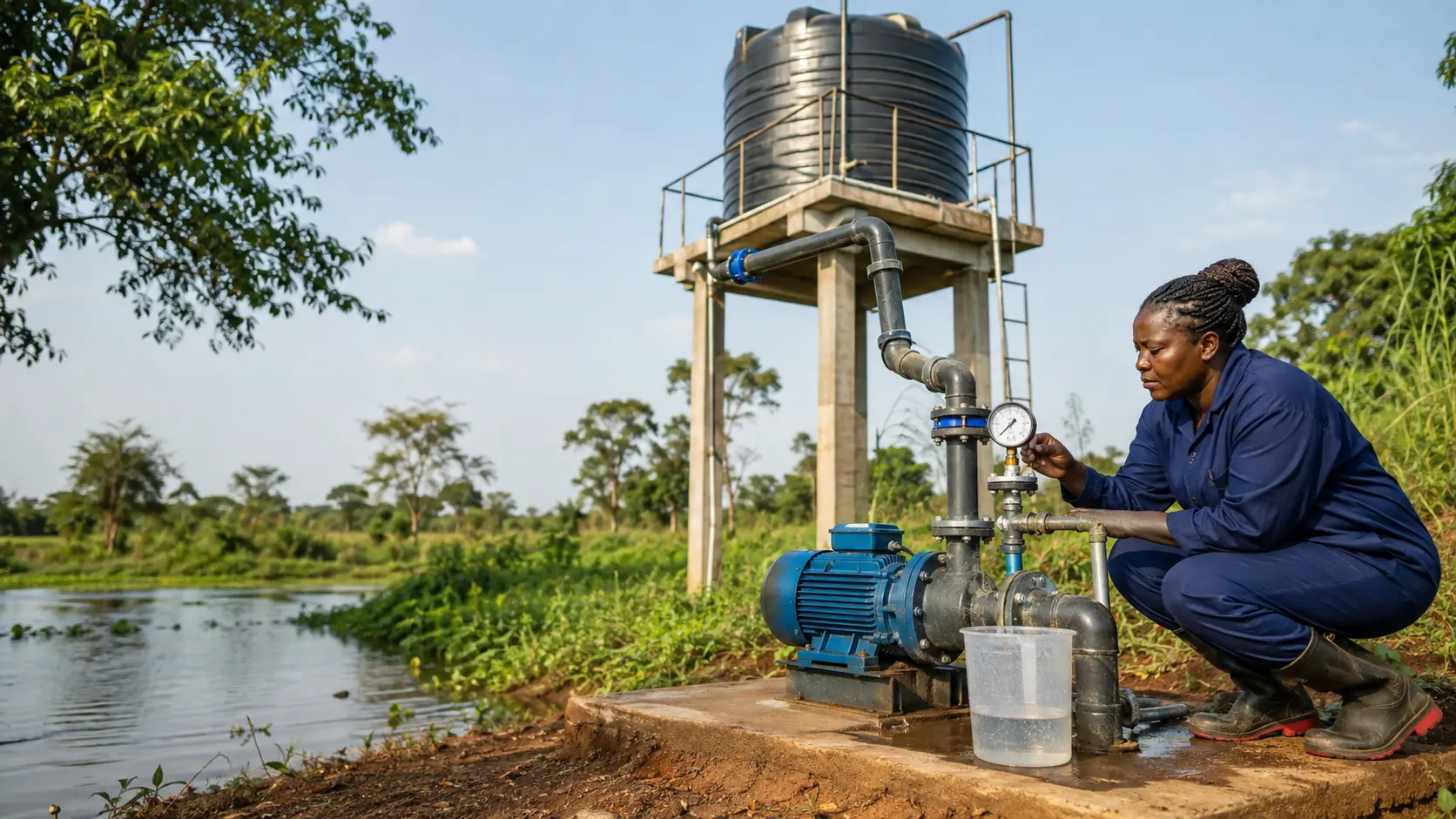
What it is. Water is delivered under pressure through nozzles that spray it over the crop.
Where FAO says it suits. Soils: "Sandy soils have a low water storage capacity and a high infiltration rate ... sprinkler or drip irrigation are more suitable than surface irrigation." Slope: "Sprinkler or drip irrigation are preferred above surface irrigation on steeper or unevenly sloping lands as they require little or no land levelling." Water availability: "Water application efficiency ... is generally higher with sprinkler and drip irrigation than surface irrigation and so these methods are preferred when water is in short supply."
Where it does not suit. Wind, per the FAO quotation above. And crops whose foliage should stay dry, because wetting leaves affects some diseases.
Filtration. FAO's pressurised irrigation handbook states that for sprinklers "Filtration requirements, where necessary, are about 20 mesh", for microsprinklers "about 60 mesh (300 microns)", and for micro-jets and sprayers "filtration of the water is essential" with "60-80 mesh (250-200 microns)".
Honest verdict. Sprinkler is the middle option: more tolerant of water quality than drip, more tolerant of slope than furrow, less labour than furrow, more energy than either. On a Ugandan farm with moderate water quality, uneven ground and a pump already in place, it is often the practical answer.
Drip
What it is. Water is delivered slowly through emitters directly to the root zone.
Where FAO says it suits. Salinity: "drip irrigation is particularly suitable, as less water is applied to the soil than with surface methods." Slope and soil, as with sprinkler. Crop value: FAO groups sprinkler and drip as "mostly used for high value cash crops, such as vegetables and fruit trees."
The condition that decides everything: water quality. FAO Irrigation and Drainage Paper 29 gives the clogging thresholds, and Falcon reproduces them because they are the most useful table in this article.
| Potential problem | Units | No restriction | Slight to moderate | Severe |
|---|---|---|---|---|
| Suspended solids | mg/l | Below 50 | 50 to 100 | Above 100 |
| pH | Below 7.0 | 7.0 to 8.0 | Above 8.0 | |
| Dissolved solids | mg/l | Below 500 | 500 to 2000 | Above 2000 |
| Manganese | mg/l | Below 0.1 | 0.1 to 1.5 | Above 1.5 |
| Iron | mg/l | Below 0.1 | 0.1 to 1.5 | Above 1.5 |
| Hydrogen sulphide | mg/l | Below 0.5 | 0.5 to 2.0 | Above 2.0 |
| Bacterial populations | maximum number per ml | Below 10,000 | 10,000 to 50,000 | Above 50,000 |
FAO attaches its own honest caveat to that table: "There is not enough experience with localized (drip) irrigation systems to predict with precision if or when clogging problems will occur with a given water."
FAO identifies three categories of clogging, "physical (suspended solids), chemical (precipitation), and biological (bacteria and algae)", notes that "The chief cause of clogging is solid particles in suspension, but this is also the easiest problem to solve", and warns that "Screening alone is not adequate to prevent clogging in all cases, as small particles may still get through the screens." It also describes a particularly difficult case: "One of the most severe forms of clogging is caused by a white, gelatinous sulphur slime associated with sulphur bacteria."
A Ugandan extension source confirms filtration is standard practice. A GIZ manual on micro and small scale irrigation technologies covering Northern Uganda states simply that "Filters prevent dirt or soil particles from blocking the dripline emitters (drippers)."
Falcon does not print a single mesh figure for inline drip emitters, because FAO's handbook gives mesh requirements for sprinklers, microsprinklers and micro-jets but describes drip tape as having "a filtration system incorporated inside the tubing" and does not state one number for all drip. Ask your supplier for the filtration specification for the specific emitter they are selling.
Honest verdict. Drip is the highest-capital, lowest-labour, most water-efficient method when maintained and when the water suits it. Both conditions are real and both are commonly unmet. The Kenyan abandonment study puts maintenance first among reasons farmers stopped.
The comparison table
| Factor | Furrow | Sprinkler | Drip |
|---|---|---|---|
| FAO field application efficiency, design value | 60 percent | 75 percent | 90 percent |
| Capital cost | Lowest | Middle | Highest |
| Labour | Highest, per FAO | Lower | Lowest |
| Energy | Lowest, often gravity | Highest, needs pressure | Middle |
| Slope limit | Should not exceed 0.5 percent, per FAO | Suits steeper and uneven land | Suits steeper and uneven land |
| Land levelling | Required | Little or none, per FAO | Little or none, per FAO |
| Tolerance of sediment | Highest. FAO says surface is preferred where water contains much sediment | Middle, with filtration | Lowest. See the clogging table |
| Tolerance of iron and manganese | High | Middle | Lowest. Severe above 1.5 mg/l |
| Wind | Unaffected | Disturbed by strong wind, per FAO | Unaffected |
| Wets foliage | No | Yes | No |
| Salinity | Less suitable | Middle | FAO says particularly suitable |
| Maintenance burden | Channel maintenance, labour | Nozzles, pressure, moving equipment | Emitters, filters, flushing. The documented reason for abandonment in a Kenyan study |
| Suits which crops | All, per FAO | Mostly high value cash crops, per FAO | Mostly high value cash crops, per FAO |
| Suits very coarse sands | No, per FAO | Yes | Yes |
The selection sequence
Work through these gates in order. Each gate can eliminate a method, and the elimination is the useful part.
Gate 1: water quality. Get a laboratory test. Compare it with the FAO clogging table. If suspended solids exceed 100 milligrams per litre, or iron or manganese exceed 1.5, drip is in the severe category and should not be chosen without solving the water first.
Gate 2: slope. Measure it. If the field slope exceeds 0.5 percent, furrow is outside FAO's stated range for that method.
Gate 3: soil infiltration. Very coarse sands rule out surface methods, per FAO. Easily crusting soils favour furrow, per FAO.
Gate 4: crop. A crop that must not have wet foliage rules out sprinkler. A low-value bulk crop rarely justifies drip capital, on FAO's own framing.
Gate 5: wind. Strong wind pushes you away from sprinkler.
Gate 6: labour. Furrow costs the most labour. If your peak labour is already fully committed, that is a real constraint, not a preference.
Gate 7: maintenance realism. Ask yourself honestly who will flush the filters weekly and who will replace emitters. If the answer is nobody, the efficiency advantage will not materialise, and the Kenyan evidence says the system will be abandoned.
Gate 8: only now, cost.
Field record: irrigation method selection sheet
| Item | Entry |
|---|---|
| Field name and area, hectares and acres | |
| Crop and its value per unit area | |
| Water source, per FF-105 | |
| Water test date and laboratory | |
| Suspended solids, mg/l, and FAO category | |
| Iron, mg/l, and FAO category | |
| Manganese, mg/l, and FAO category | |
| pH, dissolved solids, hydrogen sulphide, bacteria, and categories | |
| Measured field slope, percent, at three points | |
| Soil type and infiltration observation | |
| Does the crop tolerate wet foliage? | |
| Prevailing wind strength at the site | |
| Peak-season labour available, person-days per week | |
| Who will perform weekly filter and system maintenance, by name | |
| Methods eliminated at each gate, and why | |
| Method selected | |
| Filtration specification required, from the supplier | |
| Operating pressure required, to be passed to FF-604 | |
| Water applied per irrigation, measured, first season |
The row that decides the outcome is "who will perform weekly maintenance, by name". If it is blank, do not buy drip.
Costs
Falcon publishes no equipment prices. Compare by category and always at the same duty point.
| Cost category | Furrow | Sprinkler | Drip |
|---|---|---|---|
| Land preparation | Levelling and channel forming, the largest item | Minimal | Minimal |
| Equipment | Minimal | Pipes, risers, sprinklers, fittings | Mainlines, laterals, tape, emitters, filters, fittings |
| Filtration | None | Screening, mesh per FAO by emitter type | Essential, specification from the supplier |
| Pumping energy | Lowest, often none | Highest, pressure required | Middle |
| Labour, recurrent | Highest | Middle | Lowest |
| Maintenance, recurrent | Channel repair | Nozzles, seals, moving equipment | Filter flushing, line flushing, emitter replacement |
| Replacement cycle | Very long | Long | Falcon could not verify a published design lifespan for drip tape under smallholder African conditions and states none. Ask the supplier, in writing |
| Water cost | Highest volume applied | Middle | Lowest, if maintained |
Two honest notes. First, the recurrent columns matter more than the capital column over a decade, and they run in opposite directions. Second, the drip replacement cycle is the number Falcon most wanted for this table and could not verify. Ask the supplier for a written statement of expected life and warranty on the emitters, and treat a refusal as information.
Common mistakes
- Choosing the method before testing the water. The clogging table is gate one for a reason.
- Believing the 90 percent figure is what you will get. FAO's own African-context brief states that "drip and sprinkler efficiencies can be as low as gravity."
- Assuming drip is always better. FAO says surface irrigation is preferred where water contains much sediment.
- Installing furrow on a slope above 0.5 percent. That is outside FAO's stated range for the method.
- Relying on a screen filter alone with dirty water. FAO: "Screening alone is not adequate to prevent clogging in all cases".
- Running sprinklers in strong wind. FAO names it as the condition where drip or surface are preferred.
- Wetting the foliage of a crop that should stay dry.
- Ignoring iron. Iron above 1.5 milligrams per litre is in FAO's severe clogging category and Ugandan groundwater commonly carries it.
- Buying drip with nobody assigned to maintain it. Maintenance is first among the reasons Kenyan smallholders abandoned drip kits.
- Comparing quotations for different methods without the same duty point. See FF-604.
- Forgetting that the method sets the operating pressure, which changes the pump you need.
- Sizing the system to the whole holding rather than to the block whose crop justifies the capital.
Warning signs and escalation points
| Warning sign | What it means | What to do |
|---|---|---|
| Emitters at the far end of a drip line deliver less than those at the start | Pressure loss along the line, or partial clogging | Flush the line, check the filter, check the pressure. If it recurs, get the design checked |
| Emitters clog repeatedly within weeks | The water is outside the FAO thresholds, or filtration is inadequate | Test the water. Do not simply replace emitters |
| White gelatinous slime in the lines | FAO identifies sulphur slime associated with sulphur bacteria as one of the most severe clogging forms | Get the water tested for hydrogen sulphide and take technical advice |
| Orange or brown staining in filters and lines | Iron. Above 1.5 mg/l this is FAO's severe category | Test. Consider sprinkler or furrow instead, or treat the water before it enters the system |
| Sprinkler pattern uneven or blown sideways | Wind, or pressure below specification | Irrigate at a calmer time of day and check the pressure at the nozzle |
| Water ponding at the bottom of furrows and running off | Slope above the FAO limit, or the flow is too high | Reduce the flow, shorten the run, or reconsider the method |
| Crop at the far end of a furrow is visibly poorer | Distribution failure, which the Ugandan scheme study identifies as a driver of low water use efficiency | Measure the water reaching each end. Consider shorter runs |
| Nobody has flushed the filter in a month | The failure mode that precedes abandonment | Assign it by name and put it on a weekly schedule |
| The system was installed and never commissioned or tested | You do not know what it delivers | Measure the application depth per irrigation before the season starts |
| Anyone is working on pressurised lines or electrical connections without training | A safety risk | Stop and engage a qualified person |
When each method works and when it does not
Furrow works on gentle uniform slopes under 0.5 percent, on soils that are not very coarse sands, with sediment-laden water, on all crop types, where labour is available. It does not work on steeper or uneven ground, and it does not work where labour is the binding constraint.
Sprinkler works on uneven or steeper land, on sandy soils, where water is moderately clean, and where energy is available. It does not work in strong wind, and it does not work for crops that must keep dry foliage.
Drip works on high-value crops, on uneven land, where water is short, where salinity is a problem, and where the water passes the clogging thresholds and somebody maintains it. It does not work with turbid or iron-rich water unless the water is treated first, and it does not work where maintenance will not happen.
None of them works if the source cannot supply the demand, which is FF-105's question, or if the pump is wrong, which is FF-604's.
And a note on the efficiency argument in general. The FAO-hosted African brief warns that field studies increasingly show pressurised system efficiencies falling to gravity levels. The Ugandan scheme assessment found that "poor on-farm water application" was among the causes of low water use efficiency at scheme level. Efficiency is a property of an operated system, not of a purchased one.
A low-risk pilot
- Test the water first. Everything else follows from that result. Take the FAO clogging table to the laboratory with you.
- Measure the slope at three points, using the A-frame method in Falcon's soil erosion article.
- Work the eight gates on paper and write down which methods each gate eliminated.
- Trial the shortlisted method on one small block, not the whole field, for one season.
- Measure what you apply. Put a simple container in the field and measure the depth applied per irrigation. Almost nobody does this and it is the only way to know your real application.
- Record maintenance time honestly for that season: minutes per week on filters, flushing, nozzles or channels.
- Compare the yield and the water applied against your usual practice on an adjacent block.
- Decide after a full season, and use the measured maintenance time, not your intention, as the input.
Limitations and professional-support triggers
What this article does not do. It states no equipment price, no cost per hectare, no drip lifespan and no quantified labour comparison, because none of those was verified. It does not design a system, size a pump, choose a source or plan a scheme.
Three provenance notes on the efficiency figures, because they are the most misused numbers in this field.
- The 60, 75 and 90 percent field application efficiencies come from FAO Training Manual No. 4, Annex I. They are design values.
- The "as low as gravity" warning comes from a separate FAO-hosted African-context brief, not from the training manual. Falcon presents them together because a farmer needs both, and states clearly that they are two documents.
- FAO's training manual attaches a "bad maintenance may lower the values ... by as much as 50%" caveat to its conveyance efficiency table, not to the field application table. Falcon does not transfer that caveat, and says so here rather than quietly applying it.
Two further verification notes. Falcon could not verify a quantified labour comparison in person-days per hectare between the three methods, and could not verify a published design lifespan for drip tape under smallholder African conditions. Neither figure is stated.
Bring in a professional when:
- An accredited water testing laboratory, before choosing between the three methods. This is gate one.
- An irrigation designer, to size laterals, set operating pressure and specify filtration for your emitter type.
- Your district production office or an irrigation specialist, for local crop water requirement figures.
- A qualified electrician, for any electrical element of a pumped system.
- The supplier, in writing, for filtration specification, expected emitter life and warranty terms.
Clear next actions
- Take a water sample from your source and have it tested against the FAO clogging parameters.
- Measure the slope of the intended field at three points and record the steepest.
- Note your soil type and whether the surface crusts after rain.
- Write down who, by name, will maintain the system weekly.
- Work through the eight gates and record which methods each one eliminated.
- Ask your supplier for the filtration specification and expected emitter life, in writing.
- Pass the operating pressure requirement of your chosen method to the pump calculation in FF-604.
- Trial the method on one block for a season, measuring both the water applied and the maintenance time.