
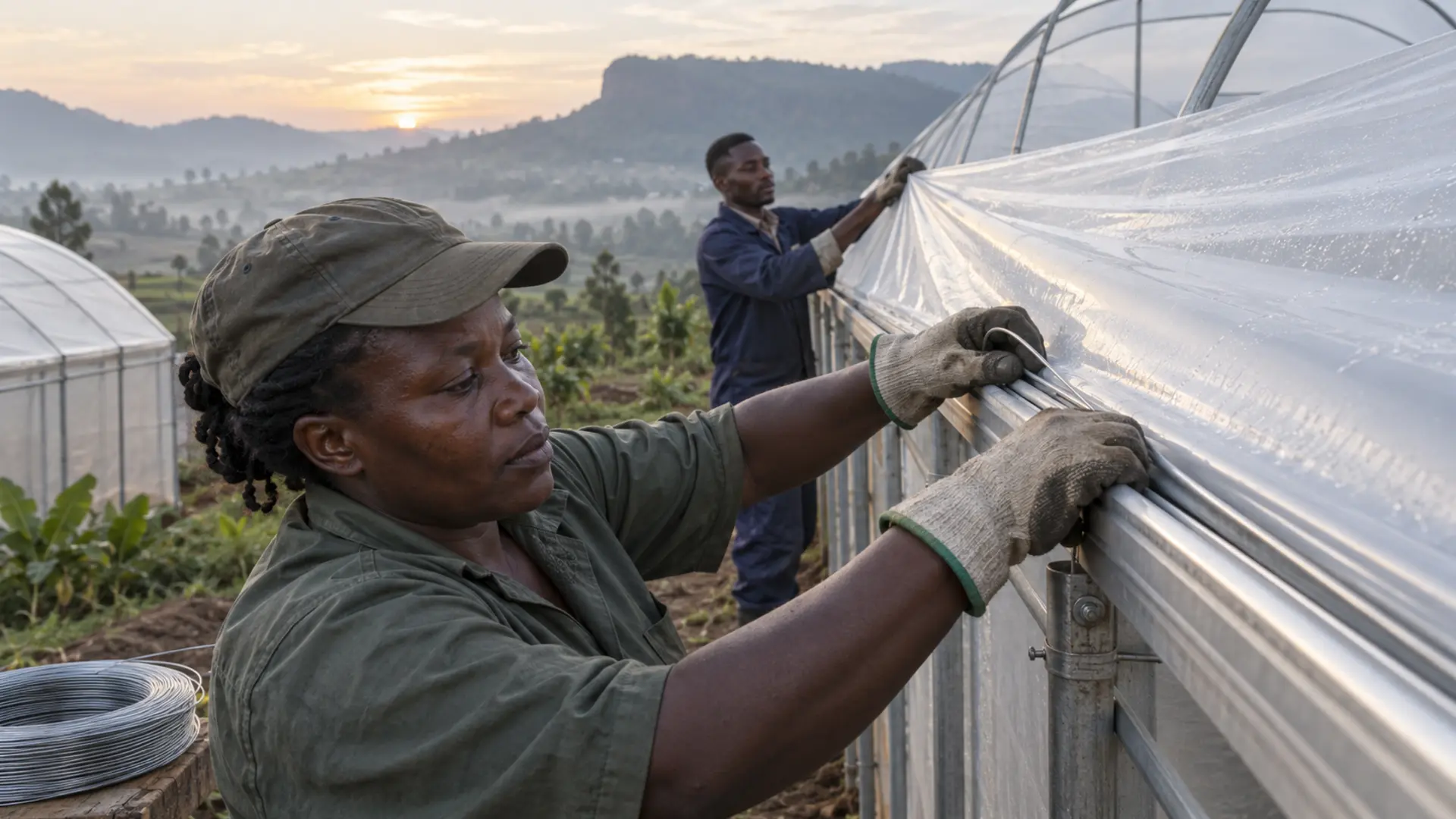
The cheapest quote wins because the film all looks the same on the roll. Clear plastic is clear plastic.
Eighteen months later it has gone yellow, it tears when you touch it, and the crop underneath is getting noticeably less light than it did. Nobody set money aside, because nobody was told this was a consumable.
The film is the part of a greenhouse that wears out on a schedule. Treating it as a one-off purchase is the mistake that turns a working structure into an abandoned frame.
What this guide helps you decide
By the end you should be able to specify a film properly and interrogate a quotation; understand what destroys it besides sunlight, including the things you may be spraying on your own crop; inspect it on a routine and know when repair has stopped being worth it; and build a replacement reserve so the next sheet is already paid for.
It does not cover the frame, which has its own guide, or insect netting, and it quotes no prices.
The short answer
Ask for the specification in writing before you ask for a price: thickness in microns, ultraviolet stabilisation, light transmission, diffusion, any anti-drip treatment, roll width, and the manufacturer’s stated life together with the basis it is stated on.
Then protect it. Keep sulphur and agrochemical residues off it, keep it from touching hot metal, tension it properly and inspect it four times a year.
And budget for the next one from the day you fit this one, because it is going to need replacing.
What a specification actually contains
FAO’s greenhouse guidance gives the basic parameters. Greenhouse cladding films range in thickness from 80 to 200 microns, and film width runs up to 20 metres.
United States extension guidance gives the light transmission bands you should expect to see quoted: ultraviolet stabilised film at 88 to 91 per cent, infrared and anti-condensate film at 82 to 87 per cent, and infrared and anti-condensate with diffusion at 77 to 88 per cent. Notice that every added property costs you some transmission. There is no free feature.
Diffusion. FAO defines diffuse radiation technically as radiation deviating more than 2.5 degrees from the direct incident radiation. Research from Wageningen on diffuse covering materials reports improved production under diffuse light conditions, expressed in growth rate or yield of up to 10 per cent in the Netherlands. That is a Dutch figure in Dutch light conditions and we do not carry it over to Uganda, but the principle, that scattered light penetrates a canopy more evenly than direct light, is not climate-specific.
Anti-drip treatment. Worth having, and worth knowing its limit: FAO notes that anti-drip additives modify surface tension and are eventually lost over time. It is a treatment with a life of its own, shorter than the film’s.
Why condensation matters beyond dripping. FAO reports that condensation can cause PAR transmission losses close to 20 per cent for incident radiation angles greater than 15 per cent. A film running with condensation is not only dripping on your crop, it is shading it.
Double layer. Extension guidance from Florida reports that a double poly layer reduces heat loss or gain by 35 to 40 per cent with a 10 per cent reduction in light transmission. In Uganda, where the problem is heat gain rather than heat loss, that trade needs thinking about rather than assuming.
Greenhouse Film: Choosing the Cover, Knowing When to Replace It, and Keeping the Structure Alive
Film specification checklist listing the eight things a quotation must state, with the published ranges beside each
Service life, and why nobody can give you a figure in years
This is the question everyone asks and the one where honest sourcing gets difficult.
What we can tell you. FAO reports that the life span of greenhouse films has increased from 9 months during the 1950s to approximately 45 months today. United States extension guidance states that greenhouse grade poly is warranted for 4 years or more. Florida extension guidance is more location-specific: standard polyethylene lasts nine months in Florida, while ultraviolet stabilised versions last from eighteen months to four years.
What we cannot tell you. We found no manufacturer specification or study giving a film service life for Uganda, East Africa or any equatorial country. Every figure above is either generic or attributed to a temperate or subtropical location, and we will not convert one into a Ugandan expectation.
Why manufacturers often do not use years at all. Because film degradation is driven by accumulated solar radiation, not by calendar time. A film that lasts four years in northern Europe and eighteen months in the tropics has not behaved differently. It has received the same total dose faster.
Manufacturers therefore often rate film in kilolangleys, written kLy, a unit of accumulated solar energy. An EU research project on greenhouse film degradation states its own target as three years guaranteed resistance under light radiation of 145 to 150 kilolangleys per year, described as the average radiation in southern Europe.
How Uganda compares. A peer-reviewed study using measured data from 56 Ugandan stations between 2015 and 2022 found the average solar irradiation in Uganda to be 1,680 kilowatt hours per square metre per year, with regional daily averages of 5.16 in the north, 4.94 in the east, 4.30 in the centre and 4.20 in the west, in kilowatt hours per square metre per day.
Converting 1,680 kilowatt hours per square metre per year into kilolangleys gives roughly 144. That conversion is our own arithmetic, not a published finding, and we flag it as such. But it puts Uganda’s annual radiation load in the same range as the southern European figure the EU project used, and clearly above temperate northern Europe.
What that means practically. Uganda’s radiation load is high but not extraordinary by Mediterranean standards. A film rated for southern European conditions is a defensible specification here. A film with no stated rating, or one rated for northern European conditions, is not.
What ageing actually does. A study of plastic film covered greenhouses under arid conditions measured it: one year of exposure drastically reduced the spectral and total transmittance of the cover film to global and photosynthetically active radiation by about 32 per cent, and increased reflectance by about 19 per cent, on a 200 micron low density polyethylene film.
Roughly a third of the light, in one year, in an arid high-radiation climate. Your crop feels that long before the film tears.
What destroys film besides the sun
This is the part most growers do not know, and it is the part they have most control over.
Sulphur. An EU research project dedicated to this problem states that sulphur is especially aggressive and that the current method of application has a great impact on the degradation of films used as cover. A film additive manufacturer explains the mechanism: photo-oxidation of sulphur deposited on the greenhouse film surface can yield acidic species, deactivating the light stabilisers and resulting in early degradation of the film.
Read that carefully. Sulphur does not simply dirty the film. It chemically disables the ultraviolet protection you paid for. A stabilised film with sulphur residue on it is behaving like an unstabilised film.
Agrochemicals generally. Extension guidance states that contact with chemicals from pesticides or pressure treated lumber can also affect the life of the plastic.
That has an operational consequence worth stating plainly: how and when you spray inside a greenhouse affects how long the roof lasts. Spraying with the vents shut, letting residue settle and dry on the film, is a decision about the film as well as about the crop. The published guide to safe pesticide use covers the application side.
Treated timber. Named in the same guidance. Where film contacts a treated timber frame member, the preservative can attack it. That is an argument for a batten, a channel or a barrier strip wherever film meets timber.
Hot metal. Installation guidance requires that all metal parts coming into contact with the film be rust free and smooth, and heat build-up at metal contact points is a documented failure location. Painting frame contact points white to reduce heat absorption is a standard mitigation.
Abrasion and flapping. A film that moves against a fixing rubs through. Tension is not cosmetic.
Installation, which decides a good part of the life
Trade installation guidance gives conditions that are easy to meet and routinely ignored.
Time of day and temperature. Installation should preferably take place early in the morning when wind speed is below about 8 kilometres per hour, at temperatures between roughly 15 and 21 degrees Celsius. Film expands and contracts with temperature. A sheet fitted taut in the heat of the day goes slack when it cools; one fitted taut in the cold tears when it warms.
Tension. Over-stretching risks tearing as the film contracts. Under-stretching leaves it to flap in the wind, which abrades it at every fixing. Neither is recoverable afterwards.
Fixings. Aluminium or polypropylene channel with spring wire, or batten tape. Remove protruding nails and rough edges from timber first.
Storage before fitting. Store the film on a smooth dry surface in a cool protected location. A roll left in the sun on the ground is already ageing before it goes up.
Inspection
Manufacturer guidance recommends inspecting at every change of season and after severe weather. In Uganda’s bimodal pattern that works out at roughly quarterly, plus after any storm.
Walk it and look for:
- Yellowing or loss of clarity, best judged against a strip that has been protected under a fixing channel
- Brittleness, tested by flexing a small area at an edge
- Fine micro-cracking, usually visible first near fixings
- Tears, and their length
- Loose, corroded or sharp fixings
- Abrasion where film meets frame
- Dust and algae film on the outer surface
On dust. FAO reports that dirt accumulation reduced light transmission of a new polyethylene film by approximately 6 per cent after one year of exposure in coastal Spain. Six per cent of your light for the price of washing it down. That is one of the cheapest gains available in a greenhouse.
Repair, and when to stop
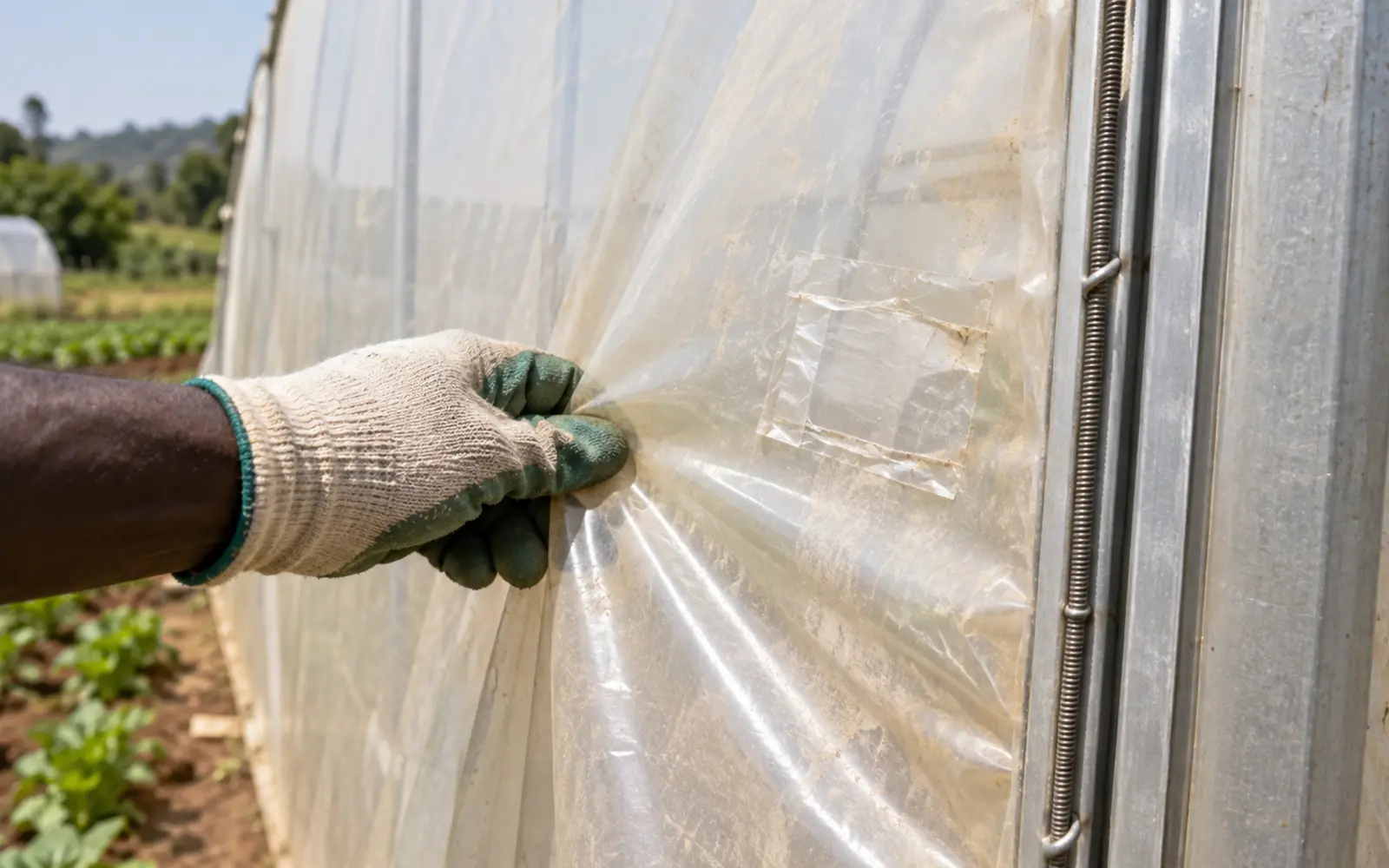
Manufacturer guidance gives usable thresholds. If a tear is longer than about 30 centimetres, or if the polythene is already yellowed and brittle in the affected area, repair adhesive is a temporary fix only. Replacement is indicated once yellowing is visible across more than about 20 per cent of a panel, or once a panel carries multiple repaired zones.
The practical reading. Repair is for a fresh tear in sound film, from a branch or a tool. It is not a treatment for old film. A structure with tape across it in six places is telling you the film is finished, and each new tape is buying weeks.
We could not find any FAO or university extension source specifying repair tape materials or adhesive chemistry, so we name no product. Retail listings exist and we do not treat them as guidance.
The replacement reserve
This is the discipline the article is really asking for, and it is simple.
On the day the film goes up, write down two numbers: what a replacement sheet was quoted at, and the manufacturer’s stated life. Divide the first by the second in months. That is what you set aside every month.
We could not find any authoritative agricultural extension or engineering source addressing a replacement reserve for greenhouse film specifically. What we can do is name the categories that reserve has to cover.
Cost categories
No prices. Fill these in with your own quoted figures:
- The film itself, at the specification you have decided on, in the width and length your structure needs
- Freight and clearing, for imported film
- Fixings and channel, which may need replacing with the sheet
- Labour for stripping and refitting
- Lost production during the changeover, if there is any
- Disposal of the old sheet
- A margin for the price moving between now and then
The point of writing it down on day one is that the reserve is complete before the film fails, rather than the failure arriving as a crisis.
Greenhouse Film: Choosing the Cover, Knowing When to Replace It, and Keeping the Structure Alive
Quarterly inspection routine paired with a blank replacement reserve planning table
Standards and disposal in Uganda, stated honestly
We looked for both and found less than we hoped.
Standards. We searched the Uganda National Bureau of Standards catalogue and found no standard relating to agricultural polythene film, greenhouse film, plastic sheeting for agriculture, mulch film or polyethylene film. The only Ugandan plastics standard we could identify covers plastic carrier bags and flat bags made from thermoplastic materials.
That negative finding rests on the 2015 edition of the catalogue, because a later edition returned an access error on repeated attempts. It is possible something has been added since. What we can say is that as far as we could verify, there is no Ugandan standard you can cite at a supplier, which is exactly why the written specification in this article matters so much.
Disposal. Uganda’s National Environment Act of 2019 prohibits polythene and polypropylene products below 30 microns. Greenhouse film, at 80 to 200 microns, is a different product category and is not covered by that provision. A Ugandan environmental law review found that the instruments reviewed do not address disposal obligations for agricultural plastic waste, and Uganda’s environment regulator describes its plastics focus as carrier bags, straws and packaging.
We could not verify any legal disposal obligation for agricultural film in Uganda, and we could not find any documented recycling route for greenhouse film in East Africa. A study of plastic waste management in East Africa that we opened deals only with urban post-consumer plastics in Kenyan cities and does not address agricultural films at all.
So we will not tell you the law requires something we could not find. What we will say is that a stripped greenhouse sheet is a large volume of durable plastic, and leaving it in a hedge or burning it are both bad answers. Ask your district environment officer what routes exist locally before the sheet comes down, not after.
Common mistakes
Buying on price with no specification. Two films of the same thickness can have entirely different stabilisation packages.
Accepting “UV treated” as a specification. Ask how it is expressed, and for what radiation load.
Fitting film in the middle of the day. Thermal movement is the reason installation guidance names a morning window and a temperature range.
Letting film touch bare hot metal or treated timber. Both are documented degradation routes.
Spraying sulphur with the house shut. Documented to deactivate the film’s ultraviolet stabilisers.
Never washing the outside. Roughly 6 per cent of your light, recoverable with water.
Taping old film. A repair on brittle yellowed film is temporary by definition.
Not budgeting for replacement. The single most common reason a working greenhouse becomes an idle frame.
Assuming a Florida or European life figure applies here. No Ugandan or equatorial figure exists that we could find.
Warning signs and escalation points
- Film that cracks rather than creases when you flex it
- Yellowing across a substantial part of a panel
- A tear that lengthens between one inspection and the next
- Multiple tears originating at fixing points, which indicates tension or fixing failure rather than film failure
- Condensation running consistently down the inside and dripping on the crop
- A visible drop in light that plants respond to, with no other explanation
- Any film that has had sulphur applied under it repeatedly, which should be inspected more often than the routine
If film fails suddenly and completely during a storm, treat the structure as unsafe until it is inspected, because an unclad frame behaves differently in wind from a clad one.
Where this approach works, and where it does not
It works for anyone buying film, or maintaining a structure that still has a serviceable sheet on it.
It works less well in three situations. Where the film is already brittle and yellowed across much of the structure, the inspection routine is documenting a decision that has already been made and the money is better spent on the replacement. Where the frame is failing, recladding a bad frame is a poor investment and the frame guide is the one to read. And where the specification cannot be obtained from any supplier locally, you are choosing between unspecified products, which is a procurement problem this article cannot solve, though asking the questions still sorts suppliers by whether they can answer.
Evidence limits. No Ugandan or equatorial film service life figure exists that we could find. No Ugandan standard for agricultural film could be verified. No legal disposal obligation for agricultural film could be verified. No recycling route in East Africa could be documented. The Uganda solar radiation comparison in this article rests on our own unit conversion, clearly labelled. We have said each of those where it arises rather than filling the gap.
A low-risk first step
Go out to the structure with a soft brush, a bucket of water and half an hour, and wash a single bay of the outside of the film.
Then stand inside and look at the difference between the washed bay and the ones either side.
That tells you two things immediately. It tells you how much light you are currently losing to dirt, which the published figure puts at around 6 per cent after a year but which may be more where dust is heavy. And it tells you whether your film is dirty or actually degraded, because dirt washes off and yellowing does not.
If the washed bay looks new, you have a cleaning schedule to introduce and no urgent spending. If it looks the same as before, your film has aged and the replacement reserve conversation starts today.
What to do next
- Wash one bay and compare, to separate dirt from degradation.
- Write out the eight-item specification and send it to every supplier before asking for a price.
- Ask specifically whether the stated life is in years or in accumulated solar radiation, and for which climate.
- Set up a quarterly inspection walk with a written checklist, plus after every storm.
- Fit barrier strips or battens wherever film meets timber or metal.
- Review how and when spraying happens inside the structure, particularly anything containing sulphur.
- Get a replacement quote now, divide by the stated life, and start setting that amount aside monthly.
- Ask your district environment officer what disposal or recycling routes exist locally, before the old sheet comes down.
Related reading: greenhouse frame design - scheduled in this programme covers the structure the film is fixed to, ventilation sizing - scheduled in this programme covers the openings cut into it, and greenhouse maintenance planning - scheduled in this programme covers the wider upkeep schedule. The published guide to managing heat and humidity covers the condensation problem from the operational side.
About the author
This guide was researched and written by the Falcon Foundation Ltd Editorial Team. Falcon Foundation Ltd is a privately owned Ugandan agricultural company producing greenhouse crops, livestock and honey. Our Knowledge Hub is written for Ugandan farmers making practical decisions with incomplete information. We quote no film lifespan for Uganda because none exists that we could verify, we label our own arithmetic as our own, and we do not assert legal obligations we could not find in the law.