
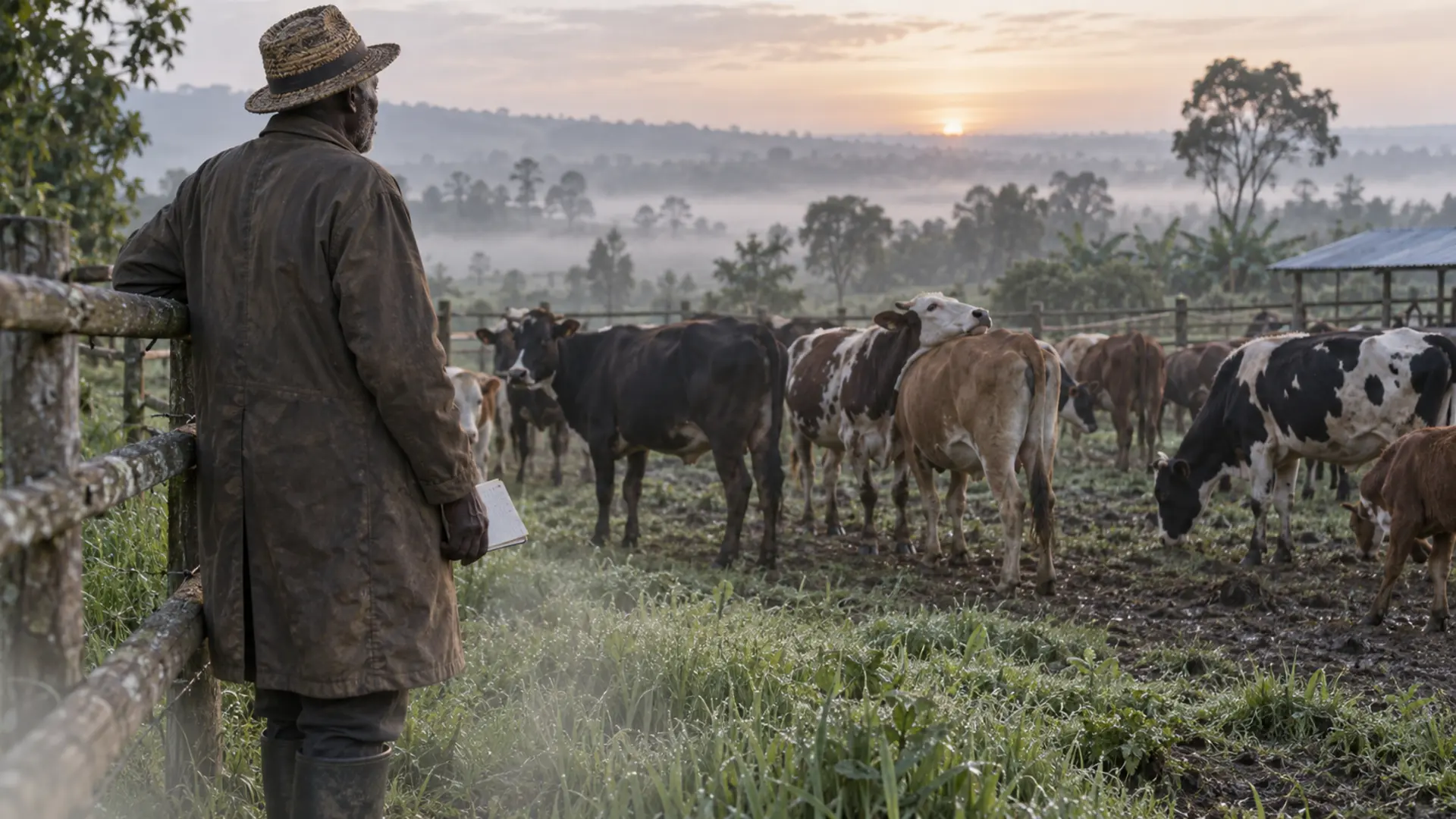
The technician comes, inseminates the cow, and three weeks later she is bulling again. It happens a second time. By the third, the conclusion on the farm is that the semen was poor or the technician is careless.
Occasionally that is true. Far more often the cow was served at the wrong time, because nobody knows when she actually came into heat. She came in at two in the morning, stood for four hours, and by the time anyone looked at her it was over.
This is the most expensive quiet problem in Ugandan cattle keeping, and it is fixed by watching rather than by buying anything.
What this guide helps you decide
By the end you should be able to tell real heat from the signs that only suggest it; know when to watch and for how long; know when to call for service after you have seen it; and decide, for your own herd, whether artificial insemination or a bull is the right system.
It does not teach insemination technique, which is trained technician work. It gives no hormone or synchronisation protocols of any kind. It does not cover breed selection or calf rearing.
The short answer
Watch twice a day, early morning and late evening, for at least thirty minutes each time, standing still and well back where the cattle can move naturally.
You are looking for one thing above all: a cow standing to be mounted. That is the only definitive sign. Everything else tells you to look harder.
Then serve roughly half a day later. Heat seen in the morning means service that evening. Heat seen in the evening means service the next morning.
And know that if your cattle are zebu or zebu crosses, your window is shorter than the guidance written for European dairy breeds assumes.
The one sign that counts, and the ones that do not
Standing heat. A cow that stands still and allows herself to be mounted is in heat. Extension guidance describes this as the most reliable sign, and quantifies why: standing heat identification is incorrect only about 3 per cent of the time, while various other methods are incorrect up to 20 per cent.
Note what standing heat requires. It requires another animal to do the mounting, and it requires somebody to be there when it happens. A single cow alone in a shed cannot show you standing heat at all.
The secondary signs. These are worth knowing and worth acting on, but none of them confirms heat on its own:
- Mounting other cows, which she may do before and after her own standing heat
- Restlessness, walking the fence, bellowing
- Clear stringy mucus hanging from the vulva
- Swollen and reddened vulva
- Chin resting on another cow’s rump, and mutual sniffing
- Reduced feed intake and a drop in milk
- Hair rubbed and roughened on the tailhead, which is evidence that she was mounted while you were not watching
That last one is the most useful of the secondary signs, because it is the only one that records something that happened in your absence.
Why your cattle are harder to read than the textbook assumes
Almost all the heat detection guidance in circulation was written for European dairy breeds. Uganda’s cattle are largely zebu and zebu crosses, and the difference is measurable.
A classic study comparing zebu and grade cattle, analysing 1,130 zebu cycles and 678 grade cycles, found the zebu oestrous cycle slightly longer at 23.03 days against 22.42, but the duration of oestrus markedly shorter: 4.78 hours in zebu against 7.40 hours in grade cattle. Roughly two thirds of the length.
A 2026 review of heat detection adds a second difference. In zebu cattle, mucus discharge, vulval swelling and reddening of the vulval mucous membrane were found to be strong indicators of oestrus, lasting for a longer duration than mounting behaviours.
Put those together. In a zebu-cross herd the definitive sign, standing to be mounted, is available for a shorter time, while the physical signs persist longer. That is exactly the wrong way round for a farm where somebody glances at the cattle once a day. It means you must watch more deliberately, and it means the physical signs deserve more weight than temperate guidance gives them.
When heat actually happens
Cattle come into heat mostly when nobody is watching, and the data on this is consistent.
Extension sources report that 43 per cent of cows display heat signs between midnight and six in the morning, while only 10 per cent show signs from noon to six in the evening. A separate university source reports that cattle show 70 per cent of their standing events during the cooler hours of the day, six in the evening to six in the morning, 22 per cent from six to noon, and only 8 per cent from noon to six.
Both point the same way. The middle of the day, which is when most people are around the cattle, is when the least is happening.
The observation rule. Extension guidance across several institutions converges on observing at least twice a day, in the morning and the evening, for at least thirty minutes each time, with more frequent observation improving detection where labour allows. One source states that a heat detection rate of 80 to 85 per cent should be attainable with good visual observation. That figure was established on European dairy cattle and we would not assume it transfers unchanged to a zebu-cross herd watched under Ugandan smallholder conditions.
How to watch. Stand still and stay back. Cattle that are being walked, fed, milked or handled do not show heat behaviour. Thirty minutes of standing quietly at the fence at first light is worth more than three hours of moving among them during the day.
Heat Detection and the Bull or Insemination Decision
Heat sign identification card separating the one definitive standing sign from the secondary signs, beside a daily observation timetable showing when heat activity occurs
When to serve
The rule most widely taught is the morning-evening rule: a cow seen in standing heat in the morning is served that evening, and one seen in the evening is served the next morning. That works out at roughly twelve hours after you first saw her standing.
Sources agree on the principle and differ slightly on the number. One extension source gives 12 to 18 hours after the start of standing oestrus. A veterinary information service gives insemination twelve hours after the start of oestrus activity as producing the best conception rates. The 2026 review gives an optimal insemination window of 11 to 15 hours after oestrus onset. That same veterinary source notes that some practitioners now favour a variant timing for modern high-yielding dairy cows with weaker heat signs, so the fine detail is not settled even in its home literature.
We found no zebu-specific service timing study. Given the shorter oestrus documented in zebu cattle, that is a real gap, and it argues for calling for service promptly rather than waiting to the far end of any window.
The practical instruction: write down the time you saw her standing, not the date. Then call.
Aids you can actually afford
Tail chalk or tail paint. A broad stripe of chalk or paint along the tailhead. When she is mounted, it rubs off. A published study reports estrus detection efficiencies using a tail paint method of over 94 per cent in heifers, and states that tail paint has been reported to have a higher sensitivity than heat mount detectors and activity monitors, with no differences in efficiency or accuracy against direct visual observation in the comparisons made.
That is a striking result for the cheapest tool available. It works while you sleep, which is when most of the activity happens. Extension guidance advises treating a cow as being in standing heat when more than half of the top coating has been rubbed off.
Records. If you know when she last came in, you know roughly when to expect her next, because the cycle runs around 18 to 24 days. A cow watched on the days she is due is a cow whose heat you catch.
What we could not verify. We found no study giving a standalone accuracy figure for heat mount detectors, and none on teaser animals or on record-based prediction accuracy. We are not going to rate tools we could not find evidence for.
Insemination or a bull
This is a genuinely open decision in Uganda, and the Ugandan evidence is worth having before you make it.
What Ugandan farms actually do. A study of smallholder dairy farms in central Uganda found over 90 per cent of respondents reporting natural service as the service used in the previous five years. It also found something more interesting: although 56 per cent of farmers indicated a preference for artificial insemination, only 7.2 per cent actually used it. Cost was part of the gap, with that study recording insemination at roughly five times the cost of natural service. The average number of services or inseminations required per conception was 1.4 overall, at 1.7 for dairy breeds and 1.3 for non-dairy.
A pan-African review published in 2025 records Ugandan artificial insemination uptake rising from 5 per cent in 2004 to 7 per cent in 2008 and remaining low, attributing part of the stagnation to reliance on a single national semen production centre at Entebbe. It also records Ugandan farmers’ concern that insemination-sired calves are too fragile and too large for their dams to deliver without complications, a dystocia worry echoed in the central Uganda study.
The case for insemination. Genetic gain, without keeping and feeding a bull. A specific and real disease advantage: bulls used in natural service are lifelong potential carriers of venereally transmitted organisms, transmitting them from female to female during service, and most infected bulls remain carriers for life, while semen from recognised centres is processed before freezing to eliminate the organism concerned. No inbreeding risk in a small closed herd. And insemination is trained technician work, which means somebody qualified is looking at your cow.
The case for a bull. Cheaper per service. Available at the moment the cow is ready, which given the short zebu oestrus is not a small thing. No dependence on somebody else arriving on time. The Ugandan and regional evidence names late arrival of inseminators and the absence of farmers in cow sheds among the things that impede insemination success.
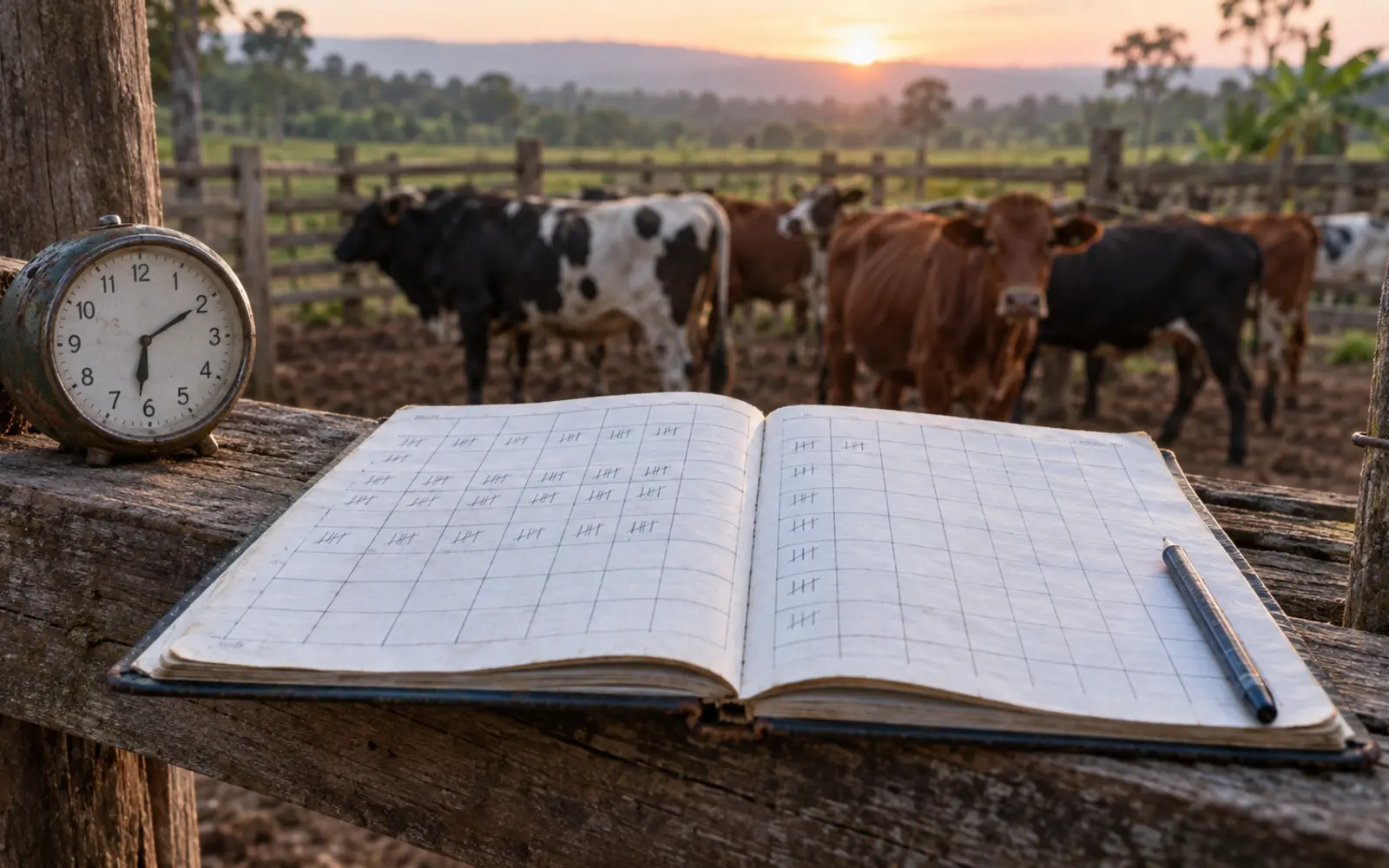
The thing that decides it. Records. The central Uganda study found record keeping was highly related to insemination use. That is not a coincidence. Insemination requires you to know when she was in heat, when she was served, and when to check her. Without records, insemination fails and the technician gets blamed. With records, it works. If you will not keep a book, keep a bull.
One warning that belongs here. A bull is the most dangerous animal on a Ugandan farm and the risk is routinely underestimated. A recognised authority on livestock handling states that attacks by bulls are the number one cause of fatalities which occur while handling livestock. United States Department of Labor data, cited by a university extension service, records that bulls caused 48 per cent of cattle-related fatalities while accounting for only 2 per cent of cattle. A national safety regulator puts it plainly: a playful bull can kill you just as easily as an angry one, and advises that a dairy-breed stock bull be kept in a purpose-made pen and never handled by a lone person.
If children are around the cattle, and on most Ugandan farms they are, that has to weigh in the decision.
Heat Detection and the Bull or Insemination Decision
Decision table comparing artificial insemination and keeping a bull across herd size, technician access, disease risk, genetic gain, records needed, safety and cost of keeping
The institutional position, verified
Uganda’s national animal genetics body is the National Animal Genetic Resources Centre and Data Bank, established by the Animal Breeding Act, 2001, and described on its own site as one of the statutory semi-autonomous bodies of the Ministry of Agriculture, Animal Industry and Fisheries. Its mandate covers both commercial supply of semen, embryos and bred stock and the developmental work of running the national genetic data bank, registry, gene bank and quarantine, and training technicians and farmers. It operates twelve government animal genetic resource centres.
We checked this carefully, because Uganda has been merging agencies into ministries. The rationalisation legislation passed by Parliament on 22 October 2024 and assented to on 18 December 2024 merged the Dairy Development Authority, the Cotton Development Organisation and the National Agricultural Advisory Services into the ministry. The national animal genetics body is not named in any of the parliamentary rationalisation records we could open, and both its own site and a national newspaper feature dated August 2026 describe it as continuing to operate as a semi-autonomous body under the Animal Breeding Act with a strategic plan running to 2030 and 2031.
Our position, stated honestly. As of September 2026, the national genetics body appears to be outside the merged group and operating as before. Uganda’s rationalisation programme is described in the government’s own reporting as covering forty agencies and still ongoing, and we could not obtain a complete current list. Treat this as verified for now rather than settled permanently, and check before relying on it.
Records: the minimum
Three independent sources converge on a short list. One veterinary information service states the minimum as calving, service or insemination and culling dates alongside pregnancy testing results. A university extension service lists freshening dates, breeding dates, pregnancy check dates, due dates and dry dates.
For a Ugandan smallholder that reduces to five columns in an exercise book:
- Cow name or number
- Date she last calved
- Date and time you saw her standing
- Date served, and by which bull or which technician
- Pregnancy check result and date
That is it. It fits on one page and it is the difference between a herd you are managing and a herd that is happening to you.
Cost categories
No prices and no fees. The central Uganda study’s cost figures date from 2014 and are specific to that study population, so we are not carrying them forward as current pricing.
- Per service, whichever system you choose
- Technician call-out and travel, for insemination
- Purchase, feed, housing and handling facilities for a bull, if you keep one
- A purpose-built bull pen and crush, which is a safety requirement rather than an optional extra
- Replacement of a bull before he can serve his own daughters
- Labour for observation, twice a day, every day
- Tail chalk or paint, recurring and very cheap
- A record book and a pen
- Pregnancy diagnosis
- The cost of every cycle missed, which is the largest number on this list and the one nobody writes down
Common mistakes
Watching in the middle of the day. The time when the least heat activity occurs.
Watching while working. Cattle being handled do not show heat behaviour.
Serving on secondary signs alone. Mucus and a swollen vulva mean look harder, not serve now.
Recording the date but not the time. The service window is measured in hours.
Assuming European timing applies unchanged. Documented zebu oestrus duration is roughly two thirds that of grade cattle.
Blaming the semen. Repeat services usually mean mistimed service, which usually means missed heat.
Choosing insemination without keeping records. Documented in Ugandan research as closely linked, and it is the practical reason insemination fails on farms that want it.
Underestimating the bull. Forty-eight per cent of cattle-related fatalities from 2 per cent of the cattle.
Warning signs and escalation points
Talk to a veterinarian or an experienced breeding technician if:
- A cow has been served three times and is not holding
- Cows are cycling at intervals much shorter or much longer than about three weeks
- A cow has not shown heat at all by a couple of months after calving
- Several cows in the herd are failing to conceive in the same period, which points to nutrition, disease or management rather than individual animals
- There is any discharge that is not the clear stringy mucus of heat
- A cow had a difficult calving and has not cycled since
And on safety: if a bull has ever charged a person on your farm, that is not a temperament to manage. Guidance from a recognised authority is that any mature bull which charges a person should be removed because he is too great a safety risk.
Where this approach works, and where it does not
It works on any farm where somebody can be present at first light and last light, and where a book will be kept. Neither requires money.
It works less well in three situations. On a farm with one or two cows and no other cattle to do the mounting, standing heat may simply never be observable, and you are left relying on secondary signs and tail chalk, with prompt service when in doubt. Where cattle are grazed far from the homestead and seen only when watered, the observation regime described here is not available and a bull running with the herd may be the honest answer. And where technician access is unreliable, insemination fails on timing however well you detect heat, which is a question to settle with your district production office before you commit.
An evidence note. Almost all the observation schedule, detection rate and service timing figures here come from United States dairy extension literature developed on European breeds, and they are labelled as such in the sources. The zebu-specific evidence is real but thin: one classic study on oestrus duration and one recent review noting the persistence of physical signs. We found no Ugandan study quantifying heat detection failure as a distinct cause of poor reproductive performance, and no zebu-specific service timing research. Where the guidance transfers, we have said so. Where it may not, we have said that too.
A low-risk first step
Buy tail chalk, or a tin of any coloured marker that will rub off, and stripe the tailhead of every breeding female in the herd. Then look at the stripes every morning.
That is the whole exercise. It costs almost nothing, it works overnight when most of the activity happens, and within three weeks you will know which of your cows are cycling and roughly when.
Write each rubbed stripe in a book with the date. At the end of a month you will have something you almost certainly do not have now: a picture of what your herd is actually doing reproductively, which is the information every other decision in this article depends on.
What to do next
- Start tail chalking every breeding female this week, and re-apply after each rub.
- Rule up a five-column record book and start filling it in from today.
- Fix two observation windows, first light and last light, thirty minutes each, and decide who does them.
- When you see standing heat, write the time, not just the date.
- Serve about half a day later, and lean towards the earlier end of the window with zebu crosses.
- Decide the system question honestly: if the book will not be kept, a bull is the more workable choice.
- If you keep a bull, build a proper pen and crush, and keep children away from him without exception.
- Talk to your district production office about technician availability before committing to insemination.
Related reading: choosing a dairy cow - scheduled in this programme covers the animals you are breeding from, rearing the replacement heifer - scheduled in this programme covers getting a heifer to the point of first service, and milking hygiene and mastitis prevention - scheduled in this programme covers the parlour. The published guides to whole-farm biosecurity and farm record keeping and gross margin analysis cover the disease and record disciplines this decision rests on.
About the author
This guide was researched and written by the Falcon Foundation Ltd Editorial Team. Falcon Foundation Ltd is a privately owned Ugandan agricultural company producing greenhouse crops, livestock and honey. Our Knowledge Hub is written for Ugandan farmers making practical decisions with incomplete information. We give no hormone protocols and no insemination technique, we label evidence developed on European dairy breeds as such, and we verified the current status of the institutions we name rather than assuming it.
