The direct answer
The price you are offered at the farm gate is not one number. It is a market price somewhere else, minus everything that stands between your maize heap and that other place.
Four things do almost all of the work.
Season. Prices in African staple markets are strongly seasonal, and Ugandan maize is among the most seasonal. Research measuring seasonal price gaps at 193 markets across seven African countries found an average seasonal gap of 33.1 percent for maize, the highest among cereals measured, and two and a half to three times larger than in international reference markets. For Kampala wholesale maize the same work found a double harvest pattern with peaks in January and July, of the order of 17 percent and 25 percent respectively.
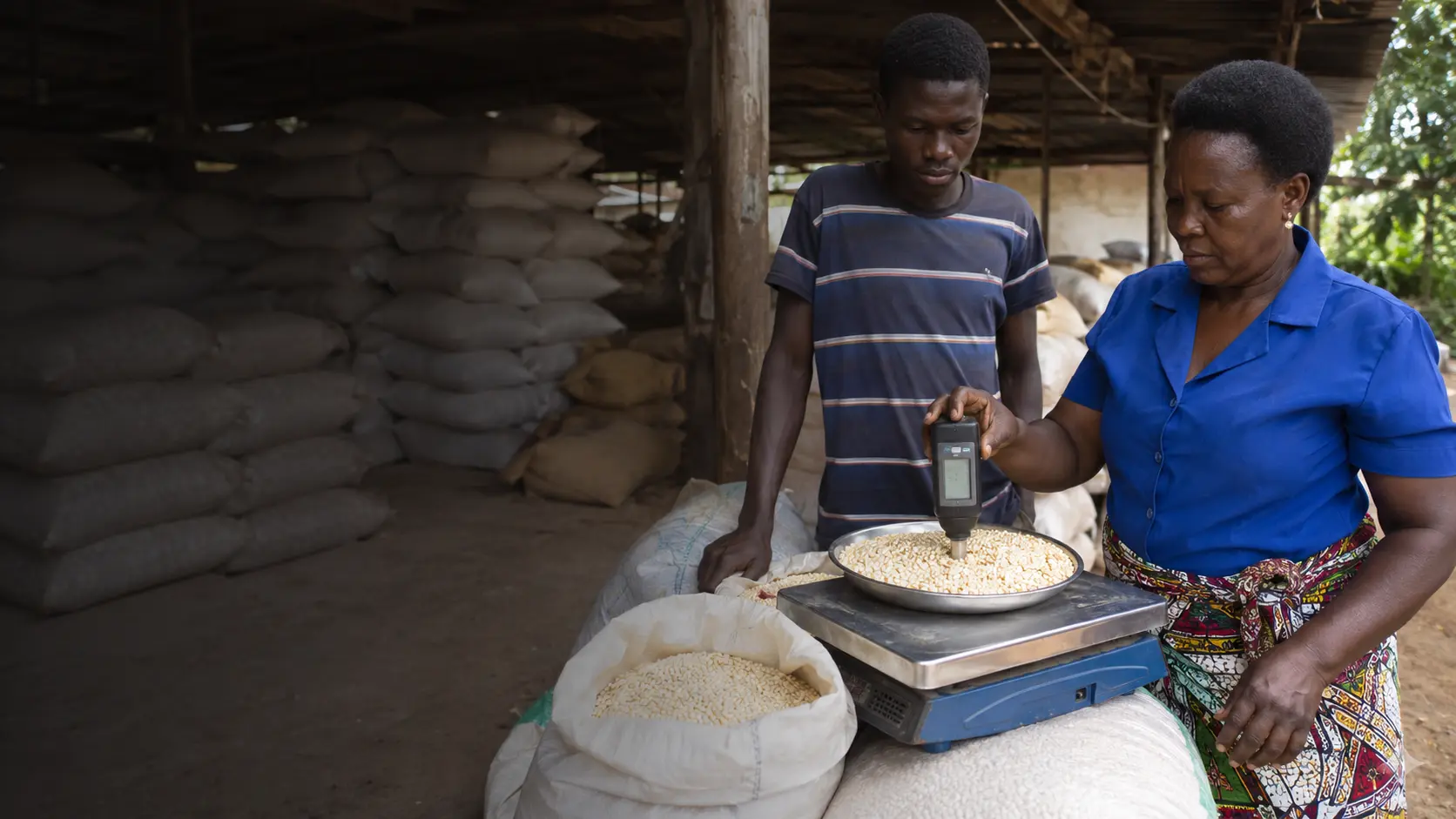
Condition. Moisture, foreign matter, broken grain and discolouration are the language in which quality is priced. The East African standard for maize grains sets graded limits for these, and a buyer who says your maize is "wet" is applying a version of that test, well or badly.
Distance and cost to move. Every kilometre, every handling, every reloading between your farm and the next buyer comes out of your price, not theirs.
Information. The trader knows the price in the next town. Usually you do not. That gap is worth money and it accrues to whoever holds it.
What you can change: when you sell, the condition you sell in, who you sell to, and how much you know before the conversation starts.
What you cannot change: the world price, the exchange rate, the road, the weather and the fact that everyone in your area harvests at the same time.
This article explains the mechanism. It publishes no prices and it forecasts nothing. Any figure quoted from research below is attributed, dated and reported as that research measured it.
Practical summary
- Understand that your harvest coincides with everyone else's, and that this is why the price is low when you have most to sell.
- Dry and clean the crop to the standard the buyer is actually applying, before the price conversation.
- Know what the standard says, so a moisture deduction can be discussed rather than accepted.
- Find out the price at the next level up before you negotiate.
- Cost your own transport honestly before you assume selling further away is better.
- Sell in more than one lot, at more than one time, where storage allows it.
- Record every sale with the price, the date, the buyer, the condition and the deductions.
Mechanism one: seasonality
What happens. Uganda's bimodal rainfall in much of the country produces two harvests. In the weeks after each harvest, a large volume reaches the market at once from farmers who need cash, lack storage or cannot hold. Supply spikes, demand does not, and price falls. Months later, as stocks deplete before the next harvest, price rises.
How large. The peer-reviewed measurement above found maize the most seasonal of the cereals studied, at an average seasonal gap of 33.1 percent across the markets in the study, against 12.2 percent for South African white maize futures and 5.1 percent for Bangkok rice. For Kampala wholesale maize the study identified a double harvest pattern with peaks in January of about 17 percent and July of about 25 percent, which the authors noted their standard models could not capture, precisely because Uganda has two seasons rather than one.
Read that carefully. These are measurements from a specific study, over the period it covered, in the markets it covered. They are evidence that Ugandan staple price seasonality is large and structured. They are not a prediction of what any price will do this year, and they should not be used as one.
What it means for you. The gap between the post-harvest price and the pre-harvest price is the return available to whoever can store. On most Ugandan farms, the person who captures that return is not the farmer, because the farmer sells at harvest to pay for school, inputs and debt. That is a cash flow problem, not a marketing problem, and it is solved with cash flow tools: staggered selling, a small working capital reserve, storage that actually holds quality, or a group arrangement that bulks and holds.
The honest caution. Storing to sell later is not free money. It carries storage loss, quality loss, aflatoxin risk in poorly dried grain, the cost of the store, and the risk that the price does not rise as it did last year. Falcon publishes no expectation of gain from storage and makes no claim that holding produce will return more than selling. It is a decision with real risk on both sides.
Mechanism two: condition, and what "quality" actually means
Buyers price condition, and they do it whether or not a formal standard is invoked.
The East African standard for maize grains, EAS 2:2011, defines Grade 1, Grade 2 and Grade 3 alongside ungraded and reject categories, with specific requirements per grade:
| Characteristic | Grade 1 | Grade 2 | Grade 3 |
|---|---|---|---|
| Foreign matter, percent by mass | 0.5 | 1.0 | 1.5 |
| Broken kernels, percent by mass | 2.0 | 4.0 | 6.0 |
| Discoloured grains, percent by mass | 0.5 | 1.0 | 1.5 |
The accessible text of that 2011 edition specifies a maximum moisture content of 13.0 percent by mass for all three grades. UNBS, writing about maize grain quality standards in Uganda, refers to US EAS 2:2017, Maize grains - Specification, second edition, and states that dried maize grains should have a moisture content of no more than 13.5 percent. The two figures come from different editions of the same standard, and this article reports both rather than choosing one. Confirm the figure in the current edition with UNBS before relying on it in a contract.
Why this matters at the farm gate. Moisture is the deduction that most often surprises farmers, for three reasons.
- It is measurable and you usually cannot measure it. The buyer has the meter. You have an opinion.
- It compounds. Wet grain weighs more, so the buyer is paying for water, and it stores badly, so the buyer carries a loss risk. Both are priced into the deduction.
- It is where aflatoxin risk sits. Grain that goes into storage above the moisture limit is grain at risk, and buyers who sell into formal chains know it. UNBS notes that aflatoxins cannot be detected visually.
What you can actually do. Dry properly and on a surface, not on bare soil. Clean out stones, soil, cob fragments and other foreign matter, because the standard prices foreign matter directly and it is the cheapest deduction to remove. Handle to reduce breakage. Sort out discoloured and damaged grain. Then, and only then, have the price conversation.
Ask for the reading. If a deduction is applied for moisture, ask what reading was taken and with what instrument. A buyer applying the standard honestly will tell you. A buyer who will not tell you has told you something else.
Mechanism three: distance, handling and who bears the cost
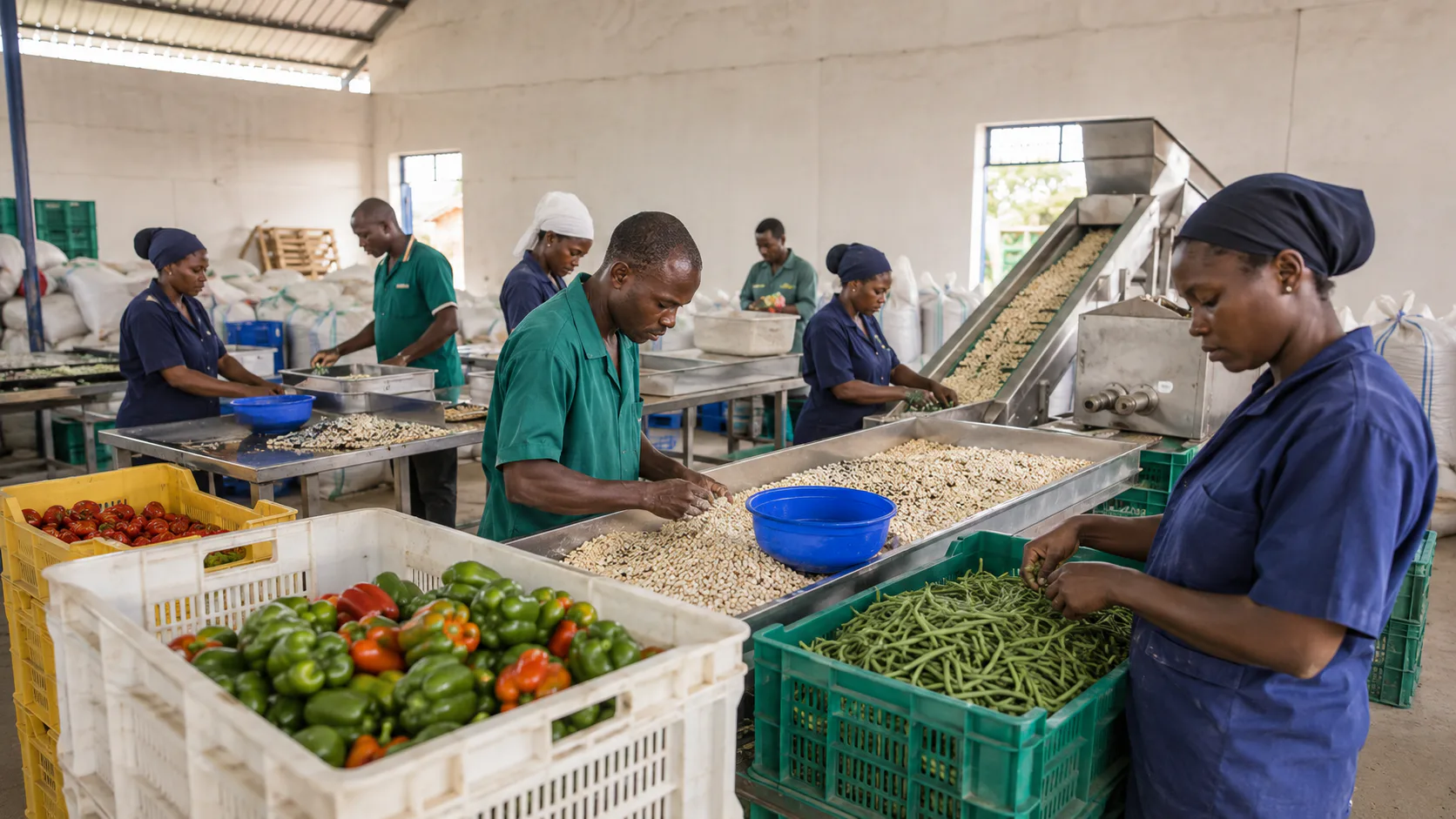
FEWS NET describes Ugandan staple markets as generally competitive, "with a large number of buyers and sellers", with "many actors" participating along the marketing system from farmers and traders to governments, retailers and consumers, and notes that traders "rarely specialize in individual goods (food and nonfood) and rather switch across commodities depending on availability and profitability". It also notes that most agricultural produce is sold by farmers at the farm gate or in local informal markets.
Two consequences follow.
The farm gate is the cheapest place for you and the most expensive place for the buyer. A trader collecting at your farm carries the cost and the risk of getting the crop to the next point. That cost is real and it is deducted from what they can offer. A farm-gate price that is lower than the market price in town is not automatically exploitation; part of the difference is transport, loading, loss and the trader's own risk.
Part of it, however, is information and timing. FEWS NET notes that thin markets, poor storage and processing facilities and other infrastructure constraints, together with multiple growing seasons in high-potential areas, produce high intra-annual staple food price variation. In a market moving that much, the party who knows this week's price at the next level has an advantage that has nothing to do with transport.
The test to apply. Before you accept or reject a farm-gate offer, work out what it would actually cost you to deliver the same lot to the next buyer: transport, loading and offloading, your own time, any market fee, losses in transit, and the risk that the price there has moved by the time you arrive. If the difference between the two prices is smaller than that total, the farm-gate offer is the better deal. If it is much larger, you have found either a transport opportunity or an information gap, and both are worth investigating.
Mechanism four: information
This is the mechanism farmers most often ignore and the cheapest one to fix.
The Uganda Bureau of Statistics publishes price statistics including the Consumer Price Index, and publishes major surveys including the Uganda National Household Survey and the national population and housing census. These describe the economy, not your farm-gate price, and they are the correct source for understanding the direction of prices generally rather than what a trader should pay you on Tuesday.
For the price at the next level, the useful sources are closer: other farmers who sold this week, your cooperative or producer group if you have one, the nearest market, and buyers other than the one standing in front of you. A price aggregator website is a starting point and not an authority, because most publish numbers without a stated methodology, collection date or location precision, which is exactly why Falcon does not publish prices either.
The single highest-value habit. Before a buyer arrives, make two calls. One to a farmer who sold in the last week, one to a second buyer. You are not obliged to sell to the second buyer. You are obliged to know what you are turning down.
Decision framework: when and how to sell
| Your situation | What is driving your price | The lever that actually helps |
|---|---|---|
| Need cash immediately at harvest | Peak supply, your weakest bargaining position of the year | Sell in lots rather than all at once if any part can wait. Fix condition first, because it is the only thing you control today |
| Can hold some of the crop | Seasonal spread, and your storage quality | Dry to standard, store properly, monitor. Accept that holding carries loss and price risk, and that neither is guaranteed to be repaid |
| Being offered a moisture deduction | The buyer's measurement and your inability to check it | Ask for the reading and the instrument. Dry properly before the next sale. Consider sharing a meter through a group |
| Offered less than the market in town | Transport, handling, loss, trader risk, and possibly an information gap | Cost your own delivery honestly. If the gap is much larger than that cost, seek a second buyer |
| Selling a small volume | Buyers pay less per unit for small, scattered lots | Aggregate with neighbours if you can do it without disputes. Bulk changes which buyers will come |
| Selling into a formal chain or a contract | The written specification, not the conversation | Get the specification in writing before harvest and grow and handle to it |
| Do not know this week's price anywhere | Information asymmetry, entirely | Two phone calls before the buyer arrives |
Field record: sales log
One line per sale, every sale, no exceptions. This is the only record that lets you see next year what actually happened this year.
| Date | Crop and variety | Quantity and unit | Buyer name and type | Where sold, farm gate or elsewhere | Gross price per unit offered | Deductions applied, and stated reason | Moisture reading if given | Net received | Transport and other costs I paid | Net to me per unit | Notes |
|---|
The three columns everyone skips are the deductions column, the moisture reading and the transport cost. Without them you cannot tell whether last season's "good price" was actually better than this season's lower headline price with no deductions.
At the end of the season, put the log next to a calendar and look at when you sold. Most farms discover they sold almost everything in the four weeks when everyone else did.
Search evidence for this article
In Google Keyword Planner with the location set to Uganda, the exact term maize prices in uganda returned an average monthly search band of 100 to 1K. The related term coffee prices in uganda returned 1K to 10K, the second highest band measured anywhere in Falcon's Uganda keyword research for this portfolio. market prices in uganda and milk prices in uganda each returned 10 to 100. Bands are reproduced exactly as returned, and none has been converted into a single number.
A Uganda-geolocated Google search for maize prices in uganda returned a classified advertising site in first position, a market listing page in second, a commodity price aggregator in third, a regional miller price page in fourth and a Ugandan market price aggregator in fifth. The result set carried videos, short videos, people also ask, images and people also search for.
Every one of the leading results publishes a number. None of them explains the number. That is the gap this article fills, and it is also the reason Falcon does not compete on price data: maintaining an accurate, dated, location-specific price feed is a data service, and publishing one badly is worse than not publishing one at all.
Uganda-specific importance
Two recurring losses at the point of sale are larger than almost anything happening in the field.
Harvest-period selling. The seasonal gap measured in Ugandan and comparable African markets is large. A farmer who sells the entire crop in the four weeks of peak supply is selling at the bottom of that range by definition. The constraint is usually cash, not knowledge, which is why the answer is a cash flow answer.
Moisture and condition deductions. These are applied on almost every formal grain transaction and they are the most avoidable cost in the chain, because drying and cleaning are labour rather than purchase.
Neither loss is caused by the buyer being unusually harsh. Both are caused by the farmer arriving at the transaction with less information and less preparation than the person on the other side of it. That asymmetry is fixable, and fixing it does not require a better price to exist anywhere.
Limitations and common mistakes
Limitations. This article publishes no current or historical price for any commodity, in any currency, and makes no forecast of any price. It is not a market information service. The seasonal figures quoted are from a named peer-reviewed study, over the period and markets that study covered, and are reported as measurements of past seasonality, not as a prediction. It does not cover choosing a sales channel, contract terms, export, storage technology or gross-margin calculation, each of which is covered elsewhere by Falcon. It does not advise anyone to store, to hold, or to sell at a particular time.
Common mistakes.
- Selling everything at harvest without asking whether any part can wait. Even a partial hold changes the average.
- Treating a price aggregator figure as the price. Most publish without a stated methodology, collection date or precise location.
- Accepting a moisture deduction without asking for the reading. The reading is the basis of the deduction and you are entitled to ask.
- Drying on bare soil. It adds foreign matter, which is priced separately, and it adds risk.
- Ignoring foreign matter. It is the cheapest deduction to remove and it is priced by the standard.
- Assuming the town price is available to you. It is available minus transport, loading, loss, time and risk.
- Negotiating without a second price. Two calls change the conversation entirely.
- Comparing headline prices instead of net received. The sales log exists for exactly this reason.
- Assuming storage pays. It carries loss, quality risk and price risk, and it sometimes does not.
When to bring in a professional
- A qualified grain handler or your district production office, for advice on drying, moisture measurement and safe storage before you commit a crop to a store.
- UNBS, for the current edition and exact requirements of any standard your buyer applies.
- An advocate registered in Uganda, before signing any contract that fixes price, grade or delivery obligations.
- Your cooperative or producer group, before agreeing to a group sale, so that the split, the deductions and the payment terms are written down in advance.