
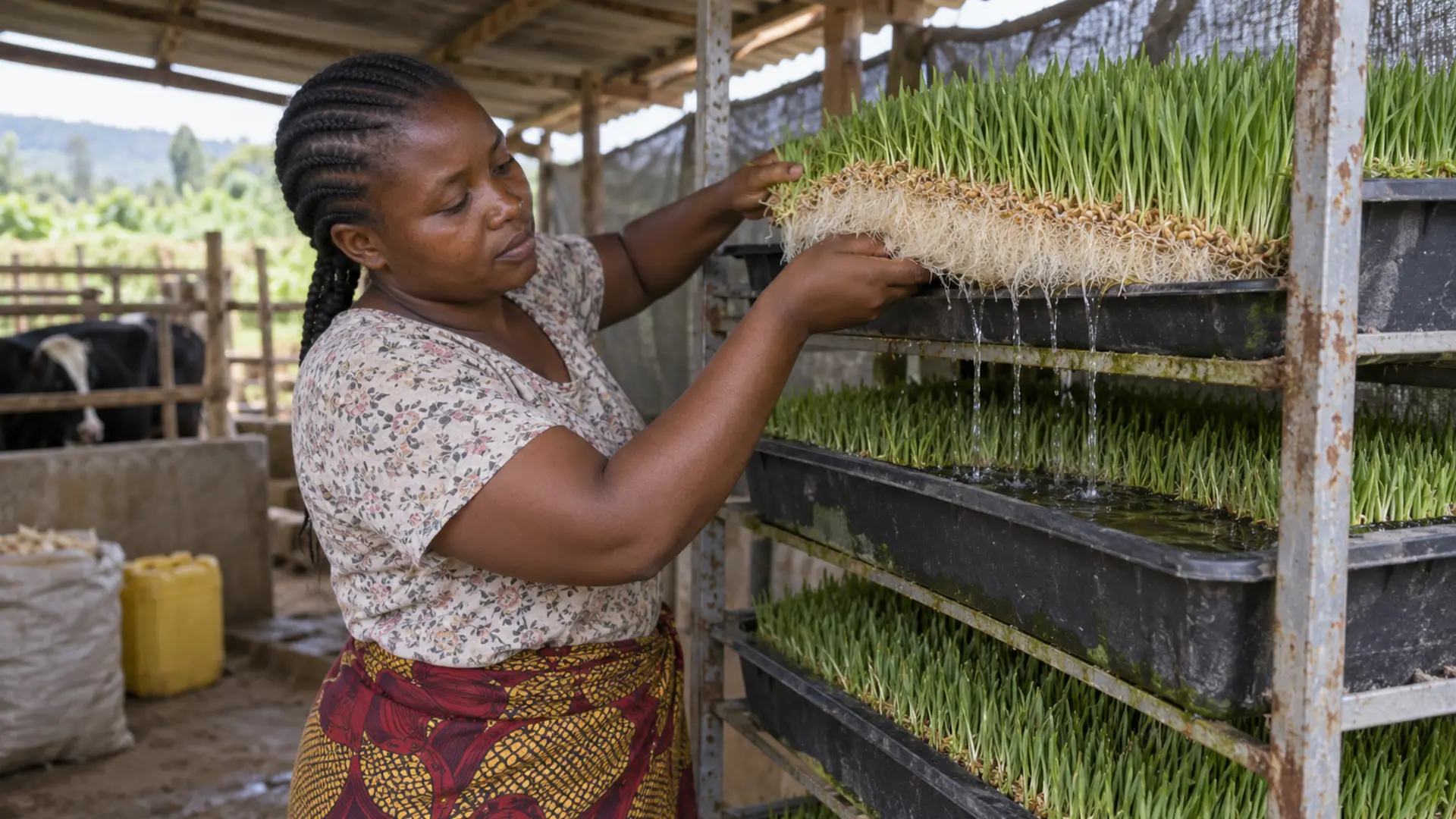
The pitch is good, and the arithmetic in it is real. One kilogramme of grain goes into the tray. Eight kilogrammes of green fodder come out seven days later. No land, little water, feed in the dry season.
Every part of that is true. It is also the wrong measurement, and everything turns on that.
An animal does not eat kilogrammes. It eats dry matter, the actual feed once the water is taken out. And when researchers weigh the dry matter going in against the dry matter coming out, it does not go up. It goes down.
What this guide helps you decide
By the end you should be able to convert a fresh weight claim into dry matter yourself; understand what the feeding trials actually found, including the ones that found nothing; and work out the cost per kilogramme of dry matter for sprouted fodder against the alternatives on your own farm using your own prices.
This is a verdict article, not a how-to. It does not teach you to build or run a sprouting unit. It does not cover silage, hay or planted fodder, which have their own guides, and it names no machine brands and quotes no machine prices.
The short answer
Sprouting loses dry matter. It does not create feed. It converts stored grain into a wet, palatable, vitamin-rich mat weighing several times more, while destroying roughly a quarter to nearly half of the dry matter that was in the seed.
That does not make it useless. It makes it expensive. Published cost work from four countries puts sprouted fodder at two to five times the dry matter cost of the grain that went in, and one economic study found the system running at a loss against conventional cultivation.
Before you buy a unit, do the two calculations in this article with your own prices. If the numbers work for you, they work. If a salesman will not do them with you, that tells you something.
What actually happens in the tray
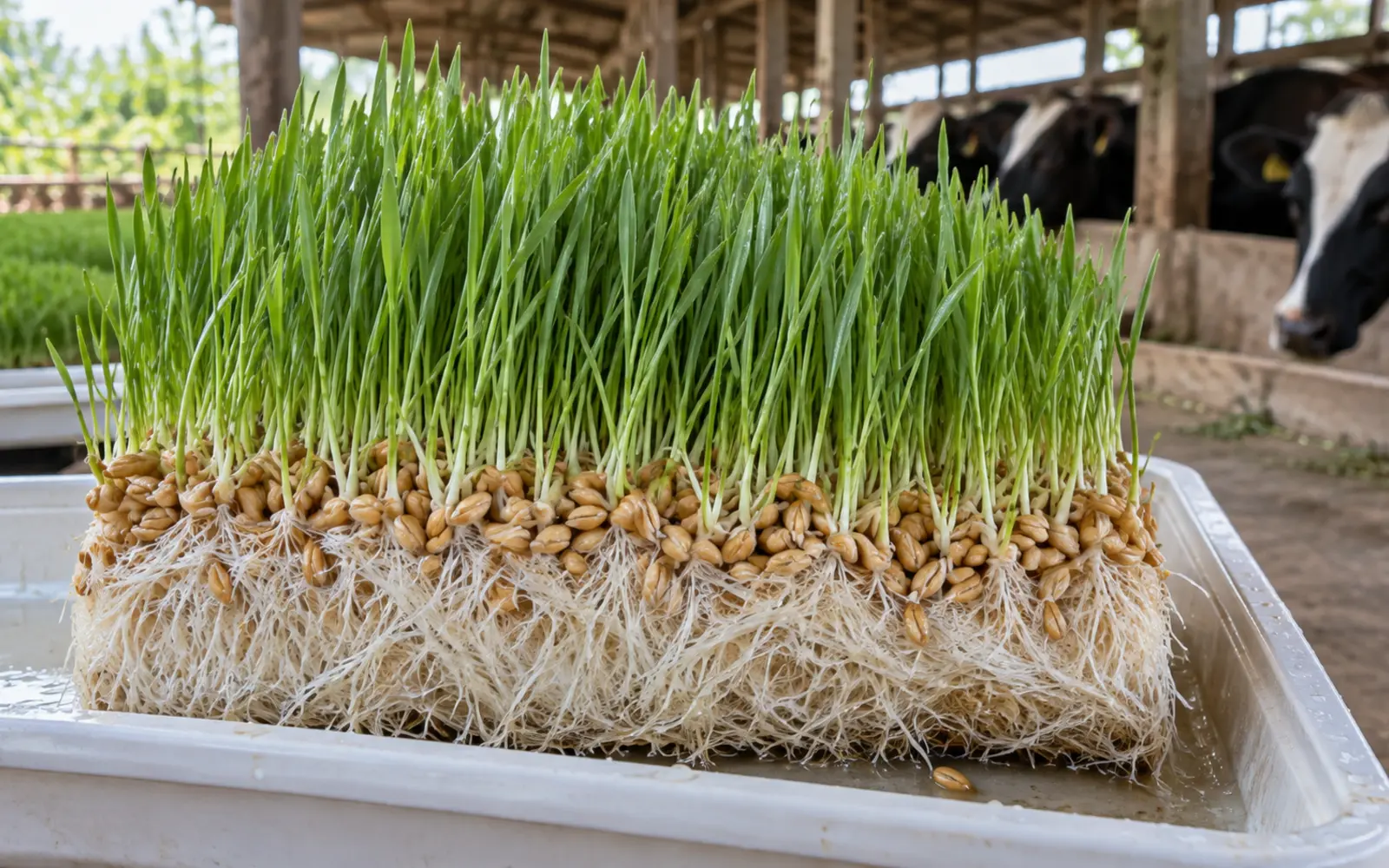
Germination is a metabolic process. The seed burns some of its own stored starch to power the growth of the shoot and root. That burning releases carbon dioxide and heat, and the carbon that leaves as gas is dry matter that has gone.
Meanwhile the mat takes up a large amount of water. The fresh weight rises steeply. The dry matter falls.
The measured figures. A critical assessment compiled by the international feed database Feedipedia reports that sprouting resulted in 7 to 47 per cent loss in dry matter from the original seed after sprouting for a period of six to seven days, drawing on several studies together. A University of California analysis reported by a forage trade publication puts it at a 25 to 30 per cent loss in dry weight once sprouting occurs, and makes the point concretely: adding water to a 100 pound bag of barley would provide about 75 pounds of feed to the animal.
How wet the result is. A 2025 systematic review pooling 21 studies gives the mean dry matter of hydroponic barley sprouts as 10.5 per cent, with a standard deviation of 2.8. That means roughly nine tenths of what you carry to the trough is water.
Put those two findings together and the eight-to-one claim resolves. Eight kilogrammes of mat at around 10.5 per cent dry matter is about 0.84 kilogrammes of dry matter. One kilogramme of stored barley is roughly 0.88 kilogrammes of dry matter. You have carried eight times the weight to arrive at slightly less feed.
Hydroponic Fodder: What the Evidence Actually Shows About Sprouted Barley and Maize
Dry matter reality check worksheet converting fresh sprout weight to dry matter and comparing it with the dry matter in the seed that went in
The protein question, which is where the pitch is most misleading
You will be told that sprouting raises the protein content. On a dry matter basis, that is true, and it is also not what it sounds like.
The Feedipedia assessment is precise about the mechanism: on a dry matter basis, crude protein, fibre and calcium concentrations increase while organic matter and non-fibrous carbohydrate decrease. The concentration rises because the starch mass fell away, not because the plant made more protein. The 2025 systematic review gives pooled barley sprout composition of 14.8 per cent crude protein on a dry matter basis, against stored barley grain which is lower.
Same protein, less total mass, higher percentage. If you are buying protein, you have bought less of it and paid more per kilogramme.
Two other findings from the same compilation are worth having. Vitamins, beta-carotene, chlorophyll and enzyme activity do rise, peaking around day seven, which is a genuine benefit for an animal on a dry season ration with no green feed at all. And an Iranian study found that in sacco dry matter degradability of barley grain and sprouts was comparable while the metabolisable energy of the sprouted product was lower than the original grain.
What the feeding trials found
The animal response literature is genuinely mixed, and an honest article has to report the negative and null results alongside the positive ones. Every study below is labelled by country.
Positive. In India, feeding hydroponic maize fodder to lactating cows gave a 13.7 per cent increase in milk yield, at 4.64 against 4.08 kilogrammes per day, with higher crude protein and crude fibre digestibility and a higher net profit per cow per day. In Pakistan, barley and maize hydroponic based rations fed to Beetal goats improved dry matter digestibility from 55 to 68.5 per cent and daily gain from 48.8 to 75.5 grammes per day.
Partly null. In India, hydroponic fodder at 7 per cent inclusion in the ration of crossbred calves improved dry matter intake and weight gain and lowered cost per kilogramme of gain, but the data on digestibility of nutrients revealed no difference between treatment groups.
Mixed. In China, hydroponic wheat seedlings fed to sheep improved rumen fermentation and some meat quality traits but produced no statistically significant differences in amino acid profiles or in rumen bacterial richness and diversity.
Negative at high inclusion. The 2025 systematic review summarises trials in which sole-forage hydroponic barley reduced dry matter intake by 15 to 25 per cent in sheep, sole-diet feeding caused negative nitrogen and mineral balance, and high inclusion of 45 to 80 per cent in lambs cut average daily gain by around 73 per cent. That review’s overall recommendation is an inclusion band of roughly 10 to 30 per cent of diet dry matter.
What that adds up to. Sprouted fodder appears to work as a modest supplement in a ration that already has bulk in it, and to fail as a replacement for forage. It is a green top-up, not a feed base. None of these trials was conducted in Uganda.
The cost, which is the actual decision
Here is where the technology is judged.
Seed is almost the whole cost. The Feedipedia assessment states that seed cost contributes 85 to 90 per cent of the total cost of production of hydroponic fodder. Everything else, the trays, the water, the labour, the structure, is the remaining tenth.
That single figure reframes the whole proposition. You are not buying a feed production system. You are buying a grain conversion system, and the conversion loses dry matter.
What the published cost work found. All of it is foreign and each figure is labelled:
- Australia. A review of hydroponic fodder production for beef cattle found sprouts cost from two to five times the cost of dry matter compared with the original grain, and concluded that profitable use of sprouting grain as a feed source for commercial cattle production appears unlikely.
- United States. The University of California analysis puts the hay-equivalent price of sprouts at about 580 dollars per ton when hay is valued at 100 dollars per ton.
- Saudi Arabia. A study comparing hydroponic and conventional green fodder production found the hydroponic system ran at a loss with a benefit-cost ratio of 0.96, against 1.2 for conventional cultivation, with a break-even price of 0.21 dollars per kilogramme hydroponic against 0.16 conventional.
- Rwanda. A commissioned cost-benefit analysis found hydroponic fodder costs averaging 120 Rwandan francs per kilogramme against about 400 for maize bran, which is favourable, but noted adoption constrained by high upfront costs and sensitivity to seed prices. Note that maize bran is a concentrate, not a forage, so that is not a like-for-like dry matter comparison.
- India. The dairy trial cited above reported a positive net profit per cow per day, but that is a feeding substitution result within Indian input costs, not a production cost per kilogramme of dry matter.
None of these figures is Ugandan and none should be converted into shillings as though it were. What we can give you instead is the worksheet, which uses your prices.
Hydroponic Fodder: What the Evidence Actually Shows About Sprouted Barley and Maize
Blank cost per kilogramme of dry matter comparison table for sprouted fodder against planted fodder, silage and crop residues
Water, which is the real advantage
The water case for sprouting is the strongest part of the pitch, and it survives scrutiny better than the feed case, with one correction.
Feedipedia reports roughly 1.5 to 2 litres of water per kilogramme of fresh fodder, against 73, 85 and 160 litres for field-grown barley, alfalfa and Rhodes grass respectively. An FAO report on a Namibian project puts it at about three to four litres per kilogramme of fresh fodder, and notes the system does not require any fuel.
The correction is important. The Saudi study measured 2.83 cubic metres of water per tonne of hydroponic fresh fodder against 117 for open field, a 48-fold advantage on a fresh weight basis. On a dry matter basis, that advantage collapsed to 2.4 times.
Still an advantage. Not the advantage advertised. And a 2.4-fold water saving is a genuinely different proposition from a 48-fold one when you are weighing it against the cost.
Mould, which is the hazard
This matters more in Uganda than in most of the places these systems were designed.
The Feedipedia assessment states that it is difficult to control or adjust humidity and air circulation in low-cost hydroponic production units, especially during hot months, and that mould infestation is one of the biggest challenges. It names a specific organism, Aspergillus clavatus, and states that hydroponic fodder heavily infested with it should not be fed to dairy or beef cattle, because animals may develop posterior ataxia, decreased milk yield and possibly death.
The Australian review is blunter: mould is a common problem that increases labour and costs, reduces animal performance and sometimes results in stock deaths.
We found no quantified mycotoxin incidence study in hydroponic fodder specifically, and no Ugandan data at all. What we can say is that a warm humid environment with dense wet grain and limited air movement describes both a Ugandan sprouting shed and the conditions the literature names as the problem.
If a mat shows grey or fuzzy growth, or smells musty rather than sweet, do not feed it. Do not cut around the mouldy part.
Can you even get the seed in Uganda?
This is the question that decides the matter for many readers, and the answer is more complicated than either yes or no.
Barley is grown commercially in Uganda. Ugandan press reporting describes barley growing taking root in the Kigezi region driven by demand from beer brewers, and a Ugandan agribusiness account describes barley production expanded in Kisoro district in collaboration with a brewing company, with certified seed supplied through that scheme.
But a 2025 peer-reviewed study of Uganda’s barley value chain found that an underdeveloped seed system, poor agronomic and post-harvest handling practices and infrastructure and mechanisation gaps are among the key challenges hindering local barley production, and that Uganda’s brewing industry remains heavily dependent on imported barley rather than local production.
Read those together: barley exists in Uganda, inside a contract farming arrangement, with seed distributed within that scheme, in a sector that still imports. A dairy or goat farmer outside that arrangement should treat barley seed supply as an open question and check locally before designing a system around it. Maize is the obvious alternative and is what the Indian dairy trial used.
One further Ugandan institutional point. The Ministry of Agriculture, Animal Industry and Fisheries has published on hydroponics and promotes it, with training available through the Makerere University Agricultural Research Institute at Kabanyolo. That material is entirely about horticultural crops for human consumption. It does not mention livestock fodder.
Cost categories for the worksheet
Fill these in with your own local prices, for sprouted fodder and for each alternative you are comparing it against:
- Seed or grain, per kilogramme, at the quantity you would actually buy
- Labour, daily, because sprouting is a daily task that does not stop
- Water, including carrying it if that is what you do
- Power, if the unit needs any, and what happens when it is off
- The unit itself, spread over the years you expect it to last
- The structure it sits in, and any shading or cooling
- Losses to mould, which the literature says are routine rather than exceptional
- Cleaning and disinfection between batches
Then divide the total by the kilogrammes of dry matter actually produced, not the fresh weight. That is the only number that compares across systems.
Common mistakes
Comparing fresh weight against fresh weight. A sprout mat at around a tenth dry matter and a bale of hay at four fifths dry matter are not comparable by weight.
Believing protein went up in total. It went up in concentration because the starch went down.
Forgetting the grain had a use already. The input is a marketable, feedable commodity. Sprouting it is a choice against feeding or selling it directly.
Feeding it as the whole ration. Documented in the review literature to reduce intake and gain substantially at high inclusion.
Ignoring mould. Named in two independent sources as a common problem, in one case linked to stock deaths.
Converting a foreign cost figure into shillings. Every published cost study is from Australia, the United States, Saudi Arabia, India or Rwanda.
Taking the water saving at the fresh weight figure. On dry matter it is roughly 2.4 times, not 48.
Buying the unit before doing the arithmetic. The arithmetic takes twenty minutes.
Warning signs and escalation points
- Grey, white or fuzzy growth anywhere on a mat, or a musty smell
- Mats that are warm in the middle, which indicates heating and precedes spoilage
- Animals refusing the fodder after initially accepting it
- Any animal showing unsteadiness in the hindquarters, incoordination or an unexplained drop in milk after sprouted fodder was introduced
- A salesman who will not quote cost per kilogramme of dry matter
- A quoted yield figure with no dry matter percentage attached
Call a qualified veterinarian immediately if animals show incoordination or hindquarter weakness after eating sprouted fodder. Stop feeding that batch and keep a sample.
Where this works, and where it does not
It works, on the evidence, as a modest green supplement at roughly 10 to 30 per cent of ration dry matter, in a system where the grain is genuinely available and affordable, where somebody will run the trays every single day, and where a shaded well-ventilated space exists to keep the mould pressure down. Its clearest genuine benefits are the vitamin and green feed contribution in a dry season, and a real if smaller water advantage.
It does not work as a way to make feed cheaper. Four independent cost studies from four countries point the same way, and one of them concludes that profitable commercial use appears unlikely. It does not work as a forage replacement. It does not work where the grain has to be bought at retail, because the seed is 85 to 90 per cent of the cost. And it does not work as an unattended system, because a day missed is a batch lost.
The evidence position, stated plainly. There is no Ugandan feeding trial, no Ugandan cost study and no Ugandan mould incidence data on hydroponic fodder. Everything in this article comes from elsewhere and is labelled. Anyone telling you what sprouted fodder yields or costs in Uganda is telling you something no published work supports. That is not an argument against the technology. It is an argument for testing it yourself, at small scale, with the worksheet.
There is also a regional signal worth knowing. A study in northwestern Ethiopia found that while 83.2 per cent of peri-urban farmers considered hydroponic fodder production a good opportunity, actual adoption was 6.9 per cent, with prohibitive seed expenses, inadequate labour availability and insufficient awareness named as the main obstacles. Interest is high everywhere. Adoption is low everywhere. The gap between those two numbers is the cost.
A low-risk first step
Do not buy a unit. Buy a bucket of grain and borrow four trays.
Weigh the dry grain. Sprout it for seven days. Weigh the fresh mat. Then take a sample of the mat, weigh it wet, dry it thoroughly in the sun or a low oven until it stops losing weight, and weigh it again. That gives you your own dry matter percentage rather than a published one.
Now you can complete the first worksheet with your own numbers, and you will know, for your grain and your conditions, whether the dry matter went up or down. That costs you a bucket of grain and a week.
Then do the second worksheet with your own local prices, comparing against whatever you currently feed in the dry season. If sprouted fodder wins on cost per kilogramme of dry matter, buy the unit with confidence. If it does not, you have saved yourself the price of one.
What to do next
- Ask the seller for the cost per kilogramme of dry matter, not per kilogramme of fresh fodder. Note whether they can answer.
- Find out whether you can actually buy the grain locally, at a price you can repeat, in the quantity you would need every week.
- Run the one-bucket test above and measure your own dry matter percentage.
- Complete the cost worksheet for sprouted fodder and for at least two alternatives you already use.
- If you proceed, plan for a well ventilated, shaded space, and for daily cleaning between batches.
- Plan a mould inspection into the daily routine, and a rule that a suspect mat is discarded, not trimmed.
- Introduce it as a supplement within the 10 to 30 per cent range the review literature supports, not as a forage replacement.
Related reading: the published guide to year-round fodder planning for goats and cattle covers the alternatives you should be comparing against, and integrated crop and livestock farming covers the wider system. Within the programme, see diagnosing a high feed cost - scheduled in this programme for where your feed money is actually going, and getting real value from stover, straw and haulms - scheduled in this programme for the free bulk you may already own.
About the author
This guide was researched and written by the Falcon Foundation Ltd Editorial Team. Falcon Foundation Ltd is a privately owned Ugandan agricultural company producing greenhouse crops, livestock and honey. Our Knowledge Hub is written for Ugandan farmers making practical decisions with incomplete information. Every cost and yield figure in this article is labelled with the country it came from, we report the trials that found nothing alongside those that found something, and we do not convert foreign figures into Ugandan assumptions.
