
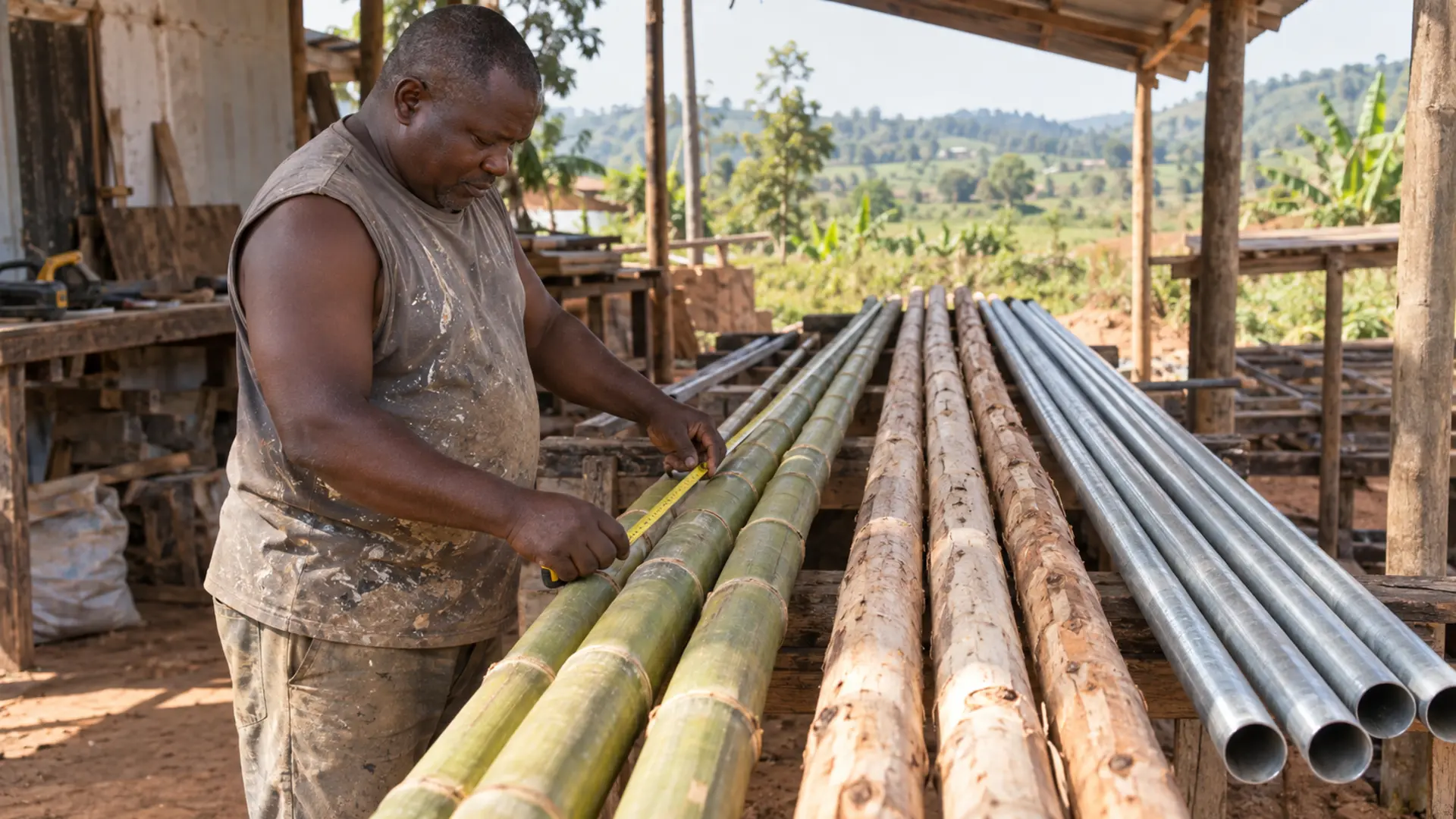
The quotations arrive and one of them is much cheaper than the others. It is a timber frame. The steel one is nearly double, and the supplier cannot say what the coating thickness is. Nobody has quoted bamboo, though it grows two districts away.
Four years later the cheap frame has soft posts at ground level and the grower is rebuilding. The frame was never the cost. The frame plus the rebuild was the cost, and nobody priced that.
This guide is about choosing a frame you can still maintain in year seven.
What this guide helps you decide
By the end you should be able to compare treated timber, bamboo and galvanised steel on seven whole-life criteria rather than on price; specify the basic geometry of a simple structure; and interrogate a supplier’s quotation so that the things which decide service life are written down before you pay.
It does not cover cladding film or insect netting, which are separate choices, and it does not cover where the structure goes, which is settled first.
The short answer
There is no single right material. There is a right question, and it is this: what will destroy this frame where I am, and has the quotation told me how it is protected against that?
For timber, the destroyer is fungal decay and termites, and the protection is pressure treatment plus keeping the wood dry and off the concrete. For bamboo, the destroyer is insects and rot, and the protection is proper seasoning and a real preservative process rather than a lime wash. For steel, the destroyer is corrosion, and the protection is hot-dip galvanising applied after fabrication with a stated coating thickness.
A quotation that does not name the treatment, the standard and the thickness is not a quotation you can compare.
The geometry, before the material
Two sets of figures from FAO’s structural guidance for tropical conditions, carried unchanged through both the 1972 and 2011 editions of the same textbook.
Heights and bays. Gutter heights of 2.8 to 3.0 metres are recommended for multi-span greenhouses. In single-span greenhouses, eave height should be at least 2 metres. Multi-span blocks of 3.2 metre bays are described as least expensive to build.
Frame spacing. For spans up to about 20 metres, the spacing of steel trusses is likely to be about 4 metres, and in the case of timber, about 2 metres. That is generic farm building guidance rather than greenhouse-specific, and we flag it as such, but it captures the real difference: timber needs roughly twice as many frames as steel for the same span, which is a cost and a shading consequence that the headline material price does not show.
Bracing. Diagonal bracing makes framed structures stiff. Long braces should preferably transfer load in tension rather than compression, to avoid buckling. Post-and-beam buildings generally require wind bracing both along and across the building, because there are no rigid connections at the top of the wall. A greenhouse is a light, tall, mostly empty box with a large sail area, and bracing is not an optional extra on it.
Foundations. FAO’s guidance on pole structures is that they are usually built with a relatively simple foundation, deeper than usual, backfilled with rammed earth. No numeric depth is given for greenhouse-scale posts in any source we could open, and we are not going to invent one. What the depth is for is resisting uplift and racking, so it is a question for whoever designs your structure against your local wind.
On wind, an honest gap. We could not find a Ugandan design wind speed applicable to a low-rise, lightweight structure. The only Ugandan design wind figure we located sits in the Ministry of Works and Transport bridge design manual, which uses a base design wind velocity adjusted by a national wind intensity map. That is bridge engineering, at a different scale, and it should not be transplanted onto a greenhouse. Uganda’s national building control regulator addresses lateral wind loading only qualitatively.
Timber
What kills it. FAO’s guidance on building materials states that natural decay resistance is particularly important in the warm humid regions of East and Southeast Africa, that heartwood is more resistant than sapwood, and that flying termites usually enter the end grain of untreated timber and build a colony from inside. The end grain is the vulnerable face, which is why a cut you make on site matters as much as the treatment applied at the yard.
The moisture rule. FAO states that decaying fungi never attack timber which is seasoned to a moisture content of less than 20 per cent and which is kept well ventilated and dry, and that where a structure is correctly designed and built and moisture content does not exceed 20 per cent, preservative treatment is generally unnecessary against fungal attack. Read that carefully. The condition is that the timber stays dry, and in a greenhouse it will not. Humidity is the point of the building.
Treatment: what works and what does not. FAO distinguishes pressure methods, in which preservative is forced into the wood in a cylinder until the required amount is absorbed, from superficial methods such as painting and spraying. A brushed-on coat is not the same product as pressure-treated timber, whatever the yard tells you.
Uganda’s own rule. The National Building Review Board’s 2024 guidelines for design and construction with steel, concrete and timber are the strongest Ugandan source on this. They state that for structures whose design life is at least 50 years the timber should undergo pressure treatment with preservatives such as chromated copper arsenate. They require timber to be seasoned to a maximum of 18 per cent moisture content in accordance with Uganda Standard US 833-2:2020. They reference Uganda Standard US 2248:2021 for structural stress grading, and require graded timber to be marked with the manufacturer’s name, the appropriate stress grade, a date or batch number and a certification body mark. And they require a plastic material or other suitable waterproofing to be placed between concrete and timber members to avoid contact.
That last requirement is small, cheap and routinely skipped. Concrete holds and transfers moisture into the timber sitting on it. A piece of damp-proof membrane at every footing is one of the highest-value details on the whole structure.
We could not independently open the texts of US 833-2:2020 or US 2248:2021 because the standards catalogue was not accessible to us, so we cite them as the national regulator cites them. Ask your supplier for the actual grade mark.
Ugandan species. Research from Makerere University tested 17 Ugandan timber species and established four strength classes, with modulus of rupture ranging from 3.9 to 20.3 newtons per square millimetre and basic density from 322 to 595 kilogrammes per cubic metre. The useful finding for a builder is that several lesser-known species showed strength comparable to well-known timbers. If the species you can afford is not the species everybody names, that is not automatically a compromise, but it is a question for someone who can read a grading mark.
What we could not verify. No FAO or Ugandan source we opened gave a numeric service life for treated versus untreated timber posts in ground contact in tropical conditions. That figure is quoted freely online. We could not source it and so we do not give it.
Bamboo
Bamboo is the material most often dismissed and most often misunderstood, and Uganda has a real resource.
What Uganda actually has. The National Forestry Authority’s national bamboo strategy identifies two native species, Oldeania alpina in the highlands and Oxytenanthera abyssinica in the lowlands, alongside introduced species including Bambusa vulgaris and Dendrocalamus giganteus. At least 13 bamboo species had been identified in Uganda by 2013, of which only two were native. Bamboo covers 54,533 hectares in protected areas, and the Authority manages around 200 hectares of plantation. Existing use is described as huts, fencing and crop props, and the strategy itself names the market problem: bamboo is still considered a poor man’s timber used for low-quality and less durable products.
A NARO and INBAR site-species matching study locates Oxytenanthera abyssinica in northern Uganda and West Nile, including the Otzi Mountains, Metu and the Agoro-Agu Central Forest Reserve, and Oldeania alpina on Mount Elgon, the Rwenzoris, Mgahinga and Echuya. It also records a West Nile operator producing treated bamboo poles, which matters: treated structural bamboo is not a theoretical product in Uganda.
What kills it, and what the numbers are. FAO states plainly that bamboo without proper seasoning and preservative treatment will rot and be attacked by insects, particularly in moist locations such as earth foundations. It specifies air seasoning for four to eight weeks depending on humidity, stacking well off the ground so air circulates, and dusting the freshly cut lower end of the culm immediately after cutting.
A technical review of bamboo preservation methods gives the service life figures. Graveyard tests show the average life of untreated bamboo is less than two years. Chromated copper arsenate treated bamboo gave a fresh appearance even after five years in partially protected use, and one cited case of treated bamboo roofing showed practically no damage after 40 years of service.
That is the whole bamboo argument in three numbers. Untreated, under two years. Treated, a serious structural material.
Which treatments count. The same review ranks them. Effective chemical processes are the Boucherie process, in which preservative displaces sap in freshly felled culms; diffusion by soaking for 10 to 20 days; pressure treatment; and hot and cold tank treatment. Traditional and limited methods are water soaking, which leaches starch and sap over four to twelve weeks but confers no chemical protection, and lime washing, which the review describes as successful only when continuously applied at cut surfaces. Fire baking is likewise limited.
If a supplier tells you the bamboo has been soaked in a river, they have told you it has been de-starched, not that it has been preserved.
Standards. There is an international structural design standard for bamboo, ISO 22156, covering round bamboo, split bamboo, glued laminated bamboo and bamboo-based panels using limit state design and explicitly addressing durability. The Institution of Structural Engineers published a design manual to the 2021 edition in November 2025 and notes that despite bamboo’s good strength-to-weight ratio and high durability when treated correctly, there remains a lack of design guidance. Both of those facts are worth knowing: the material is standardised, and the practical guidance is still thin.
Steel
What kills it. Corrosion, and the point at which the protection is broken.
Galvanising after fabrication, not before. FAO’s guidance is direct: steel must be galvanised after fabrication, as any welding or drilling breaks the galvanised layer. This is the most common way a galvanised frame becomes an unprotected frame. A supplier who galvanises the sections and then welds them on site has sold you bare steel at every joint, which is exactly where water sits.
Coating thickness. The international standard for hot-dip galvanised coatings on fabricated iron and steel articles is ISO 1461, and it specifies minimum coating by steel thickness. For steel over 6 millimetres thick the requirement is a mean coating of 610 grammes per square metre, equivalent to 85 microns, with a local minimum of 505 grammes per square metre, equivalent to 70 microns. Thinner sections require correspondingly less: about 70 microns mean for 3 to 6 millimetre steel, 55 microns for 1.5 to 3 millimetre, and 45 microns for under 1.5 millimetre.
Those are the numbers to write into a quotation. A supplier who says the steel is galvanised without stating a coating thickness has said nothing measurable.
Service life. Galvanising industry sources state that a galvanised coating can last over 100 years, with the explicit caveat that such figures are based on minimum coating thickness and are usually very conservative, and they refer environment-specific performance to a separate standard on corrosivity categories. We could not open that standard, and we found no figure for galvanised steel service life in humid tropical or Ugandan conditions specifically. Treat the century figure as a temperate benchmark rather than a promise for a Ugandan greenhouse, where a warm humid interior is a harsher environment than the outside air.
Uganda’s rule. The National Building Review Board guidelines require designers to specify protective measures against moisture and air, listing coatings and barrier methods, encasement of critical elements, galvanisation, electro-plating or the use of stainless steel. The requirement is that a protective measure be specified, not merely assumed.
Aluminium. FAO notes it is very resistant to corrosion but expensive, suited to glazing bars rather than the main frame, and should be bolted rather than welded.
Repairability, and the thing nobody quotes for
We looked for a source comparing repairability and skills availability across these three materials in Uganda, and found none. What follows is our own reasoning, offered as reasoning rather than as evidence.
A timber frame can be repaired by any competent carpenter with a saw and a hammer, from material bought locally, on the day. A bamboo frame can be repaired similarly where treated culms are available, which currently means a short list of suppliers. A galvanised steel frame that has corroded at a weld requires someone who can cut and weld, and any repair breaks the coating again unless it is treated afterwards, which is a step almost never taken on a farm.
Weigh that against how far you are from a town, and how quickly you need a broken frame fixed in the middle of a crop.
Cost categories
No prices, no duty rates. We tried to verify Uganda Revenue Authority and East African Community tariff treatment for greenhouse structures and materials and could not open a functional tariff lookup, so we will not guess a rate. Ask a clearing agent, or ask the Revenue Authority directly, before you assume anything about imported steel.
Budget across these categories rather than on the frame price:
- Frame material, delivered
- Treatment, if it is not already included, and evidence of it
- Fabrication and erection labour
- Foundations, footings and the damp barrier
- Bracing, which is sometimes quoted as an extra and should not be
- Fixings, which corrode long before the frame does if they are the wrong specification
- Import duty and clearing, for anything imported, at a rate you have confirmed
- Planned maintenance: re-treatment intervals, touch-up coating, fixings replacement
- Expected replacement of individual members over ten years
- Downtime, meaning the crop you do not grow while repairing
Common mistakes
Comparing quotations on total price alone. If one quote is for pressure-treated stress-graded timber and another is for untreated offcuts, they are not the same product.
Accepting “treated” without asking how. Pressure treatment and a brushed-on coat are different things with different outcomes.
Welding galvanised steel on site. This destroys the protection exactly where corrosion will start.
Timber sitting directly on concrete. Uganda’s own building guidelines require a waterproof separation, and it is one of the cheapest details on the structure.
Dismissing bamboo on reputation. The two-year figure that gives bamboo its reputation is for untreated culms. Treated is a different material.
Under-bracing. A light tall structure with a large surface area needs bracing along and across, and it is the first thing value-engineered out of a cheap quotation.
Buying imported steel without confirming duty and lead time. Both are real exposures that local timber does not carry, and neither shows in the quoted price.
Warning signs and escalation points
- Timber posts that sound dull rather than sharp when struck, or that a screwdriver enters easily at ground level
- Frass, mud tubes or fine boreholes at the base of posts or at cut ends
- Rust bleeding from a weld or a drilled hole in a galvanised frame
- Any visible sag, lean or racking of the structure, especially after a storm
- Cladding fixings pulling through or working loose repeatedly, which usually indicates frame movement
- Bamboo culms that have split at the nodes or show powder beneath them
Structural lean or racking is not a maintenance item. Stop using the structure and get someone competent to look at it. Uganda’s building control framework exists for this, and a structure people work inside daily is worth a professional opinion.
Where each material works, and where it does not
Treated timber works where a certified pressure-treated, stress-graded supply exists, where carpentry skill is local, and where the design keeps the wood off the ground and out of standing water. It does not work with untreated or superficially treated timber in a humid greenhouse, and it does not work where nobody will do the periodic inspection.
Bamboo works where treated culms can be bought, where the design keeps culms out of earth contact, and where the builder understands that the treatment is the whole argument. It does not work with untreated culms, and it does not currently work everywhere in Uganda, because the treated supply is limited.
Galvanised steel works where the fabricator galvanises after fabrication and will state a coating thickness, and where the grower can accept the higher initial cost and the import exposure. It does not work where welding will be done on site without recoating, and it does not work as an unspecified purchase.
A low-risk first step
Send your shortlisted suppliers the nine questions from the quotation checklist, in writing, before you ask for a price.
Species and stress grade mark. Treatment method. Preservative and retention. Moisture content at delivery. Steel section and wall thickness. Galvanising standard and coating thickness. Whether galvanising is after fabrication. Post spacing, span and eave height. Foundation detail and damp barrier.
The answers will sort the suppliers faster than the prices will. A supplier who can answer all nine is a different proposition from one who cannot answer any, and you will have learned that for the cost of one message.
What to do next
- Settle the site first, if you have not, using the companion guide to greenhouse siting and orientation.
- Send the nine quotation questions to every supplier before requesting prices.
- Ask specifically to see a stress grade mark on the timber, or a galvanising certificate for the steel.
- Confirm import duty treatment with a clearing agent or the Revenue Authority for anything imported.
- Specify the damp barrier between concrete and timber in writing, and check it is installed.
- Price the maintenance categories, not just the build, over ten years.
- If considering bamboo, contact the National Forestry Authority or NARO about treated pole suppliers in your region before you design around it.
Related reading: choosing greenhouse cladding film and ventilation and cooling design cover the next two decisions. The published guide to managing heat and humidity in a Ugandan greenhouse explains why the interior environment is harder on materials than the weather outside.
About the author
This guide was researched and written by the Falcon Foundation Ltd Editorial Team. Falcon Foundation Ltd is a privately owned Ugandan agricultural company producing greenhouse crops, livestock and honey. Our Knowledge Hub is written for Ugandan farmers making practical decisions with incomplete information. We do not quote prices or duty rates we have not verified, and we say when a widely repeated figure could not be sourced.
