
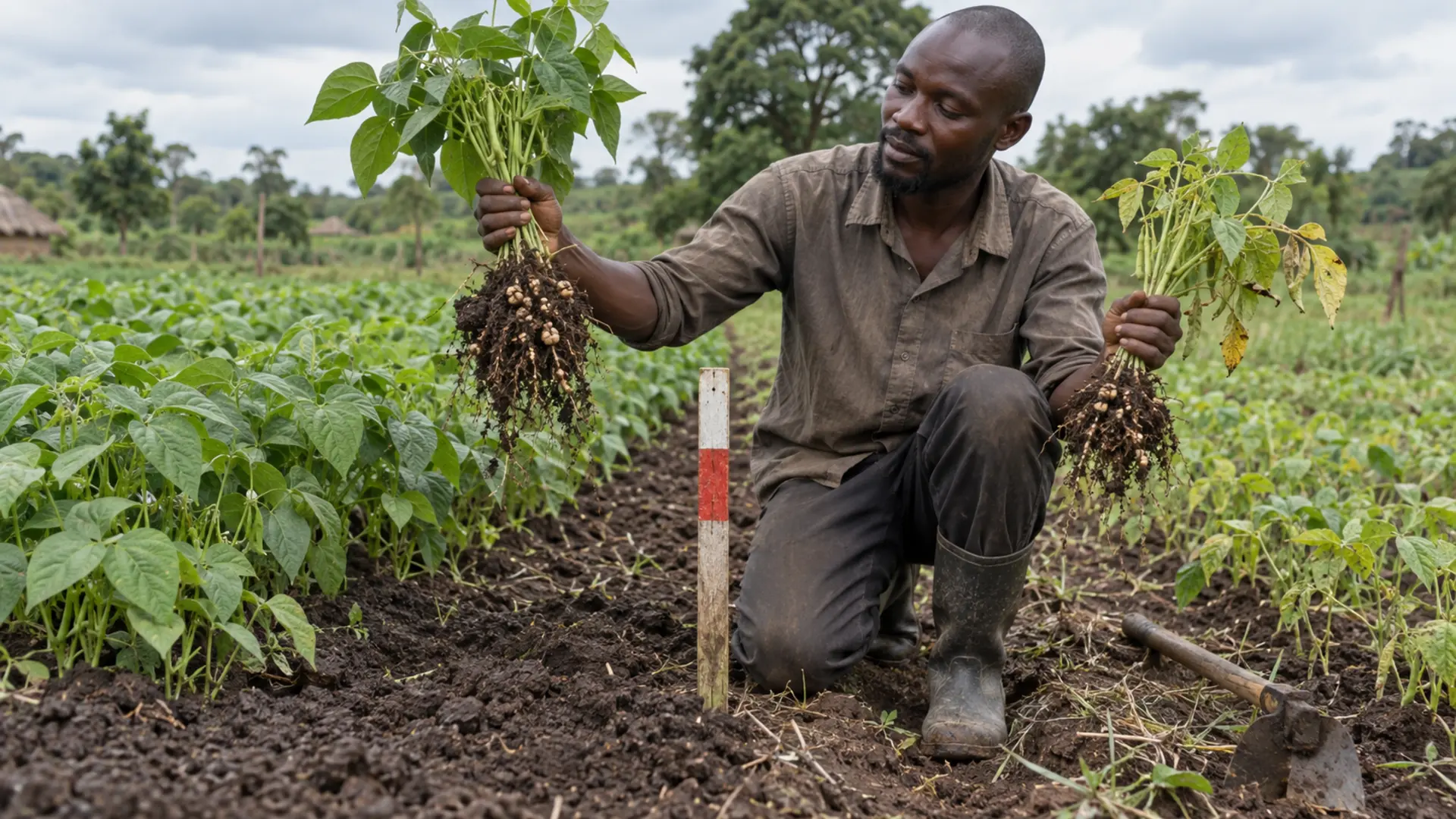
The dealer has a shelf of sachets. One is for beans, one improves soil life, one is described as feeding the plant naturally. They cost a fraction of a bag of fertiliser and the claims on them are much larger.
You buy one. You use it. The crop does whatever it was going to do. You have no way of knowing whether the product did anything at all, and neither does the dealer.
Some of what is on that shelf rests on decades of research. Some of it, on the evidence of independent testing, does not contain what the label says. This guide is about telling them apart, and about the one method that lets you check any of them on your own land.
What this guide helps you decide
By the end you should know which product classes have real evidence behind them and which do not; know what independent laboratory testing found when researchers opened commercial products and looked inside; know how to store and handle a live product so it survives to the field; and be able to run a strip trial that actually answers whether a product worked for you.
It does not cover soybean crop management specifically, composting, or mineral fertiliser types, all of which have their own guides. And it endorses no product and no supplier. Where a product is named below, it is because a study tested it or a government register lists it, not because we recommend it.
The short answer
Rhizobium inoculants for legumes have a well-established biological mechanism and a large body of field evidence. They often work. They do not always work, and the research is clear that nobody can reliably predict where they will.
Mycorrhizal products are a different case. The underlying biology is real, but when researchers tested commercial products, half of them produced no measurable colonisation and on average they slightly suppressed crop growth.
General microbial and biostimulant products are the weakest class, with effects that vary enormously by organism and that in several cases were statistically indistinguishable from nothing in field conditions.
Whichever you buy, leave an untreated strip. Without one you cannot know.
Class one: rhizobium inoculants for legumes
The mechanism is real and specific. Rhizobia are bacteria that form nodules on legume roots and convert nitrogen from the air into a form the plant can use. This is not a general growth promotion claim. It is a well-described biological process.
The specificity is the important part. As a Uganda-oriented bean training manual puts it, each legume crop needs a different type of rhizobium bacteria. A product for soybean is not a product for beans.
When it is needed. N2Africa’s guidance draws the practical line: legumes that have a specific requirement for rhizobia, such as soybean and chickpea, need inoculation, while cowpea and groundnut are promiscuous and unlikely to respond to inoculation unless inoculated with selected strains applied in high concentrations.
So the first question is not whether inoculants work but whether the effective bacteria are already in your field. Prior legume history matters. A field that has grown well-nodulated soybean is a different proposition from one that never has.
What the field evidence shows. This is where honesty is required, because the research is consistent and it is not a simple endorsement.
A synthesis of on-farm nutrient response trials for four grain legumes across East and West Africa found that legume response to phosphorus was variable but consistently positive and profitable for 67 per cent of farms in any given year, and made a finding that should temper everybody’s confidence: response heterogeneity was mostly associated with local or temporary factors and could not be explained or predicted by spatial, biophysical or management factors.
That is a serious statement. Researchers with far more information than you have could not predict which fields would respond.
A separate synthesis of 41 on-farm trials across eleven countries, covering 515 cereal fields and 3,930 legume fields, found cereal non-response relatively rare at 0 to 1 per cent of fields, while legumes showed zero response in 7 to 16 per cent of fields on average.
A multi-site trial in northern Ghana shows the same pattern concretely. At one site, inoculation gained soybean 12 to 19 per cent and cowpea 11 to 38 per cent over uninoculated controls. At another site in the same study there was no significant effect of inoculation on cowpea, which the authors attributed to sandy soil and dry spells at flowering.
N2Africa reports a mean yield increase of around 8 per cent from bean inoculation across 30 trials in the highlands of East Africa, which is a modest but consistent effect on a promiscuous legume.
The phosphorus interaction. Several studies point the same way. A Ghanaian meta-synthesis found combined rhizobium and phosphorus giving soybean a 92.6 per cent yield response against 31.0 per cent for inoculation alone. A field study in acid tropical soil found inoculation alone raised nodulation fifteen-fold and yield by 126 per cent, but that nodule numbers and the proportion of nitrogen derived from the atmosphere only reached their higher levels when phosphorus was added, while dolomite lime showed no effect in that trial.
Inoculation and phosphorus are not alternatives. On phosphorus-deficient soil, inoculating without addressing phosphorus is likely to disappoint. Reading your own soil report is covered in reading a soil laboratory report - scheduled in this programme.
Evidence verdict: strong mechanism, large evidence base, genuinely variable response that nobody can predict for your field. Which is exactly the argument for the strip trial at the end of this guide.
Class two: mycorrhizal products
Arbuscular mycorrhizal fungi form associations with plant roots and help them take up nutrients, particularly phosphorus. The biology is real and long studied.
What the field evidence shows for the biology. A meta-analysis of 21 field studies with 546 observations found that mycorrhizal inoculation increased crop yields by 23.0 per cent, with legumes at 29.4 per cent against 20.4 per cent for non-nitrogen-fixing crops. But it also found that in conventional agriculture, mycorrhizal fungi did not play a vital role due to high fertiliser input and tillage treatments.
So the effect is real under some conditions and largely absent under others.
What independent testing found in the products. This is the part that should change how you read a label.
Researchers assessed 23 commercial mycorrhizal inoculant products. Fifty per cent of the commercial products resulted in no observable arbuscular mycorrhizal fungal infection. Spore count discrepancies against label claims ranged from 72 to 100 per cent. Five of sixteen products sourced in the United States were contaminated with a plant pathogen. And most tellingly, the commercial inoculants inhibited crop growth by an average of minus 0.06, against plus 0.60 for laboratory-grown fungi in the same assessment.
Read that last figure carefully. The fungi worked. The products, on average, did not, and slightly suppressed growth.
Evidence verdict: moderate evidence for the biology under low-input rainfed conditions, weak to poor evidence for commercial products as actually sold. This is the class where marketing most clearly outruns what is in the packet.
Class three: general microbial and biostimulant products
This covers products claiming general plant growth promotion via bacteria such as Azotobacter, Azospirillum or Bacillus, and products marketed as undefined mixtures of effective microorganisms.
What the meta-analyses found. A global meta-analysis of 171 studies with 1,726 comparisons found an average yield increase of 16.2 per cent from biofertiliser inoculation, but with efficacy depending heavily on soil phosphorus availability, organic matter content and pH.
A meta-analysis focused on maize is more useful because it separates the organisms. Field yield gains averaged 15.3 per cent overall, but by genus the picture diverged sharply: Azotobacter produced the largest gains at 34.4 per cent, while Bacillus, Enterobacter and Pantoea showed poor field performance with confidence intervals overlapping zero.
A confidence interval overlapping zero means the effect could not be distinguished from no effect at all. Those are organisms that appear on plenty of labels.
For undefined effective microorganism products, a review concluded that there is a need for research to point out the real benefits on plants and on the soil, and cited a trial in which effective microorganisms used alone did not obtain significant results, only in combination with conventional fertiliser.
Evidence verdict: weak to moderate and highly inconsistent, with real differences between organisms that a label saying “beneficial microbes” completely obscures.
And the same product quality problem appears here. An independent assessment of 12 commercial biofertiliser products marketed in South Africa, using high-throughput sequencing, found the manufacturer-specified species detected in relatively high abundance in only two of the products. Contaminating organisms including several associated with disease were found, toxin-encoding sequences were highly predicted in over 67 per cent of the products, and the assessment concluded that the majority of the products were of poor quality.
Twelve products. Two contained what they claimed in meaningful quantity.
Rhizobium Inoculants and Biofertilisers: What Works, What Is Marketing, and Where to Get It
Product class table separating rhizobium inoculants, mycorrhizal products and general microbial products by evidence strength and by what independent testing found
Storage, which is where good products die
Everything above assumes the organisms in the packet are alive when they reach your field. Often they are not.
The East African evidence is specific. A study of legume inoculant shelf life in carrier materials available in East Africa found a bean rhizobium in filter mud carrier achieving 135 days of shelf life, and a soybean rhizobium holding above a billion cells per gramme for 105 days. Both fell short of the six month expiry period stated on the commercial product tested against. Refrigerated storage at 4 degrees improved shelf life over 24 degrees, and the project summary concludes that inoculants should be used during the season they were produced.
A regional evidence review corroborates it: peat-based and lyophilised products typically have shelf lives ranging from two to six months and often require cold or at least cool storage, and quality testing reveals contamination, unsterilised carriers or low viable counts in some products.
What that means in a Ugandan agro-input shop. A sachet on a shelf in the sun, in a shop that gets to 35 degrees in the afternoon, for an unknown number of weeks, is a sachet whose contents may already be dead. The label will not tell you.
The rules that follow:
- Ask when the batch was produced, not just the expiry date
- Buy for the season you are planting, not in advance
- Keep it cool and out of direct sunlight from the moment you take it
- Do not keep a part-used packet for the next season
- Treat any packet that has been sitting in a sunlit window or on the back of a lorry as suspect
- Protect inoculated seed from direct sunlight, covering the container with paper, cloth or a gunny bag and keeping it in shade until planted
Regulation and supply in Uganda
There is a regulatory framework, and it covers these products. Uganda’s Agricultural Chemicals (Control) Act defines agricultural chemicals to include bio-rationals, bio-pesticides and bio-fertilisers, and provides that no agricultural chemical may be imported or sold in Uganda unless it has been registered, packed and labelled in accordance with regulations.
And it is applied. MAAIF’s Agricultural Chemicals Register lists registered biological inputs, including a Bradyrhizobium japonicum product at 4 times ten to the ninth colony forming units per gramme and an Azotobacter vinelandii product. We name these only as evidence that registration happens, not as recommendations.
The practical instruction that follows. Ask whether the product you are being offered is on the register. A product not on it is being sold outside the framework, and given what independent testing found in unregulated products elsewhere, that matters.
Supply, honestly. We could not verify, from any named non-promotional source, a current Ugandan distributor list or a named research institute production line for rhizobium inoculant. We checked NARO’s own partner listing and found no mention of rhizobium inoculant production, biofertiliser research or a relevant project partnership.
What we can confirm is that at least one rhizobium product is on the government register, and that a regional evidence review found that of 22 documented commercial products across the region, just six are explicitly marketed for cowpea, groundnut or common bean in the focal East African countries.
So: treat inoculant as something to source deliberately through a research institute, a project or a registered supplier you have confirmed, rather than as a routine shelf item. Ask NaCRRI, Makerere’s School of Agricultural Sciences or your district agricultural officer.
The strip trial: how to find out for yourself
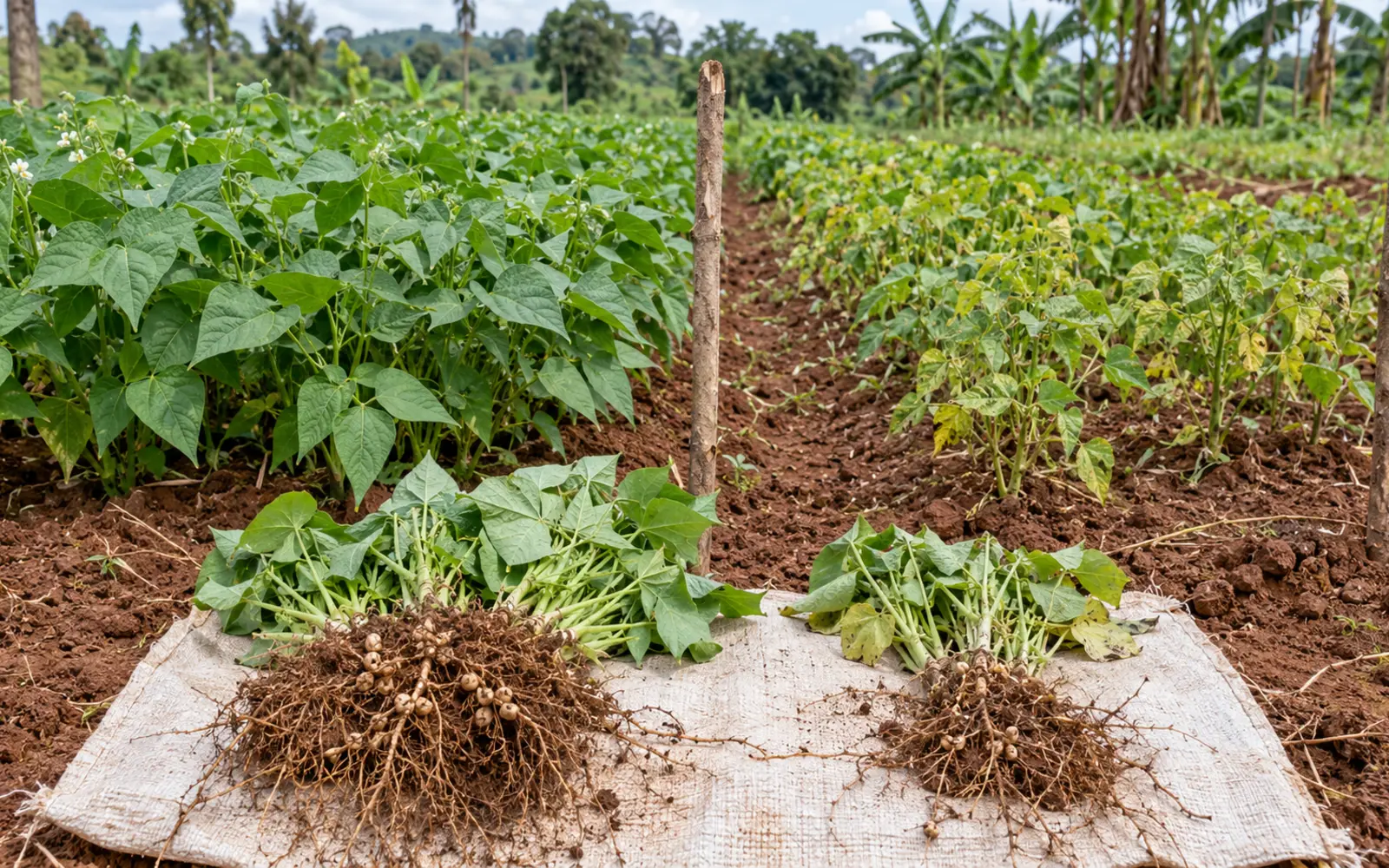
Everything above leads here. The research says response cannot be predicted for your field. The product testing says the packet may not contain what it claims. The only way to resolve either for your own farm is to test it, and testing means one thing above all: an untreated control strip.
Why the control is not optional. Without it, you are comparing this season to last season, or your field to a neighbour’s, and both comparisons are dominated by rainfall, soil and everything else that differed. Applied-research guidance puts it simply: the control provides a reference to your standard practice.
How to lay it out.
- Run strips the full length of the field, alternating treated and untreated
- Make each strip the width of your planting band or equipment, so you can plant and harvest a strip cleanly without mixing
- Run the strips across any variation you know about, such as a slope or a wet corner, rather than along it, so every treatment meets the same range of conditions
- Mark both ends of every strip with a stake before you plant, not after
- Replicate. Applied-research guidance recommends replicating all treatments four or more times in each trial
Why four and not two. Because with one treated strip and one untreated strip, any difference you see could be the product or could be that part of the field. Four of each lets you see whether the difference is consistent.
What to measure. Plant stand, nodule count at flowering if it is a legume inoculant, plant vigour scored the same way each time, and harvest weight per strip weighed separately.
What a single trial can and cannot tell you. Methodological work on on-farm strip trials is explicit about the limits: fields may only allow three to four blocks, which results in limited statistical power, and results from such trials cannot be extended to other fields unless they have the same underlying conditions as the trial field.
So a one-season strip trial tells you whether the product appeared to work in that field, in that season. It does not tell you it will work everywhere, or every year. Repeat it. And if a group of neighbours each run the same trial, you learn far more than any of you would alone.
Rhizobium Inoculants and Biofertilisers: What Works, What Is Marketing, and Where to Get It
Strip trial layout showing treated and untreated strips alternating across a field, with the control strips marked and a recording sheet beneath
Cost categories
No prices. Budget across:
- The product itself, per unit of seed or per area
- Any sticker or carrier material
- Cool storage from purchase to planting, which usually means care rather than money
- Phosphorus, where the soil report indicates it, because the evidence says the two work together
- A soil test, so you know whether phosphorus or pH is the actual constraint
- Labour for the strip trial layout, stakes and separate harvesting
- A notebook and a spring balance for weighing strips separately
- The value of the seed and land in the untreated strips, which is the real cost of finding out, and is much less than the cost of buying a useless product for five seasons
Common mistakes
Buying a product without knowing which legume it is for. Each legume needs its own rhizobium.
Assuming inoculation is needed on a field with a legume history. It may already have effective bacteria.
Inoculating a promiscuous legume and expecting a large response. Cowpea and groundnut are documented as unlikely to respond except to selected high-concentration strains.
Ignoring phosphorus. Repeatedly documented as conditioning the inoculation response.
Buying early and storing warm. East African shelf life research found viability falling short of label claims even under controlled storage.
Trusting a general microbial label. The meta-analysis separating organisms found some with strong effects and others indistinguishable from nothing.
Assuming a commercial mycorrhizal product contains viable fungi. Half of 23 tested products produced no observable colonisation.
Running a trial without a control. The most common error, and it makes the whole exercise worthless.
Running one treated strip against one untreated strip. Cannot separate the product from the part of the field.
Concluding from one season. The methodological literature is explicit about the limits.
Warning signs and escalation points
At purchase:
- No batch or production date on the packet
- No stated viable cell count
- The product has been on a sunlit shelf
- No named legume on a rhizobium product
- Claims covering many unrelated crops and many unrelated benefits
- The seller cannot say whether it is on the government register
In the field:
- No nodules on an inoculated legume at flowering, or nodules only on lateral roots
- No visible difference between treated and untreated strips across several replications
- A crop that performed no differently in three successive seasons of use
Take an unregistered product, or one making claims you cannot reconcile with the evidence here, to your district agricultural officer. Registration exists precisely so that this is somebody’s job.
Where this approach works, and where it does not
It works for a grower with enough field to lay out replicated strips, a season to spare, and the discipline to harvest strips separately.
It works less well in three situations. On a very small plot, four replicated strips may not fit, and the honest answer is that you will be relying on other people’s evidence rather than your own, which makes buying from a registered product with a named organism more important rather than less. Where the limiting factor is something else entirely, such as soil acidity, a biological product cannot fix it and the trial will correctly show nothing. And where the product could not be stored properly between purchase and planting, a negative trial result tells you about your storage rather than about the product.
Evidence limits, stated plainly. No Ugandan field trial of rhizobium inoculation was among the studies we could open directly. The nearest verified evidence is from Ghana, Madagascar and multi-country East and West African syntheses, and it is labelled as such throughout. The product quality testing is from South Africa and the United States, not Uganda, and it would be wrong to assume Ugandan products are either better or worse without local testing. We could not verify a current Ugandan supplier list. Where we could not confirm something, we have said so rather than guessing.
A low-risk first step
Before you buy anything, do the free part.
Go to the field you are thinking about, at flowering, and dig up ten plants of whatever legume is growing there. Wash the roots in a basin of water. Count the nodules and cut a few open.
Pink or red inside means the bacteria are already there and already working. If that is what you find, an inoculant has much less to offer that field, and you have saved yourself the purchase.
If you find few nodules, or white and brown ones, then you have a reason to test a product, and you now have a baseline to compare against.
That costs you a spade, a basin and an hour, and it converts a purchasing decision into an informed one.
What to do next
- Dig and cut nodules in the field you are considering, at flowering, before you buy anything.
- Get a soil test if you have not, so you know whether phosphorus or pH is the real constraint.
- Ask any seller which legume the product is for, when the batch was produced, what viable cell count is stated, and whether it is on the government register.
- Buy for this season only, and keep it cool and dark from the shop to the field.
- Lay out at least four treated and four untreated strips, running across any known variation, staked at both ends before planting.
- Record plant stand, nodule counts, vigour and harvest weight by strip.
- Repeat for a second season before drawing a conclusion.
- Compare results with neighbours running the same trial if you can, because several farms answer the question far better than one.
Related reading: the published guides to crop rotation and cover crops, soil testing and fertility and fertiliser types and quality verification cover the ground either side of this decision, and reading agricultural research for a Ugandan farm covers judging claims like these for yourself. Within the programme, see soybean inoculation, nodulation checks and rust watch - scheduled in this programme for the crop-specific procedure and reading a soil laboratory report - scheduled in this programme for the phosphorus question.
About the author
This guide was researched and written by the Falcon Foundation Ltd Editorial Team. Falcon Foundation Ltd is a privately owned Ugandan agricultural company producing greenhouse crops, livestock and honey. Our Knowledge Hub is written for Ugandan farmers making practical decisions with incomplete information. We endorse no product and no supplier, we name products only where a study tested them or a government register lists them, and we report what independent testing found rather than what labels claim.
