You apply fertiliser and the crop barely responds. So next season you apply more, and it barely responds again. The seed is good, the rain came, the weeding was done, and still the yield sits where it has sat for years.
On many long-cultivated and heavily weathered Ugandan soils, the explanation is not the fertiliser. It is that the soil has become acid, and on an acid soil a large part of what you buy is chemically locked away before the roots can reach it. You are paying for nutrients that the crop never receives.
This guide is about recognising that situation and deciding what to do.
What this guide helps you decide
This guide helps you answer one question: is soil acidity the reason my fertiliser is not paying, and if so what should I do about it?
It explains what low pH actually does, gives you the signs that point to acidity before you have a test result, explains why the lime rate must come from a laboratory, and sets out what liming can and cannot fix.
It does not cover how to take a soil sample or where to send it, which our guide to soil testing covers, and it does not cover reading a full laboratory report, which is a separate guide. We do not publish a lime rate. We explain why below.
How big a problem is this?
Soil acidity is one of the largest and least discussed constraints in African agriculture. A 2025 analysis published in Nature Food estimated that crop yield loss to soil acidity affects 32.7 million hectares, around 23 per cent of sub-Saharan Africa's cropland, with an associated economic burden of about 6.0 billion US dollars, roughly 6 per cent of current production value [1].
A separate 2023 spatial study covering sixteen sub-Saharan countries, Uganda among them, reports that acidic soils with pH below 5.5 cover approximately 30 per cent of the region's cropland [2].
Both of those are regional figures. We looked specifically for a verified Uganda-only figure for the share of cropland that is acidic and could not find one. Notably, the field and policy work behind the Nature Food analysis names Ethiopia, Kenya, Rwanda and Tanzania as its focus countries, and does not name Uganda [3]. That is a genuine gap in the evidence, and anyone quoting you a Ugandan percentage should be asked for the source.
What we can say is that Uganda's dominant soils in many cropping areas are Ferralsols, which are old, deeply weathered and inherently prone to acidity, and that Ugandan researchers have worked directly on acid Ferralsols in farmers' fields in Mpigi, Mubende and Wakiso districts in central Uganda [4].
What low pH actually does to your crop
Four separate things go wrong at once, which is why the effect is so severe.
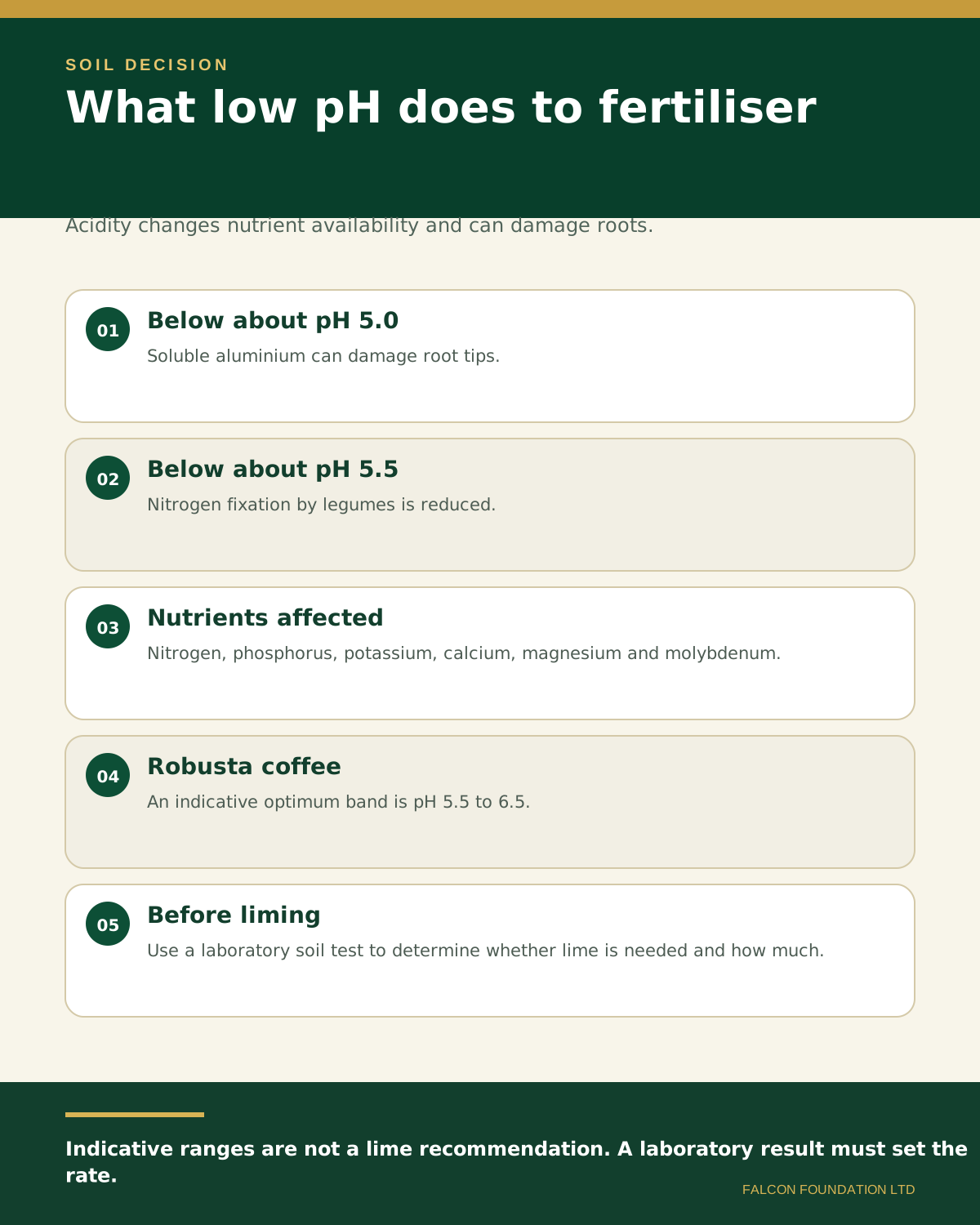
Aluminium becomes soluble and attacks roots. Below about pH 5, aluminium in the soil is released into the soil solution as toxic aluminium ions. These damage root tip cell structure and inhibit root elongation, so the plant cannot explore the soil for water or nutrients [5]. A crop with a stunted root system will look drought-stressed in a normal season.
Phosphorus gets locked up. Aluminium and iron bind phosphate into insoluble forms that roots cannot take up [5] [6]. This is why phosphate fertiliser can appear to do nothing on an acid soil. The phosphorus is there. It is simply not available.
Legumes stop fixing nitrogen. Low soil pH reduces nitrogen fixation by legumes, and liming increases legume yields by improving rhizobial survival and nodule formation [6] [7]. If your beans, groundnuts or soybean look pale and produce few nodules, acidity is a candidate explanation.
Calcium and magnesium leach away. Hydrogen ions displace base cations from the soil's exchange sites, and once displaced those cations are easily leached, leaving acid soils low in calcium and magnesium [8].
On top of that, acidity suppresses microbial activity and nutrient cycling, and liming has been shown to enhance both [7].
Signs that point to acidity before you have a test
None of these prove acidity. Together they justify paying for a test.
- Fertiliser response has declined over several seasons on the same land, without a change in rainfall or management.
- Legumes nodulate poorly, or nodules are few and pale when you cut them.
- Crops show phosphorus deficiency symptoms despite phosphate being applied.
- The land has been cultivated continuously for many years with little organic matter returned.
- The soil is a deeply weathered red or reddish-yellow subsoil type.
- Yields on the same field have fallen while a neighbour's newly opened land performs well.
Which crops feel it first
Crops differ in tolerance. FAO nutrient management guidance gives some useful reference points.
Cassava is frequently grown on acid laterite soils with pH around 4.0 to 4.5, but liming still has a large beneficial effect, raising starch content and lowering the toxic hydrocyanic acid content of the roots [9]. Groundnut calcium deficiency problems are corrected by liming to pH 6.0 [9]. Sugar cane tolerates a wide range from pH 5.0 to 8.0, but liming is recommended under very acid conditions specifically to avoid aluminium toxicity [9]. Potato grows best on slightly to moderately acid soils and tolerates a fairly wide range [9].
For Uganda's most important cash crop, the Robusta Coffee Handbook published in 2019 by the Uganda Coffee Development Authority with the Ministry of Agriculture, Animal Industry and Fisheries gives an optimal pH range of 5.5 to 6.5, states that below 5.5 crop performance will be limited, and says that adequate liming must be done to correct the pH [10].
We looked for institutional target pH ranges for maize, common bean and banana in Uganda and did not find them in a source we could open. Do not treat any figure for those crops as verified until you have seen it in a published document.
Confirming it: the soil test
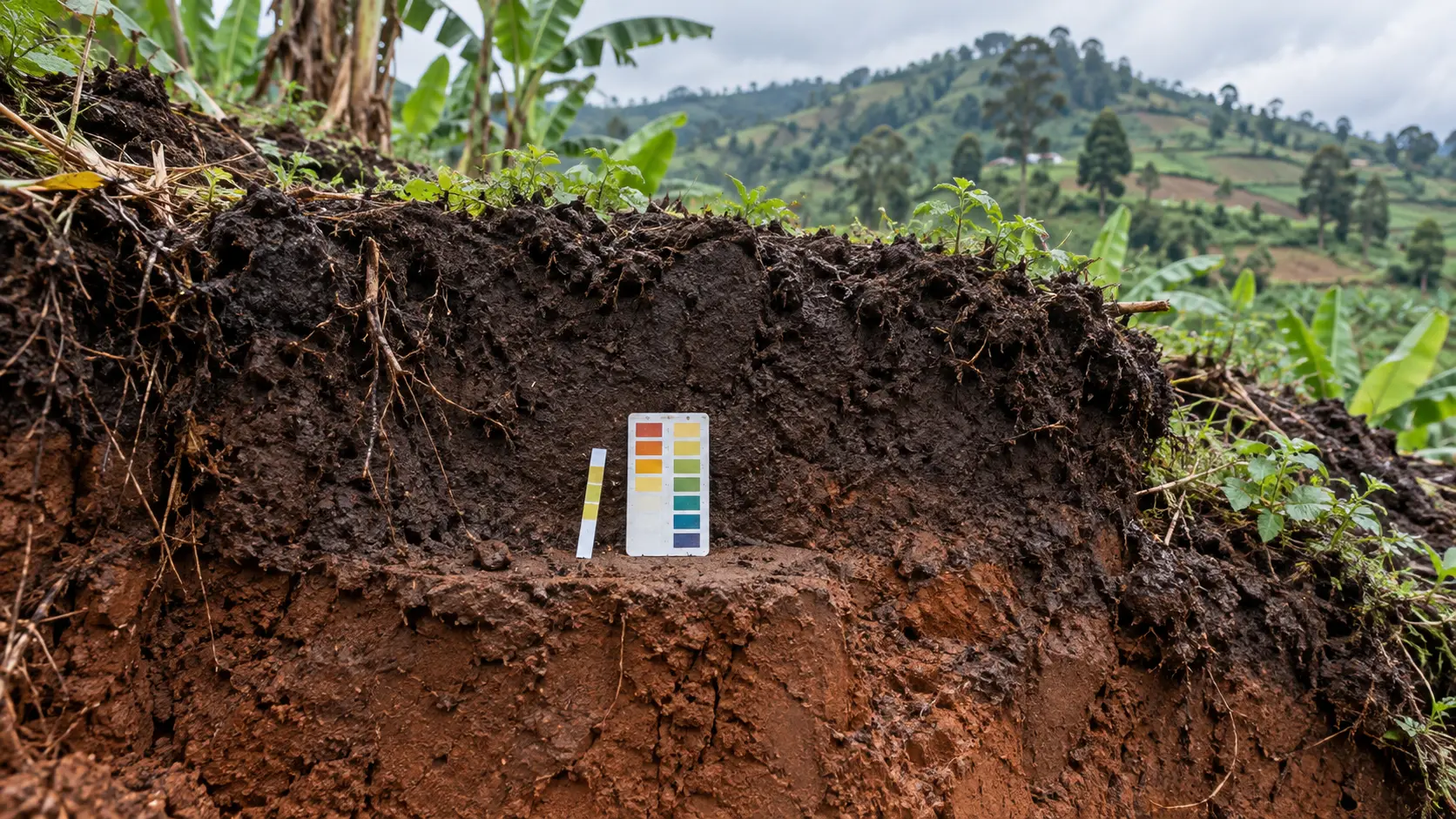
Soil acidity cannot be diagnosed by eye. It also cannot be corrected sensibly without a measurement, for a reason explained in the next section.
NARO's National Agricultural Research Laboratories at Kawanda lists soil testing analysis among its services. The published contact telephone number is +256 414 661977, and the laboratory is located at Kawanda, about 10 kilometres along the Kampala to Bombo road [11]. NARO's general laboratories services page groups its laboratories under four categories including soil health, but the page's own detail section currently states that content is coming soon, so scope and fees should be confirmed directly. NARO's general contact is Plot 11 to 13, Lugard Avenue, Entebbe [12].
Confirm the current service, turnaround and cost by telephone before sending samples. Our guide to soil testing and fertility covers how to take a representative sample, and our guide to reading a soil laboratory report covers what to do with the result.
Why we will not give you a lime rate
This is the most important section in the guide.
Two soils can show exactly the same pH and need very different amounts of lime. The reason is reserve acidity, sometimes called potential acidity, which is the acidity held on the soil's exchange sites rather than in the soil solution. Extension guidance from Ohio State explains that lime requirement is determined from soil pH plus a buffer pH measurement, which estimates how much of that reserve acidity must be neutralised [6].
FAO guidance on liming acidic soils sets lime requirement from soil pH, base saturation and aluminium saturation adjusted to crop demand, and gives a desired optimum base saturation of 50 to 60 per cent for most cereals and 60 to 70 per cent for legumes. It also cautions specifically against setting a lime requirement on exchangeable aluminium alone, because that relationship is soil-specific and depends on the soil's mineralogical properties [8].
So a blanket rate is not a shortcut. It is a way to apply either too little lime, which wastes the money, or too much, which creates its own nutrient problems.
Ask the laboratory for a lime requirement, not just a pH.
What Ugandan liming research shows, with its limits
A study on ameliorating soil acidity in Ferralsols of central Uganda, published in the International Journal of Plant and Soil Science, sampled soils from farmers' fields in Mpigi, Mubende and Wakiso districts. It tested calcium carbonate and corncob biochar at rates equivalent to 0, 1, 3 and 5 tonnes per hectare, in a greenhouse phase followed by a field trial using soybean varieties. Both amendments raised soil pH to near neutral, reported as 6.7 in Mpigi and 6.6 in Mubende [4].
That study also reports soybean yields from its field trial phase. We are deliberately not reproducing those yield figures here. They are far above what is typical for soybean in Uganda, they come from a single site-specific study, and the copy we could access is a self-archived one rather than the journal's own. A trial yield quoted without its conditions becomes a promise, and this guide does not make promises about yield.
Older field trial work on ferrallitic soils in Uganda, published in 1979, found crops responded to lime after the first cropping year on soils with pH up to 6.0, and attributed lime responses on soils above pH 5.2 to increased phosphate availability [13]. Only the abstract of that work was accessible.
Liming materials and what to check
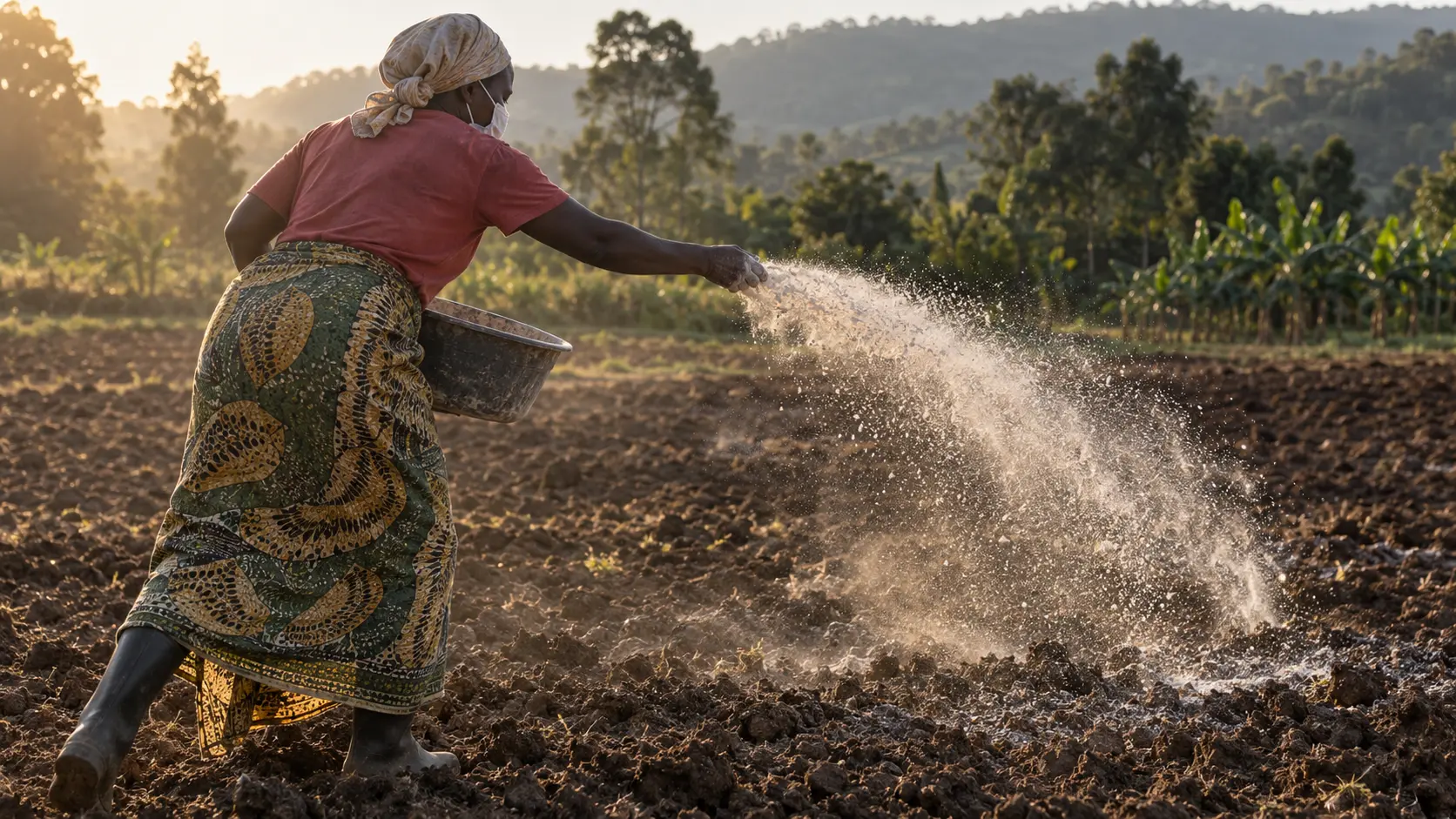
Two properties decide whether a liming material works: its neutralising value, which is how much acidity a given weight will neutralise, and its fineness, because finely ground material reacts quickly while coarse material reacts slowly [8]. Limestone is less soluble than most fertilisers, which is why it must go on well ahead of planting.
The common materials are calcitic ground limestone, which supplies calcium, and dolomitic limestone, which supplies calcium and magnesium and is usually preferable where magnesium is also low [8].
Uganda has a limestone resource base. United States Geological Survey reporting records domestic lime production, both hydrated and quick lime, of roughly 10,000 tonnes a year in the mid-2000s, and identifies the major limestone deposits at Hima and Tororo as the raw material base for the country's cement industry [14]. The current USGS country listing still names lime among Uganda's mineral commodities [15].
Here is the honest limitation. We could not verify whether lime produced at those sites is marketed and graded as agricultural lime as distinct from construction lime, and we could not verify its neutralising value, its particle size or any retail price. Every relevant supplier page we tried was inaccessible. Before you buy, ask the supplier in writing for the neutralising value, the calcium and magnesium content and the particle size distribution. If they cannot provide these, you cannot calculate how much to apply.
How long lime takes, and how often to re-test
Lime is slow. FAO guidance advises allowing several weeks for reaction in an acidic soil before sowing, notes that effects can be observable within about one month after application, and states that benefits can last up to six years and beyond depending on soil texture, nitrogen fertiliser use and rainfall pattern [8]. A meta-analysis on liming cites a study in which yield effects were still observed seven years after application [7].
For re-testing, Ohio State guidance states that annual soil testing is not necessary and that every two to four years is adequate, with more frequent testing on coarse, sandy soils [6].
Plan liming as a multi-year investment, not a season's input.
What liming will not fix
Liming corrects acidity. It does not add nitrogen, phosphorus or potassium, and it will not compensate for low organic matter, poor drainage, bad seed or late planting. On a soil that is both acid and depleted, lime makes your fertiliser work; it does not replace it. Our guide to fertiliser types and quality verification covers the other half of that equation, and micronutrient deficiencies covers the deficiencies that a standard soil test may not report.
Over-liming is a real risk. Raising pH too far reduces the availability of several micronutrients and cannot be easily reversed.
What to do next
- Write down the last five seasons of fertiliser use and yield on the affected field. A declining response is your first evidence.
- Cut open some legume nodules. Few or pale nodules support the acidity hypothesis.
- Telephone a soil laboratory, confirm the current service and cost, and ask specifically for pH and a lime requirement.
- Take a properly representative sample, following the sampling guide.
- When the result comes back, do not apply a rate you found elsewhere. Use the laboratory's recommendation.
- Ask any lime supplier for neutralising value, calcium and magnesium content, and particle size in writing.
- Apply well before planting, allow several weeks for reaction, and plan to re-test in two to four years.