The direct answer
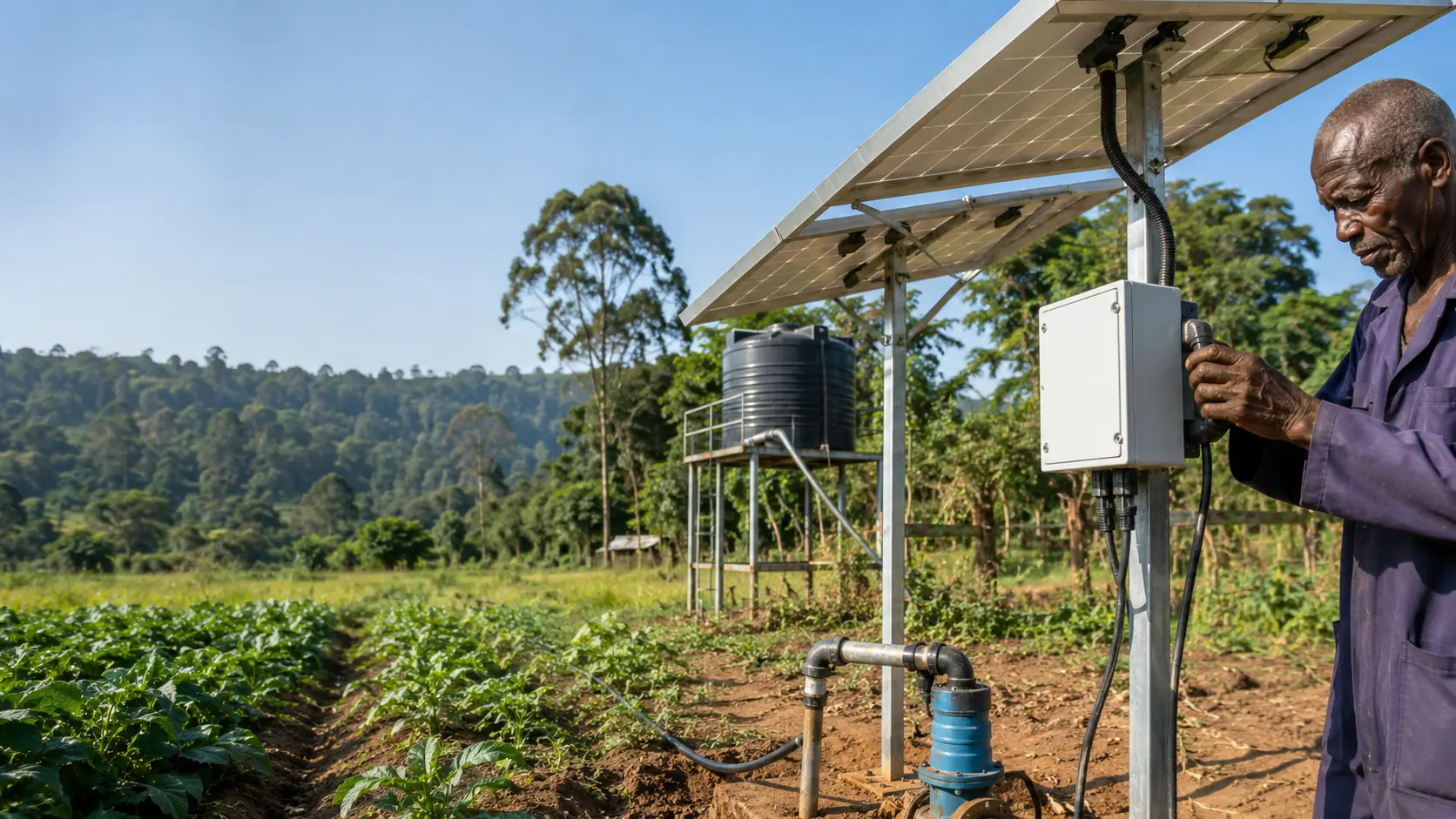
A solar irrigation system is four things: an array, a controller, a pump and somewhere to put the water. Get the fourth one right and the rest becomes manageable.
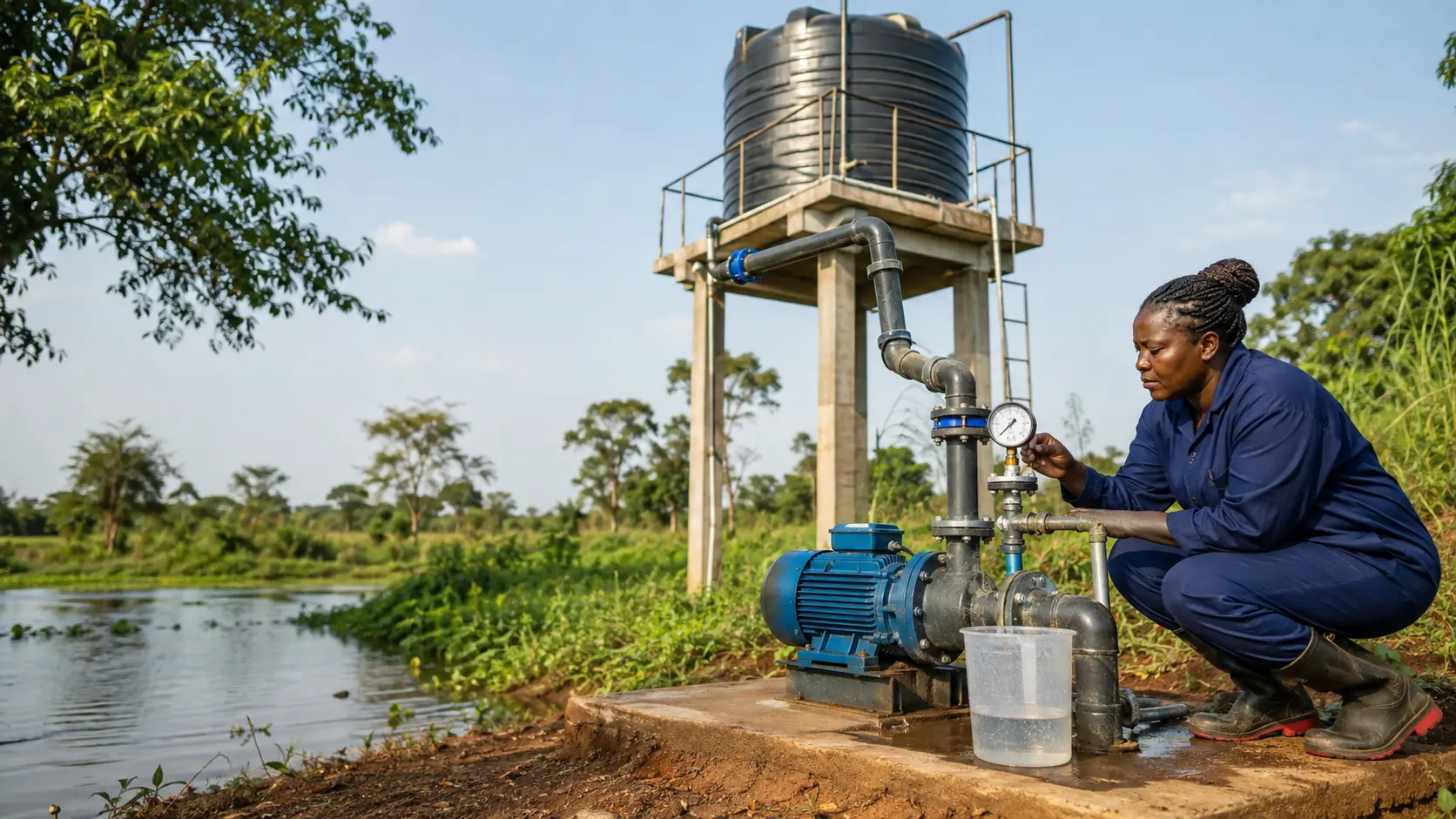
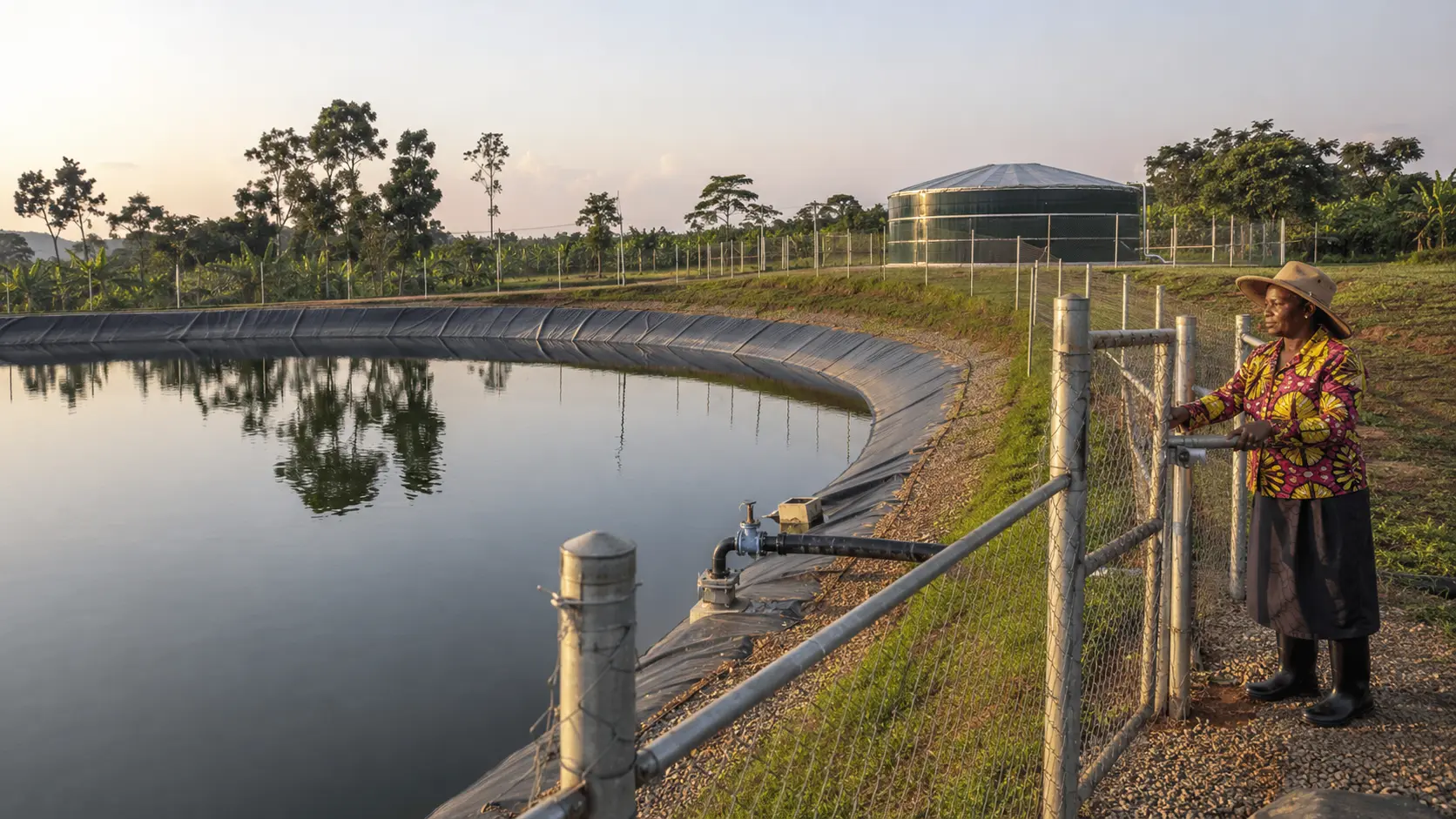
Most Ugandan farms should not buy batteries. FAO's practice brief on solar-powered irrigation is direct about it: "Though there are many promising developments in battery technologies, they are currently still costly, maintenance-intensive and require regular replacement. Currently, a more cost-effective option for storing energy is in the form of water pumped to an elevated tank or reservoir during sun hours." GIZ's technical report says the same in design terms: "Intermediate water storage tanks/basins (covered storage is to be preferred to avoid evaporation losses) should be integrated into the design of a Solar Powered Irrigation System", and "elevated storage tanks/basins that can provide onward gravity flow into the (low-pressure) network are ideal".
You store water, not electricity. That is the single most important sentence in this article.
Sizing follows from the duty point you calculated in Falcon's pump article. The GIZ and FAO solar pumping design module states that "The required size of the PV generator can be estimated using the following parameters: daily crop water requirement Vd [m3/day] total pumping head HT [m] mean daily global solar radiation G for the design month [kWh/m2day]." The World Bank's solar pumping technical paper gives the underlying energy relationship as "The hydraulic energy, E, in kWh can be calculated from E = Vh / 367", and benchmarks a good system at "about 4 - 5 %" conversion efficiency from daily solar energy to hydraulic energy.
Uganda's solar resource is good and quantified. A Global Solar Atlas point query for central Uganda returns a long-term average global horizontal irradiation of 2,074.8 kilowatt hours per square metre per year and a photovoltaic output potential of 1,642.8 kilowatt hours per kilowatt peak per year. Those annual figures divide to roughly 5.7 kilowatt hours per square metre per day and 4.5 kilowatt hours per kilowatt peak per day, though the daily figures are arithmetic on the annual totals rather than published values.
And the risk that institutions keep flagging is not technical, it is hydrological. GIZ's foreword names it: "One of the most pressing challenges as of today is the risk of groundwater exploitation by using PV-powered irrigation systems". FAO's brief agrees: "SPIS bears the risk of fostering over-exploitation of water resources, if not adequately regulated", and that "Overall, this can lead to wasteful water use, over-abstraction of groundwater, and low field application efficiency."
Falcon does not publish a solar irrigation cost, because no verified current Ugandan figure was obtained. Cost categories are given instead.
Who this article is for
Farmers considering solar irrigation, and farmers who have been offered a kit and want to know whether it is specified or merely packaged. Investors and lenders assessing a proposal. Installers who want a common specification language. Programme professionals designing subsidy schemes. Students.
You must have completed the pump duty point first. Solar sizing takes daily volume and total head as inputs, and without them any array size is a guess. Falcon's pump selection and sizing article produces those numbers, and Falcon's water source article produces the inputs to that.
The problem this solves
Solar irrigation is being promoted heavily in Uganda, by government and by vendors, and both promote in the same direction: adopt. What neither provides is the buyer's side of the transaction.
The national picture is real and verifiable. On 10 June 2026 Parliament of Uganda published an item titled "House approves EUR168.9m loan for mega solar irrigation", recording approval of a 168.9 million euro loan from "United Kingdom Export Finance (UKEF) and Citi Bank" for "427 solar-powered irrigation systems in coffee-growing areas across the country". The same item records that Hon. Karim Masaba said "the interest rate of the loan is very high and yet the Government had not presented other options", and that "The Leader of Opposition, Hon. Joel Ssenyonyi, called for accountability for the first phase of the loan." Falcon reports the debate as well as the approval because both are on the record.
Separately, the Ministry of Water and Environment hosts a project page for the Nexus Green solar-powered water supply and irrigation systems project, led by the Ministry, implemented by Nexus Green Ltd, funded by UK Export Finance, with the stated objective to "increase water supply coverage countrywide for domestic use and support irrigation for improved agricultural productivity", and the Ministry publishes field reporting on operating schemes.
There is also a distinct, differently funded strand. A World Bank account records that "In 2020, the Government of Uganda launched the Micro-scale Irrigation Program to support individual smallholder farmers to develop irrigation through a partial subsidy system combined with access to knowledge", that "The World Bank is supporting the program with a USD 50 million loan, expected to be matched by up to USD 24 million of farmers' contribution", and in one case study that "The cost was approximately USD 4,000, of which the family paid 25% and the Government subsidized 75%."
Falcon reports those three strands as three separate things, because they are. They are not one national solar irrigation programme, and a farmer being offered support should establish which one they are dealing with.
What none of that tells a farmer is whether the system on offer will work in their fourth dry season. That is the gap this article fills.
The decision you are making
You are deciding, for a specific farm:
- Whether solar suits your duty point at all.
- Array size in watts peak.
- Whether to store water or store electricity, and how much storage.
- Which components and which standards to insist on.
- What the installer must warrant, in writing.
- Whether your abstraction is authorised and sustainable.
Point 6 is the one that institutions worry about most and buyers think about least.
Uganda-specific context
Four Ugandan conditions shape whether a solar irrigation system works here.
The solar resource is good and it is quantified. A Global Solar Atlas point query for central Uganda returns long-term averages of 2,074.8 kilowatt hours per square metre per year of global horizontal irradiation and 1,642.8 kilowatt hours per kilowatt peak per year of photovoltaic output, from the Solargis solar model with data last updated 1 April 2026. Uganda is a country where solar pumping has a real physical basis, not a marketing one.
The dry season and the sunny season coincide. That alignment is solar irrigation's genuine structural advantage in Uganda: the array performs best in the months when irrigation matters most. It is worth stating plainly because it is the strongest honest argument for the technology here.
Groundwater is the constraint that national and international institutions keep raising. Every source Falcon opened on solar irrigation in sub-Saharan Africa names over-abstraction. GIZ calls it "One of the most pressing challenges as of today". FAO warns that solar irrigation "bears the risk of fostering over-exploitation of water resources, if not adequately regulated". A system with no fuel cost removes the natural brake on pumping, and in Uganda that brake was doing real work.
And Ugandan abstraction is a permitted activity. Under the Water Act, no person may extract water or construct works without authorisation, with narrow exceptions that do not cover commercial irrigation. A solar system does not change that position. Falcon's water sources article sets out the permitting landscape in full and this article does not repeat it.
Three national programme strands also exist, and they are separate from one another. They are described in the next section, because a farmer being offered support needs to know which one is being offered.
Step 1: check that solar suits your duty point
Bring forward from Falcon's pump article two numbers: daily volume in cubic metres and total head in metres.
The physics is unforgiving on head. The World Bank paper states it plainly: "The total head is proportional to the hydraulic energy requirement, with the result that it is cheaper to pump through lower heads." Every extra metre of head is extra energy, which on a solar system is extra array, which is extra capital.
Two practical implications.
- Reduce head before buying array. Moving the pump closer to the water, using larger pipe to cut friction, and siting the tank as low as gravity distribution allows are all cheaper than more panels.
- Solar suits steady, moderate daily volumes better than short high-flow bursts. A solar system pumps while the sun shines. If your method needs a large flow for two hours, either the array is large or the storage does the work.
And be honest about the season. The dry season is when you need irrigation and it is also, in most of Uganda, when the sun is best. That alignment is solar irrigation's genuine advantage and it is worth stating.
Step 2: size the array
Ask the installer to size the array from the measured duty point and the solar resource for the actual site and design month.
Inputs: daily crop water requirement Vd in cubic metres per day; total pumping head HT in metres; mean daily global solar radiation G for the design month in kilowatt hours per square metre per day.
The required array size depends on the daily water volume, total pumping head, available solar energy, pump and motor efficiency, controller losses and practical system margins. Require the installer to state every input, show the calculation and provide the selected pump's performance curve. Do not accept a panel count that is based only on farm area or pump nameplate power.
The cross-check. The World Bank paper gives the underlying hydraulic energy as "E = Vh / 367", with E in kilowatt hours, V in cubic metres and h in metres, and states that "The efficiency of conversion from the daily solar energy to hydraulic energy should be about 4 - 5 % for a good system". Those two together let you sanity-check any array size a vendor proposes. If a proposed system implies a solar-to-hydraulic efficiency far above five percent, ask how.
Which radiation figure to use
For a point in central Uganda, the Global Solar Atlas returns long-term averages of GHI 2,074.8 kilowatt hours per square metre per year, DNI 1,626.3, and PVOUT 1,642.8 kilowatt hours per kilowatt peak per year, using the Solargis solar model with data last updated 1 April 2026.
Three cautions.
- Those are annual totals. The daily equivalents, roughly 5.7 kilowatt hours per square metre per day of global horizontal irradiation and 4.5 kilowatt hours per kilowatt peak per day of photovoltaic output, are simple division and not published values.
- They are for one point in central Uganda. The drier north-east and the wetter south-west differ, and a design should use a point query for the actual site.
- The sizing method asks for the design month, not the annual average. Size for the worst month you intend to irrigate in, not the mean.
Ask your installer to show you the Global Solar Atlas figure for your coordinates and the design month they used. It takes them a minute and it tells you whether they sized or estimated.
Step 3: decide storage, and it should be water
This is where most of the money is saved or wasted.
The institutional position is consistent. FAO: batteries "are currently still costly, maintenance-intensive and require regular replacement", and the more cost-effective option is "water pumped to an elevated tank or reservoir during sun hours". GIZ: intermediate storage "should be integrated into the design", with "covered storage ... to be preferred to avoid evaporation losses", and elevated tanks that "provide onward gravity flow into the (low-pressure) network are ideal". The World Bank paper observed that "Very few solar pumping systems include batteries at present".
How much storage. The World Bank paper is the only source Falcon could verify that gives a duration: "Although 5 days may be desirable, in practice only about 2 or 3 days is usually affordable." That paper is from 1993, and Falcon flags its age rather than hiding it. Neither the 2017 FAO brief nor the 2020 GIZ report states a storage duration. Treat two to three days as a working starting point and discuss it with your installer against your own crop's tolerance for a missed irrigation.
Why the World Bank paper says storage matters at all: "with solar pumping there may be significant variations in sunshine from day to day, and so water may not be available when it is most needed without some form of storage."
Three design consequences for a Ugandan farm.
- Cover the storage. GIZ says so explicitly, to avoid evaporation losses. Falcon's water storage article covers evaporation and seepage in detail.
- Elevate it if the site allows. Gravity distribution from an elevated tank removes a pressure requirement from the pump and can remove a second pump entirely.
- Size the tank against the days of storage, not against the tank sizes the supplier stocks.
When batteries might still make sense. If the same array must also power something that cannot wait for sunshine, such as lighting or a cold chain, then a battery system is a different project with different economics. That is not solar irrigation, and it should be costed separately.
Step 4: specify the components and the standards
This is the buyer-check section, and it is the part vendors are least often asked about.
The standards to name
VeraSol's Global LEAP Solar Water Pump Test Method, version 3 of 11 March 2025, covers "small-scale (less than or equal to 2.2 kilowatts of PV power input) solar water pumping systems (SWPs) intended for deployment in stand-alone applications", and references IEC 62253: 2011, IEC 62257-9-5:2018 and IEC 62257-9-8:2020. VeraSol describes IEC 62253:2011 as "an international standard for Photovoltaic Pumping Systems- Design Qualification and Performance Measurements".
The Global LEAP method assesses "performance and durability of SWPs" and "overall system quality", including wire-to-water efficiency, head range, volume moved during simulated solar days, cold start, and protection against reverse polarity, dry runs, overvoltage and overcurrent.
VeraSol's quality standards page states that "Product packaging should include sufficient and accurate information on performance", requires safety features including "circuit and overload protection", covers durability including "workmanship quality, water and physical ingress protection", and requires consumer protection including "a detailed user manual and adequate warranty coverage."
The GIZ and FAO design module adds two specific asks: "only high-quality products should be offered that meet the standards of the International Electrotechnical Commission (IEC)", and equipment "should be protected to at least IP54 Ingress Protection rating or higher".
The buyer checklist
| Ask the supplier | Why it matters | What a good answer looks like |
|---|---|---|
| What duty point did you size this for? | Without it the system is a kit, not a design | Your flow and head, repeated back, with the design month named |
| Which solar radiation figure did you use, and for which month? | Sizing for the annual average undersizes the dry season | A point figure for your coordinates, for the design month |
| Show me the pump curve and the wire-to-water efficiency | This is what you are actually buying | A curve, with your duty point marked on it |
| Does the pump meet IEC 62253, or has it been tested under the Global LEAP or VeraSol regime? | Named standards exist for exactly this equipment class | A named standard or a test result, not "it is good quality" |
| What is the ingress protection rating? | GIZ asks for at least IP54 | An IP rating, stated |
| Does the controller protect against dry running, reverse polarity, overvoltage and overcurrent? | These are the protections the Global LEAP method tests | Yes, itemised |
| What is the warranty, on what, and for how long? | See the honest caveat below | A written warranty naming duration, coverage and how to claim |
| Where do spare parts come from and how long do they take? | GIZ identifies spare parts and after-sales service as a distinct issue | A named source and a realistic lead time, in writing |
| Who installs the electrical side and what are their qualifications? | Safety and warranty both depend on it | A named qualified person |
| What happens if the borehole yield falls? | Over-abstraction is the top institutional concern | A monitoring plan, not a bigger pump |
| Can I see a system you installed at least two dry seasons ago? | The failure mode is time, not commissioning | A site visit, arranged |
An honest note on warranties. Falcon could not verify any numeric warranty norm. The Global LEAP test method imposes no mandatory warranty duration; it only assesses whether the warranty information supplied states duration, coverage and how to claim. So do not accept "standard warranty" as an answer, and do not believe anyone who tells you a particular number of years is the industry standard. Get the actual terms in writing.
Step 5: plan for the documented failure modes
Institutions have written down how these systems fail. Read the list before you buy, not after.
| Failure mode | What the sources say | What to do about it |
|---|---|---|
| Groundwater over-abstraction | GIZ: "One of the most pressing challenges as of today is the risk of groundwater exploitation by using PV-powered irrigation systems". FAO: "SPIS bears the risk of fostering over-exploitation of water resources, if not adequately regulated" | Monitor your water level and record it. Do not respond to a falling level by pumping harder. See FF-105 |
| Wasteful use because the energy feels free | FAO: this "can lead to wasteful water use, over-abstraction of groundwater, and low field application efficiency" | Irrigate to a schedule based on crop need, not to whatever the array will deliver |
| Poor sizing | GIZ: "SPIS are designed and planned in a fragmented way ... Most systems are not planned in such a way that system capacity is oriented towards the specific farmer's requirement" | Bring your own duty point. This is the whole reason FF-604 comes first |
| Theft | GIZ: "Risks such as theft can negatively influence the decision-making of the farmer" | Design for it: mounting, fencing, visibility from the dwelling, and note where the array sits in your farm layout |
| Spare parts and after-sales | GIZ devotes sections to "Availability of SPIS Components on Local Markets" and "Spare Parts and After Sales Service" | Ask before buying, in writing |
| Capacity to manage the resource | GIZ: "The urgent need to improve farmers', advisors' and system installers' capacity to sustainably manage water resources in a SPIS has become evident" | Treat training as part of the purchase, not an extra |
Falcon could not verify any quantified failure or abandonment rate for solar irrigation in sub-Saharan Africa, because two directly relevant peer-reviewed reviews were inaccessible. The list above is what institutional sources name, not a measured frequency.
Field record: solar irrigation specification and verification sheet
| Item | Entry |
|---|---|
| Daily volume required, cubic metres per day, from FF-604 | |
| Total head, metres, from FF-604 | |
| Site coordinates | |
| Global Solar Atlas figure used, and for which design month | |
| Array size proposed, watts peak | |
| Sizing method shown by the installer? Yes or no | |
| Implied solar-to-hydraulic efficiency, cross-checked against the 4 to 5 percent benchmark | |
| Pump make and model, and whether a curve was supplied | |
| Wire-to-water efficiency at the duty point | |
| Standard claimed: IEC 62253, Global LEAP or VeraSol test, or none | |
| Ingress protection rating | |
| Controller protections: dry run, reverse polarity, overvoltage, overcurrent | |
| Batteries proposed? If yes, why, and what is the replacement cycle | |
| Water storage volume, and days of autonomy it represents | |
| Storage elevated? Covered? | |
| Warranty: what, how long, how to claim. Attach the document | |
| Spare parts source and stated lead time | |
| Installer name and electrical qualification | |
| Abstraction authorisation position, per FF-105 | |
| Baseline water level, measured and dated | |
| Reference system visited, its age and its condition | |
| Training provided, to whom, on what |
The row that predicts long-term success better than any other is the last but one: a reference system at least two dry seasons old, visited.
Costs
Falcon publishes no solar irrigation price, because no verified current Ugandan figure was obtained. One documented data point exists and is quoted with its full context rather than as a market price: in a World Bank case study of Uganda's Micro-scale Irrigation Program, "The cost was approximately USD 4,000, of which the family paid 25% and the Government subsidized 75%." That is one case study of one system under one subsidy programme, and it is not a price for a solar system on your farm.
| Cost category | What sits inside it | How to control it |
|---|---|---|
| Array | Panels, mounting, cabling | Reduce head first; every metre saved reduces the array |
| Pump and controller | The unit, and its protections | Specify to a duty point, with a curve |
| Storage | Tank or reservoir, elevation, cover | This is what replaces batteries. See FF-607 |
| Distribution | Pipework from storage to field | See FF-606 for the method |
| Civil and mounting | Plinth, frame, security measures | Include theft mitigation here, not as an afterthought |
| Electrical installation | By a qualified person | Never a place to economise |
| Batteries, if any | Purchase plus a replacement cycle | FAO describes them as costly, maintenance-intensive and needing regular replacement |
| Recurrent | Cleaning panels, servicing, spares | Ask for the schedule in writing |
| Monitoring | Water level measurement and recording | Cheap, and the only defence against the top institutional risk |
| Compliance | Abstraction authorisation, per FF-105 | Part of the project |
Where a subsidy or programme is involved, establish in writing which programme it is, what it covers, what you contribute and what obligations you take on. The three Ugandan strands described earlier are separate, differently funded and differently administered.
Common mistakes
- Buying a kit instead of specifying a system. A kit is sized for someone else's farm.
- Skipping the duty point. Without flow and head from FF-604, an array size is a guess.
- Sizing on the annual average radiation. Size for the design month, which is the worst month you will irrigate in.
- Buying batteries by default. FAO and GIZ both point to water storage instead.
- Uncovered storage. GIZ specifically prefers covered storage to avoid evaporation losses.
- Storage sized by what the supplier stocks rather than by days of autonomy.
- Not asking for the pump curve. No curve, no specification.
- Accepting "good quality" instead of a named standard. IEC 62253 and the Global LEAP and VeraSol regimes exist for this equipment class.
- Ignoring the ingress protection rating. GIZ asks for at least IP54.
- Believing there is a standard warranty length. There is not, and the Global LEAP method imposes none.
- Treating free energy as free water. FAO names wasteful use and over-abstraction as the consequence.
- Responding to a falling water level by pumping harder. That is the mechanism institutions warn about.
- No theft mitigation. GIZ names theft as a real factor in farmer decision-making.
- Not visiting an older installation. Commissioning day tells you nothing about year four.
- Unqualified electrical work. A safety and warranty failure at once.
Warning signs and escalation points
| Warning sign | What it means | What to do |
|---|---|---|
| The supplier cannot state the duty point they sized for | The system was not sized | Give them the FF-604 specification sheet and ask them to re-quote |
| The sizing uses an annual average radiation figure | The dry season will be undersized, exactly when it matters | Ask for the design-month figure for your coordinates |
| Batteries are proposed without a stated reason | Cost and maintenance are being added without a corresponding benefit | Ask what water storage would cost instead |
| No IEC standard or test regime is named | Quality is being asserted rather than evidenced | Ask again. If no standard is named, treat that as the answer |
| No written warranty terms | You have no recourse | Do not buy without them |
| No spare parts source or lead time | GIZ identifies this as a distinct sustainability problem | Get it in writing before purchase |
| Output falls year on year at the same season | Panel soiling or degradation, pump wear, or a falling water level | Clean and inspect first, then measure the water level. Do not increase pumping |
| The water level in your source falls across seasons | The over-abstraction risk that every institutional source names | Reduce abstraction and consult the Ministry of Water and Environment. See FF-105 |
| The pump runs dry or trips repeatedly | Controller protection working, or failing | Stop. Check the controller's dry-run protection and the water level |
| Anyone unqualified is working on the electrical side | Safety and warranty risk | Stop the work and engage a qualified electrician |
| The system was installed with no training given | GIZ names capacity as an evident need | Ask for training as part of the contract |
When solar irrigation works and when it does not
It works where the head is moderate, the daily volume is steady, the site has room for elevated or at least covered storage, the source can sustain the abstraction, and the buyer specifies rather than accepts a kit. It works especially well where the dry season and the sunny season coincide, which in most of Uganda they do.
It works partially where head is high. High head means a large array, and at some point another power source or a lower-head configuration becomes the better answer. The World Bank paper's point stands: it is cheaper to pump through lower heads.
It does not work where the water source cannot sustain the abstraction. This is the case where solar is actively dangerous rather than merely uneconomic, because a system with no fuel cost removes the natural brake on pumping. Every institutional source Falcon opened raises this.
It does not work where there is no realistic route to spare parts and service. A solar pump with no serviceable path is a capital asset with a short life.
And it does not substitute for the rest of the system. A well-specified array feeding a badly chosen irrigation method wastes the water it lifts. FF-606 covers the method.
A low-risk pilot
- Complete FF-604 first and write down your duty point. Do not start here.
- Get the Global Solar Atlas figure for your own coordinates, for the month you most need water.
- Ask three installers to size to that duty point and that design month, and to show their working.
- Compare the three array sizes. If they differ widely for the same inputs, at least two of them did not size it.
- Cross-check the proposed system against the 4 to 5 percent solar-to-hydraulic benchmark.
- Visit an installation each of them did at least two dry seasons ago, and talk to that farmer without the installer present.
- Start with storage and a modest array serving a small area. Storage is easier to add to than to retrofit around, and a small array proves the water source before you commit to a large one.
- Measure and record your source water level from day one, monthly, with dates. That record is your protection against the failure mode every institution names.
Limitations and professional-support triggers
What this article does not do. It states no solar irrigation price, no array cost, no warranty duration, no failure rate and no Ugandan reference evapotranspiration figure. It does not size your array for you, does not choose your irrigation method, does not design storage and does not endorse any supplier or product.
Three verification notes carried forward.
- The two to three days of storage guidance comes from a 1993 World Bank paper. Neither the 2017 FAO brief nor the 2020 GIZ report states a duration.
- The daily radiation figures are Falcon's own division of published annual totals, for one point in central Uganda, not published daily values and not a national average.
- Ministry of Water and Environment project specifics could not be verified verbatim. Site counts, dates and funding amounts on that project page are not reproduced here. The parliamentary loan figure is quoted from Parliament's own published item.
Bring in a professional when:
- A qualified electrician, for every electrical connection, without exception.
- An irrigation designer or agricultural engineer, to confirm the duty point and to review the proposed array size independently of the vendor.
- A hydrogeologist, if the source is a borehole and you intend to increase abstraction.
- The Ministry of Water and Environment, for abstraction authorisation, as set out in FF-105.
- An advocate registered in Uganda, before signing any supply, installation or subsidy agreement.
- Your lender or programme administrator, in writing, to establish exactly which programme any subsidy comes from and what obligations attach to it.
Clear next actions
- Complete the pump duty point in FF-604 and write the two numbers down.
- Get the Global Solar Atlas figure for your coordinates and identify your design month.
- Send the same duty point and design month to three installers and ask each to show their sizing.
- Ask every one of them the eleven buyer-checklist questions and write down the answers.
- Ask for the pump curve, the IEC standard or test result, the IP rating and the written warranty.
- Plan water storage rather than batteries, covered and elevated where the site allows.
- Visit at least one installation that is two dry seasons old.
- Measure your source water level today and start a monthly record, before any system is installed.