The direct answer
Storage is what turns a modest water source into a usable supply. It is also where more capital is quietly lost than anywhere else in a farm water system, for three reasons.
You will lose water to evaporation, and the shape of the store decides how much. FAO's manual on small earth dams states: "Evaporation losses can be high and will depend upon climate and the surface area of the stored water. A narrow deep reservoir will have a much smaller evaporation loss than a broad shallow reservoir, and as evaporation can vary from 0.3 m to 2.5 m per annum from temperate to arid climates, this can be a very important design consideration." The same manual notes that "Annual rates of evaporation from dams in Africa can exceed 30 percent but for calculating water uses (i.e. for irrigation), where actual figures are not known, dry season losses can be taken as 20 percent maximum."
You will lose water to seepage, and the only question is how much. FAO: "Seepage will always occur with an earth dam and will depend upon site soil conditions, the embankment itself and the depth of the water", and as a design allowance, "it is best to estimate that a well constructed embankment will lose about 10 percent of its water to seepage in any one year."
And the lining answer that most people reach for is the one FAO warns against in the tropics. On plastic sheeting: "Artificial impermeable materials, such as heavy duty plastic sheeting, have successfully been used in many parts of the world as an alternative to clay cores. In the tropics, however, such materials have been found to attract termites and rodents; have been burrowed into by animals and have not resisted settlement of the embankment after construction." FAO is equally cautious about the traditional Ugandan alternative: termite mound material "is losing favour beacause of its undesirable organic and mineral constituents; its variability within a small area and, once used, its subsequent attraction to termites (and their predators) despite its being treated with insecticide or mixed with diesel fuel." That spelling is FAO's own.
So a deep, narrow, covered store beats a broad shallow one, and lining choice needs local advice rather than a catalogue.
One more thing, and it is the most important paragraph in this article. Falcon searched for a Ugandan requirement or guidance on drowning risk, fencing and safety around farm water storage and found none published by the Ministry of Water and Environment, MAAIF or NEMA. The safety section below is therefore Falcon's own duty-of-care framework, clearly labelled as such. The absence of a published standard is not a reason to build without safety measures. It is a reason to be more careful, not less.
Who this article is for
Farmers building or planning water storage, from a plastic tank to a valley tank. Investors assessing whether a proposed storage volume is realistic once losses are counted. Extension officers. Installers.
You should have chosen your water source and completed your farm layout first, because storage siting is a zoning decision and its position depends on where water arrives and where it is needed. Falcon's articles on water sources and farm layout cover both.
If your interest is a fish pond for production, this article covers siting and safety but not stocking or husbandry, which belong elsewhere.
The problem this solves
Ugandan farms build storage that is too shallow, too open, too close to where children walk, and sized on the volume they wanted rather than the volume that survives a dry season.
The national context makes storage central. The Ministry of Water and Environment's Water for Production department states its mandate as the "Provision and effective utilization of water for multipurpose uses including storage, irrigation, livestock, and aquaculture; rural industries, wildlife and tourism and flood control", covering facility types including irrigation schemes, earth dams, valley tanks, deep boreholes and bulk water supply systems.
The Ministry publishes its own capacity bands, which are the most useful Ugandan reference points Falcon located. In its Service Delivery Standards FY 2025/26-2029/30, communal valley tanks are described as "All valley tanks impounding about 30,000 - 50,000m3 of water for at least 5,000TLUs", individual valley tanks as "All valley tank impounding about 1,000m3- 5,000m3 of water", and storage dams as "All storage dams impounding at least 1,000,000m3 of water ensuring water availability for irrigation of at least 100hectares & livestock watering for at least 10,000TLUs".
Read the middle band. An individual valley tank, in the Ministry's own terms, holds between 1,000 and 5,000 cubic metres. That is the scale most commercial Ugandan farms are actually working at, and it is a useful anchor when a contractor proposes something very different.
What the Ministry's standards document does not contain, and Falcon checked directly, is any statement about fencing, barriers, signage or drowning safety. Nor does its Water for Production department page. That is the gap this article names.
The decision you are making
For one farm, you are deciding:
- Whether to store in tanks, in a lined pond, or in an excavated or embanked structure.
- Where it goes, within the farm layout and outside any protected zone.
- What volume, after losses are subtracted rather than before.
- Whether and how to line it.
- Whether and how to cover it.
- What safety measures go in, and when.
- Who designs anything involving an embankment.
Point 7 has only one acceptable answer, and it is not you.
Uganda-specific context: what the law requires before you dig
Storage is "works" under the Water Act. The Act's definition of works includes "any works, excavations or boreholes ... where water or waste may be used, extracted, collected, diverted, stored, conducted, regulated, controlled, supplied, discharged, treated or measured", and section 18(1) provides that "No person shall construct or operate any works unless authorised to do so under this Part of the Act."
The Water Resources Regulations name a specific storage trigger. Regulation 3(1)(b)(ii) describes works including a "weir, dam, tank or other work capable of diverting or impounding an inflow of more than 400 cubic meters in any period of twenty-four hours", and regulation 15(3) provides that a person wishing to construct works "for the purpose of ... impounding, damming, diverting or conveying any surface water, whether or not on or adjacent to a waterway; or ... draining any land to fit any motorised pump to the works, may apply to the director for a construction permit".
Falcon does not state that any storage below a stated volume is exempt, because it found no such exemption in the instruments it opened. Establish your position with the Ministry of Water and Environment before you dig. Falcon's water sources article sets out the permitting landscape in full.
Protected zones apply. Under the National Environment (Wetlands, River Banks and Lake Shores Management) Regulations, 2000, regulation 29 gives scheduled rivers "a protection zone of one hundred metres from the highest water mark" and other rivers "a protected zone of thirty metres", regulation 30 gives scheduled lakes 200 metres and other lakes 100 metres, and both provide that "No activity shall be permitted within protected zones without the written authority of the Executive Director." Regulation 12(1) provides that "a person shall not carry out any activity in a wetland without a permit issued by the Executive Director."
Environmental assessment may apply. NEMA states that Schedule 4 of the National Environment Act lists "projects for which Project Briefs are required" and Schedule 5 lists "Categories of Projects for which an Environmental and Social Impact Assessment is mandatory", with Schedule 10 covering projects that may require assessment and Schedule 11 those exempted. The National Environment (Environmental and Social Assessment) Regulations, 2020 provide at regulation 6 that "A developer of a project in section 112 of the Act and set out in Schedule 4 of the Act shall assess the likely environmental, health and socio-economic impacts of the project."
Falcon could not verify whether farm dams, valley tanks or ponds appear in Schedule 4 or Schedule 5, because the Act's schedules could not be opened. Ask NEMA or your district environment officer whether your intended works require a project brief or a full assessment. Do not assume either way.
And physical planning applies. Under the Physical Planning Act, 2010, section 3, "The entire country is declared a planning area", and section 33(1) requires development permission from a physical planning committee.
Step 1: choose the type of storage
| Type | Typical scale | Suits | Main losses | Main risks |
|---|---|---|---|---|
| Plastic or steel tank | Small, roof catchment or pumped supply | Nursery, spraying, livestock water, solar pumping buffer | Almost none if covered | Cost per cubic metre; UV degradation of some plastics |
| Ferrocement or masonry tank | Small to medium | Where a durable fixed store is wanted and materials are local | Minimal, if sound | Cracking, requiring competent construction |
| Lined excavated pond | Medium | Where soil is too permeable to hold water and the site is flat enough to excavate | Evaporation from the open surface; seepage if the lining fails | Lining failure, and the tropical lining problems FAO names |
| Unlined excavated pond | Medium | Only where the soil genuinely holds water | Evaporation plus significant seepage | Discovering the soil does not hold water after excavating |
| Embanked pond or valley tank | Medium to large. MWE's individual band is 1,000 to 5,000 cubic metres | Farms with a catchment and a suitable valley position | Evaporation, seepage through and under the embankment | Embankment failure. This is a life-safety risk and requires professional design |
| Valley dam | Large. MWE's storage dam band starts at 1,000,000 cubic metres | Community or estate scale | All of the above | Far beyond farm-scale self-build |
The decision rule. Tanks are expensive per cubic metre and lose almost nothing. Open storage is cheap per cubic metre and loses a great deal. The right answer for most farms is a small covered tank for the uses that need clean water and reliable supply, plus larger open storage for bulk irrigation, sized with the losses counted.
Step 2: site it
Storage siting is part of the farm layout, and Falcon's layout article covers the surrounding zoning. These are the storage-specific rules.
Site it high if you can. Elevation is free pressure. Gravity distribution from an elevated store removes a pumping stage, which is exactly why GIZ's solar irrigation guidance recommends "elevated storage tanks/basins that can provide onward gravity flow into the (low-pressure) network".
Site it where water arrives naturally. A store filled by gravity from a catchment costs nothing to fill. A store filled by pumping costs energy every time.
Site it away from where children walk. This is the rule with no published Ugandan standard behind it and the one that matters most. Not on the path to school. Not between the house and the borehole. Not where a footpath cuts a corner.
Site it outside protected zones. See the regulations above, and confirm the boundary with NEMA or your district environment officer.
Site it away from latrines, animal housing and the compost area, and downslope of none of them. Contamination travels downhill.
Site it deep rather than broad. FAO is explicit that "A narrow deep reservoir will have a much smaller evaporation loss than a broad shallow reservoir". On a given volume, depth is free evaporation control.
Site it where a vehicle can reach it for maintenance and desilting.
And do not site an embanked structure above anything you care about, including a house, a road, a neighbour's land or livestock. That is a professional siting decision.
Step 3: size it, with the losses counted
This is where most storage plans fail, because they size to demand and then discover the losses.
The loss allowances
Falcon uses FAO's own design allowances, stated as allowances rather than as measurements of your site.
- Seepage: "it is best to estimate that a well constructed embankment will lose about 10 percent of its water to seepage in any one year."
- Evaporation, dry season: FAO advises that where actual figures are not known, "dry season losses can be taken as 20 percent maximum."
- Evaporation, annual, African context: FAO notes that "Annual rates of evaporation from dams in Africa can exceed 30 percent", and cites an estimate that "Evaporation from dams in South Africa is estimated at 25-30 percent of the water stored per annum."
On evaporation depth figures
FAO's range of "0.3 m to 2.5 m per annum from temperate to arid climates" is the design bracket. Falcon looked for a directly measured Ugandan open-water evaporation figure and could not verify one. The nearest verified East African number is a modelled climatology for Lake Victoria: "The mean annual evaporation over the lake is 1521 mm yr-1", derived from a regional climate model rather than from measurement.
Falcon flags three reasons not to use that number for your pond. It is modelled, not measured. It is for a very large, very deep lake, whose thermal behaviour is nothing like a shallow farm pond. And a shallow pond in the sun will typically behave differently from a deep lake. Use FAO's percentage allowances for design, and ask your district water officer or an irrigation specialist for a local evaporation figure if you need one.
The sizing method
- Start with dry-season demand, from the calculation in Falcon's pump article: daily volume multiplied by the number of days storage must carry.
- Add the seepage allowance, using FAO's 10 percent per year for an earth structure, pro-rated to your storage period.
- Add the evaporation allowance, using FAO's dry-season maximum of 20 percent for open storage where local figures are unknown.
- Add a dead storage allowance for the volume you cannot practically draw down, and for silt accumulation.
- Compare the total with what your catchment or source can actually deliver. A store larger than the water available to fill it is an expensive hole.
- Then reduce the surface area for the same volume, by going deeper, which cuts the evaporation loss you just calculated.
Worked logic, not worked numbers. Falcon does not publish a worked example with figures, because the inputs are entirely site-specific and a specimen calculation is routinely mistaken for a recommendation. The sequence above is the method; your district water officer or irrigation designer supplies the inputs.
Step 4: decide on lining
First establish whether you need it. Dig a test pit at the intended site, fill it with water, and see how fast it drains. If it holds water for days, the soil may be suitable unlined. If it empties overnight, you have your answer. This is a rough test and it is far better than assuming.
Then read FAO's tropical warning before choosing a material.
On plastic sheeting: "In the tropics, however, such materials have been found to attract termites and rodents; have been burrowed into by animals and have not resisted settlement of the embankment after construction."
On termite mound material, which is a traditional Ugandan choice: it "is losing favour beacause of its undesirable organic and mineral constituents; its variability within a small area and, once used, its subsequent attraction to termites (and their predators) despite its being treated with insecticide or mixed with diesel fuel."
Falcon does not tell you which lining to use, because FAO's small earth dams manual covers clay cores and warns about the two alternatives above, and Falcon could not verify guidance on bentonite or on modern geomembrane products under Ugandan conditions. This is a decision for a qualified engineer with knowledge of your soils. What this article gives you is the two documented failure modes to raise with them.
On drainage, FAO does give a usable measure: "Either a rock toe or drainage layer ('blanket') of gravel or similar material will help relieve seepage problems in the downstream areas of an embankment on impervious foundations."
Step 5: cover it, if you can
GIZ's solar irrigation guidance recommends that "covered storage is to be preferred to avoid evaporation losses". For tanks, covering is standard. For ponds, full covering is rarely practical at scale, but partial measures help:
- Depth over breadth, which is the single most effective evaporation control available and costs nothing extra at the design stage.
- Shade from trees on the sun-facing side, provided root systems are kept away from any embankment. Ask the engineer about this, because tree roots in an embankment are a failure mechanism.
- Windbreaks, since evaporation rises with air movement across the surface.
Covering has a second benefit that matters more than evaporation on many farms: a covered store is a safer store, and it keeps the water cleaner for spraying and for drip irrigation, where suspended solids and biological growth are direct clogging risks. Falcon's irrigation method article sets out those thresholds.
Step 6: safety, in the absence of a Ugandan standard
This section is Falcon's own duty-of-care framework. Falcon searched the Ministry of Water and Environment's service delivery standards, its Water for Production department page and NEMA's material, and found no published Ugandan requirement or guidance on fencing, barriers, signage or drowning safety around farm ponds, valley tanks or valley dams. Nothing below is presented as a legal requirement, because Falcon could not verify one.
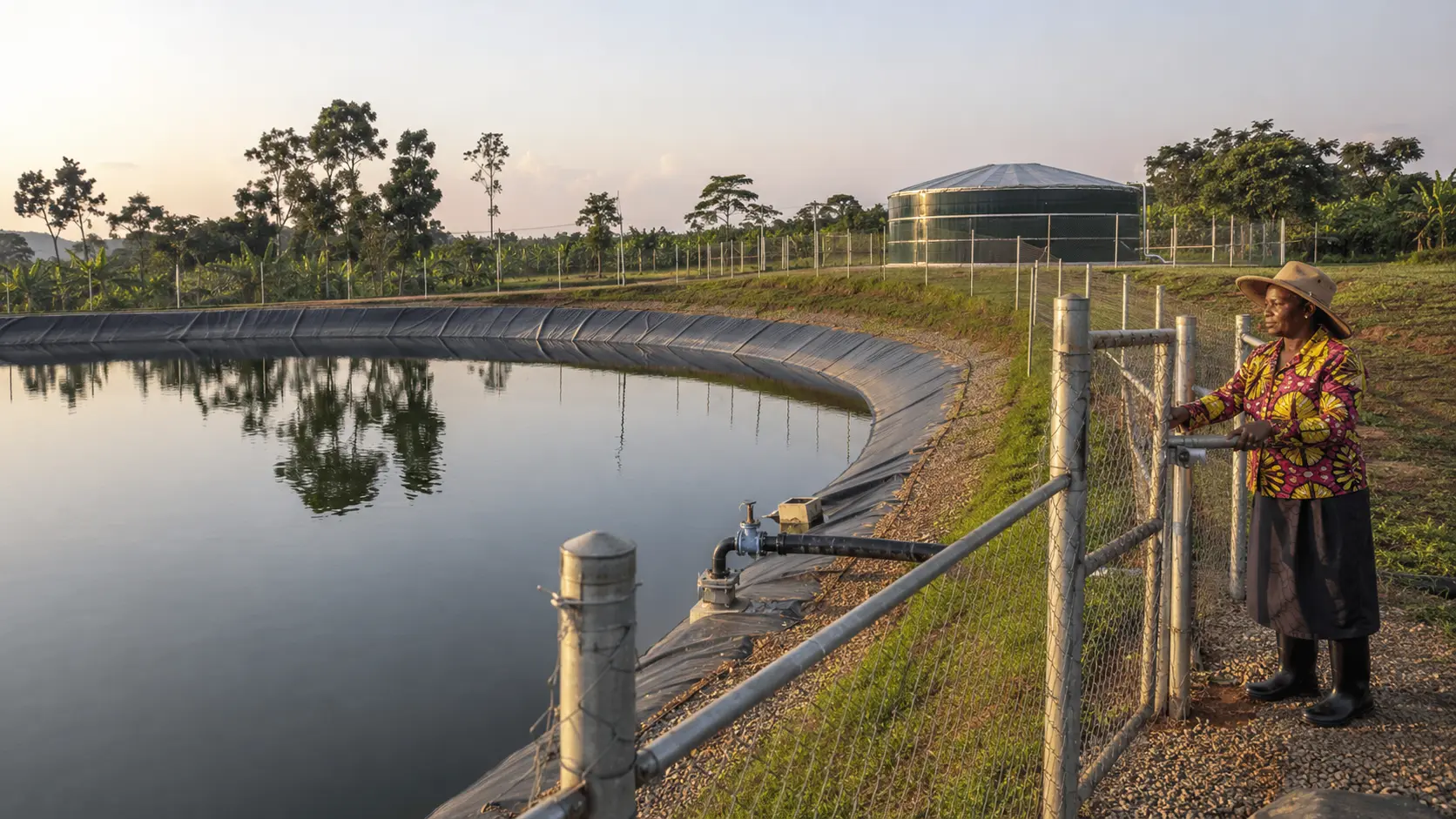
Open water on a farm is a permanent hazard to children, to visitors and to livestock. A valley tank in the Ministry's individual band holds between 1,000 and 5,000 cubic metres. Depth, not volume, is what drowns people, and a store deep enough to control evaporation is deep enough to be dangerous.
Falcon's minimum measures
| Measure | Why | When |
|---|---|---|
| Fence the store, with a gate that closes | The single most effective barrier between a child and open water | Before the store first holds water, not after |
| Site it away from paths, especially routes children use | Prevention beats barriers | At the siting stage, which is why this is in Step 2 |
| Shape at least one bank as a gradual slope rather than a vertical edge | A gradual bank is a way out. A vertical edge is not | At design, with the engineer |
| Provide a fixed exit aid: steps, a ladder, or a knotted rope secured at the top | Someone who has fallen in needs a way out, not a shout | At construction |
| Keep a long pole or a rope with a float near the store | Reaching and throwing rescue, which does not require the rescuer to enter the water | Immediately |
| Mark the water's edge where the bank is steep | The edge is not always visible from above, especially in vegetation | At construction |
| Tell everyone on the farm, including visiting workers, where the store is and that it is deep | Most incidents involve someone unfamiliar with the site | Induction, and repeat it |
| Never allow swimming or washing in irrigation storage | It is not designed for it, and it contaminates irrigation water | Standing rule |
| Water livestock at a trough fed from the store, not at the store itself | Protects the bank from trampling and the animals from drowning | At design |
| Inspect the fence and the exit aids monthly and record it | Barriers fail quietly | Monthly, on the record sheet |
Falcon's honest position: the absence of a published Ugandan standard means nobody will inspect this for you. That makes it the farm owner's responsibility entirely.
Step 7: know when to stop and call an engineer
Any structure that impounds water behind an embankment is a structure whose failure sends that water downhill at once. That is a life-safety matter, not an agronomic one.
Engage a qualified civil or agricultural engineer whenever:
- The store relies on an embankment rather than purely on excavation.
- There is anything downstream that would be harmed by a sudden release: a house, a road, a field, a neighbour, livestock.
- The store requires a spillway, which almost all embanked ponds do.
- The excavation is deep enough that the sides could collapse during construction.
- The soil is uncertain and lining is being considered.
- Any part of the works falls near a wetland, river or lakeshore.
Falcon does not publish embankment dimensions, spillway sizing, side-slope ratios or compaction specifications, because those are site-specific engineering outputs and publishing generic figures would be dangerous.
Field record: storage siting, sizing and safety sheet
| Item | Entry |
|---|---|
| Storage type proposed | |
| Location, marked on the farm layout drawing | |
| Distance and elevation relative to the point of use | |
| Filled by gravity or by pumping | |
| Test pit water-holding observation, and the date | |
| Dry-season daily demand, cubic metres, from FF-604 | |
| Days of storage required | |
| Base volume required | |
| Seepage allowance applied, and the basis | |
| Evaporation allowance applied, and the basis | |
| Dead storage and silt allowance | |
| Total design volume | |
| Surface area at full supply level | |
| Maximum depth | |
| Depth-to-area ratio, noting FAO's preference for narrow and deep | |
| Catchment or source capable of filling it? Evidence | |
| Lining: required, material, and who advised it | |
| Cover or shading provided | |
| Inside a NEMA protected zone? Confirmed by whom and when | |
| Project brief or environmental assessment required? Confirmed by whom and when | |
| Water Act authorisation position, per FF-105 | |
| Physical planning permission position | |
| Engineer engaged for embankment or spillway design? Name and date | |
| Safety measures installed, itemised, with dates | |
| Monthly safety inspection log started? | |
| Silt level measured, date 1 | |
| Silt level measured, date 2 |
Costs
Falcon publishes no construction costs, tank prices or excavation rates, because none was verified.
| Cost category | What sits inside it | Notes |
|---|---|---|
| Investigation | Test pits, soil advice, survey | Smallest line, largest consequence |
| Design | Engineer's fees for anything embanked | Not optional where there is an embankment |
| Authorisation | Water Act, NEMA and physical planning processes | See FF-105 for the water permitting landscape |
| Excavation and earthworks | Machine or hand excavation, embankment forming, compaction | The largest single item on a pond |
| Lining | Material and installation, if required | Read FAO's tropical warnings before choosing |
| Inlet, outlet and spillway | Structures that control water entering and leaving | The spillway is a safety component, not a convenience |
| Cover or shading | Tank covers, shade planting, windbreaks | Cheap relative to the evaporation it prevents |
| Safety | Fencing, gate, exit aids, rescue pole or rope, marking | Budget it as a line item from the start, because nobody will require it of you |
| Recurrent | Desilting, fence and bank repair, monthly inspection | Silt accumulation reduces your storage every year |
| Contingency | The first wet season, which will show you what you missed | Do not set it at zero |
Common mistakes
- Sizing to demand and ignoring losses. FAO's own allowances are 10 percent seepage per year and up to 20 percent dry-season evaporation where local figures are unknown.
- Building broad and shallow. FAO states directly that a narrow deep reservoir loses much less to evaporation than a broad shallow one.
- Assuming the soil will hold water. Dig a test pit and fill it first.
- Reaching for plastic sheeting as the default lining. FAO's tropical warning names termites, rodents, burrowing animals and settlement.
- Using termite mound material because it is traditional. FAO explains why it is losing favour.
- Building an embankment without an engineer. The failure mode is sudden and downhill.
- Omitting or undersizing a spillway. Overtopping is how embankments fail.
- Building inside a protected zone. Written authority from the Executive Director is required.
- Not asking whether a project brief or environmental assessment is required. Falcon could not verify whether farm dams fall in Schedule 4 or 5, so you must ask.
- Leaving safety until after the store fills. By then the hazard exists and the budget is spent.
- No fence. There is no Ugandan standard requiring one, which means nobody will make you, which means it is entirely on you.
- Letting livestock water directly at the bank. It destroys the bank and endangers the animals.
- Never measuring silt. Your storage volume falls every year and nobody notices until the dry season is short.
- Storing water for drip irrigation in an open, uncovered pond and not testing it. Suspended solids and biological growth are direct clogging risks. See FF-606.
Warning signs and escalation points
| Warning sign | What it means | What to do |
|---|---|---|
| Wet ground or seepage appearing on the downstream face of an embankment | Seepage is finding a path through the structure. This can precede failure | Treat as urgent. Lower the water level if you can do so safely, keep people and animals away from below it, and get an engineer immediately |
| Cracking, slumping or a soft spot on an embankment crest | Structural movement | Same as above. Urgent, engineer, keep the area below clear |
| Water level falling far faster than evaporation would explain | Seepage or a lining failure | Investigate. Do not simply refill |
| The store empties before the end of the dry season, every year | It was sized before losses, or the source cannot fill it | Recalculate with the loss allowances. Consider depth over area |
| Water is green, smells, or is thick with suspended matter | Biological growth and solids. A direct problem for drip irrigation | Test it. See the clogging thresholds in FF-606 |
| A child or an unaccompanied person is found near the store | The siting or the fencing has failed | Fix the barrier that day. This is not a matter for the next budget cycle |
| The fence is down or the gate does not close | The single measure standing between the water and a child | Repair immediately and record it |
| Livestock are drinking at the bank and the bank is breaking down | Bank erosion and a drowning risk | Install a trough fed from the store |
| Silt has visibly reduced the depth | Your storage volume and your evaporation ratio are both getting worse | Plan desilting. Address the catchment erosion feeding it. See FF-106 |
| Any part of the works is discovered to be inside a protected zone | A legal exposure | Stop and consult NEMA or the district environment officer |
When on-farm storage works and when it does not
It works where the source cannot meet peak demand directly but can meet average demand over time, which is the situation on most Ugandan farms with a modest borehole or a seasonal stream. It works particularly well with solar pumping, where storage substitutes for batteries.
It works where the site allows depth, and where elevation allows gravity distribution.
It works partially where the only feasible position is broad and shallow. The store will still be useful and it will lose more, and the sizing must reflect that rather than pretending otherwise.
It does not work as a way to make a fundamentally inadequate source adequate. Storage moves water in time; it does not create it. If the annual yield of the source is less than the annual demand, no amount of storage fixes that. That is FF-105's question and it must be answered honestly first.
It does not work where the soil will not hold water and lining is not affordable. In that case a tank at smaller volume, serving the highest-value uses, is a better use of the same money than a leaking pond.
And it must not be built as an embanked structure without professional design, whatever the cost pressure.
A low-risk pilot
- Dig a test pit at the intended site, fill it and time how long it holds water. This single test can change the whole design and costs an afternoon.
- Measure your actual dry-season use for one season from an existing tank or drum before sizing anything permanent. Most farms overestimate.
- Start with a tank rather than a pond, sized for the uses that most need reliable clean water: nursery, spraying, livestock and a solar pumping buffer.
- Watch it through one full dry season and record how far it draws down and how fast.
- Put the safety measures on the tank installation too, so that the habit exists before the larger store does.
- Only then design open storage, using a season of real drawdown data rather than an estimate.
- Have an engineer look at the site before any embankment is proposed, even informally. It is far cheaper than a redesign.
- Measure and record silt annually from the first year, so that you know the real rate rather than guessing at year five.
Limitations and professional-support triggers
What this article does not do. It publishes no construction cost, no tank price, no excavation rate, no embankment dimension, no spillway sizing, no side-slope ratio and no compaction specification. It does not design any structure. It does not cover fish stocking or husbandry.
Four verification gaps, stated openly.
- No published Ugandan requirement or guidance on drowning risk, fencing or safety around farm water storage was found. The safety section is Falcon's own framework, labelled as such.
- No directly measured Ugandan open-water evaporation figure was verified. The only East African figure Falcon could verify is a modelled Lake Victoria climatology, which is not transferable to a farm pond.
- Whether farm dams, valley tanks, ponds or irrigation works appear in Schedule 4 or Schedule 5 of the National Environment Act could not be verified, because the schedules could not be opened. Ask NEMA.
- No FAO guidance on bentonite lining or on modern geomembranes under tropical conditions was verified. FAO's small earth dams manual covers clay cores and warns about plastic sheeting and termite mound material.
A legal currency note. The Water Act text quoted is from a copy stating Chapter 152, and Uganda has since issued a revised edition of its principal laws. Confirm current citations before relying on a section number. Falcon's water sources article carries the same note in full.
Bring in a professional when:
- A qualified civil or agricultural engineer, for any embankment, any spillway, any deep excavation and any lining decision. This is the non-negotiable one.
- The Ministry of Water and Environment and your district water officer, for Water Act authorisation before construction.
- NEMA or your district environment officer, to confirm protected zone boundaries and whether a project brief or environmental assessment is required.
- Your district physical planning office, for development permission.
- An accredited water testing laboratory, before using stored water in a pressurised irrigation system.
- Your district production office, for local evaporation and siltation experience.
Clear next actions
- Mark the intended storage position on your farm layout drawing and check it against the siting rules.
- Dig a test pit at that position, fill it, and record how long it holds water.
- Bring forward your dry-season daily demand from the pump calculation.
- Size the store with the seepage and evaporation allowances added, not subtracted afterwards.
- Check with NEMA or your district environment officer whether the position is inside a protected zone and whether an assessment is required.
- Put the Water Act authorisation question to the Ministry of Water and Environment in writing.
- Engage an engineer before any embankment is designed, and budget the safety measures as a line item now.
- Start the storage record sheet, including the monthly safety inspection log, on the day construction begins.