
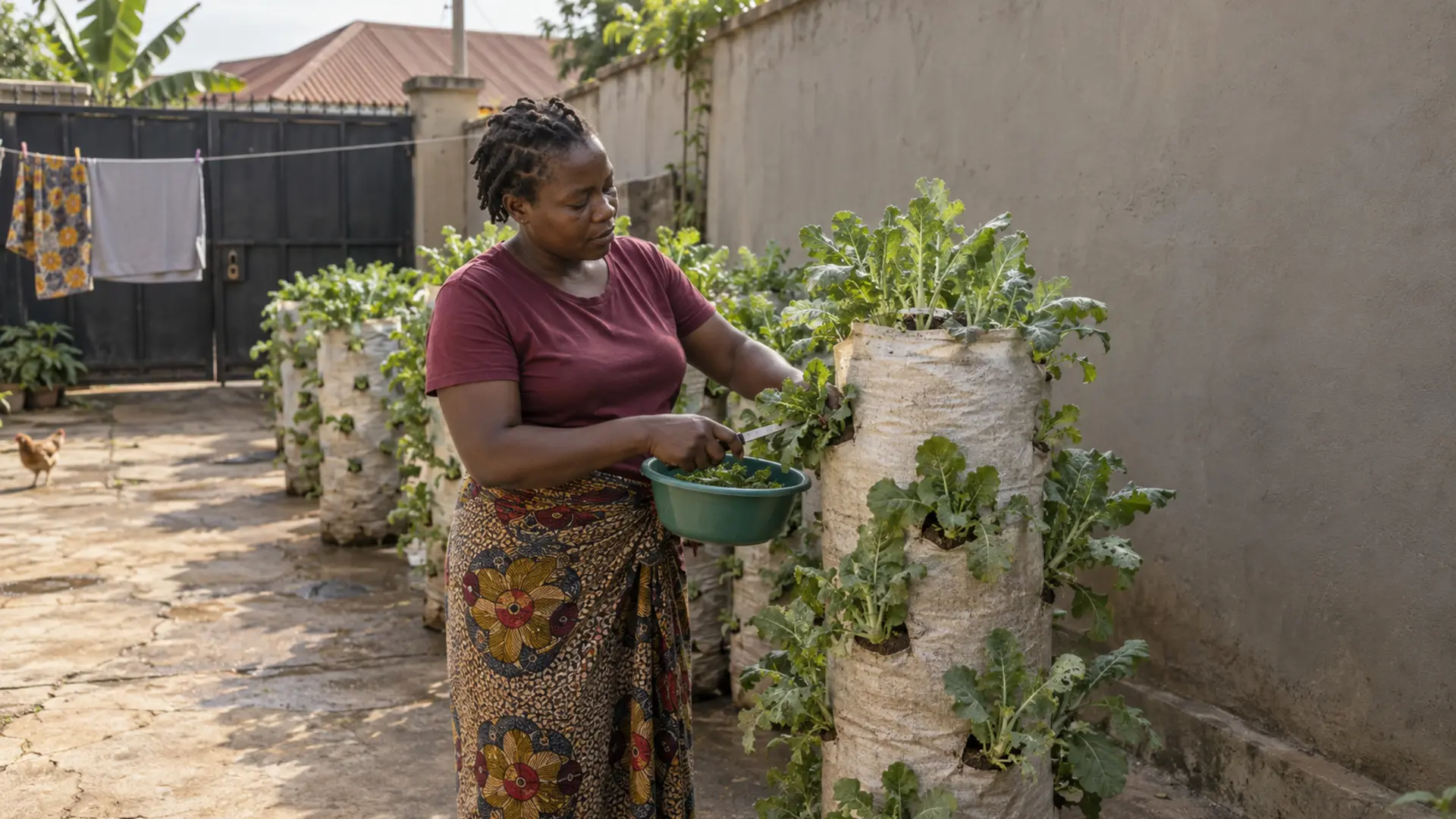
Most advice about urban food growing is written for people who have soil.
A typical Kampala compound does not. It has concrete, a strip of packed earth along a wall, a shared yard where children play and washing dries, a gate, and somewhere between two and eight hours of direct sun depending on which neighbour built what. The soil that does exist is of unknown history. Space is contested. Water comes from a jerrycan or a tap with a queue behind it.
Growing food in that setting is entirely possible, and households across Kampala do it. But it works on a different logic from field agriculture, and the failures are specific: containers that drown their own roots, media dug from somewhere it should not have been dug, crops chosen for a light level the compound does not have, and watering decided by looking at the surface.
This guide addresses those four things.
Why this is worth doing, honestly stated
A small compound will not feed a household. It is not a farm and pretending otherwise sets people up for disappointment.
What it will do is produce a continuous supply of the crops that are bought most often in the smallest quantities and at the highest unit cost: leafy greens, herbs, and a steady trickle of fruiting vegetables. These are the items that are purchased two or three times a week, that wilt within a day of purchase, and that a household buys at retail prices in small amounts. Replacing those purchases has a real effect on a household budget, and it also puts fresh green vegetables within reach on days when nobody goes to the market.
It also gives a household control over how its vegetables were grown, which matters more in a city where produce arrives from unknown fields.
That is the honest scope. Staples are not in it.
What this guide covers and what it does not
It covers soil-based growing in sacks, containers and towers: construction, drainage, media, safe sourcing, watering and crop selection by light.
It does not cover hydroponics, which is a different system with different costs and a different failure mode. It does not cover mushrooms, which are covered separately in oyster mushrooms on farm waste, and which happen to be one of the few genuinely productive options for a dark space. It does not cover greenhouses or urban livestock.
Start with the sun, not the container
The most common reason a Kampala sack garden fails is that it is in the wrong place, and the reason it is in the wrong place is that nobody measured the light before deciding.
Direct sunlight is not the same as brightness. A compound can feel bright all day because of reflected light off white walls and still receive only two hours of direct sun, and two hours of direct sun will not produce a tomato no matter how good the media is.
Measure it. Pick one clear day, choose the spot where you intend to put the container, and write down the time whenever direct sun arrives on that spot and whenever it leaves. Do it for the whole day. The total is your sun-hours figure, and it is the number that decides your crop list.
Two things about that measurement. First, it changes across the year as the sun’s path shifts and as the neighbours build, so repeat it in a different season. Second, the shade in a compound is usually from a fixed structure, which means the measurement is stable and worth the effort: unlike a farmer’s weather, your compound’s shade is not going to surprise you.
Growing Food in a Small Kampala Compound: Sacks, Towers and Containers That Actually Produce
A three-band crop selection card grouping container crops by the hours of direct sunlight a space receives, with a short method for measuring the sun hours in a compound.
Broadly, leafy crops tolerate the least direct sun, root crops need more, and fruiting crops - tomato, pepper, the cucurbits - need the most. A compound that measures at the low end of the range is a leafy-greens and herbs compound, and accepting that produces far more food than fighting it.
Where the media comes from: the question to get right first
This section matters more than any construction detail, and it is the section most urban gardening guidance skips.
Urban soil can carry contaminants from traffic, from waste burning, from disposal of unknown material and from the history of the site. Some of those contaminants are taken up by plants, and leafy vegetables - which are exactly what a small compound is best at growing - are the crop type that accumulates most.
Here is what is actually established for Kampala, and here is what is not.
A study of eleven farming sites along major highways around Kampala measured lead, cadmium and zinc in soils. Lead ranged from 30.0 to 64.6 milligrams per kilogram, zinc from 78.4 to 265.6, and cadmium from 0.8 to 1.40. Concentrations reached background levels at thirty metres from the road. The study’s own practical recommendation was that leafy vegetables should be grown thirty metres from roads in high-traffic urban areas.
One note on how firmly to hold those numbers. We confirmed them from the published bibliographic record of the paper, which carries the full abstract including the site count, the concentration ranges, the thirty-metre finding and the recommendation. We were not able to open the publisher’s full text, so we have not read the methods or the tables behind those figures. The numbers are quoted here exactly as the record states them, and you should know that is the level of verification behind them.
That is a real finding, from a real study, and the thirty-metre figure is the single most useful contamination-related number in this guide.
What does not exist, and what you should be sceptical of when you see it, is a contamination figure for any particular Kampala neighbourhood. We looked. There is no published dataset that tells you what is in the soil in Kawempe, or Makindye, or your street. Anyone quoting a number for a specific area is either citing a study we could not find or making it up. Do not repeat such numbers and do not make decisions on them.
The practical consequence is that you manage this by precaution rather than by measurement.
Growing Food in a Small Kampala Compound: Sacks, Towers and Containers That Actually Produce
A decision tree for judging whether a source of soil is safe to use in an urban food container, branching on distance from heavy traffic, history of the site, presence of burning or dumping, and available alternatives.
The precautionary rules:
Do not dig media from beside a busy road. The thirty-metre finding is the guide.
Do not dig media from a site that was used for waste disposal, vehicle repair, battery handling or burning, or from ground where you can see ash, clinker, oil staining or buried rubbish.
Do not dig media from ground whose history you do not know, if a known alternative exists.
Prefer material you can trace. Soil from a known rural plot, from a friend’s garden in a known location, or purchased topsoil from a supplier who can say where it came from, is worth the cost and effort relative to unknown urban fill.
Use compost you made or that you can trace. Compost is a large part of good container media and it is the part you have most control over. Making it is covered in composting and organic matter. Do not compost material of unknown origin - painted wood, printed packaging, treated timber - into food-growing media.
If you must use soil of uncertain history, use it for non-food plants and buy or source clean media for the food containers.
Laboratory testing is the only way to actually know. If the question matters enough - for example, if the household’s whole vegetable supply will come from that soil - a laboratory analysis for heavy metals is the answer, and the general framework for approaching a soil laboratory is set out in soil testing and fertility.
Two things to be clear about. A standard agricultural fertility test is not a heavy-metal test, and you must ask for the specific analysis by name. And we were not able to confirm, from any published page we could open, which laboratory in Uganda currently performs heavy-metal analysis on soil. Both the national agricultural research laboratories and at least one accredited commercial laboratory in Kampala list soil analysis among their services, but neither states on its published pages that lead, cadmium and zinc are among the parameters offered. That is a gap we are reporting rather than filling with a guess: ring and ask what parameters are on the schedule before you send a sample anywhere.
Building the sack
A growing sack is a vertical column of media with planting holes cut in its side, so that one square metre of ground carries the growing surface of several. It is the workhorse of small-space urban production in East Africa and it is genuinely productive when built properly.
The materials are a large woven polypropylene sack, media, coarse stone or gravel, and something to shape the central column.
Growing Food in a Small Kampala Compound: Sacks, Towers and Containers That Actually Produce
An annotated cutaway of a growing sack showing the drainage layer at the base, the central coarse column, the growing media around it, the side planting holes and the top planting surface.
The base. A layer of coarse stone or gravel at the bottom of the sack, so that water reaching the base has somewhere to go and the lowest media is not sitting in a permanently saturated pad. If the sack stands on concrete, raise it slightly on stones or timber so that water leaving the sack can actually drain away rather than pooling under it.
The central column. A vertical core of coarse stone or gravel running the height of the sack. Water poured onto the top of the sack travels down this core and moves outward into the media at every level, instead of soaking only the top twenty centimetres and leaving the middle of the sack dry.
Here the published guidance genuinely diverges, and it is worth knowing that before you start. Some sources describe the column as a permanent fixed structure formed as you fill: a narrow well of stone built up alongside the media, left in place. Others describe using a removable former - an open-ended tin, a length of pipe, a plastic tube - which is stood in the centre, filled with stone while media is filled around it, and then pulled upward and out so the stone column stays behind. Both approaches are documented by credible organisations working in East Africa. The removable-former method is easier to keep straight and easier to do alone; the fixed method needs no former at all. Choose on what you have.
Filling. Mix the media before filling, in one batch, on a sheet. Filling a sack from separate heaps layer by layer produces a container with different properties at different depths, and since you cannot see inside it afterwards, you will never know why one hole grows well and another does not.
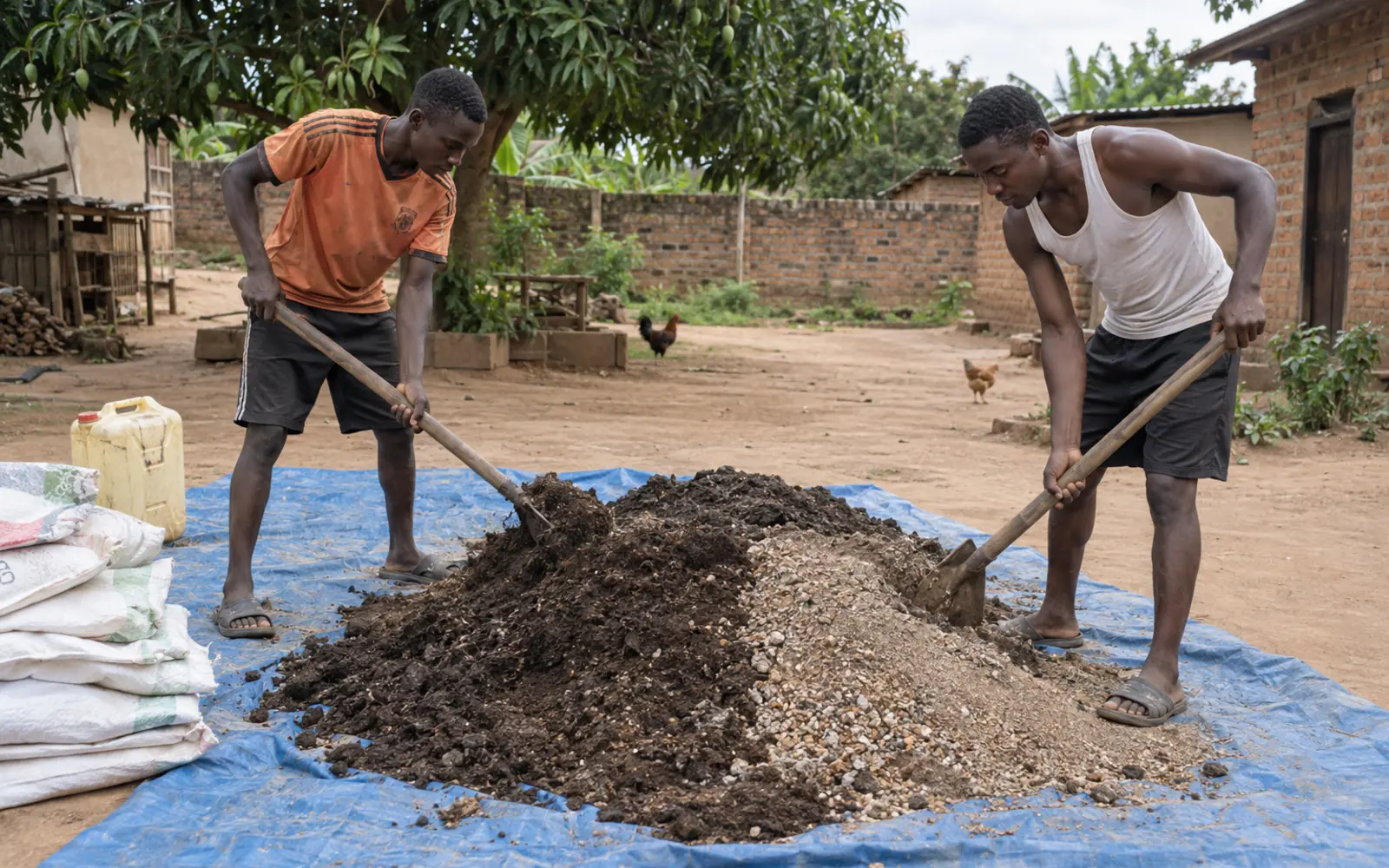
The side holes. Cut holes in the sack wall, staggered so that no hole sits directly above another, and plant a seedling into each.
On spacing, the sources are more consistent than we expected. Three independent East African sources - a humanitarian agency handbook, a Kenyan sack-garden guide and a Kenyan cookery and kitchen-garden programme - all give 15 centimetres between holes. Treat 15 centimetres as the working figure.
What genuinely varies is how many plants a sack ends up carrying, and that is a crop question rather than a spacing question. FAO’s Kenya factsheet gives up to 50 plants of kale or 20 of tomato in one sack. A programme report on Nairobi sack gardens gives approximately thirty seedlings per sack depending on the crop. One Kenyan guide claims up to 150. Those numbers cannot all describe the same thing, and you should plan by the mature width of your chosen crop rather than by any of them. Crowded holes produce a tall green sack and very little harvest.
The top. The open top of the sack is the best growing position in the whole container, because it gets the most light and the deepest media. Reserve it for the crop that most rewards those conditions rather than filling it with the same thing as the sides.
Containers other than sacks
Sacks are not the only option and are not always the best one.
Basins, buckets, tins and drums. Anything that holds media and can be drilled for drainage. The critical requirement is drainage holes in the base, not the side, and enough of them. A container without drainage is a container that kills its plants after the first heavy rain regardless of how careful you were the rest of the time. Depth matters: a shallow container dries out fast, heats up fast and restricts roots, so deeper is generally better for everything except the shallowest-rooted leafy crops.
Towers and stacked systems. Vertical arrangements of containers or pockets. They gain surface area per unit of floor space, and they lose it in water management, because the upper containers dry fastest while the lower ones receive everything that drains from above. They work when the watering routine is designed around that gradient and fail when it is not.
Raised beds on concrete. Where floor space exists but is paved, a timber or block frame filled with media works and is easier to manage than many small containers, because it holds moisture more evenly and takes one watering decision rather than twelve.
Bags and grow-bags. Simpler than sacks, used flat or upright, one or two plants per bag. Good for fruiting crops that need depth and do not suit side holes.
A note on containers previously used for chemicals: do not grow food in a drum, jerrycan or container that held pesticide, fuel, paint, solvent or any industrial product, however thoroughly it has been washed. Use food-grade or new containers for food.
Media: what goes in the container
Container media has to do a harder job than field soil. It has a small volume, it dries faster, it cannot be recharged by capillary rise from below, and its structure cannot be repaired by an entire soil ecosystem.
It needs three things: a mineral fraction for body and nutrient holding, an organic fraction for moisture retention and nutrient supply, and a coarse fraction for drainage and air.
Straight soil in a container compacts, seals at the surface and drains badly. Straight compost holds too much water, shrinks as it decomposes and often carries too much salt. A mix of the three fractions is what works, and the exact proportions matter far less than the presence of all three.
Do not use unfinished compost. It continues decomposing in the container, generates heat and ties up nitrogen at the point where the plant needs it.
Do not use fresh manure in a food container.
Do not reuse media from a container where the crop died of something you could not identify.
Media is consumed. The organic fraction decomposes and the level in the container drops over successive crops. Top up with fresh compost between crops rather than waiting until the container is half empty.
Watering: the finger test
More container plants in Kampala are killed by water than by anything else, in both directions. Overwatering suffocates roots in a container that cannot drain. Underwatering is the default in a household where the water comes in a jerrycan.
Do not water on a schedule. A schedule is a guess about the weather.
Do not water by looking at the surface. Container media surfaces dry within an hour of sun while the media below stays saturated, so the surface is the least informative part of the container.
Use the finger test. Push a finger into the media to the depth of the first two joints, roughly to the second knuckle. If the media at that depth is damp, do not water. If it is dry at that depth, water.
That is the whole method and it is more reliable than any schedule, because it measures the actual condition of the root zone rather than a proxy.
Three supporting rules:
Water thoroughly when you do water. Water until it runs from the drainage holes. A small splash wets the top and trains roots to stay shallow, where they dry out fastest.
Water in the morning. Evening watering leaves foliage and media surface wet overnight, which favours disease, and midday watering in a hot compound loses a large fraction to evaporation before it reaches the roots.
Check every container individually. A sack in full sun and a basin in the shade of a wall three metres away have completely different water needs on the same day. Towers need checking at each level.
The finger test works for sacks too, but a sack has depth and the finger only reaches the surface. For a sack, check at a side hole partway down as well as at the top.
Crop selection
Match the crop to the measured sun hours first, then to the container.
Leafy greens are the highest-value crop for a small compound. They tolerate the least light, they are harvested repeatedly from one planting rather than once, they suit sack side holes, and they are the item a household buys most frequently in small amounts. If a compound grows only one thing, this is it.
Herbs and aromatics are similar: small, repeatedly harvested, tolerant of containers, and expensive to buy in the tiny quantities households actually use.
Root crops need depth and reasonable light. They work in deeper containers and in the top of a sack, less well in side holes.
Fruiting vegetables need the most light, the most depth and the most consistent water. They are the crops that fail most often in small compounds, and they fail because of light. A compound that genuinely gets high direct sun can grow them well in individual deep containers.
One caution on tomatoes specifically, and it is a genuine disagreement between credible sources.
Solidarités International, an agency that ran sack gardening at scale in Nairobi’s informal settlements, advises against fruiting vegetables in the side holes, giving two reasons: they may destabilise the bag, and they yield less when grown on the sides. Against that, FAO’s own Kenya factsheet quantifies tomato as a normal sack crop at 20 plants per sack, and Ugandan press guidance lists tomato among the vegetables a vertical sack garden suits.
Note that the disagreement is narrower than it first looks. The agency objection is specifically about fruiting crops in the side holes, not about tomatoes in sacks as such. The practical reading is that tomatoes demand more water, more light and more support than the leafy crops the side holes are designed around. Treat them as an advanced sack crop rather than a default one, and give them the top of the sack or their own deep container rather than a side hole.
Rules, neighbours and the shared compound
Urban agriculture in Kampala sits inside a specific legal instrument, and it is worth reading rather than guessing at.
The Local Governments (Kampala City Council) (Urban Agriculture) Ordinance, 2006 was published on 29 December 2006 and, by its own terms, came into force three months from the date of publication. Four of its provisions matter to a household growing food in a compound.
It covers growing crops, not only keeping animals. The ordinance’s definition of urban agriculture takes in the growing of crops and the rearing of fish, poultry and livestock without distinguishing between them. A reader who assumes this is a livestock instrument is reading it wrong.
It requires a permit. The text states that a person shall not engage in urban agriculture without an urban agricultural permit issued by the Council.
It restricts certain locations. Prior permission is required for urban agriculture in a road reserve, a wetland, a gazetted greenbelt, a gazetted park, an abandoned landfill, or ground less than ten feet from an open drainage channel. Note how the road reserve restriction lines up with the roadside contamination finding earlier in this guide: the legal restriction and the soil evidence point the same way.
It prohibits untreated human waste as manure. The text states that a person shall not use untreated human waste as manure for agricultural purposes.
The penalty provision sets a fine not exceeding two currency points, a term of imprisonment not exceeding six months, or both.
Two honest qualifications. First, this is a 2006 instrument made by Kampala City Council, the body that Kampala Capital City Authority succeeded, so how it is administered today is a question for the Authority rather than something the text can answer. Second, the ordinance as written applies to engaging in urban agriculture and does not carve out an explicit exemption for a household growing vegetables for its own table. We are not going to tell you that a few sacks in your own yard definitely require a permit, and we are not going to tell you they definitely do not. What we can tell you is that the instrument covers crop growing, that a permit provision exists, and that the reliable answer for your situation comes from your division office. Ask before you build, particularly if you intend to sell anything, to use shared or public ground, or to grow near a drainage channel or road reserve.
Within a shared compound, the constraints that bite first are usually social rather than legal: water use, drainage onto a neighbour’s area, space that others also use, children, and the visual encroachment of a growing operation on a shared yard. Settling those in advance, before building, is what keeps a garden in place.
Common mistakes
Choosing the container before measuring the sun. The most common failure by a wide margin.
Digging media from the roadside. The thirty-metre finding exists for a reason.
Building a sack with no central column. The middle of the sack stays dry, the side holes at mid-height fail, and the grower concludes sacks do not work.
Containers without drainage holes. Or with holes in the sides above the base, which leaves a permanent reservoir at the bottom.
A sack standing directly on concrete with nowhere for water to go.
Filling layer by layer from separate heaps instead of mixing the media in one batch.
Watering on a schedule. Or by the appearance of the surface.
Cutting side holes too close together and then wondering why there is no harvest.
Growing fruiting crops in low light because they are the crops people want rather than the crops the compound supports.
Reusing pesticide, fuel or solvent containers for food.
Using unfinished compost, which then heats and locks up nitrogen inside a closed container.
Never topping up. The media level drops as organic matter decomposes and the container quietly becomes too small.
A practical action plan
Week one: measure. Pick your spot, log the direct sun hours across one clear day, and write the figure down. Decide your crop category from that number and not from what you would like to grow.
Week one: source. Decide where the media is coming from, applying the sourcing decision path. If the honest answer is that you do not know the history of the only soil available, budget for bought or traced media instead. This is the decision that is hardest to reverse.
Week two: build. Mix the media in one batch on a sheet. Build the base drainage layer, form the central column, fill, and let the container settle and be watered thoroughly once before planting.
Week two: plant. Start with the top and with a small number of side holes rather than filling every hole at once. Leafy greens in the side holes. Space according to the mature crop, not a generic figure.
Daily: finger test. Every container, individually, before watering anything.
Weekly: look underneath. Check that water is actually leaving the containers and not pooling beneath them.
Between crops: top up. Add fresh compost to replace what has decomposed. Do not simply replant into a settled, depleted container.
After one full crop cycle: review. Which holes produced and which did not. Which containers dried fastest. Whether your sun-hours measurement matched what the plants actually did. That review is what turns a first attempt into a system.
Conclusion
A small Kampala compound is a real growing space with real constraints, and the constraints are specific enough to design around.
The light is fixed, so measure it and choose crops that suit it. The soil is of unknown quality, so source media deliberately and keep leafy crops away from roadside ground. The container has no subsoil to drain into, so build drainage into the base and a column into the middle. The water comes in a jerrycan, so decide with a finger rather than a schedule.
Get those four things right and a compound will produce leafy vegetables continuously for years. Get them wrong and it will produce one disappointing season and a row of sacks nobody waters.
Author: Falcon Foundation Ltd Editorial Team
The Falcon Foundation Ltd Editorial Team produces evidence-based agricultural guidance for Ugandan farmers, drawing on published research and institutional sources and translating them into practical decision support. Where evidence is unavailable or contested, we say so rather than filling the gap.
