
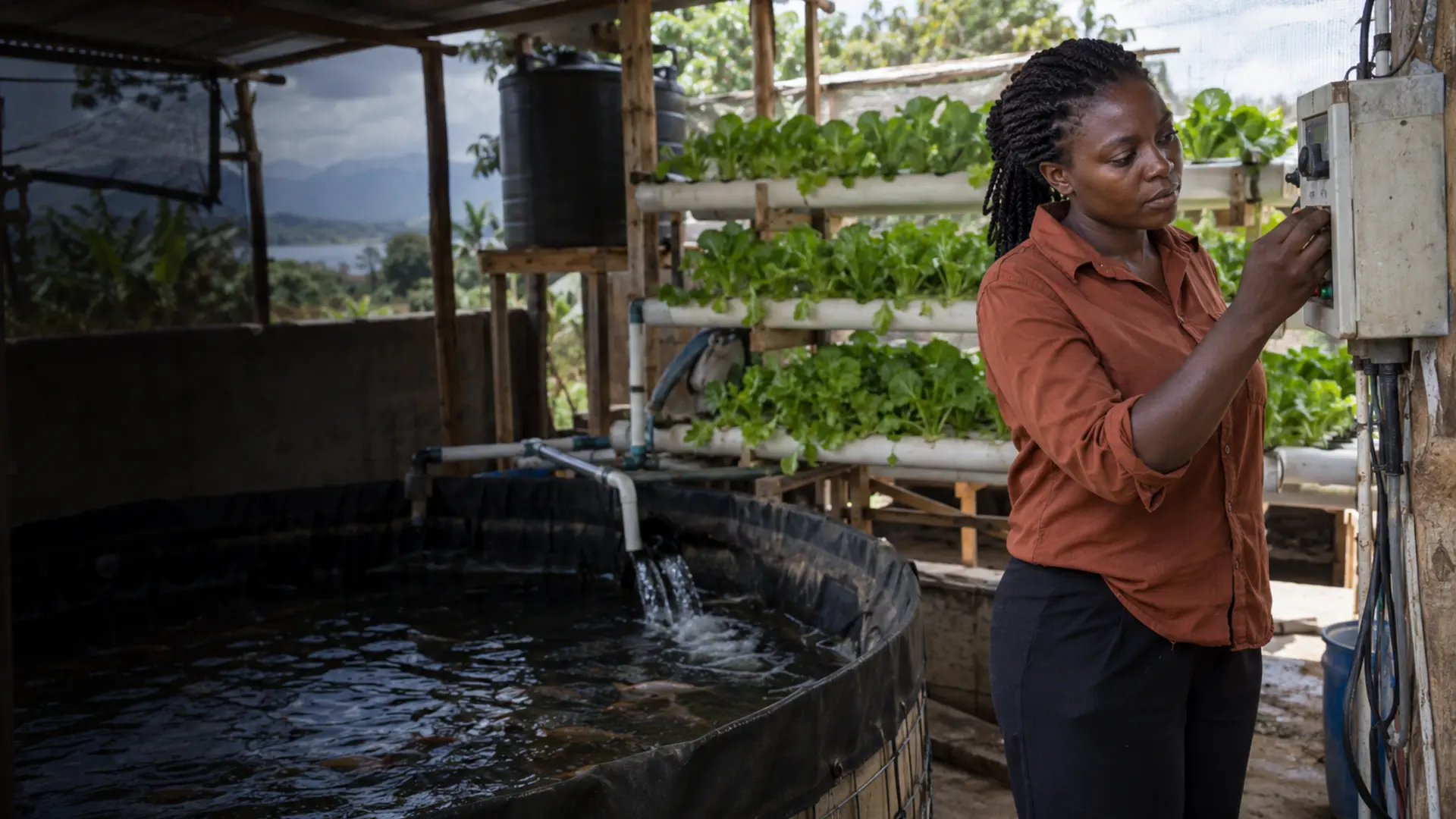
Imagine a four-tier rack built from angle iron by a local fabricator. During an outage, its strip lights go dark and its pump falls silent. Lettuce on an upper tier begins to yellow, while tilapia in the sump tank rise towards the surface. The equipment may be well made, yet the biological system remains exposed to every interruption in power.
The welding can be good, the plumbing tidy and the plant selection sensible, yet the investment can still fail if the arithmetic is missing. Before money is spent, the buyer must list every component that needs electricity, what happens to the crop or fish when it stops, and what continuous operation costs at the tariff Uganda actually charges.
This guide does that arithmetic. It is not an argument that these systems never work. One configuration can be defensible in Uganda, and this article explains the conditions it must meet. The central question is whether the proposed system can carry its electricity, backup and market costs before the fabricator starts cutting steel.
What this guide helps you decide
By the end you should be able to answer four questions about any stacked-growing or aquaponic proposal put in front of you.
Which components need power continuously, and what happens to the crop or the fish when each one stops. What the continuous load actually costs per month at the published Ugandan tariff. Whether the backup you would need to survive a normal Ugandan outage is affordable. And whether the configuration in front of you depends on artificial lighting, because that single question separates the proposals worth studying from the ones worth declining.
The short answer
Stacked indoor growing under artificial light is an electricity business with a crop attached. Published reviews put the energy needed to grow a kilogramme of lettuce in a stacked, artificially lit system at roughly ten to eighteen kilowatt-hours in one systematic review, around fifteen kilowatt-hours in another study, and at a median of 127 megajoules per kilogramme in a large meta-analysis, against roughly one megajoule per kilogramme for open-field production. These figures come from different studies with different system boundaries and should be read as an order of magnitude rather than a settled number, but they all point the same way. One peer-reviewed analysis modelled a facility in which energy reached 77 per cent of operational costs.
Aquaponics is a different proposition. The energy demand of a small, naturally lit aquaponic system is far lower, because the lighting is the sun. What aquaponics has instead is fragility: the fish depend on aeration measured in minutes, not hours, and the bacteria that make the system work depend on the same air supply.
So the honest summary is this. If the proposal in front of you stacks crops under lamps, the Ugandan tariff and the Ugandan grid make it very hard to defend. If the proposal is a single-layer, naturally lit system with a modest pump-and-aerator load, it deserves a proper audit rather than a dismissal, and the rest of this article shows you how to conduct that audit.
The Ugandan numbers you must use, and how often they change
A serious error in these business plans is using an electricity price from another market. Uganda’s tariffs are set by the Electricity Regulatory Authority and are reviewed every quarter, which means any figure you were given more than three months ago should be rechecked.
For the third quarter of 2026, covering July to September 2026, the Authority approved the following rates in Ugandan shillings per unit: domestic 779.4, commercial 562.1, medium industrial 363.8, medium service 423.9, large industrial 308.1, large service 357.0, extra-large industrial 207.7, extra-large service 224.2, and public amenities 360.0. A lifeline rate of 250.0 applies to the first fifteen units for domestic customers and a cooking rate of 412.0 applies to units 81 to 150. The distribution company publishes the same schedule broken down by time of day, which matters for a system that runs around the clock: for the commercial category, the peak rate is 666.5, the shoulder rate 562.1 and the off-peak rate 429.7.
Two things follow. First, a system that runs continuously does not pay the average rate; it pays a blend that includes the peak rate every evening. Second, the rate you plan against will have changed by the time you commission. The first quarter of 2026 carried a domestic rate of 756.2 and a commercial rate of 546.4; by the third quarter those had moved to 779.4 and 562.1. The Authority has attributed quarterly adjustments to exchange rate movements and fuel costs.
Vertical Farming and Aquaponics: Why the Impressive Systems Rarely Survive a Ugandan Power Bill
Worked electricity cost table showing how a continuous load in watts converts to units per month and to a monthly bill at the published quarterly tariff
Before you accept any figure in a business plan, ask which quarter it came from and open the Authority’s own page for the current one. If the promoter cannot tell you the quarter, the number is decoration.
Supply reliability, and what the published record actually says
A continuous-load system is exposed twice: once to the price of electricity and once to its absence.
The distribution company’s own annual report for the 2022/23 financial year records a system availability index of 91 per cent against a 95 per cent target, with distribution losses of 21 per cent against an approved target of 20.1 per cent. The Regulatory Authority’s later figures put energy losses at 17.1 per cent for the year to June 2025.
An academic analysis of feeder data covering 319 feeders and just over a million customers from January 2015 to October 2022 found that while median outage duration fell across all regions, outage frequency remained largely unchanged except in one part of Kampala, and that more than 60 per cent of outage duration fell in the shoulder period rather than at night.
Older firm-level survey data exists and is worth knowing about, but it must be labelled honestly. World Bank enterprise survey rounds published in 2013 recorded outages falling from 11 to 6 in a typical month between 2006 and 2012, and typical outage duration falling from 10 to 7 hours. Those are the most recent firm-level Ugandan figures we could verify, and they are more than a decade old. Do not present them as today’s conditions.
What the record supports is a modest and useful statement: outages in Uganda are frequent enough, and long enough, that a system which cannot survive several hours without power is a system that will eventually lose its crop or its stock.
The load and failure-point audit
This is the instrument the article exists to give you. Take the proposal, list every component that draws power, and fill in three columns for each: what it does, what happens when it stops, and how long the system tolerates the stoppage.
Vertical Farming and Aquaponics: Why the Impressive Systems Rarely Survive a Ugandan Power Bill
Continuous load and failure consequence diagram showing each powered component of a stacked or aquaponic system, what fails when it stops, and how long the system tolerates the interruption
Aeration. In any system holding fish, the air pump or aerator is the shortest fuse. A South African aquaculture account describes fish in an aeration failure having as little as ten minutes before they are in serious trouble. That is a trade account rather than a controlled study, and the true window depends on species, stocking density and water temperature, but the order of magnitude is not in dispute. A peer-reviewed model of tilapia tanks in Egypt found growth affected below five milligrammes of dissolved oxygen per litre and survival at risk at two milligrammes, with oxygen depletion from fish respiration alone running at 12 to 47.5 grammes per cubic metre per hour in that trial.
The biofilter. This is the component people forget. The bacteria that convert fish waste into a form plants can use are themselves aerobic. The same South African account describes bacterial die-off beginning within about half an hour of an aeration failure, and warns that hydrogen sulphide can be released when a stagnant system restarts. Losing the biofilter is worse than losing a crop, because it takes weeks to rebuild.
Water circulation. In a film-flow hydroponic channel there is no growing medium holding a reserve of water, so the roots depend on the flow continuing. A commercial hydroponics supplier states a survival window of thirty minutes to two hours in such channels. We could not find a peer-reviewed study of acute root desiccation timing, so treat that figure as vendor guidance rather than measurement. What is peer-reviewed is the slower failure: a 2026 review of film-flow strawberry systems describes how low root-zone oxygen reduces energy production in root cells, weakens membrane function and opens the way to waterborne root pathogens, and notes that a root-zone temperature of 30 degrees Celsius sharply reduces root oxygen consumption and cell viability. Those are two different failure modes on two different clocks and should not be run together.
Lighting. Where stacked growing uses lamps, lighting is the largest single load and the main reason the energy figures above are what they are. One published analysis attributes about 98 per cent of a vertical farm’s energy use to artificial lighting and climate control.
Climate control. Fans, and in some designs cooling, run whenever the lights run, because the lamps are also heaters.
Write the audit out. If any line has a tolerance measured in minutes and no backup beside it, you have found the reason the system will fail.
Doing the electricity arithmetic yourself
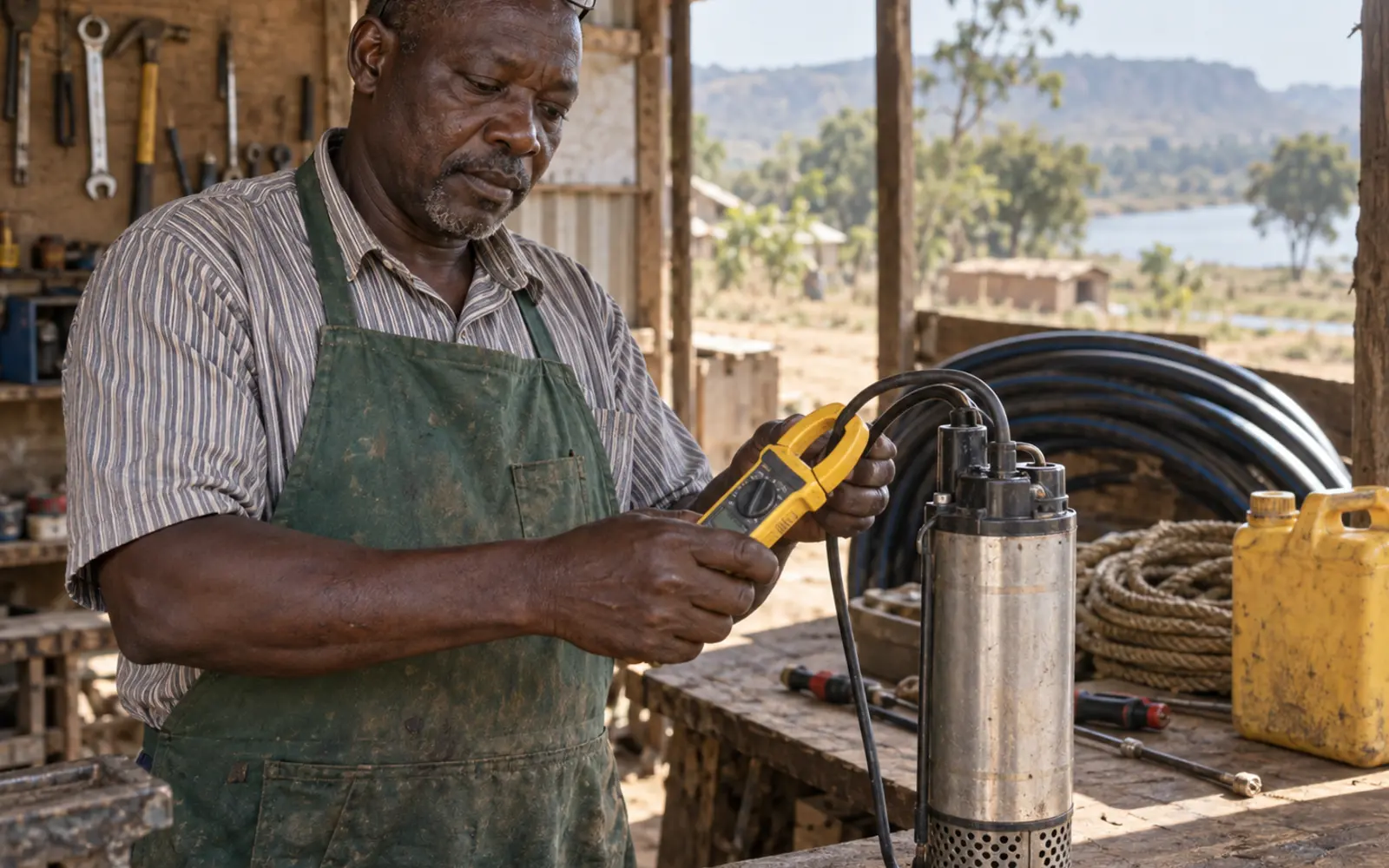
You do not need an engineer for this, only a clamp meter or the rating plates.
Add up the watts of everything that runs continuously. Multiply by 24 to get watt-hours per day, divide by 1,000 to get units per day, and multiply by 30 for a month. Then multiply by the rate for your tariff category in the current quarter. For loads that run only part of the day, use the actual hours rather than 24.
Two cautions. Rating plates overstate: a pump rated at 100 watts may draw less in service, which is why a clamp meter reading on the installed system is worth more than a plate. And a system on the commercial tariff running around the clock will meet the peak rate every evening, so the average rate understates the bill.
Then ask the second question: what is the backup? Continental figures from an energy policy organisation put the cost of self-generation in Africa at about three times a cost-reflective tariff. We could not verify a Ugandan-specific figure for backup generation cost and will not invent one, but the direction is clear. A system that needs a generator to survive routine outages is paying a premium on top of an already unfavourable tariff.
What the failures elsewhere actually show
The strongest argument against stacked indoor farming in Uganda is that it has failed repeatedly in countries where electricity is cheaper, more reliable, and where the produce sells for far more than it does here.
AeroFarms filed for Chapter 11 bankruptcy protection in the United States Bankruptcy Court for the District of Delaware on 8 June 2023; its chief financial officer stated that the business was capital intensive and that attempts to raise sufficient capital had fallen short. Fifth Season, a robotic vertical farming company in Pittsburgh, closed in late October 2022, with reporting attributing the closure to the macroeconomic environment and the cost of operating high-technology facilities. AppHarvest filed for Chapter 11 on 24 July 2023, its shares having fallen from over 35 dollars in 2021 to 34 cents at filing. Infarm, once Europe’s largest vertical farming company, shut operations across the United Kingdom, France, Germany, the Netherlands and Denmark over the course of a year, with its Dutch arm declared bankrupt on 19 September 2023.
Four companies, three countries, all within roughly a year, all in markets with cheaper power and higher vegetable prices than Uganda. None of this proves that no such business can succeed. It does mean that a promoter who presents stacked indoor growing as a proven model has not read the record.
Vertical Farming and Aquaponics: Why the Impressive Systems Rarely Survive a Ugandan Power Bill
Comparison chart of published energy use per kilogram of lettuce for stacked artificially lit systems, greenhouses and open-field production
The configuration that is defensible
There is one, and it is worth stating clearly because a reality check that ends in a blanket refusal is not useful.
A naturally lit, low-stack or single-layer system, whether hydroponic or aquaponic, removes the lighting load entirely. What remains is a pump and, in a fish system, an aerator. A review of aquaponics across fifteen African countries documents a solar-powered prototype in Zimbabwe running a combined electrical load of 293.2 watts from a water pump, an aerator and electronic devices from a 1.6 kilowatt solar array. That is a load a modest solar and battery installation can carry through an outage, and it is a completely different proposition from a lit rack.
The same review is worth reading for its cautions as well as its encouragement. It reports fish feed accounting for up to 70 per cent of fish production costs, and it notes that lack of electricity in many rural areas is among the challenges to establishing aquaponics in East Africa. Its reported yields vary enormously with scale and country, from small-scale Nigerian systems producing 27.9 kilogrammes of fish a year to Egyptian commercial operations producing 5 to 7.5 tonnes. Those are measurements from named places at named scales. They are not a yield you can plan against in Uganda, and this article does not offer one.
Reading a yield claim without being misled
Promoters of these systems lean heavily on yield per square metre, because stacking makes that number look extraordinary. It is the wrong number.
Yield per square metre of floor is flattering by construction: four tiers give four times the growing area on the same footprint. What matters to a business is yield per unit of capital and per unit of electricity, and those numbers are often absent from a sales presentation. A stacked system that produces four times the lettuce of a single layer while consuming four times the lighting energy has improved nothing except the photograph.
There is a second problem with the yield claims specifically. The peer-reviewed review of African aquaponics cited in this article reports outcomes that range across two orders of magnitude between countries and scales, and its authors are explicit that system design and whether materials were sourced locally or imported drove the economics more than anything else, reporting benefit-cost ratios as low as 0.08 for import-dependent systems against 1.12 for locally sourced ones. A yield figure detached from its scale, country and system design tells you nothing you can plan against.
When someone shows you a yield, ask four questions. Where was it measured? At what scale? Over how long, and how many cycles? And was the electricity that produced it counted in the cost? If any of the four cannot be answered, set the figure aside entirely rather than discounting it.
Who is awake at three in the morning
This is the operational question that decides whether a fish system survives its first year, and it is not a technical question at all.
If aeration failure gives you minutes, then somebody or something must notice within minutes. That means either an operator who sleeps on site and is woken by the silence, or an alarm that reaches a phone. An industry body recommending backup provision for aquaculture makes the point that the simpler these systems are, the more likely they are to work, and lists an automated dialler alongside backup oxygen and redundant generation as basic insurance rather than luxury.
In a Ugandan context this is worth thinking through honestly before stocking any tank. Who lives on the site? Does their phone have credit and charge at night? What do they do when the alarm sounds, in the dark, in the rain, three hours into an outage? If the answer to any of these is vague, the system is not ready for fish, whatever the plumbing looks like. A naturally lit plant-only system fails far more gently, which is one more reason it is the more defensible starting point.
Cost categories
We give no prices. What we can give you is the list of cost lines a complete plan must contain, so you can tell whether the plan in front of you is complete.
Structure and tanks. Pumps, aerators and their spares, because a pump with no spare is a single point of failure. Plumbing and the filtration or biofilter media. Electrical installation and protection. Backup power, which must include both the generator or solar and battery capacity and its fuel or replacement cycle. An alarm that tells someone the power has failed, since a failure nobody notices is the same as a failure with no backup. Fish feed, which the African review identifies as the dominant recurring cost in fish systems. Seed or fingerlings. Water testing. Labour, including someone available at night. And the electricity itself, calculated as above at the current quarter’s rate.
Common mistakes
Using an electricity price with no quarter attached to it. Sizing the backup for the pump but not the aerator. Treating the rating plate as the real load. Assuming the biofilter survives whatever the fish survive. Planning for the average tariff when the system runs through peak hours every evening. Taking a yield figure from a study in another country at another scale as a Ugandan planning number. Buying the rack before establishing who buys the lettuce. And accepting a comparison with open-field production that leaves out the electricity line entirely.
Warning signs and escalation points
Walk away from, or at least stop and get independent advice on, any proposal that: quotes an electricity cost without naming the tariff category and the quarter; presents a yield figure without naming the study, the country and the scale; has no line item for backup power; describes stacked artificial lighting as a proven business model without addressing the documented failures; or promises a payback period computed from a margin the promoter cannot show you a buyer for.
If fish are involved and you cannot identify who will notice an aeration failure within the hour, at night, the system is not ready to be stocked.
Where it works and where it does not
It works, or can work, where the light is free, the load is small enough for solar and a battery, the operator is on site, the buyer is identified, and the numbers were done before the steel was cut.
It does not work as an import of a business model built for cheap, reliable, subsidised power and high-value produce markets. The energy figures above are not a Ugandan disadvantage that better management can close; they are the physics of replacing sunlight with lamps.
A low-risk first step
Before spending anything on structure, do two things.
Take a clamp meter to whatever pump and aerator the design specifies, or borrow one, and measure the real draw. Then write the load and failure-point audit out by hand, one line per component, and cost the monthly electricity at the current quarter’s rate for your tariff category.
If the audit shows a tolerance measured in minutes with nothing behind it, the design has to change before anything else happens. If the electricity line is a number you can live with and the crop has a buyer, you have a proposal worth taking further.
What to do next
Read the Falcon Foundation guides on solar-powered irrigation and pump selection and sizing before specifying any pumping component, because the same sizing discipline applies. If you are weighing this against other enterprises, choosing a farm enterprise and starting a farm with limited capital will help you place it in a sequence. Our guide to simple soil-free growing methods covers the low-technology end of the same family of systems, and our forthcoming guide to assessing agricultural technology claims - scheduled in this programme covers how to read a promoter’s evidence.
About the author
The Falcon Foundation Ltd Editorial Team produces evidence-based agricultural guidance for Ugandan farmers, drawing on published research and institutional sources and translating them into practical decision support. Where evidence is unavailable or contested, we say so rather than filling the gap.