
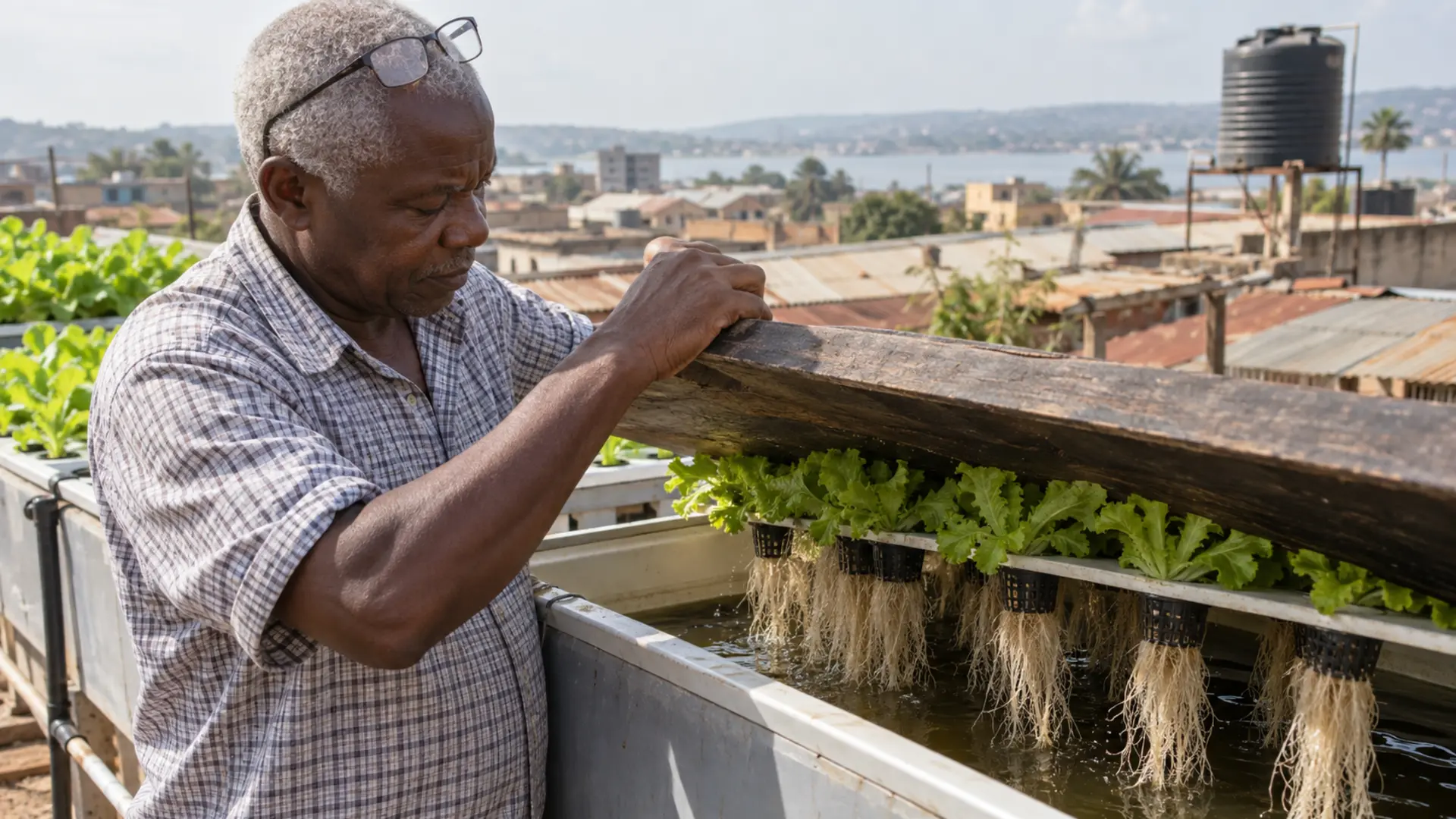
Almost every hydroponic system offered to a Ugandan grower is a pumped one. Water circulates through channels, a pump keeps it moving, and the plants sit in a thin film that never stops flowing.
Then the power goes off. In a nutrient film system the thin film is the whole water supply, and there is nothing else in the channel. The roots dry out in hours, not days. A grower who was away for the afternoon comes back to a crop that cannot be saved.
Power interruption is not an emergency in Uganda. It is a normal operating condition. A system that dies without electricity is the wrong system here, whatever it yields when the power is on.
What this guide helps you decide
By the end you should be able to choose between four system types on the criteria that actually matter in Uganda: whether they need power, which crops they will carry, what skill they need to build, and what happens when they fail. You should also be able to build the simplest viable one.
It does not cover whether to try hydroponics at all, which is a separate decision, and it does not cover hydroponic fodder or greenhouse substrate bags.
The short answer
For leafy greens on a small scale, use a non-circulating tank that you fill once and do not top up. It needs no pump, no power and no daily attention beyond looking at it. The method is well documented in university research and the mechanism is deliberate: as the plants drink, the water level falls away from the net pots and leaves an expanding pocket of humid air, and the roots that grow into that pocket take up the oxygen the plant needs.
Do not use it for tomatoes or cucumbers in a small tank. Their water demand over a long season is far beyond what a shallow tank holds.
If you want deep water culture with an air pump, understand that you have reintroduced the power dependency you were trying to escape.
Why the power question decides the system
Uganda’s electricity supply has improved and remains interrupted. World Bank Enterprise Survey data recorded outages falling from about eleven a month in 2006 to about six a month in 2012, with average duration falling from about ten hours to about seven, and sales losses attributed to outages falling from 9.5 per cent to 6 per cent. Electricity was still named the top obstacle by 23 per cent of firms in 2013, down from 63 per cent in 2006.
More recent analysis of daily outage data from 2015 to 2022 found the pattern has changed rather than disappeared: outages have become shorter but occur about as frequently, they are concentrated in daytime hours, failing equipment is the leading cause, and outage frequency correlates positively with rainfall. Uganda’s Electricity Regulatory Authority acknowledges the position directly, describing consumers enduring several hours of outage with brownouts in between, and runs a reliability improvement project. It requires utilities to calculate and publish reliability indices, but we could not find published national figures for them.
Read those two paragraphs together and the design conclusion is straightforward. Outages are shorter than they were, still frequent, more common in the wet season, and worst in the daytime, which is exactly when a crop is transpiring hardest.
The four systems
Wick system. Entirely passive. A wick made of material with high capillary action runs from a reservoir below into a container of growing medium above, and draws solution up to the roots. No power at any point. The published extension descriptions of wick systems are thin: we found the definition and the principle, but no university or peer-reviewed source giving maximum wicking height, medium specification or crop size limits. That is a genuine gap, and we are not going to invent numbers to fill it. Treat the wick system as suitable for small herbs and single plants, and test it before you scale it.
Kratky non-circulating tank. A covered tank filled nearly to the top at planting, with net pots set so the base of each pot sits in the solution. The plants drink, the level falls, and an air gap opens between the falling water and the underside of the lid. Roots split into two populations: the lower ones stay in solution and take up water and nutrients, the upper ones sit in the humid air gap and take up oxygen. The tank is never topped up during the crop. No power at any point.
Deep water culture. A raft floats on a deeper body of solution with roots hanging into it. At commercial scale this needs aeration. Cornell’s controlled environment agriculture programme, working with float ponds, treats dissolved oxygen as a hard constraint: levels should exceed 4 parts per million to prevent growth inhibition, visible stress may be seen at 3 parts per million, and crop failure occurs below 3. A 2026 peer-reviewed study of hydroponic lettuce found that raising dissolved oxygen from 2.9 to between 3.5 and 4.0 milligrams per litre increased shoot fresh mass by 98 to 139 per cent at twenty-one days, driven mainly by tissue hydration rather than additional dry matter. Both of those findings are from controlled research outside Uganda and neither was measured in Ugandan conditions. Small home-scale floating systems described by university extension do run without aeration, which is a different scale and a different expectation.
Pumped nutrient film. Efficient, well understood, and the one that fails hardest when the power stops. It is included here so you can see what you are choosing against.
How the Kratky tank actually works, and where it stops
The method comes from published University of Hawaii research and the detail matters, because most of the online versions of it leave out the parts that make it fail.
Tank depth and fill. The published methods use tanks of the order of 9 to 14 centimetres deep, filled nearly to the top before transplanting, with at least 8 centimetres of solution. In the described trials the level falls by 6 to 12 centimetres by harvest and no additional water is given.
The air gap is the design, not a fault. Within a few weeks the solution drops below the net pots, but by then the roots have emerged and an expanding moist air space has formed. That space is where the plant gets its oxygen.
Do not raise the level once roots have emerged. This is the rule most often broken, and the published guidance is specific: raising the nutrient solution level by rainfall or additions above 2 centimetres after that point may cause plant injury. Rain is the danger, not the watering can. In Uganda’s rainfall, an uncovered tank outdoors will be refilled by weather. Shelter is not optional.
Match the crop to water demand, not to plant size. The published rule is a water budget: crops needing less than about 4 litres of water over their whole life suit the small formats. That is why the recommended crops are leafy, romaine and semi-head lettuce, coriander, spring onion, pak choi, kai choy and watercress. Cucumbers, at roughly eighty days, and tomatoes, at 25 to 40 litres of water per kilogram of fruit, need proportionally much larger tanks, which is why the same research treats them as poor candidates for the small non-circulating formats.
Support the cover. In the float-support version, boards float on the solution at first and then come to rest on supports as the level drops. Published trials found that where supports were too shallow, at 5 centimetres, yields fell by up to 23 per cent compared with 10 centimetre supports. If the cover sinks with the water, the air gap never opens.
Refill between crops, not during them. The published guidance is to drain and refill after each crop ideally, and at minimum after every three, with electrical conductivity used to judge what to add if topping off between crops.
Reported harvest times in the trials are around five to seven weeks for lettuce, longer in cooler seasons.
Temperature, which is where Uganda differs
The Hawaii research is tropical, which makes it a reasonable analogy for Uganda, but it is not equatorial Africa and it was not done here.
Two temperature points come from the sources. Cornell’s lettuce handbook puts optimum pond and root temperature at about 24 degrees Celsius and advises against exceeding 25 to 26. The Hawaii work notes lettuce tolerates warm conditions but tips towards tip burn and bitterness at the upper end.
Warm water also holds less dissolved oxygen than cool water. That is basic physics rather than a finding from any of the sources here, and we flag it as our own reasoning rather than attributing it to a study. The practical consequence is worth acting on anyway: shade the tank, keep it off hot concrete if you can, and site it where it is not in full sun all afternoon. A rooftop is convenient and it is also the hottest place on the property.
Water, and the test to do before you build
Every hydroponic system is only as good as the water going into it. Oklahoma State University’s guidance is blunt: the very first step for hydroponics is to have the water analysed by a laboratory, because poor quality water can cause nutrient toxicity or deficiency problems initially or later in production. It flags alkalinity above 75 parts per million as a cause of pH drift needing acid correction. A European institutional guide to simplified hydroponics for developing-country conditions states that water up to about 1000 microsiemens per centimetre of electrical conductivity is workable.
Test the water you will actually use, from the source you will actually use, not a sample from somewhere else on the property.
The honest position on nutrient salts in Uganda
This is the part of the article we most want to be able to answer and cannot.
We could not verify, from any named, checkable, non-promotional source, that calcium nitrate, potassium nitrate, monopotassium phosphate, magnesium sulphate and micronutrient mixes are reliably obtainable in Uganda. Commercial listings exist. We do not treat them as evidence.
What we can report is peer-reviewed and points the other way. A survey of hydroponic operators in Uganda and Tanzania found 20 per cent reported inadequate availability of hydroponic fertiliser options in agricultural shops. That same survey found high investment cost was the top barrier, named by 31 per cent, with greenhouse construction, fertiliser cost, electricity for system installation and equipment all cited. It also found that only 21.6 per cent treated hydroponics as their main economic activity and 47.1 per cent grew only for home consumption, and that the systems in local use are overwhelmingly the recirculating ones, drip at 54.9 per cent and nutrient film at 33.3 per cent, rather than the non-circulating methods this article recommends.
Before you build anything, go and find out whether you can buy the salts, locally, at a price you can repeat. If you cannot, the system design is irrelevant.
What it costs
No prices, because we cannot verify Ugandan prices for any of this. The cost categories are:
- The tank or container, and a rigid lid that will not sag
- Net pots, or a locally made substitute
- Growing medium for the pots
- Nutrient salts, recurring for every crop, and the single most uncertain item on this list
- A water test at a laboratory, once at the start
- Shelter from rain, which may be a simple roof or a polythene cover on a frame
- Shading or siting work to keep the solution cool
- Seed, recurring
- For deep water culture only: an air pump, an air stone, tubing, and the electricity to run them
Common mistakes
Topping up the tank mid-crop. This drowns the air roots the system depends on. It is the single most common failure and it comes from good intentions.
Leaving the tank open to the rain. Same outcome, arrived at by weather.
Growing tomatoes in a lettuce tank. The plant will look fine for weeks and then run out of water at exactly the point it needed most.
A cover that sinks. If the lid follows the water down, no air gap forms.
Skipping the water test. Alkalinity and salinity problems in the source water do not announce themselves until the crop is already struggling.
Building on a hot roof in full sun. Convenient, and the worst thermal position available.
Assuming a foreign yield figure applies here. We have deliberately given none. The Hawaii and Cornell figures are from Hawaii and from controlled research, and the only Ugandan lettuce study we could confirm reported that hydroponics has the potential to perform as well as conventional farming on leaf yield, without a figure we can pass on.
Warning signs and escalation points
- Roots turning brown, soft or slimy, which points to root disease or a solution that is too warm and too low in oxygen
- Green water, which is algae and means light is reaching the solution
- Mosquito larvae in the tank, which is a household health matter as much as a crop one and means the tank is not sealed
- A solution level that has stopped falling while the plants are still growing, which usually means the roots are no longer reaching it
- Leaf tip burn or bitterness, which points to heat
- Plants collapsing within a day or two of heavy rain, which points to the level having risen
If algae or mosquito breeding appear, deal with them the same day. Both are documented problems with non-aerated non-circulating systems, and both are solved by covering and sealing the tank rather than by anything added to the water.
Where this works, and where it does not
It works for leafy greens, herbs and salad crops, on a small scale, close to the house, where somebody looks at it daily and where the water source has been tested. It works particularly well where land is the constraint rather than money, which is the situation of most urban and peri-urban growers.
It does not work as a substitute for field production of staples. It does not work for fruiting crops in the small tank formats described here. It does not work where nutrient salts cannot be bought locally and repeatedly. And it does not work as an investment case on the strength of anything in this article, because no peer-reviewed or institutional source reports hydroponic profitability or yield per area for Uganda or a comparable East African setting. We looked, twice, and found none.
Ugandan institutional support does exist. The Ministry of Agriculture, Animal Industry and Fisheries has published on hydroponics for horticultural enterprises and names the Makerere University Agricultural Research Institute at Kabanyolo and CURAD as a training point. That is a real place to go and ask questions, and it is the most useful Ugandan contact we could verify.
A low-risk first step
Build one tank. Not a system, not a bench, one tank, planted with lettuce.
Use a shallow container you already have, a rigid lid you can cut holes in, and however many net pots the lid will take. Fill it once. Cover it. Put it in shade with a roof over it. Then do nothing except look at it every day and write down what you see: the water level, the root colour, the leaf colour, the date.
One crop cycle is five to seven weeks. At the end of it you will know whether you can source the salts, whether your water works, whether the heat where you live is a problem, and whether you enjoyed it. Those four answers cost you one container and one packet of seed.
What to do next
- Take a sample of your intended water source to a laboratory and get it analysed.
- Visit two agricultural suppliers and ask specifically whether they stock hydroponic nutrient salts. Write down what they say.
- Build a single non-circulating tank as described above and run one lettuce crop.
- Keep a daily one-line record: date, water level, root colour, anything unusual.
- Shade the tank and shelter it from rain before you plant, not after the first storm.
- If the single tank works, repeat it once more before you build anything larger.
- Contact the training point at Kabanyolo if you want to see a working system before committing.
Related reading: the published guide to small-scale irrigation covers water delivery for soil-grown crops, and on-farm water sources covers the source itself. For the decision about whether to enter hydroponics at all, see the hydroponics investment decision. For nutrient solution management in more detail, see greenhouse fertigation and nutrient solutions.
About the author
This guide was researched and written by the Falcon Foundation Ltd Editorial Team. Falcon Foundation Ltd is a privately owned Ugandan agricultural company producing greenhouse crops, livestock and honey. Our Knowledge Hub is written for Ugandan farmers making practical decisions with incomplete information, and we label international evidence as international rather than presenting it as if it were measured here.
