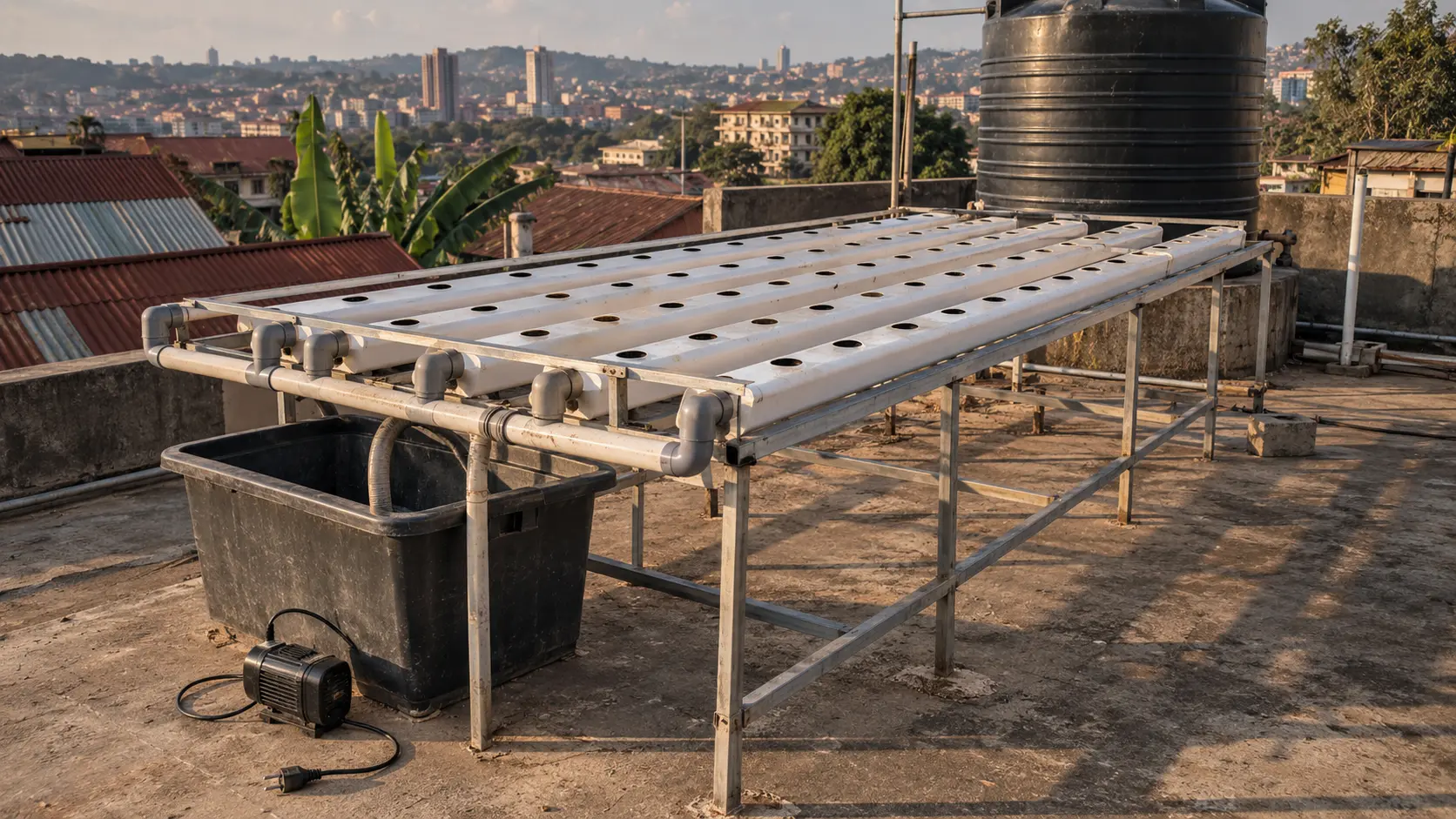
Hydroponics is real. It works. There is a documented, FAO-supported hydroponic installation running at a school in Kampala right now. This guide is not here to tell you the technology is fake.
It is here to tell you that hydroponics is capital intensive, skill intensive and unforgiving, that a small mistake can destroy an entire crop within days, and that a great many Ugandan setups are bought after a demonstration and abandoned within a year. Before you spend money, you should know which kind of grower you are.
What this guide helps you decide
This guide helps you answer one question: should I put money into hydroponics at all?
It sets out what hydroponics genuinely requires, gives you seven conditions to test, and names the five ways Ugandan systems usually fail. If you pass, our separate guides cover which system to build and how to manage the nutrient solution.
It does not tell you how to build a system, and it does not cover hydroponic fodder for livestock, which is a different question with different economics.
What hydroponics actually is, in Uganda's own words
Uganda's Ministry of Agriculture, Animal Industry and Fisheries published an extension note on hydroponics for horticultural enterprises. It defines hydroponics as growing crops without using soil, in solid media, in water or in air, and lists the claimed benefits as elimination of soil-borne diseases such as bacterial wilt, faster growth, higher yield per unit area, greater predictability of return, precise use of fertiliser and water, and environmental friendliness [1].
That note also names a place you can go and look. It identifies Makerere University Agricultural Research Institute Kabanyolo as a demonstration and training site, with a hydroponics and greenhouse section that trains young people through a Learn As You Earn programme, and it states that free consultations on building hydroponic systems, whether from locally sourced materials or higher technology components, are offered there [1].
Notice what the ministry note does not contain: any cost, any prerequisite, and any performance figure. That is not a criticism of the note. It is a signal about how much you still have to work out for yourself.
The one documented Ugandan installation
In March 2026, FAO published an account of a hydroponic garden at St Kizito Namugongo Secondary School in Kampala. The reported details are specific: a 115 square metre garden holding around 650 plants, producing about 35 kilogrammes of greens a week, with an estimated annual value of 12,000 US dollars, serving a school of 1,200 students including 300 boarders. The crops grown are celery, spring onions, sukumawiki, spinach and peppers. It was funded through FAO's Elevate Innovation Fund with the Mountain Partnership Secretariat and Italian partners [2].
FAO reports that the system saves up to 95 per cent of water compared with conventional soil-based farming [2]. That figure applies to that installation. It is not a general figure for hydroponics, and we did not find FAO attaching a percentage to the general case.
The project page adds detail that matters for anyone thinking about copying it: the system runs on tap water with organic fertilisers, is described as requiring minimal energy, was built with 90 per cent certified sustainable wood, and came with training for teachers, cooks and students plus a maintenance manual [3].
Read that list as a set of preconditions. Reliable tap water. Training. A maintenance manual. Institutional backing. A guaranteed consumer of the produce sitting in the same compound. Those are the reasons it works, as much as the technology.
What hydroponics demands of you
FAO's own general guidance is blunt about the requirements. It describes hydroponics as capital and labour intensive, needing technical skill and experience, and warns that mistakes in nutrient management or a failure of the equipment can destroy an entire crop. It also stresses that reliable access to suitable and affordable water is essential, and notes that hydroponic plants are more sensitive to salts in the irrigation water than soil-grown plants [4].
Take the salt sensitivity point seriously. In soil, a clay and organic matter buffer absorbs your mistakes. In hydroponics there is no buffer. What you mix is what the roots get.
Daily measurement is not optional
University extension guidance on hydroponic nutrient management states that pH and electrical conductivity should be checked daily. Target pH is generally 5.5 to 6.0, with a crop-dependent working range of 5.0 to 7.0. Electrical conductivity targets vary by crop, from around 0.8 millisiemens per centimetre for peppers to around 4.0 for beans and tomatoes [5].
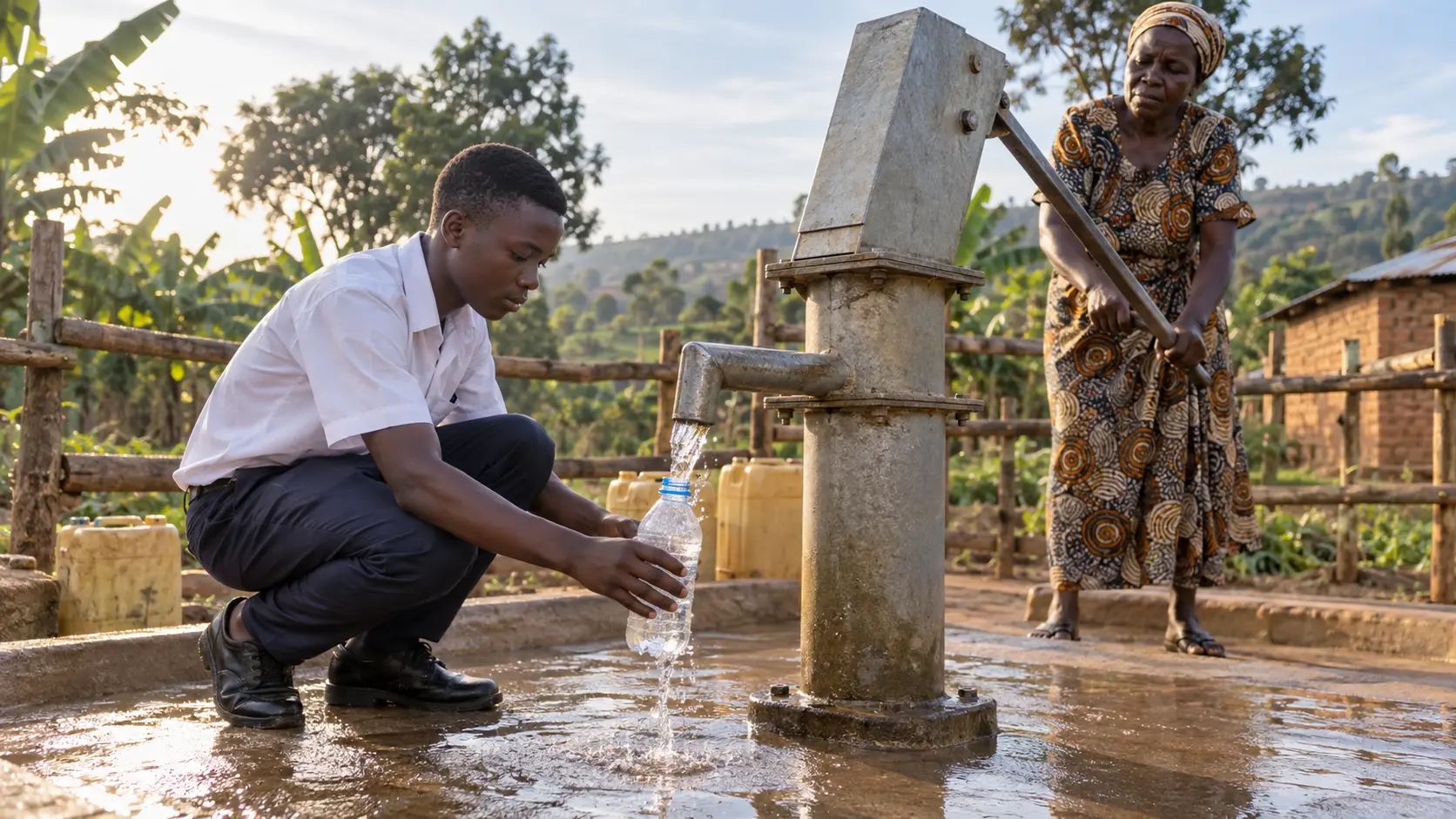
The same guidance recommends a laboratory analysis of your water before you set up, and gives reference thresholds including sodium below 50 parts per million, calcium below 150 and chloride below 140, and notes that water with alkalinity above 75 parts per million will keep pushing pH upward and demand more frequent correction [5].
This is United States extension guidance and the crop-specific figures should be checked against advice for the varieties you actually grow. The principle transfers: hydroponics starts with a water test, and it continues with a daily reading.
If nobody on your farm will take a meter reading every day, including Sundays, hydroponics is not your technology.
Power is a single point of failure
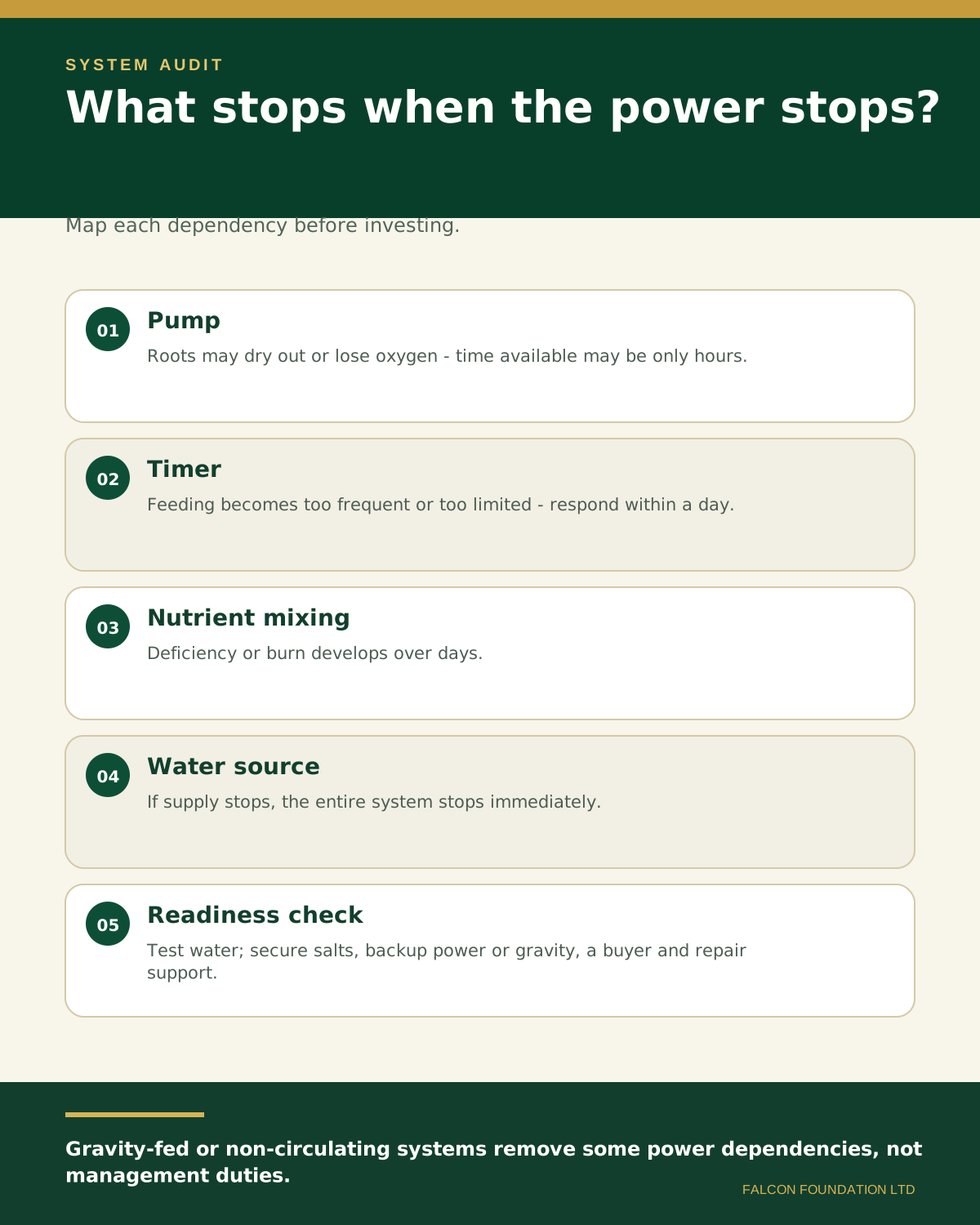
In a pumped system, the pump is the plant's only route to water and nutrients. FAO's statement that equipment malfunction can cause complete crop loss is the whole argument [4].
We could not verify Uganda's current end-user electricity tariff to the level of precision needed to publish a figure. What we can confirm is that the Electricity Regulatory Authority publishes end-user distribution tariffs separately from the feed-in tariff paid to generators, so the two must not be confused [6]. If you are budgeting for a pumped system, download the current quarter's tariff schedule from the regulator yourself, and be aware that these are revised quarterly.
The more useful design response is to reduce your exposure. Non-circulating and gravity-fed systems remove the pump from the critical path entirely. That is covered in our guide to low-cost hydroponic systems that do not need mains power.
The seven conditions
Test all seven. Any single failure is a reason to stop.
- Water you can test and trust. Not just available, but low enough in salts. Get an analysis before you build [4] [5].
- Nutrient salts you can actually obtain. Repeatedly, locally, at a predictable price. A system with no fertiliser supply is scrap.
- A power plan, or a design that does not need power. Either a backup for the pump or a non-circulating system.
- Daily attention. A meter reading and a visual check every day, by a named person.
- A high-value crop. Leafy greens, herbs and salad crops carry the economics. Staples do not.
- A buyer you have spoken to. The school system works partly because the consumer is on site [2] [3].
- Repair help within reach. Somebody who can fix a pump, a leak or a nutrient problem quickly.
The five ways Ugandan setups fail
- The water was never tested. Salts or alkalinity quietly defeat the nutrient programme, and the grower blames the fertiliser [4] [5].
- Nutrient supply stops. The system was bought with a starter pack and no plan for the second batch.
- The pump fails or the power goes. In a pumped system this is a crop loss, not an inconvenience [4].
- Daily monitoring lapses. Two weeks of skipped readings and the solution has drifted beyond recovery.
- There was never a real buyer. Produce is grown and then sold at ordinary market prices, which do not cover the system.
What the evidence does not tell us
We looked for an independent study of hydroponic vegetable profitability in Uganda or a comparable low-income tropical setting. We did not find one.
The closest independent regional source we could verify is a World Bank feature on a Kenyan hydroponics entrepreneur, which states that hydroponic systems are at least ten times more efficient in water use than field farming and that barley fodder reaches 30 centimetres in five to seven days. It also notes the company had installed systems in Kenya, Rwanda, Somalia, Tanzania and Uganda and trained over 5,000 people [7]. That article contains no cost, revenue, margin or break-even data.
There is an active hydroponics supply and training market in Uganda. One provider states it was founded in May 2020 and reports having trained more than 2,500 farmers, students and refugee community members, with installations in more than 30 schools [8]. Those are the company's own figures and we cite them only as evidence that a supplier and training market exists, not as evidence that the systems perform or pay.
So the honest position is this. The technology is proven. The Ugandan economics for a commercial vegetable grower are not documented in any source we could verify. Anyone who quotes you a return on investment figure should be asked where it came from.
Limitations and where to get independent advice
This guide reflects what could be verified from published institutional sources in September 2026. It is not engineering advice and it does not cover system design.
Before you commit money, visit a working installation that is not owned by the person selling to you, and speak to the operator about what has failed. The ministry note identifies MUARIK at Kabanyolo as a demonstration and training site offering free consultations [1], which makes it a reasonable independent starting point. Our guide to finding reliable farming advice in Uganda covers how to judge a source.
If you are evaluating any farm technology, not only this one, our thirteen-point technology screening test is designed for exactly that purpose.
What to do next
- Take a water sample and get it analysed before anything else.
- Find out today where you would buy nutrient salts, and at what price, on a repeat basis.
- Decide who checks pH and electrical conductivity every day, by name.
- Name your buyer and confirm the price they will pay.
- Visit one working installation you are not being sold.
- If you fail any of the seven conditions, put the money into soil-based production and revisit this in a year.
- If you pass, read the guides on system choice and hydroponic fodder before buying anything.