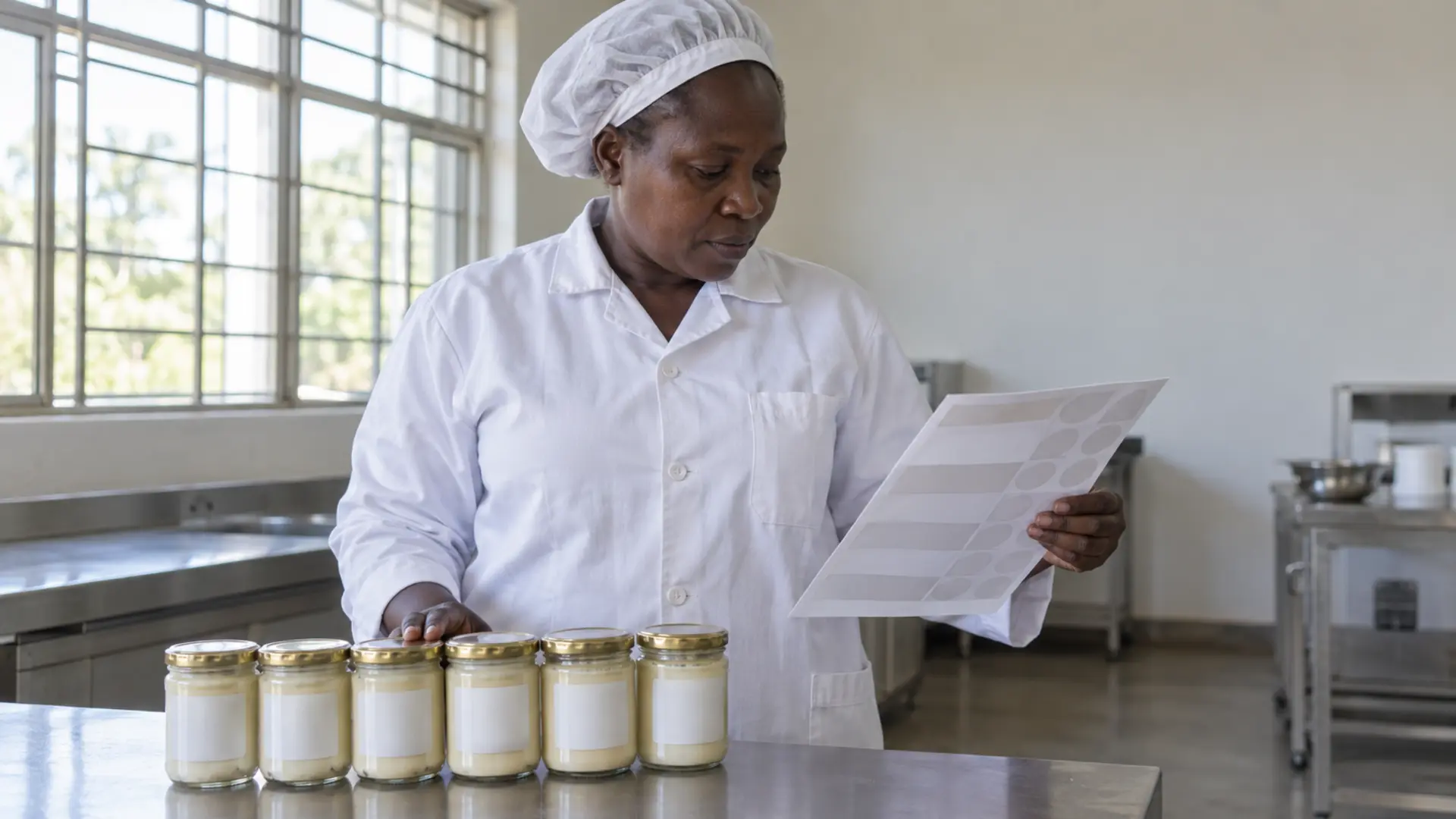
The usual sequence is the wrong way round. A processor builds a product, finds customers, prints labels, and then discovers the compliance requirement when a supermarket buyer declines the product, or when an inspector arrives, or when a batch is detained.
By that point the label print run is paid for, the premises are built the way they are built, and the corrections are expensive.
This article is a roadmap for doing it in the right order. It is written under an unusual constraint, and readers should understand the constraint before they read the roadmap: we report only what we could open and read on a page, and we are equally explicit about the procedural detail that is not published. There is a good deal of the second kind, and the honest response to it is a list of questions to put to the regulator rather than a plausible-sounding process invented to fill the gap.
Everything below was verified on 10 September 2026. Fees, forms, timelines and scheme names change. Treat the access date as part of the information.
Who regulates what
The standards body. The Uganda National Bureau of Standards operates under the Uganda National Bureau of Standards Act, Chapter 327 of the Laws of Uganda. The Act gives the Bureau functions including formulating national standard specifications for commodities and codes of practice, and enforcing standards in the protection of the public against harmful ingredients, dangerous components, shoddy material and poor performance.
A note on a discrepancy we found and could not resolve. The Bureau’s own homepage summary refers to a different chapter number. Two independent sources, the Uganda Legal Information Institute’s consolidated text and a copy of the Act hosted on the government’s trade portal, both give Chapter 327. This article uses Chapter 327 and flags the inconsistency rather than quietly picking one.
Compulsory standards, and why they matter to you. Section 18 of the Act allows the Minister, on the recommendation of the council, to declare a standard specification compulsory by notice in the Gazette, and provides that the council may not make such a recommendation unless satisfied that the purposes of the standard cannot practicably be achieved otherwise.
Section 21 is the section that reaches your business directly: no person may import, manufacture, sell or possess for sale a commodity for which a compulsory standard has been declared unless it conforms to that specification and bears the required distinctive mark.
That is the legal basis of the thing everybody calls the Q-Mark.
The registration body. The Uganda Registration Services Bureau states that it is mandated under the Uganda Registration Services Bureau Act, Chapter 217, to register all business entities in Uganda which are required by law to be registered. This article does not describe the registration procedure, which is covered elsewhere; it simply notes that registration comes first, because the certification application asks for it.
The revenue authority. The Uganda Revenue Authority states that any person, company or organisation likely to transact in any tax-related business is required to apply for a taxpayer identification number. We could not find a page stating that a taxpayer identification number is a prerequisite for a certification application, so we have not claimed that it is. It is on the questions list below.
Local government. A trading licence is issued at local government level. Kampala Capital City Authority’s published guidance on the trading licence lists among its conditions appropriately located premises, appropriate hygiene and health standard of premises, appropriate building standard of premises, and required personal specifications such as medical fitness, especially for vending consumables. That document is dated 2017 and should be checked with your own local authority.
The ministry. The Ministry of Trade, Industry and Cooperatives lists the standards body among its affiliate institutions and holds the trade policy and licensing mandate.
One body whose position appears to be changing. Ugandan press reporting describes a reorganisation under which the National Drug Authority would regulate human medicines, vaccines, medical devices, in-vitro diagnostics, public health products and nutritional supplements, with a new body established to regulate plant and animal health. We could not open an official notice confirming this or its effective date, and we therefore report it as unconfirmed. It matters to a food processor only in one situation: if your product makes a health claim or is positioned as a supplement rather than as a food, the boundary between food regulation and medicines regulation is exactly the boundary that appears to be moving, and you should ask before you print.
What this guide helps you decide
The order in which to do things, which is the part that saves the most money. What the certification process actually consists of and how long each stage is stated to take. What must go on the label. And which questions you personally have to ask, because the published record does not answer them.
The certification schemes
Two are confirmed by name from a legal instrument or the Bureau’s own material.
The Distinctive Mark. The Uganda National Bureau of Standards (Use of Distinctive Mark) Regulations, 2018, Statutory Instrument No. 12 of 2018, require that a commodity for which a compulsory standard specification has been declared conform to that standard and bear the distinctive mark specified in Schedule 2 of the Regulations. The Regulations state that a person shall not apply a distinctive mark to any commodity except under a permit issued by or under the authority of the Council, and prohibit any person from importing, distributing, manufacturing, selling or having in possession or control for sale or distribution any commodity that does not meet those requirements. Following a permit, the Council conducts surveillance audits.
Systems certification, covering management system standards, is listed by the Bureau alongside product certification.
On the term “Q-Mark.” The Bureau’s own published material repeatedly uses the phrase “UNBS distinctive mark (Q-Mark)” and states in one blog post that any product without a Q-Mark on the market is illegal. What we could not find is a single page stating in so many words that the Q-Mark and the Distinctive Mark are formally the same scheme under one legal instrument. The usage strongly implies it. We have not asserted it, and it is on the questions list.
Two schemes we could not verify. We looked for a “Certificate of Conformity” as a domestic scheme and found the term only in connection with pre-export verification of conformity for imports, which is a different situation from a domestically produced, domestically sold food. And we looked for a distinctly branded certification scheme for small and medium enterprises and did not find one. What exists instead is fee tiering by enterprise size inside the general certification regulation. Both are on the questions list.
The certification process, as published
This is the best-documented part of the whole subject, because the Bureau publishes a process description. The document we read is numbered CERT/PC/ID01, Issue 04, Revision 01, with an effective date of 2 August 2021. The stated stages are these.
Application. Submitted online by opening a user account on the Bureau’s certification portal, or through its main site. The timing is at the applicant’s discretion.
Application review. The Bureau evaluates the submission for completeness within three days, and any concerns with the application are resolved before proceeding.
Payment. The applicant is billed within about a week and has up to 21 days to pay. Delayed payment delays audit scheduling.
Audit. Scheduled within one month after the application is verified. Auditors visit the applicant’s factory for an on-site evaluation.
Product evaluation. Samples are obtained during the audit and submitted for laboratory testing. The published timing depends on laboratory turnaround.
Closing non-conformances. The applicant has up to 30 days to satisfactorily close out non-conformances. Where a file is deferred, the stated maximum for resolving it is three months.
Review. The Certification Review Committee evaluates the file within five days.
Decision and permit. A permit is issued within 48 hours of the certification decision. Electronic permits are valid for one year, and renewal applications should be submitted three months before expiry.
The Uganda National Bureau of Standards (Certification) Regulations, 2021, No. 68 add several details. An application is made on Form 1. An application for a permit is valid for nine months, after which, if a permit has not been granted, a new application must be submitted. A permit is valid for twelve months from the date of issue. And the Bureau may conduct surveillance audits or commodity sampling and testing at the manufacturing facility, warehouse or other storage facility, market or other location where the commodities are available, to ensure that systems and procedures already evaluated are being maintained, determining the frequency itself and conducting surveillance audits without notice.
Licensing, Certification and Labelling: What a Small Ugandan Food Processor Must Actually Do
Compliance roadmap showing the sequence from business registration and tax identification through premises preparation, standard identification, application, audit, testing and certification decision
Two practical readings of that timeline. First, it is not fast: even with everything going right, the published stages add up to several months, and the laboratory step has no stated duration at all. Start before you need the certificate, not after a buyer has asked for it. Second, the nine-month application validity is a real deadline. An application left half-finished expires and has to be started again.
Fees
We found a fee schedule, and we are going to report it with an unusually heavy caution attached.
The Certification Regulations of 2021 set out, in Schedule 3, Part I, an annual figure of 500,000 shillings for micro and small enterprises and 1,000,000 shillings for medium and large enterprises, with a separate per-unit figure in Part II for digitally marked goods.
Those figures are from a 2021 statutory instrument. They are five years old at the time of writing. We could not find a current fee page. Do not plan around them. Ask.
Premises and hygiene
The relevant East African standard covering hygiene in food and drink manufacturing is EAS 39, a code of practice. Here we hit the first of two edition conflicts: the Bureau’s own site cites the standard as adopted in 2002, while the East African Community standards catalogue held by a member bureau gives it as 2000, first edition. We could not resolve which is currently in force, and it is on the questions list.
What the premises step means in practice is the factory audit described above. An auditor will visit. We could not find a published Ugandan checklist of what that audit examines, and we are not going to invent one. What we can say from the local trading licence conditions is that appropriately located premises, appropriate hygiene and health standard, appropriate building standard and medical fitness for those handling consumables are conditions attached at local government level, and that these are the same broad concerns any food premises inspection addresses.
We also found no evidence of a separate premises registration step distinct from the certification audit and the trading licence, and that absence is itself on the questions list.

The label
This is where most small processors get caught, and it is where our verification was hardest.
The standard. The applicable standard is EAS 38, on the labelling of pre-packaged foods. Its scope, as published on a regulatory database, applies to the labelling of all prepackaged foods to be offered as such to the consumer or for catering purposes and to certain aspects relating to the presentation thereof. It is recorded as gazetted in Uganda by Uganda Gazette Volume CVIII Number 20 of 21 April 2015.
Here is the second edition conflict, and it is worth stating precisely because it affects which document you would buy. The Bureau’s own site and the East African Community catalogue both give the standard as EAS 38:2014, titled as a Specification. A regulatory database gives it as US EAS 38:2013, titled General requirements, gazetted on the date above. We could not determine which designation is current. Ask before you order the standard.
What we could confirm about label content, and at what confidence.
Confirmed from the Bureau’s own published material: batch number; date of manufacture; expiry date; ingredients and other additives, particularly preservatives; correct weight and volume clearly labelled; the distinctive mark itself; and a prohibition on statements or pictorials which may create confusion or mislead the public.
Indicated by a related East African standard that incorporates EAS 38 by reference: product name; net weight; the name and address of the manufacturer, distributor or importer; country of origin; batch or lot number; date of manufacture; and expiry date. That list comes from a commodity standard which states that in addition to the requirements of EAS 38, its own specific provisions apply, so it tells you the shape of the baseline without reproducing it.
Not verified at all: allergen declaration and nutrition labelling. We could not establish from any page we could open whether EAS 38 requires either. Given that both are mandatory in many jurisdictions and are the two label elements most likely to be missed, this is the single most important thing on the questions list.
Licensing, Certification and Labelling: What a Small Ugandan Food Processor Must Actually Do
Label content checklist divided into items confirmed from a Ugandan regulator source, items indicated by related East African standards, and items that could not be verified
The practical consequence. Do not commission a label print run from this checklist. Use it to have an informed conversation, obtain the standard, and have your artwork checked before you print. The standard is a purchasable document, and buying it is cheaper than reprinting.
The questions to put to the regulator
This list is the honest deliverable of this article. Take it with you, write the answer down, and write down who gave it and on what date.
Licensing, Certification and Labelling: What a Small Ugandan Food Processor Must Actually Do
A blank sheet listing the specific questions a small processor should put to the standards body, with space to write the answer, who gave it and the date
- What are the current certification and testing fees, and has the 2021 fee schedule been revised?
- Is the Q-Mark the same certification as the Distinctive Mark under Statutory Instrument No. 12 of 2018, or a separate designation?
- Does a Certificate of Conformity apply to a domestically produced, domestically sold packaged food, or is it only relevant to imports and exports?
- Is there a dedicated certification pathway or reduced-fee route for micro and small processors beyond the general product certification scheme?
- Which edition of EAS 39 on food hygiene is currently in force?
- Which designation of the labelling standard is current, and please confirm the complete list of mandatory particulars it requires.
- Does the labelling standard require an allergen declaration, and in what form?
- Does the labelling standard require nutrition labelling, and for which products?
- Is a taxpayer identification number required as part of the certification application?
- Is there a separate premises registration or food premises licence beyond the certification audit and the local trading licence?
- Which form should a small processor use to apply for the mark, and is Form 1 in the Certification Regulations the correct one?
- What does the factory audit examine, and is there a published checklist a processor can prepare against?
- What is the current typical laboratory turnaround time for product testing?
And one for your local authority: what document proves compliance with the hygiene and medical fitness conditions for a trading licence?
Common mistakes and failure points
Printing labels before confirming the label requirements. Building or fitting out premises before finding out what the audit looks for. Starting the certification application after a buyer has already asked for the certificate, when the published timeline runs to months. Letting an application lapse past its nine-month validity and having to start again. Budgeting from a fee figure found in an article rather than from a current quotation. Assuming that because a product is small-scale or sold locally it falls outside a compulsory standard. Making a health claim on a food label without first establishing which regulator that claim brings you under. And treating the certificate as a one-off event rather than a permit that expires annually and is subject to unannounced surveillance.
Regulatory escalation and where to get help
Go directly to the standards body, not to an intermediary, for anything on the questions list. The published process is an online application through the Bureau’s certification portal, which means there is a documented channel to start from.
Go to your district or city authority for the trading licence conditions and for what the hygiene condition requires in your specific location.
Get professional advice before you print if your product makes any health, nutritional or medicinal claim, because that is the claim most likely to move your product across a regulatory boundary, and because the boundary itself appears to be under review.
And treat anyone who offers to obtain a certificate for you quickly, or without an audit, as a serious warning sign. The published process includes an on-site factory evaluation and laboratory testing of samples. A route that skips those is not the route the Regulations describe.
A practical action plan
Before anything else. Register the business and obtain a taxpayer identification number, because both are asked for downstream. Get the local trading licence conditions from your own authority in writing.
Before you build or fit out. Ask question 12 above. It is far cheaper to build a compliant room than to modify one.
Before you design the label. Ask questions 6, 7 and 8, and buy the standard. Design from the standard.
Then apply. Allow for the published timeline plus the unstated laboratory turnaround, and diarise the nine-month application validity and, once granted, the twelve-month permit expiry and the three-month renewal lead time.
Keep the answers. Every answer you get to the questions above, with the name and the date, goes in a file. When a scheme name or a fee changes, that file is what tells you what changed.
Conclusion
Compliance in this area is not mysterious, but a great deal of the detail that a small processor needs is not published, and the honest thing to do about that is to say so and to hand the reader a list of questions rather than a confident procedure.
What is published is enough to work with: a legal basis in Chapter 327, a mark established by Statutory Instrument No. 12 of 2018, a documented certification process with stated timeframes, and a labelling standard whose designation you should confirm before you buy it. Start with the sequence, ask the thirteen questions, and write down who answered them.
Author: Falcon Foundation Ltd Editorial Team
The Falcon Foundation Ltd Editorial Team produces evidence-based agricultural guidance for Ugandan farmers, drawing on published research and institutional sources and translating them into practical decision support. Where evidence is unavailable or contested, we say so rather than filling the gap.